
The Truth About Who is Targeted by ICE
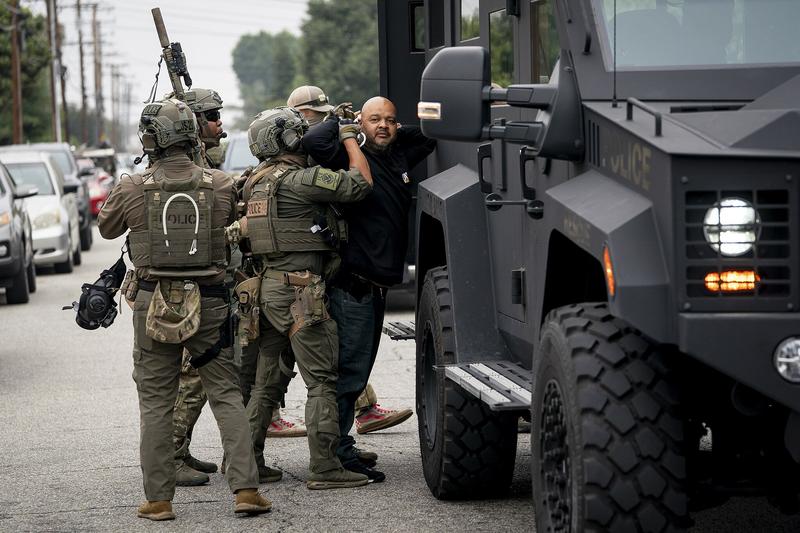
( DHSgov, Public domain, via / Wikimedia Commons )
_Enforcement_and_Removal_Operations_(ERO)_in_Los_Angeles,_California,_June_12,_2025_-_79.jpg)
[music]
Brian Lehrer: It's The Brian Lehrer Show on WNYC. Good morning, everyone. Have you asked yourself what percentage of immigrants detained by ICE are the violent criminals who President Trump claims are his top priority? Well, according to a Cato Institute review of deportation data from the first half of this year, almost half of the people being detained don't even have criminal charges against them. The numbers come originally from the Deportation Data Project at the University of California at Berkeley.
A New York Times article last week about this data set focused specifically on New York stats, which indicates similarly that through October, around 45% of detainees had no criminal convictions and no criminal charges. Let's take a closer look at some of those numbers and their implications for innocent people's lives with David Bier, director of immigration studies and the Selz Foundation chair in immigration policy at the libertarian Cato Institute think tank. We'll invite your questions and stories. David, thanks for joining us. Welcome to WNYC.
David Bier: Thanks for having me on.
Brian Lehrer: Listeners, have you been detained by ICE or know someone who has, despite having no criminal convictions or criminal charges? Tell us your story or their story. 212-433-9692, call or text. 212-433-9692. The way mass deportation is being conducted, how is it affecting any community you might be part of or involved with? Even if you haven't been detained or don't know anybody individually who's been detained, how is it affecting behavior in the community? Fear, going to school, anything else? 212-433-9692. Yes, we can also have the policy debate. How much is this approach right or wrong? 212-433-WNYC, 433-9692. David, the headline on your blog post about this from Cato begins with the stat that only 5% of people detained by ICE have violent convictions. Why do you start there?
David Bier: Well, this is the group of individuals that the administration has said that they want to focus on. This is who they highlight. If you look at their social media, you would think 100% of the people that they're detaining had violent criminal convictions because that is who they lead with in all of their social media and all of their messaging, their press events. It always starts with, "We are arresting the worst of the worst and here's the examples of that." They start, "We have this many arrests, and then here are some of the people that we arrested." It's always the people with the most depraved criminal histories you've ever heard of. Then there's just a total blackout of the 95% of the people who don't have those convictions.
That is really the purpose of highlighting this data and taking a look at what's actually happening here, so you don't get this biased view from the Department of Homeland Security and Immigration and Customs Enforcement, and Border Patrol on what is actually happening with these arrests in the interior of the United States. Who is actually being pulled off our streets and being sent to these detention facilities around the country?
Brian Lehrer: Only 5% had violent convictions. Your next stat is 73% have no convictions, and then nearly half didn't even have pending criminal charges. Do you know roughly how many people that is in addition to the percent?
David Bier: Right. Through this year, the total number is somewhere around- you're looking at about 10,000 a week. You can look at it that way. It's probably the easiest way to look at it. Over however many months, that's how many you're going to end up with, about 10,000 arrests per week.
Brian Lehrer: That is a lot of people who haven't committed any crime or even been charged with any crime. Of course, people will say that their status here is criminal. That's considered a civil offense. That's just their immigration status. It's not what is communicated to the general public when they say, "We're going after criminals, we're going after violent criminals."
The rhetoric is first priority, the worst of the worst. You're starting to describe the reality. This had already become an issue earlier in the year, before this deportation data project from UC Berkeley. These numbers were released when Press Secretary Karoline Leavitt was asked about the percentage of non-suspected criminals in early immigration sweeps versus the President's campaign speeches that said worst of the worst and get the violent people here illegally out of the country, the violent ones. Here's part of her response to the question, which was from NBC's Peter Alexander.
Karoline Leavitt: Two things can be true at the same time. We want to deport illegal criminals, illegal immigrants from this country, but the President has said that, of course, the illegal criminal drug dealers, the rapists, the murderers, the individuals who have committed heinous acts on the interior of our country, and who have terrorized law-abiding American citizens, absolutely, those should be the priority of ICE. That doesn't mean that the other illegal criminals who entered our nation's borders are off the table.
Brian Lehrer: Press Secretary Karoline Leavitt. You know when that was, David? Maybe you do know, but for our listeners, that was January 28th, one week and one day into the Trump administration. January 28th, and they were already moving quite far away, it seems like, from violent criminals as an overwhelming priority.
David Bier: Absolutely. If you look at what the president did on his first day in office, he signed executive orders that rescinded the requirement for Immigration and Customs Enforcement to prioritize people with serious criminal convictions or public safety threats, national security threats, to really open up the population of people who they want to deport.
If you look at how this campaign has been prosecuted and carried out by this administration, they have not focused on the violent criminal convictions and the people who are public safety threats. They have made it easier to target the people who've gone through vetting, who've gone through processes to get legal status. The people who are going to immigration court hearings are not the people with violent criminal histories who are trying to evade detection by Immigration and Customs Enforcement because they know they're not going to be eligible for anything.
You can go down the list, that the first priority for this administration was to get rid of the requirements and mandates to go after those people. Then the second thing they did right after that was we're going to take away people's legal status, their eligibility for legal status, and again, to open those people up to deportation. We take away their temporary protected status or their parole, or their opportunity to receive asylum. Those are those people who would go through vetting, they would pass a background check. We know who they are. They only qualify because they are willing to step forward and prove who they are and prove they don't have any security risks.
They took away their status to open up all those people who, now, they have their names, they have their addresses. That makes it easy to deport them because they're going through the process because they're complying. The whole narrative that this is who they really want to focus on is really belied by their actions from day one till today.
Brian Lehrer: In a couple of minutes, we'll play a clip from Tom Homan, the border czar, who has a broader definition of who they consider a public safety threat beyond people who've even been charged with any kind of public safety crime. We'll get to that broader definition and what it looks like they're really going for in a couple of minutes.
I want to first get some callers on here because we invited people to call with stories of yourself or people you know as we continue with David Bier, from the Cato Institute, who, if you're just joining us, is analyzing data from the Data Deportation Project from UC Berkeley that finds through most of the Trump administration so far, of those detained by ice, nearly half had no criminal conviction nor even any pending criminal charges. Sam in Queens, you're on WNYC. Hi, Sam.
Sam: Hi, Brian. Thank you for taking my call. I just wanted to chime in with my own unique perspective on this. I was adopted from Colombia when I was quite young, but I look very, I guess, Latino. There's been a lot of news stories or a few of ICE agents. One of the first questions they're asking people are, where were you born? There's been some stories of adoptees whose passports say that they were born in a Latin American country who are then given some problems by ICE agents. If they're citizens, maybe they're let go, but there's still a challenge there.
That's something that's certainly been in the back of my mind. I carry my passport with me when I'm traveling to some of these redder states. I know I'm not at the forefront of the risk here, but it is something that's in the back of my mind, and I can't imagine what others who are more at risk must be feeling as well.
Brian Lehrer: How do you think it's affecting the behavior as well as the feelings, the emotional condition of people in any of the communities, your own community, people who may have come here very young, and are citizens from Colombia or anyone else?
Sam: Well, just anecdotally. Anecdotally, I know a lot of my friends have talked about carrying some documentation on them, especially since we've started hearing stories of pop-ups in Jackson Heights and other areas. For now, there's been just a, what do we carry on us? For friends of mine who have family members that are undocumented, there's a lot of them staying home more than they used to. A lot of the local businesses in the neighborhood are seeing less traffic, I think, out of fear. You want to be able to think that if, certainly in my case, if you're a US Citizen, there would be no issues, but from all the videos you're seeing online, it's difficult to really trust that that's the case.
Brian Lehrer: Sam, we appreciate your call. Thank you very much. Let's hear another story from Andrew in Queens. Andrew, you're on WNYC. Hello.
Andrew: Good morning. Brian, I wanted to comment on a community that I'm familiar with up in Cape Cod, Massachusetts, and back toward the Boston area. I'm sure you've seen some of the news reports about ICE agents taking people into custody in front of their kids, and local politicians attempting to intervene and getting arrested as well. Mostly, I wanted to comment on the community up there. When ICE first started operating up there, the immediate effect was a pervasive atmosphere of fear. This seems to be a theme with this administration. They love to use fear and intimidation to attempt to get what they want.
The people that they're attempting to take into custody up there, they started with people who had some kind of a public arrest record. We're not talking convictions, we're talking just arrests. Like if there was a domestic dispute incident, these are the people whose doors they knocked on. These are not violent felons. These are not even bad people. In fact, most of them are just trying to live the American dream and earn money, and make a better life for themselves and their kids. A lot of these people are better Americans than most Americans in terms of work ethic and just attempting to make their lives better. It's a very sad situation.
Brian Lehrer: Andrew, what would you say to another listener who just texted this, "All undocumented persons are deportable, we need to change the law"?
Andrew: I would say technically, that is an accurate statement. Nevertheless, there are any number of ethnic groups in this country that are not deported because they have some kind of status or they have friends. I'm sure people have mentioned this before, the Cuban Wet Foot, Dry Foot law in Florida. They have a large community that made it over here already. Got naturalized, had kids. Got some political pull, and as a result, they can keep bringing people over under this legislation.
Apparently, amnesty is a dirty word at this point, has been for about two decades. A lot of these people are just such good people and have made such contributions to the community that there has to be a change in the law to give them some sort of a path to citizenship. If you've been here for 10 years, you've built a business, you've had a kid, you've contributed to the community, that should count for something. It did in the past when immigrants showed up and made contributions. Why not now?
Brian Lehrer: Andrew, thank you very much for your call. David Bier from Cato, I'll let you react to that first set of callers but here's another piece of listener input. This is a text that says, "I'm an Italian-American, but people generally perceive me as Latina. At the request of my family, I started carrying copies of my birth certificate and passport because I'm afraid of getting profiled. I'm not even convinced they would read my documents if they felt like grabbing me. ICE is completely out of control, and the administration likes it that way."
Before we play these, these Tom Homan clips, which seems to expand the definition of who's a public safety threat, what were you thinking listening to those callers or hearing those texts I read out?
David Bier: Well, the first thing you have to understand is how radically different they have carried out this immigration enforcement, is how they describe it. The first caller talked about the fear of being stopped. That is new. That really is new. We never had this indiscriminate street enforcement where people are being profiled because they meet the description of some stereotype of someone who's in the country illegally. That is what is new.
I have documented in the data that we have received over 1000% increase in the number of Latinos on the streets being stopped by immigration enforcement compared with, not with the Biden administration, but with the first Trump administration. This is completely new, where we have government agents prowling the streets just trying to stop people who look a certain way to see if they're in the country illegally or to see if there's some basis for stopping them.
That's really the change that is being felt. It is the fear that we're talking about. Where is that coming from? Well, it's not coming from some people's irrational perception, but really grounded in reality, grounded in this huge change in how they are telling their agents to go about their jobs. They're not telling them, go to the prisons, go to the police departments, find people who've been arrested. That was maybe the first five days of this administration.
Really, the rest of the time, and really starting with May, in May, we've seen this massive change to have Border Patrol not at the border, but in the interior of the United States, stopping people because of what they look like, because of what jobs they do.
That is really a sea change in how we've been operating here. Of course, it makes everyone who fits that demographic characteristic feel like a second-class citizen in their country. This makes them feel like I'm not at home if I'm being stopped by the government and being interrogated about my right to be here. What if I did forget my passport at home? What if I was born in a different country? Now the burden of proof shifts to me. As soon as you say I was born in a different country, the burden of proof shifts away from the agent to you to prove that you have a right to remain in the United States, that you have legal status, even if you're a citizen.
That is the unfortunate situation that's been created by this immigration enforcement operation. I would call it the racial profiling operation, because it really, there's nothing in immigration law that tells them to do this. This is their choice. They've been allowed by the Supreme Court to do this so far. It's really changed how people feel about their country, about who they are, and their place in it.
That's unfortunate because, under the Constitution, we're all supposed to be equal. We're all supposed to feel the justice home here doesn't matter what our race or our job is. All of our rights should be the same. That's really been overturned in the last year as a result of what the administration has done. Of course, the administration wants to say, "Well, all these people are illegal. All these people have violated immigration law, and therefore, that makes them a priority for removal operations."
They want to have it both ways. They want to say that everyone's a criminal, they're all criminals, but also, we're focused on the worst of the worst. It's not true. They aren't focused on the worst of the worst. You have to prioritize. That's the thing that they refuse to recognize is that you do have an opportunity cost. Any person that you're going out and sending to a construction site in a farm or a Home Depot is a person that you are not sending out to go get someone who's a fugitive from justice, who's committed a heinous act.
They have done absolutely nothing since day one to actually prioritize going after those people. In fact, they've shifted resources away from going after people who are part of active criminal conspiracies. That's the real choice. There's always an opportunity cost when you're considering who to go after. They have focused on the people who we know are less likely to commit crimes, people who have jobs, who are working, who are contributing to this country.
Brian Lehrer: As soon as we come back from this break, we have to take, we'll play those Tom Homan clips where he seems to expand the definition of public safety threats from just people who are convicted or charged with violent offenses. Stay with us for that.
[music]
Brian Lehrer on WNYC with David Bier from the Cato Institute, who focuses on immigration policy as we look at the increasing body of data, which indicates that the Trump administration and ICE are detaining for deportation, by and large, overwhelmingly, really, people who do not have violent criminal convictions, which may have been the impression that we got during the Trump campaign about who they were going to prioritize. Only 5%.
According to the Deportation Data Project at UC Berkeley, which has crunched these numbers, only 5% have violent criminal convictions. Maybe even more eye-popping than that, nearly half of those detained by ICE have had no pending criminal charges even. Here's a clip of border czar Tom Homan on News Nation answering a similar question to the one we heard Karoline Leavitt's response to earlier, where the White House press secretary, Karoline Leavitt, said there can be a first priority, but there also can be a bigger picture, getting a lot of people here illegally out of the country.
For Holman, he seems to expand the definition from people convicted of or charged with violent crimes to a broader notion of people who they define as posing public safety threats when they talk about who's a criminal and who they perceive as dangerous. Listen.
Tom Homan: ICE is prioritizing public safety threats and national security threats, and the data proves it. I look at the data every morning on the way to work. I look at 22 pages of data. The last time I looked at it, a couple of days ago, when I actually looked at percentages, nearly 70% of everybody ICE arrests are public safety threats or national security threats.
Chris Cuomo: What about the other 30? How did they get [crosstalk]?"
Tom Homan: Many of them are national security threats. For instance, 3,000 Iranian nationals. Most national security threats don't have criminal histories. They're laying low to do the dirty deed.
Brian Lehrer: A few seconds later, Homan added this.
Tom Homan: Okay, how about the ones that aren't national security threats, not public safety threats, not national security threats, not gang members. Who are they? They're collateral arrests. Because when the sanctuary cities force is sent into the neighborhood to find a bad guy because they won't give us access to the jail, so now we got to go to the neighborhood and find them. When we find that criminal, many times they're with others, others who are in the country illegally. We're not walking away from them. We're going to enforce immigration law, unlike the last administration.
Brian Lehrer: Tom Homan, the border czar on News Nation. David, he seems to be including as public safety threats and redefining the universe of who they're prioritizing from violent criminals, which is what Trump might have said on the campaign trail, to this category, public safety threats, which, as you heard, included people who they consider national security threats and also gang members. Is this the first time you've heard that? Have you considered how they seem to be expanding the definition in that way?
David Bier: Oh, yes. Everyone who's Iranian is now a public safety threat, even this Iranian woman who's a grandmother, who's lived in the United States for 47 years, who was targeted by ICE. This was not a racial profiling situation. After they bombed Iran, they just decided now all Iranians in the country are potential public safety threats. We're going to arrest anyone that we can, including this woman who had lived in the United States for almost five decades, and label them a public safety threat, label them a national security threat just because of where they were born.
Again, this is what they do. They define people based on their status or their birthplace as public safety threats, even if they don't have any evidence of a public safety threat. Even if they don't actually have any basis to prove that they've done anything in the country that is harmful, they will still label them that way because it's politically convenient to do so, not because they have any basis for doing so.
If you look at how they're actually carrying out the operations, though, this is the key point. He keeps coming back to this idea that we're targeting people, we're going after specific threats, people who we know they're national security threats or whatever. This is not what they are doing to gin up these huge numbers of arrests. They are going out on the street and detaining people, and pulling over cars at random, doing checkpoints. They're going to construction sites and just demanding that everyone line up and show their papers, or they'll be arrested. That is what is happening. That is what is leading to this huge increase in arrests.
Again, when you look at the data which we have documented, this is the group that has led to the big increase in arrests over the last six months. It is the people who have no criminal charges, no criminal convictions, no final orders of removal, and who were not detained by any other law enforcement entity before they encountered a Border Patrol agent or Immigration and Customs Enforcement agent who came along and demanded that they prove they were in the country legally or had some status that couldn't be taken away in the case of people with parole, which, of course, is part of the operation that I've described already.
Those are the people who we've seen this huge increase in arrests, almost 1,000% increase in the number of arrests of these people, who are overwhelmingly of Latino origin. Not from Iran or Saudi Arabia or some other country that they want to cast aspersion to the entire population, even though we know so many people have fled those countries specifically because they oppose the regimes in those places. Really, nine out of ten of these arrests that they're making are people who are from Latin American countries because we know they're using that to profile them. They've even admitted this in court now that they use speaking Spanish as a basis to stop people on the streets.
Brian Lehrer: One of the categories in Border Czar Tom Homan's, in the clip from him of this expanded notion of who is a public safety threat, in addition to those with violent criminal convictions or pending charges, was gang members. We heard him say gang members. Sharon in Manhattan is calling about that, I think. Sharon, you're on WNYC. Hello.
Sharon: Hi, I'm calling because, as I said to your caller, I'm 100% pro democracy, view Trump as an incredibly dangerous fascist. However, you have to give credit where credit is due. His administration somehow has succeeded in capturing drug cartel leaders that were residing in other countries and bringing them to trial in the United States. Just this last week, I was not a witness; I watched a trial NBC of MS-13 leaders who are, finally, after their crimes in 2008, 2009, 2010, coming to trial in the United States. I don't know why it's happening now, and it wasn't happening before, but it is happening.
These very violent, very dangerous, horrific crimes, I understand it's a small, tiny proportion of the people who are being tortured by this administration, really, normal people who are going about their lives and getting picked up. We as Democrats, we as the opposition, have got to do a better job of pursuing dangerous criminals, international criminals who are selling drugs in the United States and committing horrific crimes. You can't leave it to Republicans.
Brian Lehrer: Sharon, thank you very much. David Bier, what do you say to Sharon, who sees herself as a member of the Democratic Party, as a member of the opposition? She used that word. That side hasn't done a good enough job of getting the actual worst of the worst. It took Trump, and she wants to give him some credit for that and not leave it to them. The Democratic Party, as she frames it, needs to get more serious about the worst of the worst.
David Bier: Look, I do think it should have been more part of the messaging of prior administrations, but this administration has eviscerated a significant portion of drug interdiction and drug enforcement, diverting the DEA, Homeland Security investigations, into these mass indiscriminate roundups of people who are in the country illegally, perhaps, but aren't drug dealers. They're people working at Home Depots and farms and construction sites, and so on, and so I must disagree.
If you look at the actual data New York Times reported on, the number of arrests being made for drug trafficking has declined significantly under this administration as a result of them diverting DEA, ATF, HSI, these other entities into this mass deportation, racial profiling regime. I don't see it. I don't agree that this is-- Yes, there are still some prosecutions happening, there's still some individuals being arrested, but that is not the priority. They have deprioritized those prosecutions in favor of prosecuting people for, years ago, crossing the border illegally.
In my opinion, that's a loss to our country that we are deprioritizing people who are part of a criminal conspiracy over people who are working and contributing to this country. If you look at who they label gang members as well, we know they deported hundreds of Venezuelans to the prison in El Salvador based on their tattoos. The fact that they had a rose tattoo was somehow a basis of describing them as a gang member. In fact, basically, if you had any tattoo and you were a Venezuelan man and you were in custody in March of this year, they were going to label you a gang member.
That is, basically the only conclusion you can come to when you look at some of these people who were sent to this prison. A gay makeup artist who had crowns tattooed on his wrists with mom and dad written on top of them. That was the gang tattoo that proved that he was part of the TDA gang from Venezuela. This is the standard of proof under this administration; is literally anything that they can use to smear someone's reputation and justify what they want to do anyway.
These people were then deported to this prison wrongly, without any due process in the United States, without any right to a trial, and then imprisoned in this torture prison. Like she said, they were tortured there. I don't give them any credit. Some MS-13 members were prosecuted in the United States. Some MS-13 members were also sent back to El Salvador and freed as part of a deal with the corrupt president down there. The president of the United States, President Trump, just pardoned the ex-president of Honduras, who was convicted of drug trafficking. He was the kingpin in Honduras, and he was just freed as a result of a deal from this administration.
I don't think they're focused on this. I think it is a political ploy. I think if you look at the hard data, you'll see that they're really using this as a way to justify the racial profiling and the other mass deportation tactics that we've seen.
Brian Lehrer: Judith in Westbury has another story, this one from Long Island. Judith, you're on WNYC. Hello.
Judith: Hi. Good morning. Thank you so much for taking my call. It's an opportunity for me to share something I see that really has a level of trauma. There are people who are called into fingerprint office in Hauppauge, Long Island. They have letters. They're absolutely required to come in. They go in, and when they come out, their cars, in some cases, not all, are followed by ICE, who are surrounding the area in hidden spots. I'm on a community watch group, and sometimes we don't even see where they are. Then they're followed, and they're abducted from their cars. From there on, I don't personally have more information as to what they do, but I know they're being entrapped by going into that particular office. It's a horrible thing to see. These are such good people.
Brian Lehrer: Judith, thank you very much. When we finish with David Bier, we're going to have a local reporter on, Gwen Hogan, from the news organization, The City, to tell us about one particular case that's been in the news of family members being snatched at an immigration check-in, where they thought they were going to follow the rules based on the reporting. We'll get to that story in a couple of minutes. Lou on Staten Island, you're on WNYC. Hello.
Lou: Good morning, Brian. Thanks for taking my call. I just wanted to say that, as much as this is about immigration, it is also part of the Project 2025 thing that they are carrying on. Many years ago, there was a book written by a Wall Street lawyer right here in New York City. It's called The Dying of a Great Race. It theorizes that the time will come when white people will not have enough babies to replenish the population. The fear is that those who are all from those brown and dark skinned person will come and will be in positions of power, making decisions.
This is part of it. To reduce the population from those countries so that they don't have access to power. You will somehow get caught up in the immigration thing, but the bigger picture is about that. The book is called The Passing of a Great Race. It was written in 1913 right here on Wall Street in New York City. It is still in print. As I'm talking, I'm trying to find the author. I'm looking at one of my books, but I can't find it. I got so many of them, but that's where this thing is coming from? The immigration thing is part of it, but the larger part is the replacement theory that they came up with, and they got it from that book. Anyone can look it up.
Brian Lehrer: Lou, thank you for your call. David Bier, we've played clips recently of Trump, for example, in his UN speech this fall before the General Assembly, referring, and I don't have the exact words, but the implication was the suggestion was we don't want, and Western Europe shouldn't want too many people coming in from countries who we don't have enough cultural similarities with.
That seems to lean in the direction of what Lou on Staten Island there is raising. Trump would argue in the country's economic interest to limit illegal immigration, but also in the interest of cultural preservation, which can be heard as we don't want people coming here in large numbers, even if they're coming here to be Americans like past generations of immigrants, because it would lead to a white minority. Do you buy that at the Cato Institute?
David Bier: I do think that actually the social and cultural issues dominate the economic excuses, really, for this whole deportation campaign and immigration, restrictionism. The main arguments that I encounter are about crime, by far, in a way, the number one. Then there is this cultural element of what J.D. Vance says. I don't want neighbors that speak a different language. I don't want people who don't share my cultural values, that aren't Christian or whatever. That's much of his extended family but I do think it's a repudiation of the American idea.
The American idea is that we will be, as George Washington said, open to people from any country and any religion, and we will have protections under the First Amendment for their freedom, and if free, people who are empowered to live their lives will contribute to this country and make it a greater country. I think that's been borne out. That's the history of the United States.
If you look at what the popes were saying about freedom of religion and democracy in the 19th century, it wasn't great stuff. There was a lot of fear in the United States, the Italians were going to come, and other Catholics were going to come and totally transform the country and get rid of our tradition of freedom of religion here, and so we needed to block them and prevent them from coming. It was totally wrong.
In fact, our experiment here in freedom really is attractive to people, no matter what their cultural heritage is, and it works. People see that, and they assimilate, and they learn that this is the foundation of the United States, is this freedom that we have to enjoy. I just disagree with it historically. I disagree with it as a present reality. What I do agree with on the caller's broader point about Project 2025 is that we look at this immigration issue just from the standpoint of immigration. I think that's completely wrong.
I think if you look at what the president has done using immigration law, it is not just about immigration. It's about a broader agenda to limit the rights of people who could potentially disagree with this administration. We see it with the canceling of student visas and other status for people who protest on issues that the president disagrees with, protest the foreign policy of this administration. Even for writing op-eds that this administration disagrees with, can get your visa and status canceled. This is all part of a strategy to control what is said in the United States, what opposition can say.
Of course, if you can be deported, if your family member can be deported for saying the wrong thing or for getting on the wrong side of this administration and get a knock at your door, then that's a big disincentive to speak out and speak publicly about the abuses of this administration.
Brian Lehrer: One more story from one more caller, Mary in Brooklyn, you're on WNYC. Hi, Mary.
Mary: Hi, good morning. Thanks for taking my call. I want to also thank your guests for this extremely important work. I want to start by saying there can be no illegal immigration on stolen land. I want to share that I am a descendant of Irish and Italian immigrants from the late 19th and earlier 20th century, and I feel a personal impetus and responsibility towards paying it forward to other, more recent immigration.
To that end, I've been organizing, and I have been volunteering as an accompanier at the Federal Plaza in Lower Manhattan since this summer. I want to share, based on what I have witnessed there and the stories I have heard from the people that I've interacted with, that I would like to push back against the narrative of law and order. That seems to be the central question of whether or not someone deserves to be deported or detained or not.
What I've witnessed and what I think your guest is illustrating through data is that there is, in fact, no law and order that is being applied to these proceedings. We have a system currently for dealing with people who come to the border seeking asylum or who come through, whether or not they're seeking asylum, whether they're just looking for a better life. We have a system for dealing with that.
What we're seeing in the immigration courts is a very concerted dismantling of that system, whether it's through the firing of immigration judges, whether it's through the intimidation tactics of the ICE goons that are wandering that hallway, beating up on the people who are there and detaining them, whether it's the DHS lawyers in the courtrooms that are doing everything in their power to dismiss any cases.
This is a complete attack on the system that is in place, whatever flaws there may be. We are seeing people who, again, I'm hesitant to use this language of people who are doing it the right way or people who are trying to be legal in the way that they are doing it, because, after witnessing all of the BS going on, I personally just reject that whole framing of it. It is, as your guest said, really an extension of this cultural social prejudice that is being enacted through the pretense of legality.
Brian Lehrer: Thank you very much for your call. We appreciate it. In just a minute, we're going to bring on journalist Gwen Hogan, who has been following one of those particular cases in the city from 26 Federal Plaza. A six-year-old separated from his father, the father separated from his son. That's been in the news. We're going to take a closer look at that case and its implications.
Before you go, David Bier from Cato, I just want you to fill in one missing stat that we didn't touch on yet, just for clarity's sake, because you've been talking about the data, which shows, of those detained by ICE, only 5% had violent criminal convictions. Nearly half didn't even have any kind of pending criminal charges. There was 20% who had some kind of criminal conviction. 20% plus, but they weren't considered violent. I think part of your astonishment here is, who are predominantly those people with criminal convictions who are being detained by ICE? What kinds of convictions?
David Bier: You can have a criminal conviction for illegal entry. That's one of the most common types of convictions for someone who can be removed from the country. They enter the country illegally, it's a crime, it's punishable by up to six months in prison. That's supposed to be the end of it. Then you can go on and claim asylum or request status, or if you have a spouse who's a US citizen, you could try to receive status based on that.
Illegal entry, that's one of the top. Then you have traffic violations is probably the next most common in there. Then you have drug possession, marijuana possession, things like that. Other types of minor vice crimes, 2000 or so of the people, being detained would fall into that category. We even see people, not recent arrests either or convictions for this, people who had marijuana possession convictions from the '80s, being arrested and detained, who are legal residents of the United States, people with legal permanent resident status being arrested. It's not all people who are in the country illegally who are being arrested for this.
Brian Lehrer: As a matter of law and best practice, for you as a libertarian, you can define libertarianism in a 15-second version if you want, and as much as that means you're for individual freedom, why wouldn't you say, as I think a lot of Americans do, the country should at least have the right and in fact has the responsibility to control its borders so that we can have all the debates that we want about who the country should admit, but it really should be in the country's control, so the people who are here out of status should all be deportable?
David Bier: What I'm focused on is the individual rights and liberties of Americans to associate, contract, and trade with people from around the world. If we want to talk about reforming the law or changing the law, that's great, we should, but it should be in the direction that increases our liberties to associate and be with people from around the world. That's going to be good for our economy, that's going to be good for our country, that's going to be good for our civil liberties, as we've seen. If the people who come here come legally, they have a legal way to come.
The reason why we have illegal immigration is because the law prevents the vast majority of people who want to come legally from being able to do so. The way to solve the problem with the rule of law and the problems with enforcement is to make the law respect individual liberty, our liberty to associate, contract, and trade with people who are born in other countries.
Brian Lehrer: David Bier is director of immigration studies and the Selz Foundation chair in immigration policy at the Cato Institute. Thank you for joining us today. We really appreciate it.
David Bier: Thank you.
Copyright © 2025 New York Public Radio. All rights reserved. Visit our website terms of use at www.wnyc.org for further information.
New York Public Radio transcripts are created on a rush deadline, often by contractors. This text may not be in its final form and may be updated or revised in the future. Accuracy and availability may vary. The authoritative record of New York Public Radio’s programming is the audio record.
