
The Trump World Order
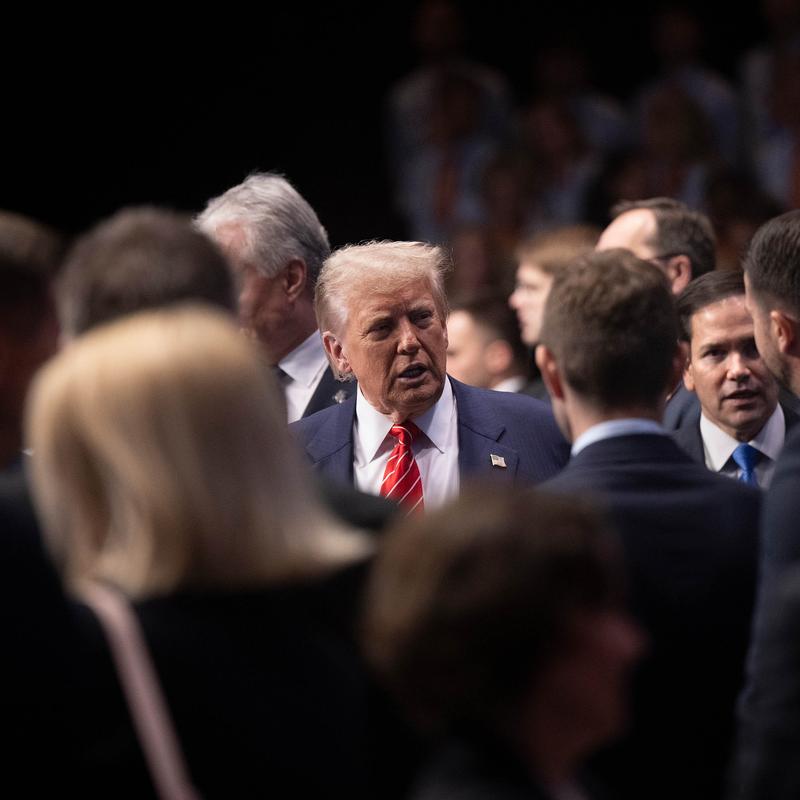
Brian Lehrer: It's The Brian Lehrer Show on WNYC. Good morning, everyone. We'll continue on the big global story that's dominating the news right now. Yes, President Trump at the World Economic Forum in Davos announcing he has a deal of some kind on Greenland. Details remain vague. He established a so-called Board of Peace. Donald J. Trump, chairman for life. Maybe more importantly, in the biggest picture sense, he continued the abolition of the US-led world order that has existed basically since World War II. It's that bigger picture and its implications for global security, which you've been hearing a lot about, but also American prosperity that we'll focus on here, as well as some of the developments that continue to break. Maybe the most important clip to play is not of Trump himself at Davos, but of Canadian Prime Minister Mark Carney, whose much-noticed speech included.
Prime Minister Mark Carney: Let me be direct. We are in the midst of a rupture, not a transition. Great powers have begun using economic integration as weapons, tariffs as leverage, financial infrastructure as coercion, supply chains as vulnerabilities to be exploited.
Brian Lehrer: He didn't say Trump or even necessarily the United States, but it was obvious what and who he was talking about, and among other implications, as reported on Morning Edition today, Canada is buying electric vehicles from China on the premise that China is a more reliable trading partner now than the United States. How different is that from any world you've known before? One example of the American prosperity implications as well.
We'll get a take on all this from Robert Kagan, contributing writer at the Atlantic, historian and senior fellow at the Brookings Institution, well known for decades as a leading neoconservative, though I think he prefers the term liberal internationalist, and author of books, including his latest, Rebellion: How Antiliberalism Is Tearing America Apart—Again. Now in paperback as Rebellion: Donald Trump and the Antiliberal Tradition in America. He has a new article in The Atlantic called America versus the World. President Trump wants to return to the 19th-century international order. We'll hear him explain what that means. He will leave America less prosperous, the subhead says, and the whole world less secure. Mr. Kagan, thanks for coming on. Welcome back to WNYC.
Robert Kagan: Thank you. It's nice to be back.
Brian Lehrer: Would you start by describing for our listeners who don't know you, a little bit of your political evolution, for a little background for our listeners? Correct me if I get any of this wrong. You served in the Reagan and first President Bush administrations. You co-founded the think tank Project for a New American Century in the late '90s with William Kristol. That was pretty aggressive internationally, arguing especially for more US Military intervention in the Middle East.
You supported the Iraq war. You served as foreign policy Advisor to John McCain's presidential campaign in 2008, but by 2016, you left the Republican Party and endorsed Hillary Clinton for president over Donald Trump. Would you like to correct anything or just fill that all in more for us about the evolution of your thinking about America's place in the world?
Robert Kagan: Thanks. First of all, I did not work in the Bush administration.
Brian Lehrer: Oh, sorry about that.
Robert Kagan: I was safely ensconced in Brussels throughout the Iraq War.
Brian Lehrer: Oh, I meant Bush 41. No?
Robert Kagan: No, I never worked in any Bush administration.
Brian Lehrer: Okay. Just Reagan?
Robert Kagan: Just Reagan. If you asked me about my evolution in terms of my thinking about foreign policy, I wouldn't say I've gone through very much evolution. I believed when I worked in the Reagan administration at the United States, for all its flaws and errors, nevertheless was playing a vital role in maintaining not a perfect world order, just one that was much better than what had come before, if you think about what the world looked like before 1945, and that therefore, America really had an important role to play in the world and needed to continue that role.
That has had me voting for various different parties over the years. I voted for Bill Clinton. I voted for Al Gore in 2000 because I thought he was the more-- I think I've been pretty consistent. Now my great concern is, is that this world order, which has been enormously beneficial to the United States, is now over because Donald Trump is killing it.
Brian Lehrer: You call it the era of the Grand Bargain, and you think it still has value. Remind everyone, what is the Grand Bargain in the way you use the term?
Robert Kagan: I think it's important because I think Americans take for granted, especially if you've been living in this world and it's the only world that you've known, you think it's normal but the Grand Bargain is that after World War II, many of the most powerful nations in the world, including those that had fought World War II, including Germany and Japan, and Great Britain, which was the largest empire in the world, and France, which was a global empire, all basically agreed by coercion at first, but ultimately not by coercion, essentially to allow the United States to provide for their fundamental security while they focused on repairing their political and economic and social situation.
American policy was for them to do that. I think it's important to remember that this was entirely unprecedented. That governments do not normally entrust their security to some distant great power. The Grand Bargain was the United States would provide fundamental security in both Europe and Asia, and it would not use its overwhelming power to abuse the very allies that it was protecting. That trust served us all very well for about 80 years, but now that that trust has been completely exploded. Trump is repudiating the Grand Bargain. That is going to force our allies into a very different international posture, and that's what is going to have a very negative effect for Americans.
Brian Lehrer: I played that clip from Mark Carney, the prime minister of Canada, from Davos, on Tuesday, and referenced the reporting on the Canadian electric vehicles purchase from China as reportedly a more reliable trading partner, in Canada's view. Are those things keys to why you include American prosperity as well as global security in your premise?
Robert Kagan: Yes. For one thing, if the United States is going to use tariffs as a weapon of control, which is how Trump uses them, these are not economic goals that he's seeking. He is seeking to dominate and to wield power over others. I think everybody now recognizes that. They all thought they could cut a deal with him and that it would stick, but because he wants to use tariffs as power, they're going to have no choice but to defend themselves.
I think one of the reasons Trump backed down on Greenland is the Europeans, at least temporarily, backed down, was because the Europeans looked like they were going to use that trade authority. What you're seeing between Canada and China is the future. You're going to see other countries diversifying away from the United States in terms of trade because the United States is an unreliable trading partner. It's more than that, too. We also benefit from open oceans, from bases that we have in other countries that allow us to protect our trade.
We have open access to most markets in the world. Those are things we take for granted. They're part of the alliance structure that we've enjoyed since the end of World War II, but now that's going to be over, and it's going to be every nation for itself. A lot of the things that the United States is getting as a benefit of its global leadership, it will now lose and have to fight for, which means we're going to be spending more on the military in this new system, not less.
Brian Lehrer: Listeners, your thoughts and questions are welcome on these very big questions of the changing US Place in the world under President Trump. Greenland's fears of influence for China and Russia as being more acceptable than before. We're going to get into that next, what our guest Robert Kagan from the Atlantic and the Brookings Institution calls a return to a 19th-century world order with negative implications. He argues for not just global security, but American prosperity.
In his opinion, as he just began to lay out. His article is called America versus the World. Your thoughts and questions welcome. 212-433-WNYC 212-433-9692. You can call, or you can text. You write that different from the US in the past, "Trump regards Russia and China not as adversaries or even competitors, but as partners in carving up the world." That includes U.S. preeminence in the Western Hemisphere, hello Venezuela, plus Russia, and what you call total dominance in their respective spheres of influence.
Make your case against to that, because supporters might say that reduces the chances of conflict with the countries that can actually threaten our security, Russia and China, and doesn't have much of a price, at least in security terms. Clearly, you disagree. Tell us why.
Robert Kagan: I disagree because if you look at what Russia's traditional sphere of interest is and which Putin, I think is very frank about wishing to recreate, it doesn't end in Ukraine. It only begins in Ukraine. Russia, from the time of the czars, through Stalin and through Putin, have always regarded, for instance, the Baltic states as being inherently part of the Russian empire.
Whenever Russia has enjoyed its full sphere of influence, it has included much of Eastern Europe as well as the Baltic states. It has also included Poland. In periods when Russia was in its full glory as an empire, Poland ceased to be an independent power. It was carved up between Germany and Russia several times and completely lost its sovereignty. Putin has made it very clear in his desire for a new European security structure that Poland should basically be within the Russian sphere of influence.
I don't know how many countries people are willing to give away to Putin's control, but that is a world in which much of Eastern and Central Europe falls under Russian control, which then raises huge security implications for Germany and even before that, as I mentioned, for Poland. In Asia, what does China regard as its natural sphere of influence? China had centuries of being the hegemonic and dominant power in East Asia. Any understanding of China's natural historical sphere of influence means that it would control most, if not all, of Southeast Asia.
It would certainly control Taiwan. I think it in the Chinese view, both Korea and Japan should be subservient to Beijing's wishes. Now, the problem in the first instance is not us. The problem is the Japanese will never tolerate this. The Poles will never tolerate this. They will both go nuclear before they are willing to be swallowed up by China. The thing that Americans need to recognize is that if we are moving into a genuinely multipolar world where the United States is not providing security to anyone, countries like Germany, Poland, and France, the UK, and Korea and Japan are going to have to become independent great powers of their own, and they also will have spheres of influence.
That is the 19th-century analogy. You had multiple great powers, all of whom were claiming various degrees of sphere of influence, which inevitably overlapped and led to repeated wars. In particular, World War I was about the overlapping sphere of influence between Russia, Germany, and Austria in the Balkans. That is the future that we are entertaining is constant conflict of great powers. If the Americans think that the United States can stay out of those kinds of conflicts and not be drawn into them, they clearly have forgotten what happened to the United States twice in the first half of the 20th century, when we were sucked into two world wars because of those kinds of conflicts.
Brian Lehrer: Let's follow up on that last thought about how the United States gets dragged in. To play devil's advocate, let's say Putin takes Ukraine and really does want to rebuild the Russian empire further into Europe, Poland, the Baltic states, maybe more. It's bad, it's violent, it's evil, but it doesn't hurt the United States directly at first. Some might argue China and Taiwan. Another example that you cited. If China invades and captures independent democratic Taiwan and forces it into China's authoritarian rule, that's obviously evil. Should the US go to war with the great power of China over Taiwan's independence? Is the answer to that clear-cut for you? Or how does this trickle down to actually affect US national security if that's the central concern in one line of argument?
Robert Kagan: Again, I'd love to introduce you to Dean Acheson and Harry Truman and all the people who lived through exactly what you're describing, which is-- Germany and Japan before World War II, were not aiming to attack the United States, at least anytime soon. We provoked the attack by the Japanese as much as anything against Pearl Harbor because they thought we were going to come after them, and we were strangling them with our oil embargo.
It wasn't about the immediate threat. Franklin Roosevelt argued, and I think a majority of Americans increasingly came to agree, especially after the fall of France, that it would be very difficult to maintain our institutions and our economic success and our political freedom in a world dominated by aggressive militaristic powers like imperial Japan and Germany. Now, could we have survived in that world? Of course, we could have. We survived in that kind of a world in the 19th century.
If Americans were really committed to cutting off all their involvement, and that means their economic involvement too, because after all, it was very much America's economic ties with the rest of the world that impacted our sense of whether this was safe for us to allow them to dominate Europe and Asia. If we want to go down the route, that would be one thing. I think it's a mistake, and I think it's been proven that we would not be able really to follow such a policy. Let's just make a point here. Trump is not doing that. Trump wants to be world emperor. Trump wants to build something in Gaza that American forces will have to protect. Trump wants to bomb Iran and Syria, et cetera, et cetera. Which is it?
Brian Lehrer: Let me jump in, because we'll definitely get back to that. We have a caller on the line who I don't want to lose. I'm told he can't stay very long. It's a caller from France who has, I think, a slightly different point of view. Bill, you're on WNYC. Bill, in France. Where in France, by the way? Hello, Bill.
Bill: Hello.Thanks for taking my call. I'm in northern Burgundy. I think you've actually touched on this a little bit, but I thought I'd add my two cents worth. The notion that Russia can just dominate the rest of Europe in that scenario is, if people are looking that way, a bit shortsighted, because the Europe that I live in, I'm a dual national, does not intend to be dominated by Russia. I think it still has the means to not be dominated. That was a point I wanted to make. Thank you.
Brian Lehrer: Thank you very much. That's interesting. I guess he's arguing Europe today has the strength to push back against Russia with a collective defense, maybe without the United States. Your thoughts?
Robert Kagan: I'm glad that he feels that way. I think that potentially at some point, Europe can have that strength, but with all due respect, it's absurd to suggest that they have that strength now. European forces on their own do not have a deployable military without the United States. They're entirely dependent because of the NATO structure, both on American intelligence, which is a critical element, and on American airlift. Europe doesn't have those capacities.
The French, if I may just point to that, had to pull out of their activities in Africa because they simply didn't have the capability. Does Europe, collectively, as one of the world's largest economy, have the capacity eventually to be able to defend itself? Possibly, but I think in the near term, I don't really see it. By the way, Europe by itself is also, in my view, unable to save Ukraine. If Ukraine falls, Europe will be looking at a very threatening situation. The people I talk to in Germany and in the French government do not share the caller's optimism on Europe's capabilities.
Brian Lehrer: Listener writes in a text message, "What's in it for Trump to destroy the current world order and return us to 19th century instability?"
Robert Kagan: That's a good question. I think what's in it for Trump is what's always in it for Trump. Power, dominance. That is what he craves. He craves it domestically, which is why he is busily imposing a dictatorship in the United States right now, which really should be the main story, by the way. In terms of his treatment of the world, he wants everybody bowing down to him.
He wants them to give him their Nobel Prizes. He wants them calling him daddy, and it never ends, by the way. He's not interested in making a permanent deal because then he doesn't have the same leverage, so he's constantly threatening new tariffs if you rub him the wrong way, as the Swiss president did, et cetera. I think what Trump is in it for is domination.
Brian Lehrer: Here's a text from a listener who writes, "Interesting that your guest as your surprise," I think they mean to my surprise. "Is a Democrat neocon proving once more that USA foreign policy is the same in both parties. This is the hypocrisy that Carney mentioned in his speech," writes that listener. Let me use that comment from a listener as a jumping-off point for a question, because we've been talking mostly about the Trumpist version of isolationism or regional spheres of influence.
There's a kind of isolationism on the left, too, I think it's fair to say. If the right argues that the world is getting over on the United States with all the money we spend on international things, that's the Trump position, the left argues that the US has been getting over on the world, US Imperialism. We spread our power largely in the interest of U.S. corporations or U.S. wealth accumulation and standard of living at the expense of others. Cheap labor, minerals, and produce from Latin America, Africa, parts of Asia, while US companies profit there.
The standard of living here has become the highest the world has ever known, while global inequality remains rampant. The argument would continue. We used our military to turn back Iraq's invasion of Kuwait in 1990 because Kuwait was a major oil supplier. We did not use it to turn back other regional power invasions of smaller countries or territories that didn't threaten U.S. economics. Te post World War II order has been exploitative by the U.S., hands-off more of the developing world, or more consistently off. Everybody might be better for everybody. The left has long argued a version of that all. Do people who argue that have a point at all, as you see it?
Robert Kagan: Every time I write about this, there are all kinds of inequities and behavior by the United States that you can disapprove of, and I don't doubt that. The United States is made up of human beings. Human beings are both selfish and make mistakes. I do think that some of this critique is comparing the United States to a standard that no nation has ever lived up to. I would say the United States has done more to live up to those kinds of standards than most nations.
If you look at any other great power in history, I don't think they come close to living up to those standards. We can imagine a utopia where everybody is just doing exactly the right thing all the time, and there's no power to be wielded. I think the biggest objection of the left is the wielding of power, and that's fine. I do think people need to understand the difference between even the flawed system that the United States has supported in the world and what is really more normal, which is the way the world was and existed before 1945, both in the early 20th century and in the 19th century. That's the norm.
What I'm trying to say is, however bad you may think the American system is, the alternatives are actually worse. That's not a speculation, that's just a reality. I'm not that sympathetic to this view only because I think it's fundamentally based on unrealistic expectations for what can happen in the real world. The most important indicator to me of the success of the American system is how many countries have voluntarily not only gone along with it, but supported it and legitimized it.
Even in wars that turned out to be unpopular, the United States had dozens of countries supporting it because they supported the basic world order that the United States has upheld, because they regard themselves as beneficiaries of it. That is just an inescapable truth. If the United States were as evil consistently as the left suggests, why is so much of the world been willing to tolerate it now?
You could just say, "It's just capitalism and the capitalists in all the countries." That's fine. You can believe that if you want. I think we've seen countries and peoples make decisions of the most important kind about their own security, in which they have trusted the United States to be essentially the guarantor of a particular world order. I think that speaks volumes about the success of the American system despite all its flaws.
Brian Lehrer: Let me go one step further down that road. The left might argue that the worst attack on US soil since World War II, 9/11, came from that supposedly benevolent US world order. Our relationship with oppressive Middle East monarchies, especially the Saudis, contributed to the kind of Islamist nationalism that rose at that time, that produced Al Qaeda and Osama bin Laden. The Islamists still hate us for that and for support of Israel, but we don't need Middle Eastern oil anymore, Trump would argue, and ceasing to prop up the Gulf states would diminish the motivation for radical Islamists to choose the US Or American American individuals as targets. Any validity to that as you see it?
Robert Kagan: The worst attack that the United States ever suffered was on December 7, 1941, and in the months that followed. What happened in the months that followed is, of course, the attack on the Philippines and the Bataan Death March and the loss of thousands upon thousands of soldiers and a real fundamental strategic setback, which required the United States to spend the next four years fighting its way back across the Pacific.
People forget that because nobody can remember what happens before 1945 and the world that existed. First of all, of course, it's true that the United States was hit, because it is out there. Whether that's a justification, I hope we're not suggesting that the destruction of two office buildings with thousands of people in it was an appropriate response to their complaint. By the way, they would have had that complaint anyway. There is a larger clash going on between a radical version of Islam, which is now weaker today than I think than it's been in the past, and the West in general.
The United States was the strongest power, so it was it became the target. I think that people need to have a better understanding of what historical possibilities are. The kinds of crises that we saw in the first half of the 20th century, which is not that long ago, were much worse than even 9/11 in terms of their overall effect on-- If we care about the rest of the world that the left claims to care about, how about the tens and tens of millions of people who were killed in those two world wars? Is that worth trying to prevent? If it's necessary to use American power to prevent a return to that kind of world, are those people's lives worth saving?
Brian Lehrer: After that rhetorical question, we will continue in a minute with Robert Kagan from the Brookings Institution and the Atlantic. His new Atlantic article, called the US versus the World. More of your calls and texts. We'll get specifically into this Trump announcement today of his Board of Peace. Is that against internationalism or a new form of internationalism? Stay with us. Brian Lehrer on WNYC. With President Trump driving so much international news right now and international change, we continue with Robert Kagan, contributing writer at The Atlantic, historian, and senior fellow at the Brookings Institution. His latest book, Rebellion: How Antiliberalism Is Tearing America Apart—Again. His new article in The Atlantic is called America versus the World. President Trump wants to return to the 19th-century international order. He will leave America less prosperous and the whole world less secure. Let me go to a caller, William, in Astoria, who wants to bring China into it in a particular way. William, you're on WNYC with Robert Kagan. Hello.
William: I'd like to know about China's One Belt, One Road. Isn't Trump falling into a deep trap? China is this emerging power in many areas of the economy. We're losing Latin America and Southeast Asia. What do you think about the effects of his policy going to have on the economy?
Brian Lehrer: Thank you, William. Robert.
Robert Kagan: He certainly is giving China an opportunity to do exactly what Xi Jinping said he wanted to do when he went to Davos a few years ago, which is that China is now the keeper of the economic world order. Because the United States now has become this predatory tariff war-making country, at the very least, not to mention the threatened territorial aggression against NATO allies in Greenland, it makes China a much more attractive possibility for other countries that have been, until now, allies of the United States.
The most obvious example of this is the strategic agreement reached between Canada and China recently about electric vehicles. You see, in Europe, which very much under American direction, had become very anti-Chinese in many ways, and also because China was an economic competitor, particularly of Germany. Now you see many Europeans talking about trying to get better relations with China.
This is just a general trend that Trump has created by using these tariffs in the way that he does of countries now seeking alternatives to the American market, and by the way, maybe even alternatives to American treasury bills. One of the things that I think spooked Trump when the EU was actually responding in a more tough manner to his threats to invade Greenland was the fact that the yield on the T-bill shot up all of a sudden because people were worried that countries might start dumping their treasuries.
Brian Lehrer: He backed down from the threat to use military force on this deal that he says exists, but we haven't really seen the details. Listener writes, "Excuse me, are you all so naive that nobody is thinking that he just did this deal to put all the troops he wants in Greenland?" Because I guess that's part of it. The US would have the ability to put troops at military bases that would have that U.S. sovereignty that military bases of countries have.
The text continues. "He doesn't have to fire one shot to get Greenland. He's going to fill her up with troops, and then who's going to fight him there if he's going to have the troops there already? That's what he's going to do. He doesn't need to invade. He doesn't need you to know anything. He was going to be there already with lots of boots." Any reaction to that listener?
Robert Kagan: I think the listener is basically right. I'm amazed at the number of people who think that this crisis is over just because Trump, one day, said that he wasn't particularly interested in using force. You can go back and look at all the times that he said he wasn't intending to use force against Venezuela at particular moments, as he continued to build up and clearly intended to anyway.
I don't know exactly what method he wants to use in Greenland, but the caller's certainly right that there's no question about American capabilities. I don't know whether European militaries would fight the United States. The Danes have a law on the books that says, as this is a result of being invaded by the Nazis in World War II, that they are required to fight for Danish territory. I don't know how that'll play out, but I don't think that the Greenland crisis is over by any means. Trump plays this game all the time, so therefore I think the listener is quite right.
Brian Lehrer: As a scholar of global security, do you agree with Trump at all that because of the rise of China and Russia and their military capabilities, the strategic importance of Greenland to the United States is much greater than it was at the end of World War II when its relationship with Denmark, I guess, in the contemporary sense, got secured. Does he have some kind of point there, and is there some other way to address that strategic importance of Greenland 2026 version if you think there is one?
Robert Kagan: First of all, I don't believe that that's the reason. I think he's concocted that reason for the simple reason that he could do anything he wants in Greenland with the full cooperation of the Danes. They're one of our most reliable allies. We are the ones who took down the number of bases that we had in Greenland. Nobody enforced us to do that. I'm sure what the NATO General Secretary Rutte discussed with him was the fact that he could do anything he wanted in Greenland except own it.
Trump is interested in owning it because he wants to get his head on Mount Rushmore. He wants to show that he can take this territory even if he could have absolutely everything we need to defend ourselves against Russia and security, along with our NATO allies, who have exactly the same mission. It's not that we can't protect Greenland with the cooperation of our allies. It's that he wants to take it. It's part of his domination, it's part of his lust for glory. It's the same reason that makes him punish India for not supporting him for getting the Nobel Peace Prize. This is all about him, his ego, and his demand for dominance.
Brian Lehrer: Which I guess brings us to the so-called Board of Peace that Trump introduced at Davos today. Donald J. Trump, Chairman for life. He framed as enhancing international institutions by adding another one. Here's a few seconds of that.
President Donald Trump: I think the combination of the Board of Peace with the kind of people we have here, coupled with the United Nations, can be something very unique for the world. For the world. This isn't United States, this is for the world.
Brian Lehrer: Your reaction to that?
Robert Kagan: First of all, I'm just loving the America First stuff. Again, he wants to be chairman of the Board of the world. Look at that ceremony that he was at. There was not a single American ally present. He's put Vladimir Putin on the board. He's put the dictator of Egypt on the board. Of course, he is the chairman, and others can see exactly what this is. This is all pursuant to his desire to be world emperor in addition to American king. I don't think anybody's taking it seriously, except as it's another sign of the degree to which he wants to replace a great bargain that the United States had with so many allies and strategic partners with simple dominance by him, the chairman of the World Board.
Brian Lehrer: Any take on the specific Gaza piece of this, which was sort of the origin of this Board of Peace, and is getting lost to the bigger picture. I read that this included today reopening of the Rafah crossing from Egypt. Egypt is one of the countries on the board, though I don't see Palestinian representation.
Robert Kagan: Of course, there's no Palestinian reputation. Basically, the Gaza thing is a joint effort by Trump and Bibi Netanyahu to consolidate Israel's gains. Now, I don't know how happy, actually, Bibi is about every detail of what Trump has in mind. Trump has fantasies about some great Riviera on the Mediterranean, but without Palestinians. I just think this is part of the general Israeli oppression of the Palestinians.
Brian Lehrer: Marie in Chicago, you're on WNYC with Robert Kagan from Brookings and The Atlantic. Hi, Marie.
Marie: Hi. Thank you. Trump's term is only four years. How does that play into world leaders' expectations and actions? Excuse me. Is it more like our system seems to have failed in electing someone like him? It seems like one of our only two major Republican parties has been doing things and supporting policies that are anti Democratic. What does Professor Kagan think about that?
Brian Lehrer: There's a few really big questions in there. What about the fact, her first one, that Trump's term will end presumably after 2028? How does that contextualize what's going on?
Robert Kagan: First of all, I'm not at all confident that that is true. I do not believe that he's going to allow free and fair elections in 2026, let alone in 2028. I think what we're seeing in Minnesota now is a dry run, a dress rehearsal, and also a desensitization that he's capable of doing this on a much broader national scale at the time of elections. I think it's entirely possible, if not likely, that he uses the Insurrection Act at the time of the elections and does what he said he wanted to do in 2020, which is have the military seize the ballot boxes.
I have no confidence, and therefore, European and other world leaders should have no confidence that we really are going to see a change of government in 2028. I'm not at all optimistic about that. Even if we were going to see a change of government in 2028, first of all, we're just at the beginning of Trump. People could say, "It's just four years." You can do a lot of damage in the next three years. He's already done tremendous damage to America's standing in the world in the first year.
Wait till he's finished after three years. Who's to say that in those three years, he doesn't take Greenland and cause the fullest conceivable rupture? I think allies are already making their decision that the United States can't be trusted. I don't think even one election will necessarily undo that. Once the trust is broken, it's very hard to restore.
Brian Lehrer: Before you go, how does anything we've been discussing relate to your book Rebellion: How Antiliberalism Is Tearing America Apart—Again? To repeat the title, you're mostly a foreign policy guy. We usually hear antiliberalism invoked around domestic social issues. How do these two things interact with.
Robert Kagan: American foreign policy is has its origins in domestic ideological battles of one kind or another. The people who were opposed to intervention in World War II were also basically soft on the fascist governments. They were soft on Hitler and Mussolini. They regarded their number one, the number one threat out there, as being communist in the Soviet Union. Whereas the people who tended to support Franklin Roosevelt were liberals who were more afraid of fascism than of communism.
You can go back through American history, and this has always been the case. The fact that Trump sits atop a movement which is basically about white supremacy and white Christian supremacy, and you now see this coming out of Stephen Miller talking about the world. They are inherently hostile to liberalism, by which I mean the founders' liberalism, the idea of equality and individual rights. They want to reestablish a hierarchical society in the United States, which is fundamentally about the supremacy of white Christians.
That is now playing out on the world stage as well. It's not an accident that Trump and his people support the right wing neo Nazi party in Germany, the AFD, or that they support Le Pen and the far right of France, and that they support Farage and the far right in Britain. This is all the piece. What's happening here in the United States in terms of the destruction of the founders' system also is playing out on the world stage.
Brian Lehrer: We have two minutes left. I'll give a listener the last question. Listener writes, "Please ask Robert Kagan if he sees any way out of Trump's destruction of the global world order."
Robert Kagan: Yes. At any time, if four Republican senators got up and said they were not going to support these kinds of activities and had the guts to stick to that position, I think Trump would be in trouble. It is the complacent, complete, abject support that Trump gets from the Republican leadership in Congress that is permitting this. If listeners have any influence on the Republicans in Congress and tell them that they don't want to be heading down into this very dangerous world that Trump is leading us, they can do what citizens normally do in these cases, which is write your congressman and tell them that they are on the wrong side of what American interests are.
Brian Lehrer: Robert Kagan, contributing writer at The Atlantic, senior fellow at the Brookings Institution, author of books, including his latest, Rebellion: How Antiliberalism Is Tearing America Apart—Again, and his new article in The Atlantic is called America versus the World. President Trump wants to return to the 19th-century international order. He will leave America less prosperous and the whole world less secure. Thank you for sharing your thinking with us.
Robert Kagan: Thank you.
Copyright © 2026 New York Public Radio. All rights reserved. Visit our website terms of use at www.wnyc.org for further information.
New York Public Radio transcripts are created on a rush deadline, often by contractors. This text may not be in its final form and may be updated or revised in the future. Accuracy and availability may vary. The authoritative record of New York Public Radio’s programming is the audio record.
