
The Trump Administration's Renewed Family Detention
[music]
Amina Srna: It's The Brian Lehrer Show on WNYC. I'm producer Amina Srna filling in for Brian today. Good morning again, everyone. Back in April of 2018, the first Trump administration implemented a "zero-tolerance family separation policy." Over the next six weeks, nearly 2,000 minors were separated from their families at the US/Mexico border in the Trump administration's effort to deter migration. Those numbers, according to the advocacy group the National Immigration Forum. Public outcry resulted in a formal reversal of the policy by June, shifting the Trump administration's policy toward family detention instead.
Within the first days of Trump's second term, our next guest writes that his administration launched a series of executive actions that in effect, directed immigration enforcement against kids. Thousands of immigrant children have been detained so far, and many have suffered from medical neglect. Joining us now to discuss her latest reporting is Sarah Stillman, staff writer at The New Yorker, and the director of the Investigative Reporting Lab at Yale. Her latest is titled The Return of Family Detention. Sarah, welcome to WNYC.
Sarah Stillman: Thank you so much for having me.
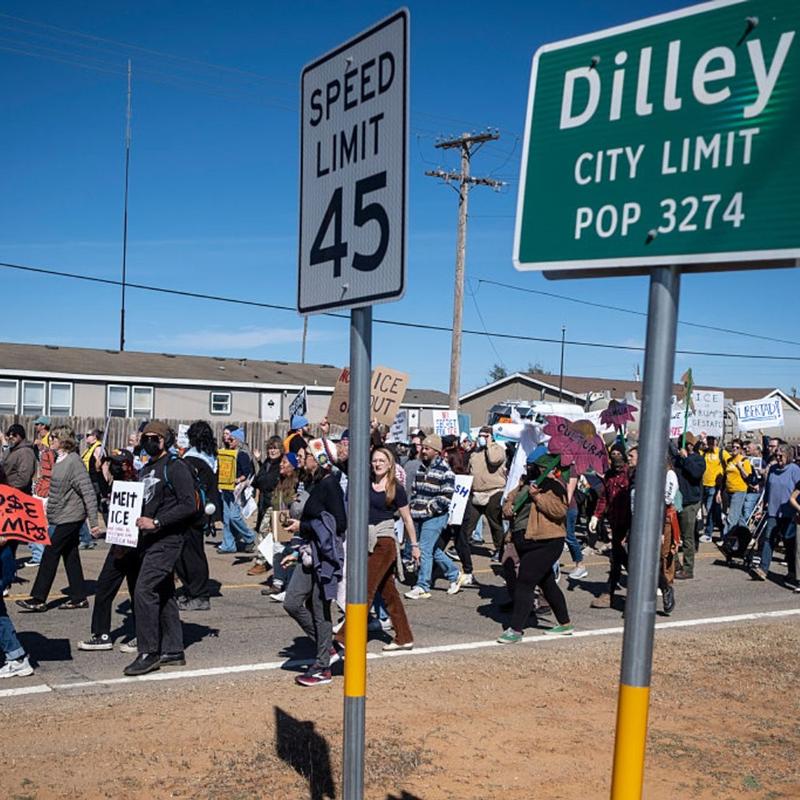
Amina Srna: You write about how the harm to children is particularly clear in the Trump administration's "revival and expansion of family detention," and that's very clear at the Dilley Immigration Processing Center in Texas. For listeners who aren't familiar with that center, can you tell us more about what's happening there?
Sarah Stillman: Absolutely. It's our understanding that more than 5,000 children and their parents in this past year have been detained there, and it's quite dissimilar from years ago. I covered family detention under the Obama administration, but one of the things that's very different in this moment is that a shocking number of the families who are there actually had roots in this country and had been living in the interior of the country. Some of these kids were in schools, and in church communities, and really embedded in their neighborhoods when they were picked up by immigration enforcement and sent to Dilley. Others are more recent asylum seekers, and many of them are being held well past the legal limit that-- kids are not allowed to be detained indefinitely before the law, the Flores Agreement prevents that. And yet many of these kids have been staying more than the 20 days, and so we're seeing medical neglect, we're seeing a long litany of things I'm sure we'll discuss.
Amina Srna: Yes, and I'll ask you about the Flores Agreement in particular, and for some of the specific stories that you highlight in your reporting. But first, you mentioned the Obama administration, and you report that Dilley was actually opened in 2014 by the Obama administration. Can you tell us some of the history behind that family detention center in particular, maybe as a way to get into family detention in the United States more broadly?
Sarah Stillman: Absolutely. There's a long history, but it also doesn't go all the way back. I mean, really, it started with George Bush, and what we saw-- the creation of Hutto, one of the first for-profit family detention centers. Then in the Obama times, around 2014, I was covering when Dilley first opened, and it was considered by the Obama administration a deterrent to a lot of the Central American families that were coming, often with small kids. During that time, for the most part, families were held when they had just arrived and they were awaiting what's known as a credible fear interview, or the early stages of the asylum process, and then typically, they were released. But what we've seen more recently is this vast expansion of the idea of mandatory detention for people who-- many of whom were actually let into this country through all of the lawful processes, people who came here illegally seeking asylum, many of whom were actually paroled in by the Biden administration, and have since had that revoked and have been subjected to detention.
Amina Srna: Because your article is titled The Return of Family Detention, can you walk us through some of those shifting policies more broadly between maybe Trump 1.0 and Trump 2.0?
Sarah Stillman: Yes, I mean, it's been really interesting talking to immigration attorneys, like Elora Mukherjee was a tremendous source for me. She's a remarkable attorney at Columbia University, where she's represented families at Dilley for many, many years, so she's witnessed those differences both between past administrations. As I mentioned, under the Obama administration, she and her team and many other attorneys were able to actually do "know your rights" presentations at Dilley and alert the families to their rights, and those have essentially been shut down, so those aren't happening anymore. So, even to get access to an attorney is so much harder than it was before.
But she's even noted differences between the first Trump administration and this one. For instance, in the context of when kids were in serious medical distress, in the past, she could often file essentially petitions to try to get those kids out, and those would be honored. In the earlier days of the second Trump term, that was not the case. Oftentimes, kids in serious medical emergencies would have an attorney-- If they were lucky enough to have an attorney at all, they would have an attorney filing on their behalf to try to get them out. They would have to file once, and then twice, and then three times using testimony from doctors, and then they would have to file a habeas petition. And even then, sometimes kids weren't always getting out.
That's changed somewhat recently, and that's partly to the credit of a lot of great reporting on this topic, Congressional interest, and the public's interest, I think. You know, for a lot of people it's shocking to learn some of the stories of kids in serious medical neglect not getting out of a facility where there's also-- As you can imagine, if you gather a lot of families densely in a place without access to the highest quality of medical care, you're going to have a lot of viruses and other serious medical things, medical kind of epidemics, so that's what we've seen.
Amina Srna: You open the story with that of 18-month-old Amalia and her family's time in Dilley. You write that the family, "Took all the steps required by the Biden administration. Arriving at the southern border, they registered for an appointment with Customs and Border Protection. They waited for months in Mexico, during which time Amalia was born." Can you pick up the story from there?
Sarah Stillman: Absolutely, yes. They're a really good example of what I was talking about earlier. This is a family that was paroled into the country under the Biden administration. They were asylum seekers who, as you mentioned, came here through all the legal pathways. They were living in El Paso, Texas. They had found a playground for Amalia, they were members of a local church, and at one point, they were asked to come to an ICE check-in earlier than had been planned. The whole family was asked to be there, and they got arrested, including baby Amalia. That was in December, this past December. They were all collectively put in a vehicle and taken to detention with other families with small kids, and that's when they wound up at Dilley, ultimately. And as you mentioned, Amalia got quite sick. That started on January 1st, she got a high fever. Her mother took her to Dilley's medical clinic, and she felt often pretty dismissed.
A lot of the families at Dilley told me they would have to wait for many hours just to get access to care if you had to get medication for your child, which was quite limited. You often had to wait in line for two hours with your sick kid, or your vomiting kid, or your child with diarrhea. All these children just waiting outside, often in the cold or in the heat. And so Amalia, in her case, it got so extreme that at one point her blood oxygen was down in the 50s, which for those of you who are familiar with that concept-- most people know it should be in the 90s, ideally high 90s. This was a child in such a bad state that I talked to a pediatrician who'd review her medical records and said, you know, she would have been at real risk of serious brain damage if she didn't get emergency help.
Amina Srna: So what was going on when she was hospitalized? What was her diagnosis?
Sarah Stillman: Wildly enough, she had, I believe, five diagnoses. It turned out she had COVID, she had RSV, she had bronchitis, she had pneumonia and an ear infection, so you can imagine the level of dismissal or neglect it would have taken for all of that to accumulate to the point that it did. She wound up spending-- I believe it was around 10 days of hospitalization that was required to get her back into stability, at which point, the family really thought and hoped she would be released, but that is not what happened. She was actually sent back to Dilley, where, as I mentioned, there was a lot of viral infections going around when she was in a very vulnerable medical state.
Amina Srna: Well, let's talk about what is going on at Dilley in terms of the sanitation. You write that Amalia's family described water in the facility as, "unclean and foul-smelling," and that even basic necessities like bottled water had to be purchased. There was also a major issue with the food. So can you just tell us about the conditions at Dilley?
Sarah Stillman: Certainly, and I didn't just hear that from Amalia's family. I mean, I spoke to a number of families, and every single family mentioned the water. Many mentioned seeing slimy stuff in it, it smelled strange. And as you just alluded to, these are families who've been taken from any stream of income that they have, so to be able to purchase bottled water is not an easy thing to do, and that was the only way to get access to drinkable water that felt safe to them.
CoreCivic, the private corporation that runs Dilley, told me that the water has been tested and is perfectly fine. I just so repeatedly heard to the contrary from families directly. There's also been a new report that just came out: Human Rights First and RAICES put together a pretty deep dive, looking at an array of different medical issues that they allege at Dilley. So it's not just the water and not just the food. Amalia's parents told me they witnessed someone find a bug in the hamburger meat, so there were things of that nature. Also, I heard repeatedly from families just the wait to get care when you're in serious medical distress or when your child is seriously ill was significant.
Amina Srna: One line in your reporting really drew a sharp contrast between the living conditions in Dilley for these families and how profitable detention is for these for-profit organizations. You write, "CoreCivic, the private contractor that operates Dilley, reported more than $2 billion in total revenue last year." So, for listeners who aren't familiar, are most families in detention kept in these for-profit centers, and what does that mean for government oversight into these conditions?
Sarah Stillman: Yes, that's been part of the model since essentially-- As I was mentioning with George Bush, that was the first, as I know it, large-scale for-profit family detention facility. And since then, it's my understanding that the majority of folks who are being held not just in the family detention context, but more broadly in detention, are often held in for-profit centers. Family detention at this point is primarily at Dilley. That's gone in different ways at different times in the past. As I mentioned, under Obama, there were multiple facilities, some of which don't exist anymore. Dilley actually was then eliminated by the Biden administration, and then revived as of last year. In March of 2025, it was reopened by Trump, and so it's still under CoreCivic.
Amina Srna: You describe medical staff at Dilley in one case as googling a child's symptoms. The child's mother, Oksana, is a nurse from Russia, and she told you that she had concluded that many of the people at Dilley were not qualified to administer the medical services that they were providing. I take it from your reporting that her daughter had a pretty bad ear infection, her teenage daughter. What does that suggest about the level of care and preparedness for treating children inside these facilities?
Sarah Stillman: Well, I think-- I mean, I certainly heard that from her, that was her claim. And again, CoreCivic vehemently denied that, but what we've seen-- I mentioned the Human Rights First and RAICES report, they looked at and documented what they called consistent patterns of these issues of medical care at Dilley. They documented delayed and denied treatment, they mentioned misdiagnoses, ignored emergencies, indirect interference with ongoing care. Those are patterns that I also heard families describe to me directly from their experience, and that also echoes what we've seen in earlier times. There was a report that had come out about a similar detention facility during the previous Trump administration in Karnes County, Texas, where they had documented a similar lack of pediatric-specific medical knowledge in the facility. So those are the claims of the families and some of the reports that have been written documenting the phenomenon.
Amina Srna: You mentioned in the beginning of our conversation that there is a limit to how long families and children can be held in detention. The families you spoke with for your reporting in The New Yorker, they were held for sometimes five or six times that length, so can you tell us about that legal limit and what's supposed to be happening that isn't?
Sarah Stillman: Absolutely. The legal limit I'm referring to is the Flores Agreement. That's a 1997 long-standing legal settlement that governs a number of things about how children can be in detention. They cannot be there indefinitely is one of the important mandates, and 20 days is the legally-recognized amount of time, after which they are supposed to find whatever the least-restrictive care for a child is, so detention would not meet that bar. But nonetheless, I definitely spoke to families who had been there for quite some time. I'm thinking about the Russian family we were just discussing, they were there upwards of four months. I spoke to an Indian family, another really good example of a family who had been living here since 2022. They were living in Los Angeles, the kids were in school at the point in time that they got detained at Dilley. When I spoke to them, they'd been there-- I think they were just about to reach the 50th day of their detention.
Amina Srna: Listeners, if you're just joining us, I'm speaking with Sarah Stillman, staff writer at The New Yorker and the director of the Investigative Reporting Lab at Yale. Her latest for The New Yorker is titled The Return of Family Detention. We can take a few of your comments or reactions, especially if you've read this story or are following similar family detention stories. 212-433-WNYC, that's 212-433-9692. You can also text that number. Sarah, you write that the center, Dilley in Texas, has both threatened family separations and enacted them. Can you give us an instance where that threat made and followed through with?
Sarah Stillman: Yes, that was something primarily documented by the folks at RAICES, an immigrant rights organization that shared some records with me about that, and those included-- There was a case of an 11-year-old child and his parents who had come here from Mongolia, and they were seeking asylum. They ultimately wound up at Dilley, and they never really believed they received an explanation for why they were shackled and sent then to adult detention, and the child was shipped to a federal shelter for unaccompanied kids. That was an instance where they said that they were-- and many families said that they were essentially told, "If you won't agree to deportation, then you might be separated from your children or your child." And in that case, the family only got reunited when they were deported back to Mongolia.
I also reviewed records in a case of a mother from China who was with her 10-year-old son, and in that case it was very similar. She was essentially told, "You have to get on a flight, and if you agree to be deported, you can stay with your son. If you insist to the contrary--" which she did, because she had very serious concerns about being deported to China and was trying to seek refuge here. She was told, and then was separated from her child. She was told she would be, and then ultimately, that's what happened. That kid was sent to a federal shelter in New York, and then she was sent onward to adult detention. They were at Dilley for a period of time, but essentially, as of the point in time when I published the piece, the two of them had actually remained separated.
Amina Srna: That reminds me of a story that we covered on this show earlier this year. In December of 2025, actually, Chinese asylum seeker Fei Zheng and his six-year-old son Yuanxin were detained by ICE in New York City, and then separated. The child was transferred from Customs and Border Protection to ORR Care, which is the Office of Refugee Resettlement. Can you just explain what happens when kids are separated from their families? I think this also applies to unaccompanied minors, where do they end up?
Sarah Stillman: Absolutely. I mean, there's a few different possible trajectories, and what's really scary in a lot of these instances is that oftentimes, the families don't know, and one of the big things I heard is that there's not always a clear communication. But typically, they'd be in the custody of the Office of Refugee Resettlement, ORR, and then they would wind up up in essentially a federally-run or federally-funded shelter. And then there's times when they can wind up in foster care as well, and we saw that certainly, and we probably remember those scenes from-- as you mentioned at the start of this, the family separation of the previous Trump administration, we saw many, many kids enter that system, some of whom got kind of lost within the ORR system, some of whom were in shelters, and others of whom wound up in foster care.
Amina Srna: Let's take a caller. Todd in Somerset, you're on WNYC. Hi, Todd.
Todd: Hi, how are you? Thank you for taking my call.
Amina Srna: Thanks for calling in. What would you like to say?
Todd: I want to say two things. First of all, we need a law that says it's illegal to separate families and put families in detention without a doctor's certification that it's necessary. Also, I'd like to know if there are any doctors that are certifying the family detentions and separations.
Amina Srna: Todd, thank you so much for your questions. Sarah, what do you want to weigh in on first? I mean, who's conducting this medical care in places like Dilley?
Sarah Stillman: Part of what's troubling is there's not a huge amount of transparency. So many journalists have worked so hard, and advocates as well, to try to get more answers about all the details, but I think what we do know is a lot of pediatricians and other doctors have spoken out about this. There's been quite a number of letters from the medical community asking very similar questions, so I think it's a great question to be asked, and it's one we need to keep asking. Because part of what's so tricky is that even just getting access to the simple numbers of how many folks are there is not always easy. We get momentary snapshots, but it's quite hard to tell answers to what should be relatively simple questions inside these facilities. That includes also more broadly in ICE custody and what we're seeing of medical neglect incidents where people have passed away in detention, and we still don't have answers.
Amina Srna: Getting several texts on this point. Ann Marie in Glen Cove, I'll let you make it. Hi, Ann Marie, you're on WNYC.
Ann Marie: Oh, hi. How are you? First-time caller, longtime listener. I just want to say briefly that these are concentration camps, and I keep hearing them referred to as detention centers, and it feels like it's being normalized. Heather Cox Richardson, Dr. Joanne Freeman, I listen to both, and they refer to these as concentration camps. That's it, I'll hang up, but thank you.
Amina Srna: Ann Marie, thank you so much for your call.
Sarah Stillman: Yes --
Amina Srna: Yes, Sarah, go ahead. I mean, as somebody who's been covering this-- Go ahead.
Sarah Stillman: Yes. Thank you, again, for saying that, and I appreciate it. The title of the report that I've alluded to a few times by Human Rights First and RAICES is A New Era of ICE Family Prisons, and I think a lot folks have been making that intervention, that while it's formally known as a detention facility or family detention center, previously the title was like "residential center," that-- You know, looking at it and understanding it as a prison. That's actually exactly what one of the Indian fathers I interviewed at Dilley said to me. He said he feels like this is not at all what he thought it would be. It's a prison, and your movements are restricted. It's kind of exactly as as he described, and I think there's a lot of attention, meaningfully, on what the right rhetoric should be now.
Amina Srna: Last question from a texter who writes, "I'm so confused. Since this administration seeks to summarily deport every and any migrant, why is there any long-term detention for anyone besides profit? Are they in special categories? Are they awaiting some due process? I thought Trump no longer regards due process as necessary. Can you ask your guest?"
Sarah Stillman: That's a really interesting question. Some of it is, they can't just do away with the law altogether, right? I mean, it seems like there are processes. I did some reporting on an interesting manifestation of this question, which was about also the return and vast expansion of this idea of third-country removals. This has been a really new area of experimentation for the Trump administration, and a very secretive realm, where essentially, they have held people, some of whom had legal protections that can't just be done away with, which included, in some cases, a status called withholding of removal, so it's somewhat similar to asylum, but a little bit more restricted. Some people who got that status and weren't allowed to be returned to the countries where an immigration judge agreed they might be tortured or killed if they were sent back, what the Trump administration has done is essentially detain them as long as it takes to get them ready to be deported. In many cases, put them in shackles, and then sent them to a third country.
For instance, I spoke to many people who-- I got a call from a military detention camp in Ghana where a number of people who had had those types of protections that I just described were deported. And then from Ghana, they were deported to the countries from which they had legal protections from being deported to. It's kind of this very convoluted way that the Trump administration has figured out how to circumvent asylum protections, and detention has become just one step in that process. So, third country removal is, I think, a big part of that puzzle, but more broadly, I think they're seeking to expand detention as long as it facilitates. I think this larger goal of-- as the caller alluded to, of a larger mass deportation.
Amina Srna: We'll let that listener have the last question. Sarah Stillman is staff writer at The New Yorker. She's also the director of the Investigative Reporting Lab at Yale. Her latest for the magazine is titled The Return of Family Detention. Very powerful reporting, Sarah. Thank you so much for joining us today.
Sarah Stillman: Thank you so much for having me, and for all the families who've shared their stories as well.
Copyright © 2026 New York Public Radio. All rights reserved. Visit our website terms of use at www.wnyc.org for further information.
New York Public Radio transcripts are created on a rush deadline, often by contractors. This text may not be in its final form and may be updated or revised in the future. Accuracy and availability may vary. The authoritative record of New York Public Radio’s programming is the audio record.