
The Trump Administration's Incomplete View of Nigeria’s Crisis
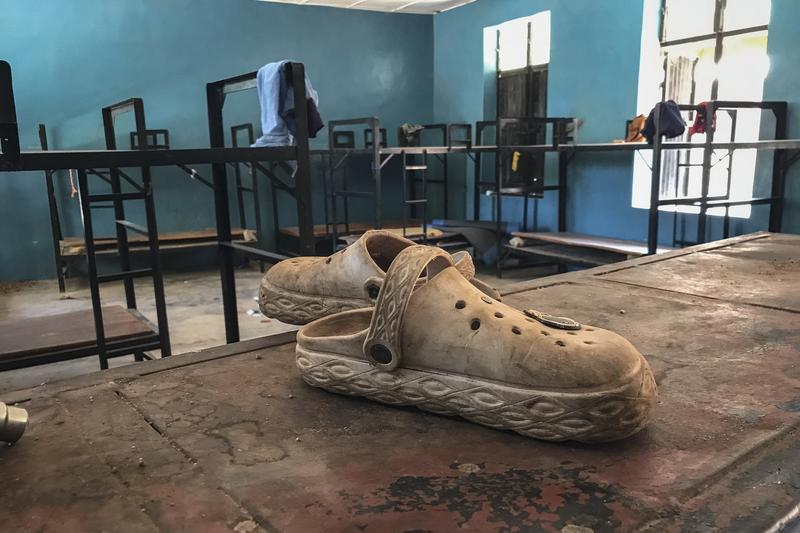
( Ifeanyi Immanuel Bakwenye/AFP / Getty Images )
Brian: Brian Lehrer on WNYC. We're going to talk about the nation of Nigeria now. Maybe you know, maybe you're connected to Nigeria, from Nigeria, roots in Nigeria, but if you're not, you may not know that Nigeria is in the news, facing a surge of violence and a security situation that analysts say has been deteriorating for years. There have been mass kidnappings at schools recently and deadly attacks in rural communities. Here in the US, there is a US element to this. The violence has been pulled into a very different conversation.
President Trump and some of his allies are describing these incidents as part of an organized Islamist campaign targeting Christians, and the president has even threatened US military action in response. Now, we should say Nigerian officials and many experts who watch the region closely say that picture is incomplete at best. Extremist groups have killed Christians, but also Muslims in Nigeria. Some of the deadliest attacks grow out of land disputes, resource conflicts, and a security system stretched far beyond its capacity for like 15 years.
At the same time, armed bandit gangs have become one of the biggest threats in the country, hitting communities of many faiths. In the middle of all this, families are still searching for more than 250 children. This is what's in the news as the immediate hook. More than 250 children still missing, taken from a Catholic boarding school just last week.
Joining us now is NPR international correspondent Emmanuel Akinwotu to help us untangle what's really driving the violence, also how it's framed in Washington, and why the reality is far more complicated than a simple religious conflict, but also to talk about whatever religious conflict is involved. Emmanuel, we really thank you for giving some time to one little NPR station instead of the whole network. Welcome to WNYC today.
Emmanuel: Good morning. Thanks so much for having me. It's a pleasure.
Brian: Can you give our listeners unfamiliar with Nigeria, first, a few demographic basics? For example, it's by far the most populous country in Africa, by far, right?
Emmanuel: Yes, that's correct. Over 220 million people, and it's roughly split demographically between a majority Christian South and a majority Muslim North. That's really the kind of context for Nigeria, and particularly the issues that you've raised in the introduction really apply most specifically to Northern Nigeria, where insecurity has been rampant, and obviously, many listeners might be familiar with the insurgency from Boko Haram in Northeast Nigeria.
What we have today is a more complicated and spread picture of insecurity, where it's not just Boko Haram who really were attacked quite heavily by the Nigerian army, but have now become a bit more resurgent in recent years. There really are a plethora of armed groups across Northern Nigeria, particularly Northwest and Central Nigeria, that have caused just a great amount of terror over the last decade. That's everything from kidnap for ransom attacks that have become prevalent, to taking over swathes of rural life in Northern Nigeria, sometimes taking taxes and levies, essentially exploiting a lack of meaningful presence of either government officials or security officials in large parts of the country that are essentially ungoverned now.
Brian: Now, listeners, Nigerians, Nigerian Americans, you'll get first priority on the phones. If any Nigerians or Nigerian-Americans happen to be listening right now, you are invited to call in or text at 212-433-WNYC, 212-433-9692, with a comment, a story, or a question for our guest, NPR international correspondent Emmanuel Akinwotu, 212-433-9692. If you know anyone who's been personally affected, you could tell a little bit of their story to help this make more personal and less about statistics, or you can help explain to everyone else what you think is really going on, or anyone can call and ask a question. 212-433-WNYC, 212-433-9692.
On the particular case, Emmanuel, that many of our listeners, even without ties to Nigeria, may have been hearing in the news, and that may be pulling on their heartstrings, more than 300 children being abducted from a Catholic boarding school. What can you tell us about the status of those kids? I see that some of them escaped.
Emmanuel: Yes, that's right. It's one of the worst kidnap of children in Nigeria. As you said, about 303 children from a Catholic boarding school in the north central state of Niger, Niger State, a very remote part of the state, were kidnapped. About 50 of those children were reportedly found. They escaped during the abduction, according to the Christian Association of Nigeria, whose chairman is the proprietor of the school. Those kids have now been reunited with their families, according to the state government, but 250 of those children are still missing, including about a dozen members of staff.
At the moment, the local authorities are saying that there is a hunt for these children to find them and bring them to safety. Nigeria's government notionally says they don't pay ransoms, but we know from reporting in many of these cases where children or indeed people who are abducted are then released, often we don't see any reports of the assailants being arrested. There's a lot of reporting that ransoms are indeed paid to these armed groups, and further exacerbating the issue that is really deeply affecting so many vulnerable communities like this school community.
Brian: You report that no one has claimed responsibility for that abduction. Do they not need to in order to get their ransom?
Emmanuel: Yes, they don't need to at all. In fact, a lot of these groups, the suspects in this particular case, are referred to in Nigeria as bandits, and they are militants, many of whom are dominated by ethnic Fulanese, but not exclusive to that ethnic group at all. They are made up of essentially hundreds, if not thousands, of groups of militants. That number, by some estimates, about 5,000 in total across north and central Nigeria. A lot of these groups are, while they might be known locally to these communities, they're not necessarily courting international profile.
In these situations, they're very well known locally to the community. There have been reports of that, indeed, in this particular case, where locals say they more or less know who they are, they know where they're based. In situations like this, what typically happens is they are reached out to on a local level, and their demands are either met, or they are pursued by security forces, but that's just a very tricky situation because these groups are heavily armed, sometimes more heavily armed than the security forces that are pursuing them. They are deeply entrenched in parts of the country where the military and governance presence is really thin.
Brian: I see that this wasn't the only recent school attack. Just days before the 300 were taken from the Catholic boarding school, more than 20 Muslim schoolgirls were kidnapped in a different state in Nigeria. How does that detail fit into the broader pattern of who's being targeted and by whom?
Emmanuel: It's a really important point. Last week was a really tough week, a really harrowing week in terms of the number of high-profile attacks. There was this attack on the 303 school children. There was also an attack that you just mentioned. About 25 children were kidnapped from northwest Nigeria, a state called Kebbi State. They have now been freed. Again, similar to what I was saying before, they've been freed, but we haven't had any reports of the assailants being apprehended. Then there was another attack on a church in a state called Kwara State in central Nigeria, where about 38 worshippers were abducted. They have also now been freed. Again, there are no reports on what has become of the assailants.
We had those three high-profile incidents and two affecting majority Christians, one affecting Muslims. I think that it really shows a few things. One, that it's absolutely the case that Christian groups in Nigeria have faced a torrid time as insecurity, especially in the north, has risen. We've seen specific instances where their faith is a factor in the attacks that are taking place. I think it's happening in a much more complicated and nuanced picture, where broadly speaking, across northern Nigeria, insecurity has really flourished. The majority population in northern Nigeria, who are Muslims, have been as deeply as affected as anyone.
Brian: Let's take a phone call right now, relevant to Nigeria. Sadiq in Flanders, New Jersey, you're on WNYC. Sadiq, thank you very much for calling in.
Sadiq: Thank you so much, Brian, for taking my call. Just like your president in the studio said, the issue here is not particularly, maybe Muslims targeting or having a genocide against Christians is a complex issue. Northern Nigeria is a majority Muslim areas. The Muslims are also affected. They are equally victims to these attacks from these armed bandits and from Boko Haram. These bandits just go into towns and just wipe out towns and burn buildings and kidnap women who are majority Muslim. All these things normally don't make the news. It is not good when a church is attacked or Christians are attacked, but that is what makes the news.
Christian evangelicals in the United States seize on that to make their point that there's a genocide going on, but there is not. Both Christians and Muslims are victims of this behavior, this terrorism. I think what the United States government needs to do is to try to equip the Nigerian government, their military. I think they've been asking for help with military and security resources. The Nigerian government, I'm sure they can afford it, but I think there's an embargo on them with arms sales. I'm not sure if it's still in place, but I think they need help. They need the resources to be able to fight these bandits. It is not a genocide targeted against Christians. Both Christians and Muslims are victims of these horrific attacks.
Brian: Sadiq, thank you very much for your call. Emmanuel, President Trump has threatened military action in Nigeria. Is that being taken seriously at all by the Nigerian government?
Emmanuel: Yes, it has been taken seriously in that it really took them by surprise and has caused a lot of worry and panic. What we saw last week is a Nigerian delegation called to the United States, essentially made up and led by the National Security Advisor and other prominent figures in the Nigerian government, reach out to members of Congress, to the State Department, and try their best to reassure US lawmakers and US government officials that there isn't a genocide against Christians specifically in Nigeria. What they have essentially tried to do is to reassure government officials of that and try to say they need help and assistance in tackling the armed groups that are prevalent in northern Nigeria.
This is also happening in a context where they're facing a lot of pressure at home. There's a lot of people in Nigeria who feel that, while they may not necessarily agree with President Trump's framing of the insecurity in northern Nigeria, they do feel as though there has been a complacency in the Nigerian government in terms of the fact that they've not taken insecurity seriously. That's a really common criticism of the Nigerian government in Nigeria. There really is this kind of overwhelming feeling that this has been a little bit of a wake-up call.
Brian: Ezhel in Brooklyn, you're on WNYC. Hello, Ezhel. If I'm saying your name right, if I'm not, please correct me. Hi there.
Ezhel: Hello. Yes, it's easy. Good morning, Brian. It's beautiful that I always call every Thanksgiving. The main truth is that they've been trying to Islamize Nigeria for a long time. It became an headline topic because Trump spoke about it, but this has been ongoing for a very long time, for a very, very long time. The goal is to Islamize Nigeria. Christians are dying every day. People tend to paint the picture in a way that to make it look as if everybody is both Christians and Muslims, but the main focus is to wipe away all the Christians.
They're coming in bit by bit, gradually from the north, coming down to the south, coming down to the east. It's not really funny. We have families back home, and every time when you see calls, when calls coming to your phone, you're scared because you don't know what bad news they want to say. I just wish Trump would make do with his word and come in. We really need him to come in. Thank you.
Brian: Thank you very much. There's somebody who identifies as Nigerian, apparently Nigerian Christian, from what he was saying. Emmanuel, does that represent a large strain of thinking among the Christian communities in Nigeria?
Emmanuel: I think there are some people who feel the way that he feels, and they feel that way because of these bandit groups. That said, a lot of them are suspected to be ethnic Fulanis, who are majority Muslim, have become prevalent in northern Nigeria, in part driven by a historic conflict between farmers and herders. They come from herding communities, but really, there's also a dynamic where they are also just criminals among these groups. Some of this is a result of these kind of historic grievances over land between farmers and herders, and some of this is just opportunism and impunity breeding criminal activity in Nigeria, because criminal groups so often get away with it.
Systems of justice systemically fail, that it essentially incentivizes armed groups to spread, and these groups are becoming more active in parts of southern Nigeria. There are people who see this as an Islamization agenda, but it's very important to qualify that with the fact that, as I said, Nigeria is roughly evenly split between Christians and Muslims. You'll get people on various sides saying that there is a Christianization agenda or an Islamization agenda, but I think what is indisputable is that criminal activity and insecurity is spreading, and it is affecting people geographically across the country in places that are majority Muslim and in places that are majority Christian.
Earlier this year, I went to a town called Yelwata in Benue State, a central state in Nigeria, that is majority Christian and majority Catholic. There was a horrific attack there. About 160 people were slaughtered by suspected bandits. They were burnt alive, shot, and hacked with machetes, and it was a majority Christian farming community. We got there a few days after the attack, and we saw Bibles, Christian prayer books, burnt, littered on the ground. It was truly horrific.
When we spoke to survivors from the attack who were really still picking up the pieces, still looking for bodies and belongings, what they overwhelmingly mentioned as the motive for the attacks was the land. They said that there was an effort, and some of them described it as a genocide against communities in Benue State to drive them from the land. Indeed, about 0.5 million people in Benue State have been displaced by this crisis. I think it's really important, though, to mention that when I was speaking to survivors in the village, in the hospitals, what they said over and over again, overwhelmingly, was that this was about their land.
At the same time, because they are majority Christian, you do have voices in Benue who are saying that this is also about their faith or even primarily about their faith. What is also clear is that when I spoke to my own experience speaking to those victims, going to the IDP camps, is the predominant factor for them was that this was a crisis to displace them from their lands. This is essentially what you see in terms of the difference between the overarching kind of narratives around this and the more nuanced dynamics playing out on the ground.
Brian: One more thing on that aspect. You had a soundbite in one of your recent NPR stories of Trump's own envoy for Arab and African Affairs, Massad Boulos, contradicting this idea of a Christian genocide. Listeners, here's that clip.
Massad Boulos: We even know that Boko Haram and ISIS are killing more Muslims than Christians. People are suffering from all sorts of backgrounds. This is not specifically targeted about one group or the other.
Brian: That's Trump's own envoy for Arab and African Affairs, Massad Boulos. Maybe he's going to get fired now, I don't know, or investigated or brought up on criminal charges for mortgage fraud, what they do. You wanted to say something about him?
Emmanuel: Yes. It was an awkward exchange because Trump contradicted him before and after he made that statement. It's also tricky in different ways. What he said is similar to what the Nigerian government have said, that Christians aren't being targeted any more than Muslims are, which some people have pointed out can be a little bit of a crude defense of the Nigerian government in that, essentially, they're almost saying there's equal opportunity insecurity across the country, whereas the Nigerian government should really be doing everything it can to prevent insecurity in the first place. I think that multiple things can be true at once.
It's been a torrid time for Christians in northern Nigeria for years, and there are various different issues in different parts of the country that prove that. I think there's also, as you said, the wider context that it's been a torrid time for several groups in northern Nigeria for years, and many of those groups are majority Muslim.
Brian: Last question. Is the United States implicated in any of the underlying dynamics? Is there anything that the government wants the US to do that does not involve a military invasion?
Emmanuel: I think that in terms of US involvement in Nigeria is tricky. There's been a little bit of a debate recently about whether President Trump's statements around this have, in a way, indirectly and advertedly incentivized attacks against Christians by these groups, because they now know that if you do kidnap children who are Christian or groups that are Christian, there is going to be a greater desperation to free them and potentially to pay ransoms. That's been a line of thought from some experts as a result of these recent claims.
I think at the same time, we're in a context where crime has been rising with or without Trump's statements on this. I think that the US maybe sees itself as playing a role in terms of helping in terms of intelligence gathering, but really, the fundamental issues with Nigerian insecurity are issues that the Nigerian government has to face internally. There are real fundamental systemic issues with the way security plays out in the country.
You have so many attacks where local communities call ahead to soldiers or the police to warn them of attacks, and help doesn't come. You sometimes have incidents where this happens in the nearby proximity to military forces, who are, in some cases, apparently reluctant to engage these militants that might be more heavily armed than they are, or for other reasons, pull back. There are multiple issues with the security architecture in Nigeria that really need addressing to make life safe for millions of people.
Brian: Emmanuel Akinwotu, NPR international correspondent, who's been doing a lot of reporting from Nigeria lately. Thank you very much for your time and explaining this to some of our listeners and taking some phone calls from some of the Nigerian Americans in our audience. Thank you very much.
Emmanuel: It was a pleasure. Thanks very much.
Copyright © 2025 New York Public Radio. All rights reserved. Visit our website terms of use at www.wnyc.org for further information.
New York Public Radio transcripts are created on a rush deadline, often by contractors. This text may not be in its final form and may be updated or revised in the future. Accuracy and availability may vary. The authoritative record of New York Public Radio’s programming is the audio record.