
The Trump Administration Broadens ICE's Powers
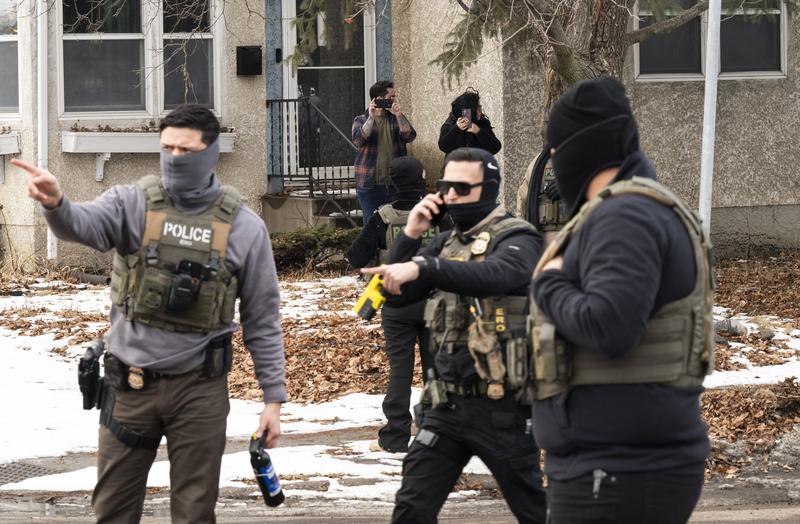
( Stephen Maturen / Getty Images )
Title: The Trump Administration Broadens ICE's Powers [music]
Kousha Navidar: It's the Brian Lehrer Show on WNYC. I'm Kousha Navidar, filling in for Brian today. Happy Friday, everyone. Coming up on today's show, WNYC and Gothamist education reporter Jessica Gould will be here to talk about what it's taking for New York City public schools to comply with the new class size restrictions and why that might include closing some schools.
Fred Kaplan, who writes a column for Slate called War Stories, will update us on the situation with Iran and the buildup of U.S. troops in the Middle East. To end the show today, we want to hear about your Lunar New Year celebrations as we learn more from a Chinese Zodiac expert about what to expect in the Year of the Fire Horse, but first today, immigration.
On Wednesday, the Trump administration issued a memo directing immigration officers to detain lawful refugees who aren't yet permanent US residents. It's the latest policy to limit the legal pathways to naturalizations. In fact, those legal pathways are themselves now ways in which aspiring residents are targeted, arrested, detained, and potentially deported. Much of this work is happening through an agency within the Department of Homeland Security called the US Citizenship and Immigration Services, or USCIS.
For two decades, USCIS was seen as the friendlier side of DHS. It didn't make arrests or participate in sweeps. USCIS officers filed immigration paperwork, conducted interviews, and administered the pathways to citizenship or permanent residency, but as my next guest has reported, the nature of that agency has changed. Aspiring citizens and green card holders, including here in New York, appear at scheduled meetings to move their process along, only to find out they are going to be arrested.
What is going on inside USCIS, and are the legal pathways to citizenship still safe? Joining us is Jonathan Blitzer, New Yorker staff writer and the author of Everyone Who Is Gone Is Here: The United States, Central America, and the Making of a Crisis. Jonathan, welcome back to the show. Hey, Jonathan, you with us? We seem to be having a little bit of a challenge right now, folks, with the audio.
We're going to get that taken care of, but as soon as we get Jonathan on the line, we're going to ask him again about the challenges that we're facing right now across the country with folks who want to have their citizenship pathway be legal, but they are facing challenges. This is the Brian Lehrer Show, and we think we have Jonathan back on the line. Jonathan, you with me?
Jonathan Blitzer: Yes, I am.
Kousha Navidar: Wonderful. It's so nice to have you here. Thanks for joining us. Let's just dive right in. This is a legally complex issue. As a lot of the latest developments center around USCIS, let's start there. Besides the broad strokes I just mentioned about what it does and how it's changing, is there any other context it'd be helpful for listeners to have before we talk about what people are experiencing?
Jonathan Blitzer: Yes. I'll be frank, I didn't catch all of your intro because of some connection issues, but the short of it is that USCIS is the agency in charge of administering the legal immigration system. Anyone who is trying to adjust, normalize, regularize their status, do things the "right way" has to go through this agency. Traditionally, the biggest gripe that people have had with USCIS, by and large, has been that it's bureaucratic, it's slow, but never that it has participated in actual enforcement operations.
What the current administration has done is it has weaponized this administrative benefits agency, and it has turned it into part of the broader anti immigration crackdown. This gives lie to the idea that you've sometimes heard members of the administration say that they're only interested in controlling the border, in limiting illegal migration.
This is the literal legal migration system, and they're essentially using this agency as a kind of trap to lure people to participate in the right ways, to file all of their papers, to come forward to play by all of the rules, and then, nevertheless, they're arresting people, harassing them, targeting them for further abuse and scrutiny. It's quite a sea change, really a profound departure from anything we've seen from past administrations, including from the first Trump administration.
Kousha Navidar: We're going to dive into that a little bit, but there's a lot of human stories behind this. Let's go into that a little bit because you just published an article titled How Legal Immigration Became a Deportation Trap, which you just referred to. You open with Anna, or Anna, a refugee who had all her papers in order and was still arrested in a parking lot. For people who assume if you followed the rules, you're safe, what does her story tell us about whether that assumption still holds?
Jonathan Blitzer: Anna, which I should say is a pseudonym because so many of the people who figure in this story needed protection, because there's now serious and legitimate concern about government reprisals, but Anna is a refugee. She and her family came to the United States through the refugee program. They were resettled from a country in Central Africa where they've been persecuted.
Refugees arriving in the United States are among the most vetted populations of people to come to the US. That is to say, they have gone through biometric scans, they've gone through security checks. They've gone through this full administrative and legal rigmarole. In 2024, Anna and her three kids came to the United States. They were resettled by the Biden administration in Minnesota. She has begun to live her life like anyone would under the present circumstances.
Refugees, when you get refugee status, you essentially have a period of time where you're not allowed yet to adjust your status and apply for what's called a green card, which gives you permanent residency in the country, but being approved as a refugee is a legal status. It is confirmation that you have done things the right way. The government has acknowledged the legitimacy of your legal claim.
What Anna was doing was she was living and working legally in Minnesota. One morning, she shows up in the parking lot of her workplace and realizes that there's a fleet of dark, unmarked cars hovering on the outskirts of the parking lot. When she tries to get out of her car, a group of agents surround her. They're in plain clothes. They're wearing masks. These are agents from ICE, Immigration and Customs Enforcement. They already know her name.
They say they know that she's a refugee. She told me, "Listen, at first, I was obviously bewildered and shocked, but I wasn't ultimately all that scared because I thought, okay, there's got to be some confusion here."
Kousha Navidar: You have your papers.
Jonathan Blitzer: "I have my immigration papers in order." She, like so many people in her position, especially these days, carries those papers on her person. She felt like, "Okay, I can immediately clear up whatever misapprehension there is here." She steps out of the car, thinking she'll have an opportunity to present her papers. Instead, what happens is she's immediately handcuffed, taken into ICE custody for a day in Minnesota, and then, at the end of the day, is flown without any explanation, to an immigration jail in Texas.
Now, during that time, during the day she spent in ICE custody in Minnesota, and then the time she spent, she was basically in a jail cell in an immigration detention center in Texas for five days, no one explained her what was happening. She wasn't allowed to call her family. She wasn't allowed to call her lawyer.
Eventually, she's taken out of her cell and given an interview, which is even more confusing to her, because in the interview, which lasts a couple of hours, this immigration agent, who we now know works for this legal immigration agency, USCIS, basically started asking her a bunch of basic questions that she'd already been through a thousand times, asking what it was that she was fleeing, why she came to the United States, whether or not she would have felt safe being returned to her home country.
She said to me, "Look, I started to get depressed. I started to cry. I could not figure out why they were holding me here." Eventually, after five days, they just walk her to the front of this detention facility, open the gate, let her out, and she's left to her own devices to get home to Minnesota. What we now know that was a part of was a thing called Operation PARRIS, which is an initiative run out of USCIS, the legal immigration agency that has basically targeted 5,600 refugees living legally in Minnesota. The alleged basis for the government's interest in this population is the government wants to be sure that no fraud has been committed during the application process by which these people have come to the United States.
Kousha Navidar: It is a distressing, to say the very least, story. Anna's story happened in a parking lot. But as your article explains, this is happening even at USCIS meetings to talk about getting the visa, getting citizenship. I have to ask, is this happening all around the country, even here at 26 Federal Plaza?
Jonathan Blitzer: Yes, this is happening everywhere in different configurations. Anna is someone who, as a refugee, availed herself of certain legal channels and was arrested as a result of this particular operation, but there are other people who are showing up for utterly routine, prosaic immigration interviews. For example, the spouse of a US Citizen who is going through all of the relevant paperwork to apply for a green card, him or herself.
Those people, when they show up with their US Citizen spouses, whether this is in California, in Ohio, in New York, wherever, are often getting arrested, in some cases detained for a period of time. If these people have good lawyers, they're often released, but then are embroiled in this protracted legal drama. You have other people who are showing up for biometric scans associated with asylum applications. You have people showing up to immigration court.
These are all people, it should be said, who are actually going through the legal process of coming to this country, of making sure their papers are in order. What the administration is increasingly doing through this agency is it is targeting anyone who interacts with the legal immigration system, which basically means that no one is safe.
It is a direct affront to the rule of law because the entire premise of this, and one of the things actually having covered a lot of the Trump administration's most extreme policies during Trump one, the General consensus, legal consensus, was that because we were, in theory, a nation of laws, if someone had a pending legal case before a judge, if someone was going through the appropriate process, immigration authorities couldn't just summarily arrest and deport them.
The idea in the past was, look, as long as you initiated some sort of legal process, you were at least protected because that meant that you were in the process of getting on firm legal footing. Now, anyone seems to be getting targeted at any stage, and people who are trying to do things the right way make a particularly easy target for a lawless administration because these aren't people who are trying to hide. These are people who, by definition, are showing up to try to do everything the right way.
Kousha Navidar: I mentioned earlier, if you follow the rules, you're safe. That assumption, it doesn't quite sound like it holds water anymore. Is that too reductive, or do you think that's a fair generalization?
Jonathan Blitzer: I think that's definitely fair to say. To give you a sense, panning out and trying to gauge what sorts of patterns we're seeing and how generalized this practice is, it's still a little difficult to say. What we're hearing is there are now a number of cases, clear-cut cases of the administration going after people who are doing things the right way, who are engaging with this legal immigration agency, USCIS.
It's now happened to a number of different categories of people. Refugees, asylum seekers, you know, green card applicants. It's happening to people showing up to immigration courts. From my perspective, I guess there are two ways I think about the degree to which we can generalize this as a phenomenon of Trump two. The first is, okay, are there different categories of people who are being affected by this sort of general approach? The answer to that question is yes.
Whether it's a green card applicant, a refugee, an asylum seeker, people are getting trapped in these ways. Then the second question would be, geographically, is this happening in one concerted district of the country? Is this happening in a bunch of different offices? I think now we have sadly enough examples of people being treated this way, whether it's in Minnesota, whether it's in Ohio, whether it's in California, or New York, or Florida, you name it, Texas, to basically, I think, say fairly that this is now, in some form or another, this is happening across the board.
The degree to which this is the norm, I'm not sure, but to give you a sense, one person from California told me-- this is someone who showed up for his green card interview. He was married to a US Citizen. He came to the United States from Mexico when he was 12. That was 10 years ago. He's never left the country. He went to high school in San Diego. He said to me a week before his green card interview, which, by the way, is an interview he and his wife had been waiting a long time to finally have, he gets a call from his lawyer.
His lawyer says, "Listen, I don't yet have clients that this has happened to, but I have been hearing that at some of these interviews, USCIS is coordinating with ICE to arrest people after the interview. What do you want to do?" You take someone like this man who's having now to make an impossible choice. Does he not show up to this interview that he's waited years to have to try to regularize his legal status on the off chance that he might get arrested in the process, or does he just go underground? These are impossible dilemmas for people to have to sort out. The idea from the administration's end is increasingly to efface this dividing line between "unlawful immigration and lawful immigration."
Kousha Navidar: This is the Brian Lehrer Show. I'm Kousha Navidar. My guest is Jonathan Blitzer, staff writer at The New Yorker. We're talking about his latest reporting about how the legal pathways for visas, green cards, citizenship how they're becoming methods to target and possibly deport the very people applying legally. We want to hear from you listening. Have you or has anyone you know been impacted by this targeting?
Maybe you've lost your application suddenly or, like Jonathan was just saying, you've chosen to skip a USCIS meeting out of fear. We'd also love to hear from any immigration attorneys whose clients have experienced what we're discussing. Do you have questions for Jonathan? Call us or text us. We're at 212-433-WNYC. That's 212-433-9692.
Jonathan, I want to go back to something you mentioned before about fraud as being a framework or a reason for this action from the administration. The administration frames these policies as justifiably identifying individuals committing fraud or breaking the law. Operation PARRIS, which you mentioned in Minnesota, was called a war on fraud. Do you have any sense of how much fraud they're actually finding or they actually found as a result of these increased powers?
Jonathan Blitzer: That's a good question. As far as I know, that particular predicate, the idea that they were initiating this operation, Operation PARRIS, in order to root out fraud, is basically completely factless, as far as we know. It's essentially a supposition that if the administration digs deep enough, they will find cases that prove their theory that these legal processes are rife with fraud, but there are no concrete examples that the government, for example, is pursuing.
For instance, in Anna's case, it wasn't like she had done something. She had filled out her application wrong. There had been some sort of administrative error or confusion, or there was someone in her family, maybe, who triggered government suspicions. No such thing. In fact, the aimlessness of the government's questions during her interview with them is specifically the thing that put her off because she couldn't understand why she was there.
If there was a proximate cause for the government's suspicion, at least she could disabuse them of whatever confusion there was. In this case, and as far as I can tell in any of the others, there isn't a solid basis for that. Now, the way the administration tends to do this it's a classic political and highly cynical maneuver where it blows up an individual or particular instance of fraud generally committed by an immigrant, and then it tries to generalize based on that fact.
Specifically, what's happened in Minnesota is unrelated to US Immigration policy and unrelated to all of the things you and I are talking about, about USCIS and the agency in charge of legal immigration and the refugee program and all the rest, there was a statewide investigation and then a national investigation into a group of less than 100, but about 100 Somali Americans who defrauded the state of Minnesota of public benefits.
Now, those people were brought to justice. There was a thorough investigation. There was political fallout. No one is denying that any of those things happened. It's a complicated and messy situation. For the administration, that then becomes an excuse to try to villainize an entire population. That was one of the things, in fact, that brought the administration to send 3,000 federal agents into Minnesota to conduct this immigration crackdown.
Now, again, there was no direct connection between these instances of public benefits frauds at the state level in Minnesota and a wider concern about fraud in the US immigration system. That's not something that the administration particularly cares about. They're assuming that the public's attention is thin and everyone's distractible and that the word fraud kind of seems to suggest lawlessness, and that that's that.
Typically, what we're seeing the administration do is it hunts around for examples of misconduct by an immigrant, and then from there it targets that entire population. There were Somali Americans involved in this particular corruption scheme at the state level in Minnesota. Before long, you see the Somali population writ large in Minnesota getting targeted. You see the Somali population in other parts of the country getting targeted.
The woman, Anna, I mentioned to you, is not Somali. She's from Central Africa, and she was a refugee whose whole story has nothing at all to do with Somalia. Nevertheless, her refugee application was flagged just by virtue of the fact that she had recently resettled in the United States. Now, the reason why the administration is going after someone like Anna is because she is still in this period where she does not yet have a green card.
Even though she is here legally, even though she did everything right, just because of how the law works, just because of how the immigration bureaucracy works, it's going to be at least a year before she can apply and then successfully obtain permanent residency. For the US Government to try to block her or strip her of her legal status, it becomes much harder once she has permanent residency.
The gambit of Operation PARRIS was to try to catch people who hadn't yet normalized their status or regularized their status, because it's much easier for the government to try to create a legal pretext for stripping them of their refugee status before they actually obtain permanent residency, because once they have permanent residency legally, it is much harder for the US Government to strip them of that protection.
That's roughly the logic that we're seeing. Again, I don't think that there are particular cases. I'm sure when you pan out, and you look at how many immigration cases are processed in any given year, there are always going to be one-off examples of whatever the administration is trying to prove, but this administration is basically governing on an assumption that is completely unfounded.
When I spoke to people who worked at USCIS, the legal immigration agency, a lot of them described very concretely being told, "Look, we are preparing a legal memo to justify a whole set of policy changes we want to make and we need you to find evidence of fraud in, and then, you name it, the asylum system, the refugee program. They were basically kind of targeting program after program of legal immigration.
Staffers were instructed to find examples of fraud so that the administration could then devise a policy allegedly aimed at rooting out such fraud. Case after case, these officials described to me, they came back to the administration and said, look, the evidence just doesn't support that. In fact, the evidence supports the reality that there isn't massive fraud in any of these programs.
When this one particular official told me that, she was basically told, you've done a horrible job, we're going to cut your analysis from the legal memo that we're preparing on the subject. Essentially, the government's trying to cherry-pick evidence and/or generate that evidence on its own without any kind of control or analysis in order to justify these wider crackdowns that we have started seeing.
Kousha Navidar: In the meantime, like you're saying, folks are caught in an impossible position to choose legal pathways, which have enormous risk now, or illegal pathways, which leave them vulnerable to the very things that they're trying to fix. I want to bring down a caller before we get to the break. Let's bring down Margo from Atlanta. Margo, hi. Welcome to the show.
Margo: Hey, there. Thank you so much for talking about this. We have partnered with a large family of refugees who arrived here shortly after Christmas, and we've been working on all of the things to do to when the green card application process reopens to be ready. Unfortunately, in Social Circle, Georgia, ICE has just bought a warehouse that is set to house 8,500 people. We really are at a loss, knowing how to support this family now, and wonder if just any of the experience that y' all have had can give us any kind of instruction.
Kousha Navidar: Margo, thank you so much for that call. I want to be clear, we're not lawyers. Jonathan, want to make sure you're not a lawyer, right?
Jonathan Blitzer: Definitely not. Definitely not. No. Thank you for the clarification.
Kousha Navidar: Yes, absolutely. Margo, you bring up such an important point about we are not living in a vacuum. There are communities surrounding these people, and I'm sure a lot of folks are wondering, what can I do? There's no easy answer, I don't think, but I'm sure that you, Jonathan, have heard this question a lot. How do you navigate those conversations? What would you say to Margo?
Jonathan Blitzer: Yes, Margo, thanks for the question and thanks for your advocacy. What I say it's going to sound kind of boilerplate, and I'm sorry if this sounds a little general, but I typically suggest that people speak directly to immigration lawyers to figure out how to plan the next steps and how to do everything as carefully and discreetly as possible. I have to say that experience is a little bit alarming for me as a journalist because typically I refer people who ask me these sorts of questions to immigration attorneys who know better than I.
I think to some degree right now, so much of what we're seeing on a policy level are changes that are completely radical, completely untethered to existing law. Many of them are going to be challenged in court, but in the meantime, the administration charges ahead, which is to say there are a lot of immigration lawyers who themselves aren't totally sure exactly the safest way to play things.
Again, the governing logic during Trump one and pretty much always was try to initiate a legal process so that you have documentation of your case and you have some measure of protection against arbitrary arrest and possible deportation. Now, obviously, we're seeing that that's less clear.
Kousha Navidar: I'm sorry to step in, but I want to make sure that, Margo, you're able to act on this. We do have to take a quick break. What I'd like to do first is to invite any immigration attorneys whose clients have experienced what we're discussing. Please feel free to give us a call. We're at 212-433-WNYC. That's 212-433-9692. Jonathan, sorry to cut you off, but we're going to have to take a quick break. We'll come right back, talk more about your experience, dive a little bit more into the legal argument that we're seeing from the Trump administration. This is the Brian Lehrer Show. Stay with us.
[music]
It's the Brian Lehrer Show on WNYC. I'm Kousha Navidar, filling in for Brian today. We're speaking with Jonathan Blitzer, staff writer at The New Yorker. Changes in the US Citizenship and Immigration Service, which have made it dangerous for people applying for visas or green cards to even show up for their meetings, that's what we're talking about. It's carrying a risk that they will be met by ICE agents, that they'll get arrested and detained.
Now, Jonathan, I cut into you before the break, so I apologize for that, but there was a text that came in that reflected actually a lot of texts that we've been seeing that I'd love to get your perspective on. It's are these all people from countries in Africa, Latin America, Asia? In other words, people of color? Any of them from so-called white countries of Western Europe.
Jonathan Blitzer: Okay, that's a great question. Before I answer the substance of it, because I think, people are right to identify an actual racial agenda in all of this, but I do want to say, just to tie up a few loose ends from Margo's question, one thing that has just been revealed, a DHS memo that was just exposed, but this was something that had been in the works now for weeks, people typically who apply for refugee status when they are granted refugee status, and to be clear, these are people who have waited years and gone through a really long and intense period of scrutiny and bureaucratic back and forth to get there, when they're finally granted that status, the language of the federal statute that describes what they can then do next has always been actually somewhat ambiguous.
It basically says at the end of a year, they must apply for permanent residency, apply for a green card. Now, the phrase at the end of a year has always been up for grabs as a definition, and one of the general tactics of this administration is to seize on any legal ambiguity in these statutes and to try to interpret that ambiguity in the most expansive and restrictive, legally creative, let's say, and policy-wise, restrictive way.
What the DHS has just put out is a clarification now that anyone who has refugee status who has not applied for permanent residency at the end of a year is now subject to arrest. Now, I don't think that that's legal. I'm not a lawyer. I think there's going to be a really spirited and thoroughgoing legal challenge to that, but it's all of these kinds of nuts and bolts that the administration is trying to kind of identify and tighten in different ways to further its agenda.
I think that reflects in an important way a lot of the experience that people like Stephen Miller, the President's chief immigration advisor at the White House, have accumulated over the years. During the first Trump administration, these were not people who had expected to govern. These were people who were interacting with the machinery of the federal bureaucracy for the first time. Now there is a sense of, "Okay, we know more or less where to go and what we have to do to try to prosecute our agenda. Even if that is legally incredibly dubious, we're at least seizing on the particular details in question that allow us to further this agenda."
Kousha Navidar: Then when you hear--
Jonathan Blitzer: I just--
Kousha Navidar: Which is great, great context. When you hear that question about like melatonin or skin color coming into this, or ethnicity, how do you sort that?
Jonathan Blitzer: Then we get to the question of race. I think there are so many ways of characterizing what this administration's immigration policies reflect in terms of racism and white nationalism and so on. I think it's actually fair to say now that that is an explicit part of the US immigration policy.
Certainly those listeners who know enough even to have asked the question are thinking about the fact that at a time when the current administration has drastically cut and essentially put on life support, the refugee program, which typically serves people from countries all over the world, but often countries in the midst of some sort of intense upheaval, the administration has opened up avenues for Afrikaner refugees from South Africa. White refugees who are claiming that they've been persecuted by a racist South African government.
That is very much an explicit part of how this administration is trying to reorder the priorities of US immigration policy. I think, in terms of how the administration goes about targeting particular populations, that also reflects a racial agenda. To be clear, all of the populations we're talking about most frequently these days in terms of people who have been abused, brutalized, mistreated by US immigration agents at any level, we're talking about a list of countries that goes on and on, which we can talk more specifically about.
That includes, for example, Somalis, people from Central Africa, Afghans, Venezuelans. There is a reason why the administration is targeting these particular populations. It has everything to do with race, and it has everything to do with not only a kind of ideology inside the White House, but a really, truly cynical sense of political opportunism that maybe there's enough of the American electorate that shares in some of these racist assumptions about people from these countries that there'll be a allowance of a crackdown on people from these countries.
Kousha Navidar: It does sound like--
Jonathan Blitzer: That's one thing.
Kousha Navidar: Okay, sorry, you're going to say, what's the next thing?
Jonathan Blitzer: The only other thing I want to say, and it's zooming way out, but I think is an important answer or partial answer to the very good question, is, you know, someone like Stephen Miller at the White House has always had a problem with the so-called family-based immigration system. The idea that people who are here can petition family members to apply for green cards and eventually become citizens themselves.
For someone like Stephen Miller, and again, this is not my interpretation, these are the explicit words that he and people in his orbit tend to use, this family based immigration system poses a "existential threat" to the United States, which, to be absolutely clear, is a threat to white America as people like Stephen Miller have understood it. One of the byproducts of this administration's war on legal immigration is to essentially, without Congress weighing in at all, reorder how the immigration system is meant to work.
One of the things that the current administration has done is it has indefinitely paused immigration visas, which is to say applications for permanent legal status for people from 75 countries. The idea behind this is, first of all, to block any kinds of immigration from any of these countries. It's countries that were included in Trump's initial Muslim ban during Trump one, it's countries like Venezuela, Cuba and all of the usual suspects, which is to say, all of the targets of this administration's racial animus.
The broader play there is there is a finite number of family-based green cards that are issued by the US government every year. It's 226,000 green cards issued every year for family-based visas. If those green cards aren't used in a particular year, they can't be reused the next year for that same purpose. There's a long and a little bit--
Kousha Navidar: There's a cap on--
Jonathan Blitzer: Exactly. They essentially die on the vine. Now, those who are really in the know can narrate what happens next. It gets shifted to the employment-based immigration system and from there eventually dies on the vine if they're unused, but the short of it is, this administration is working systematically to block the issuance of green cards to people from these countries.
The broader logic is essentially to wage this war against the family-based immigration system, which is something that, you know, if we were going to have this kind of thoroughgoing national debate about what our immigration policy should look like, in theory, that would obviously involve the US congress and lawmakers, but that's not what this administration is doing. This administration is trying to gum up the administrative and bureaucratic works as a way of unilaterally effectuating this massive policy change, which is motivated in large part by a sense that the immigration system is a threat to white America.
Kousha Navidar: Jonathan--
Jonathan Blitzer: That's my long way to answer--
Kousha Navidar: -let's pause there for a second. Let's go to Scott in Ocean County, New Jersey, who has a personal story he wants to offer. Scott, welcome to the show.
Scott: Thanks for having me on. So my position, and I will say right now that I have great empathy for all of the refugees and the people that are here for economic, whatever reasons. My position is probably a lot safer than many of those. I'm white, green card holder, came here as a child, high school, college. I've worked my entire life in the US.
Recently, I've wanted to apply for citizenship just because of the whole retirement issue and everything else, because I'll probably be here for the rest of my life. Under this administration, my anxiety level about doing anything that would change my status in the country is off the charts. I'm thinking I'm just going to keep my head low and just wait till another administration comes in before I apply for citizenship-
Kousha Navidar: Scott, thank you.
Scott: -because I don't want to have any--
Kousha Navidar: Yes, I totally hear you. There's a real challenge there that we had described. Jonathan, you had described being put in the impossible position. Scott, we so appreciate you taking the time to share on the ground floor what people are really experiencing. Like Scott said, there's a green card holder that has rights that is experiencing this.
Jonathan, I understand that there's also a push for denaturalization, which is stripping citizenship from people who naturalized. The White House is pushing for up to 200 cases a month. Is that legally viable? You had mentioned some target countries already. What countries would be targeted in that sense?
Jonathan Blitzer: It's still a bit murky what's going to happen in this vein, but it is extremely alarming. Essentially, during the first Trump administration, there was a similar push. It wasn't quite as ambitious, and a lot of the players involved weren't as experienced as they are now. It never really came to fruition, but the idea during the first Trump term, and again, this is associated with the likes of Stephen Miller, was to try to find cases where the government could essentially denaturalize a person.
Look at their legal file, find some sort of error in their application, whether it was administrative or bureaucratic or clerical, whatever, and use that as a basis to strip someone of their legal status, of their citizenship. During Trump one, to give you a sense of the numbers, there were only about 100 referrals in the entirety of Trump one. Part of the reason for that was the administration deputized a group of lawyers to oversee that denaturalization project.
The lawyers identified all kinds of legal impediments to actually carrying out the agenda. As a result, you know, it never really came to pass in any kind of major way. That was 100 referrals in the entirety of Trump one. Now, what we're seeing in Trump two are calls for quotas at the legal immigration agency, USCIS, to generate 1 to 200 referrals per month, which is absolutely astonishing and it's almost axiomatic to say that that's a recipe for abuse, for errors, for all kinds of misdeeds.
By contrast to the initial push during Trump 1, when the rough thinking was that there'd be a centralized group of lawyers overseeing that process, what I'm hearing from people inside the agency is this time around, it's going to be much more decentralized. Individual field offices are going to be able to take the lead, individual USCIS officials are going to be able to pursue whatever cases they want.
People inside and recently who've left the agency describe this as probably one of the things that makes them the most anxious and upset. The idea of how far-reaching the consequences of this can be and how many errors and errors of judgment, errors in practice, can actually play out in real time. I asked a number of these officials, "Okay, if this is the administration's agenda, where does one really even start?"
Because one of the strange bureaucratic facts of all of this is when someone is naturalized as a US Citizen, their files get archived. How is the administration going to start to dredge up these old case files? By what logic? By what basis? If they're not pursuing a specific lead, if they don't have specific reason to believe that such person, some individual had committed a crime or had made some sort of error or whatever, how does the administration even begin to find the needle in the haystack of a potentially "fraudulent case?" What this person said to me was essentially the only organizing principle that this person could imagine is a kind of country-by-country review where--
Kousha Navidar: What would those countries be? Would it be the usual suspects? You mentioned Venezuela. Break that down for me.
Jonathan Blitzer: I'm not sure, and I don't want to speak out of turn, and I should say this is all very hazy, and I'm sad to say that we'll probably start to know more in the coming weeks and months, but I think, for example, you know, Afghanistan is a country that has been in the crosshairs a lot from the administration. Late last year, an Afghan asylum seeker shot two National Guardsmen in Washington, DC, and that became the basis for, again, following this general logic of the current administration, a wider crackdown on Afghans in general, even though tens of thousands of them had done everything right legally. This was an aberration, but that became the pretext.
I think that's an example. I certainly think populations like Somali Americans, who we're seeing now in the crosshairs, are going to remain. The administration has always seized on African countries, on Muslim countries, on certain countries from Central and South America. It's very unclear, and I don't want to engage in baseless speculation.
I don't have any particular leads or tips, but essentially, what shocked me was this former official saying, "Look, they're going to have to go--" the only kind of rough organizational premise for how they would carry out this campaign would be to go country by country. I have to say, to Scott's question, it's a completely reasonable approach to want to pause on any kind of dealings with the legal immigration system while there is so much up in the air in terms of how the administration right now is acting.
Kousha Navidar: Jonathan, it really resonates with me personally, because I moved here from Iran when I was one and a half, and I went through the legal process to become a naturalized citizen as a teenager. We don't want to do baseless speculation. From a human angle, there is this looming question of should I be worried, which I am sure has been echoed through everyone that you have talked to, right?
Jonathan Blitzer: Absolutely. I think the legal barrier to the administration doing this is very high. I think there's going to be really coordinated legal pushback all across the country. I think there's going to be political pushback. I have to say, as a journalist covering this stuff, I'm often of two minds. On the one hand, you start to get tips, and you start to get little windows into some of the things that are happening at these agencies, and it's obviously urgent and important to share what that insight is, because I really think this administration is completely unchecked and unchastened about its most extreme urges.
At the same time, this is still early days in terms of what this, for example, this potential denaturalization campaign could look like. My hope in further reporting and in the reporting of colleagues covering this stuff is to try to begin to learn more about what actually is being planned inside these agencies, and what the rough agenda is, but you're right. Part of it, by the way, one of the political byproducts of all of this is, and you've identified it, is precisely to cause fear and uncertainty. That is a political tactic that this administration has made central to its immigration agenda.
On the one hand, it's pursuing this deeply ideological plan. I actually do think there's a degree to which people misunderstand how coordinated and systematic it is, because there's a level of chaos we're seeing on the street every day, which belies this sense that there is a ordered agenda from on high. There is an ordered agenda from on high. Part of the chaos that we're seeing and feeling on a daily level is a deliberate part of that broader political and policy calculus.
Kousha Navidar: We have just two more minutes left, but we got a text that I think is important about Anna, which we mentioned in the beginning. I think this is a good place to wrap up. The question is, please, what happened to Anna after she was just sent out from the Texas prison? She's the woman with refugee status from Central Africa who was taken from the parking lot of her job in Minnesota. Let's use that as an opportunity to wrap up here, Jonathan.
Jonathan Blitzer: Anna was essentially left to her own devices, had to make her way back to Minnesota, ended up hitching a ride with her boss, who found out that this had happened and drove down to pick her up. They came back to Minnesota. She's there with her family now, and she's terrified, as you could imagine. As to what happens to her legally, I'm not sure. She has very good lawyers. She's part of a broader legal campaign.
There's a lawsuit brought against the administration for Operation PARRIS to block Operation PARRIS and specifically to block this practice of arresting people who haven't yet regularized their status as permanent residents. You're already seeing the administration's response to that. They're issuing this memo saying, "Well, actually, technically, the way we're going to read the statute is to say that if you haven't normalized your status at the end of the year, then we can go after you."
That's, as far as I know, illegal, and that's going to be the subject of further litigation. One just on an anecdotal level, very striking thing about Anna here is someone who carried her immigration documents with her everywhere she went every single day, just because that was her habit of mind, given what she and her family had been through and the fact that she'd finally arrived safely in the United States.
When she was arrested and detained, and sent to Texas, the government confiscated those documents, and she has not gotten them back. I think in a way that's both on a visceral level, terrifying to think about, and also symbolically, I think, a dangerously and tragically apt summary of what we're seeing. Here are people with papers that the government is confiscating to try to efface any record of people doing things the right way.
Kousha Navidar: We have to leave it there for now with Jonathan Blitzer, author of Everyone Who Is Gone Is Here: The United States, Central America, and the Making of a Crisis. Your latest piece in the New Yorker is How Illegal Immigration Became a Deportation Trap. Jonathan, thank you so much.
Jonathan Blitzer: Thanks for having me.
Copyright © 2026 New York Public Radio. All rights reserved. Visit our website terms of use at www.wnyc.org for further information.
New York Public Radio transcripts are created on a rush deadline, often by contractors. This text may not be in its final form and may be updated or revised in the future. Accuracy and availability may vary. The authoritative record of New York Public Radio’s programming is the audio record.