
The Supreme Court Hears Arguments on Tariffs
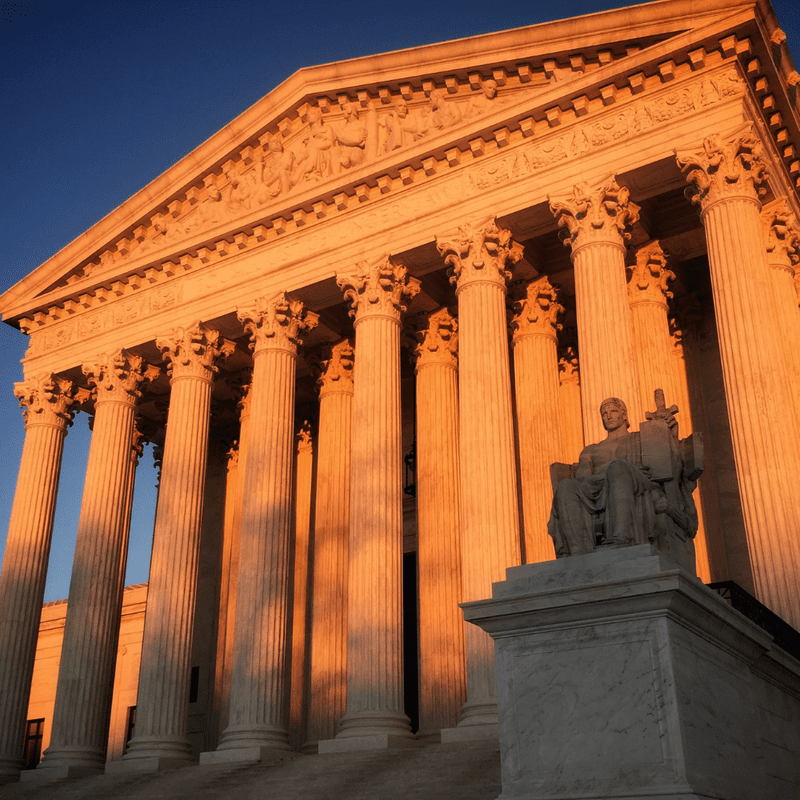
( Courtesy of WNYC Studios The Takeaway )
Brian Lehrer: Brian Lehrer on WNYC. Oral arguments at the Supreme Court over the legal basis of the Trump administration's tariff policies. Since the start of Trump's second term, as many of you know, the President has made tariffs central to his strategy to raise revenue for the country. That's one reason, but also bring manufacturers back to the United States. That's the one he generally leans on, but also, as many of you already know, to put pressure on the leaders of both friendly and adversarial nations alike to do whatever he wants them to do.
Not just on trade, but to bend to his will on many kinds of things, even domestic politics in their own countries, where the tariffs are, in effect, just a fine for not obeying in advance. The legal foundation for these tariffs is a question. The Constitution gives Congress the power to impose tariffs explicitly. Trump invoked emergency powers under a 1977 law that has never before been used to impose tariffs, in which he argues that Congress delegated tariff powers to the President.
Now, during nearly three hours of oral argument yesterday, the court appeared deeply concerned with Trump's reliance on this law, with even several members of the court's conservative wing picking apart the administration's position in a case that could have sweeping implications for the economy and also democracy, particularly presidential power. We're going to hear a little of Justice Gorsuch. We're going to hear a little of Chief Justice Roberts, as joining me now with analysis of the oral arguments heard by the Supreme Court is Aziz Huq, professor of law at the University of Chicago Law School and author of The Rule of Law: A Very Short Introduction. Professor Huq, always good to have you on the show. Welcome back to WNYC.
Professor Aziz Huq: Thank you so much for having me again, Brian.
Brian Lehrer: Let's start with that 1977 law at the center of this legal battle. What does the International Emergency Economic Powers Act of 1977 allow the President to do?
Professor Huq: The 1977 law, which is usually called IEEPA, allows the President to regulate the importation or exportation of property if the President declares that there is an unusual and extraordinary threat. The principal issue in the case before the court was what the words regulate the importation means, and whether it allows for the tariffs that Mr. Trump has used. A secondary question in the case is whether there was an unusual and extraordinary threat that constituted an emergency that allowed him to exercise that power.
Brian Lehrer: Why did the Trump administration invoke this law as the legal basis for the tariffs we've seen imposed over the last 10 months? Did he have to try to convince the court yesterday or his solicitor general on his behalf that we are in some kind of state of emergency that's really warranted?
Professor Huq: The court yesterday focused on the question of whether the statute allows for tariffs as a species of regulation. There was some discussion, particularly from the liberal justices, Justices Kagan, Sotomayor, and Jackson, of whether the unusual and extraordinary condition was met. For example, the basis of the April 2nd worldwide tariffs was the fact of a trade deficit.
The United States has run a trade deficit since 1974, and it's basically been stable for the last 12 years. My suspicion, based upon the oral argument, is that the court is going to end up deciding this case based upon whether it thinks that the tariffs are a legitimate example of regulation of importation, not on the basis of whether there is or is not an unusual and extraordinary threat.
Brian Lehrer: Can you, in that context, address the issue of whether Congress has delegated the power to the President? I think that's a major point of argument by one side or the other that Congress has delegated. Yes, the Constitution says Congress has the power to impose tariffs. Is this the same thing as you were just talking about, what constitutes an emergency, or is there something else here that's been argued with respect to whether Congress has, in fact, given away that power that it has in the Constitution?
Professor Huq: I think it's useful to answer your question by distinguishing two requirements that the statute imposes. The first requirement is there has to be the right kind of emergency. On that point, the government leans into a series of earlier cases in which courts have basically said, "We're going to defer to whatever the President says is an emergency."
The second question that the government has to win on is, even assuming it is an emergency, the government has to be able to persuade the court that the statute in question here, when it uses the word "regulate imports," allows the President to impose tariffs, levies on goods coming into the country. The constitutional question comes in because Congress has both the power to regulate foreign commerce and also the power to impose taxes, although it has delegated some measure of that power when it enacted IEEPA in 1977.
There is at least an argument that, because Congress did not use the specific word "tax" or "tariff" in the statute, the court should not read the generic word "regulate" to include the power to tax. Why is that? Because a background structural assumption of the Constitution's design is that it is up to the elected representatives in Congress to decide when and how Americans pay money directly to the government.
Because of the sensitivity of taxation as a question of public policy at the moment of America's founding, the argument goes, the court should be extremely reluctant to read a statute that does not use the word "tax" to allow the President to spring unexpected, novel species of taxations upon Americans. That seems to be an argument that resonated with a number of the justices, including conservatives such as Justice Gorsuch.
Brian Lehrer: We're going to play a Justice Gorsuch clip right now, 45 seconds of him questioning the US solicitor general, John Sauer, who was there on behalf of the Trump administration. This, I think, is where it gets even more broadly into the question of presidential power. Of course, that's a concern for so many Americans who are skeptical of Trump right now.
How much is he becoming an authoritarian where whatever Congress does, even maybe potentially whatever the courts do, don't actually matter? One of the core arguments that we heard from the administration is that the court should defer to the President because tariffs are a matter of foreign policy, in which the President does have expansive powers in the Constitution. Here's 45 seconds of that, beginning with Justice Gorsuch's question.
Justice Neil Gorsuch: You say we shouldn't be concerned because this is foreign affairs, and the President has inherent authority, and so delegation off the books, more or less. What would prohibit Congress from just abdicating all responsibility to regulate foreign commerce, for that matter, declare war to the President?
Solicitor General John Sauer: We don't contend that he could do that.
Justice Neil Gorsuch: What's the reason to accept the notion that Congress can hand off the power to declare war to the President?
Solicitor General John Sauer: Well, we don't contend that again.
Justice Neil Gorsuch: Well, you do. You say it's unreviewable. There's no manageable standard. Nothing to be done. Tell me if I'm wrong. You backed off that position.
Solicitor General John Sauer: Maybe that's fair to say.
Justice Neil Gorsuch: Okay, all right. Thank you.
Solicitor General John Sauer: That would be an abdication.
[laughter]
Solicitor General John Sauer: That would really be an abdication, not a delegation.
Brian Lehrer: Wow. It's incredible to me, Professor Huq, that they got all the way to, can the President declare war, which is explicitly a congressional authority in the Constitution, without going to Congress based on what he's doing now with respect to tariffs? Even conservative Justice Gorsuch thought that they were heading there. How did you hear that exchange?
Professor Huq: I think that that exchange bears upon two arguments that the government's making, but it's also an exchange that has to be understood against the light of the fact that the administration is using military force against what it describes as narcotics smugglers in the Caribbean and the Pacific in a way that at least looks like an unauthorized, by Congress, employment of the armed forces.
Justice Gorsuch's question, surely he knows, is not one that is out of context at this present moment in time. I think in terms of the tariffs, there are two arguments that implicitly were at stake in that exchange. The first is the idea that, regardless of what statutes say, the President has some sort of inherent foreign affairs power, not written in the text of the Constitution, that allows him to impose tariffs. That exchange, I think, punctured that claim of inherent authority.
The second argument that Gorsuch was probing there concerns a doctrine called the anti-delegation or the non-delegation doctrine. This is the idea that when the court confronts claims by the administration, this or another one, to read a statute in some way that is expansive, that gives enormous kinds of discretion to the presidency, that kind of broad delegation of authority is impermissible because it flies in the face of the separation-of-powers allocation to Congress of the authority to make meaningful public policy choices. Gorsuch has been an advocate of this non-delegation doctrine, but there have always been arguments that there is an exception to non-delegation for foreign affairs.
I think what happened in that back-and-forth was that Gorsuch was signaling his view that, look, even if there is an exception for foreign affairs, in this instance, when you're increasing the amount of effective tax paid by Americans in that by the order of not tens but hundreds of billions of dollars a year, it is implausible to describe this as a matter of foreign affairs. I think that what happened in that exchange was two distinct arguments that the administration was making were both punctured, and perhaps punctured by somebody they didn't expect to do the thrusting there.
Brian Lehrer: Before we play our clip of Chief Justice Roberts questioning Solicitor General Sauer, I wonder if you have a take on the largest possible implications of the results of this case, because I've heard some analysts, and maybe this is from watching too much cable TV on this, but who put it in really sweeping terms like, "This is the most important Supreme Court case on democracy in 100 years," things like that. I wonder how much you think this case, in particular, as opposed to all the others that have been coming to the Supreme Court around presidential powers and Donald Trump, sets an important line that goes beyond the question of tariffs.
Professor Huq: I do not think that this is the most important case concerning democracy that even the Roberts Court has heard and decided. Likely, that laurel goes to the presidential immunity case from last year, which, as we have already seen with the prosecutions of James Comey and others, has had, I think, tremendous negative consequences for democratic governance in the United States already.
I think that the importance to democracy of the tariff case is subtle and complex. It's subtle and complex because there are a range of different ways in which the court could decide this case. It could decide this case just by reading the word "regulate imports" narrowly in IEEPA, or it could do something more sweeping, like, say, that Congress cannot delegate certain kinds of decisions to the President.
To my mind, the most immediately important question here that the court could have decided, but it looks like it won't decide, is the question whether the President has unfettered power to say, "This is an emergency and, therefore, I can tap into this emergency power." To see why that question is important, consider another use of emergency powers that President Trump has employed.
His invocation of the 1798 Alien Enemies Act, which he has used as a basis for process-free deportation of individuals, principally Venezuelans, to the CECOT prison in El Salvador, where they are detained under inhumane conditions that almost certainly violate both domestic and international law. Had the court, or if the court had said, "Yes, you have the power to impose tariffs, Mr. President, under IEEPA," it would have to then say, "And also, yes, Mr. President, this is an extraordinary and unusual condition, the fact of a trade deficit."
If the court does reach that second question, the question of whether there's an emergency, and if the court defers to the quite extraordinary claim that a trade deficit that lasts for 50 years is an "unusual and extraordinary threat," then it's basically said, "You, the president, can declare an emergency under these statutes at any time you want, and then tap into the extraordinary powers that are available under emergency statutes in American law." That, I think, would be an extraordinarily risky proposition for American democracy.
Brian Lehrer: Then he could, as he has tried to do in some cases, declare an emergency on immigration, as you say, not just on tariffs. Maybe he'll declare an energy emergency. He may have done some version of that and try to use it to break our treaty obligations with respect to climate, things like that. Did I hear you say the Supreme Court, you think, is going to decide this case more narrowly, and they're not actually going to determine the range of emergency powers that Trump could declare?
Professor Huq: If the court says that IEEPA does not permit the imposition of a tariff, it does not need to get to the question whether IEEPA's trigger condition is there an unusual and extraordinary threat is met. If they don't need to get to that question, I sincerely doubt that they will. There are other cases in the litigation pipeline that pose the same question of whether an emergency power can be triggered. The Enemy Aliens Act is one of those cases. The cases concerning the National Guard, for example, the case that was decided by the Ninth Circuit, the case that is currently on the court's emergency docket concerning my own city, the city of Chicago.
Although the narrow statutory question at issue in those cases is it's not quite the question of whether there is an emergency, it is very close to that question. If the court were to decide one of those cases and say, "Well, we are simply going to defer to the President's determination," let's say that Chicago is a hellhole where people cannot walk the street safely and, therefore, you can use the National Guard, that expression of deference to the President, whether it comes in the tariff case, whether it comes in the enemy alien case, whether it comes in one of the National Guard deployment cases, would be extraordinarily significant and would have, in my view, quite damaging consequences for the balance of power and the constraints upon the President's ability to use coercion against Americans.
Brian Lehrer: Really interesting, really important. All right, one more clip on another really interesting aspect of this case, the tension in these arguments over whether tariffs, which technically are imposed on foreign countries, are really taxes on Americans. Chief Justice Roberts pressed the administration's lawyer on exactly who pays these tariffs. Let's listen to some of the exchange, beginning with Trump's Solicitor General, John Sauer.
Solicitor General John Sauer: The notion that the taxes are all borne by Americans that are not borne by foreign producers whose goods are imported, there's no basis for that in the record. It's actually a mix--
Chief Justice John Roberts: Who pays the tariffs? If a tariff is imposed on automobiles, who pays them?
Solicitor General John Sauer: Regardless of what the importer of record is, there'd be a contract that would go along the line of transfer that would allocate the tariff and there'd be different-- Sometimes the foreign producer would pay them. Sometimes the importer would bear the cost. The importer could be an American, could be a foreign company. A lot of times, it's a wholly-owned American subsidiary of a foreign corporation, so it gets allocated. The empirical estimates range from 30% to 80% of how much is borne by--
Chief Justice John Roberts: It's been suggested that the tariffs are responsible for a significant reduction in our deficit. I would say that's raising revenue domestically.
Brian Lehrer: Domestically. As we start to run out of time, Professor Huq, it's a question that's relevant to Americans' pocketbooks and whether President Trump is lying to us that foreign companies or foreign countries are really paying these tariffs when, really, the cost ultimately gets passed along to buyers in this country. That's an economics question and a political question. Why does it matter constitutionally whether they're paid by Americans versus foreigners by the Supreme Court, whether it's seen that way by the court?
Professor Huq: In this case, the individual companies that brought this suit, VOS Selections, Learning Resources, are all American companies that have alleged, without being contradicted, that they are the ones paying these tariffs, not some upstream foreign entity that produced the goods in question, in a sense that this entire back-and-forth blinks the fact that we actually know who is paying the tariffs in these cases.
More broadly, Chief Justice Roberts' question is getting back to this sensitivity that the framers had about the imposition of taxes without legislative deliberation on Americans. He's getting at the fact that, look, whether it is the company doing the importing or whether it is the foreign producer. At the end of the day, whether it's today or whether it's a year from now, those costs will not be absorbed by the producer or the importer in competitive markets. In competitive markets, at some point, those costs are going to get passed on to the consumer. By definition, the consumer is an American.
Brian Lehrer: Last question. This terrorist regime, with its implications for inflation in this country and other things, are galloping along. The Supreme Court heard this case yesterday. Are we going to have to wait until next June, when they tend to hand down most of the major decisions from the term before we know whether the tariffs can continue as Trump wants to impose them?
Professor Huq: It's impossible to know when the court will hand down this decision. I think that there are two factors that cut in different directions. The first is if oral argument is evidence, then it seems that even if there is a majority of the court that is willing to invalidate the tariffs, the majority may not agree on the basis for that invalidation. There may be three votes for the idea that the word "regulate" does not include the power to impose tariffs.
There may be two further votes for the idea that the statute does allow for tariffs, but that would be an impermissible delegation. If there's a division of that kind, it means that the opinions will take longer to write because there'll be some negotiation over exactly what they say. On the other hand, as Justice Barrett noted in oral argument, under existing statutory law, people who have paid, importers who have paid tariffs can claw back those tariffs under certain conditions.
There is a complex statutory framework that governs such clawbacks. The longer that the court waits, the longer or the greater the tally of money that is flowing from private coffers into the government's purse, and then has to be pulled out of the government's purse and reapportioned to importers. That will be an immensely complex and costly process, a process that's made even more complex and costly if the court takes until June as opposed to three or four months to decide this case.
Brian Lehrer: Aziz Huq, professor of law at the University of Chicago Law School and author of the book The Rule of Law: A Very Short Introduction. Hopefully, Professor Huq, you won't have to write a sequel called The Rule of Law in the United States: An Epilogue. Hopefully not, right? Thank you very much for joining--
Professor Huq: Fingers--
Brian Lehrer: What were you going to say?
Professor Huq: Fingers crossed. Thanks. Fingers crossed. Thank you so much, Brian.
Brian Lehrer: Thank you.
Copyright © 2025 New York Public Radio. All rights reserved. Visit our website terms of use at www.wnyc.org for further information.
New York Public Radio transcripts are created on a rush deadline, often by contractors. This text may not be in its final form and may be updated or revised in the future. Accuracy and availability may vary. The authoritative record of New York Public Radio’s programming is the audio record.
