
The Push for Junk Food Warning Labels in New York State
[music]
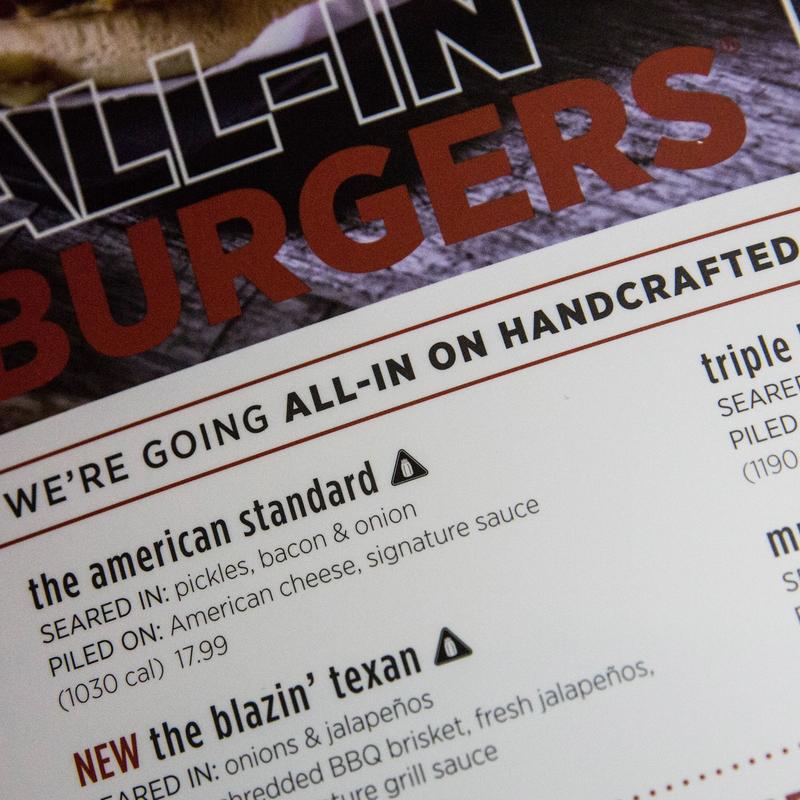
Brian Lehrer: Brian Lehrer on WYNC. If you've been to a fast food restaurant in New York City recently, you may have noticed a little triangle on the menu next to certain items. Some have a salt shaker. Others have a tablespoon of sugar. Those are warning labels indicating a dish has more sodium or added sugar than you should probably eat in an entire day. New York City implemented the country's first added sugars warning labels at chain restaurants last October. Meanwhile, the sodium warning labels were adopted back in 2015.
Now, the health commissioner who oversaw the city's rollout of sodium warning labels is arguing for a set of bills that state lawmakers are considering that would put similar warning labels on junk food at chain restaurants across the state and limit how that food is marketed to kids. Three bills, they're called the Sodium Warning Bill, the Sweet Truth Act and the Predatory Marketing Prevention Act. With me now to make the case for these bills is Dr. Mary Bassett, Public health physician, former New York City Health Commissioner and New York State Health Commissioner, and professor of practice of Health and Human Rights at the Harvard T.H. Chan School of Public Health. Dr. Bassett, always good to talk. Welcome back to WYNC.
Dr. Mary Bassett: Thanks very much for having me, Brian. Pleasure to be here.
Brian Lehrer: By way of background, you were the New York City health commissioner when the city rolled out sodium warning labels back in 2015, the first policy of its kind in the country, I believe. What does the city already have, and how would the sodium warning bill go further?
Dr. Mary Bassett: Of course, New York City has long pioneered giving people more information about the food that they eat in fast food chains. That began with the calorie posting. That was back in 2006 under Tom Frieden and the Bloomberg administration, and followed later in terms of warning labels with a sodium warning label that you've just described. New York City has done both of these things, warned about added sugar and warned about the added sodium in our diets. Both of these are important drivers of what we call diet-related diseases. They drive overweight, obesity, diabetes. They drive high blood pressure, dental decay, which having dental caries has broader effects than just ruining your teeth.
These are important health issues and ones that are preventable. That's why I'm very much hoping that the state acts to take these out of committee and bring the information that New York City residents already have to the rest of the state. Now, the predatory marketing bill really is an ambitious and important bill because it talks about how children are targeted not just on television and in stores, but on social media and encouraged to badger their parents for food. This would empower the attorney general to take actions to protect children from marketing foods directly to them that aren't good for them.
Brian Lehrer: We'll talk about that in some more detail as we go. Listeners, do you pay attention to warning or nutrition labels on packaged foods or in restaurants? If not, why not? Or do you have a question or a comment on the three bills now before the New York State Legislature that our guest, the former Health Commissioner Mary Bassett, is advocating for? 212-433-WYNC, 212-433-9692. You can call or you can text. Again, they are the Sodium Warning Bill, the Sweet Truth Act, and the Predatory Marketing Prevention Act.
I want to get into whether these warning labels have any effect. I do see a 2023 study in the American Journal of Preventive Medicine found that added sugar warning labels reduced the likelihood that consumers would order high sugar items. I also see earlier real world studies of New York City's sodium label found limited changes in what people actually ordered. To what extent do you think these warning labels really change our habits?
Dr. Mary Bassett: The first thing to say about these is that having information is part of being a good democracy. If people don't have the information, they have no opportunity to use it. I don't think that it's necessary to prove that there's a direct health impact to argue that we should provide this information so that people can use it. It's available to them. As you point out, the information has been mixed.
There has been some evidence that the sodium warning labels have driven down rates of high blood pressure. There have been some there's some evidence, and this would include calorie posting, that people just go ahead and order what they usually order without paying attention to this. The point here is that information enables people to use it and without it, they don't even have that opportunity.
Brian Lehrer: Let me ask you about why the sodium bill hasn't passed yet, because I see that it's been introduced in Albany every session since 2015 and hasn't passed. Who fights effectively against it? Is there a lobby group for Big Sodium?
Dr. Mary Bassett: I don't know the specifics for the New York act, but I can tell you that my experience in New York City is that Big Food is quite an adversary, much more powerful and with much more resources at their disposable than Big Tobacco. They fought New York City on every single one of these bills. I expect that basis of their contention will be much as it always was, that you're making us say things we don't want to say, and the other, that the federal guidance is enough for people.
I think that in general, the food industry has resisted these. Of course, predatory marketing would be a truly pioneering act, and I expect that would be contested. While I can't tell you exactly what has happened in the New York State Legislature, I would assume it's the same dynamics.
Brian Lehrer: You don't have a take on whether this year might be politically different to allow it to pass?
Dr. Mary Bassett: I would hope it is because it's the right thing to do for public health. I think the measure that we should all use is whether these measures would advance public health. It takes time. It took a while for the added sugar to be made into law in New York City. The state has the city to use as an example. It's not as though fast food chains have been driven out of business. I'm hopeful that the legislature will act in the interests of New Yorkers. Also, I guess we haven't really mentioned this, but the adverse impact of too much salt, too much sugar have been disproportionate. That's why I wrote the letter to the caucus of Black, Puerto Rican, Hispanic--
Brian Lehrer: I was just going to ask you about that because. Yes, your letter was to the Black, Puerto Rican, Hispanic & Asian Legislative Caucus urging them to prioritize this package of bills. Take us a little bit more into that, why it would be of particular public health interest to them.
Dr. Mary Bassett: Because of the excess burden of these preventable chronic diseases that are diet-related among people of color. For example, Black, Latino and Asian New Yorkers are about twice as likely to have diabetes as white New Yorkers. Diabetes is too common and it's become increasingly common, driven largely by the obesity epidemic, but it disproportionately occurs among Blacks and Latinos. That's why I'm hoping that these representatives, mindful of their constituencies and their obligation to protect them, will seize the moment and take these bills out of committee.
Brian Lehrer: Do you have a take as a public health expert on why those diseases are more prevalent in those communities?
Dr. Mary Bassett: There's a really substantially disproportionate marketing of these foods in these communities. When you think about it, fast food is often a good buy on a per calorie basis. There was a researcher at the University of Washington and right now I just can't recall his name, but he told me-- he made the statement that if you look at the weight distribution of your workforce, I'll tell you if they are making a living wage.
For low income individuals, fast food may be a good buy. People are not only pressed for money, they're pressed for time. Fast food is also quick and easy after a long day to come home with already prepared food is increasingly a way people eat. We eat over half of our calories from processed and prepared foods. It's not only that it saves money, it saves time, and disproportionately, these are are factors that drive the lives of people of color.
Brian Lehrer: Listeners, who has a story about helping your kids read nutrition labels and warning labels when they go out to restaurants, especially fast food restaurants? Here's a text, folks. Listener writes, "I agree with your guest that the information-- Oh, that's the wrong text. I'll read that one in a minute. Listener writes, "Both of my son's seventh grade science teachers spent one class discussing food labels, ingredients and expiration dates and it made them and me aware of these things forever," writes Louise in Manhattan.
What about you, listeners? Because so much of this is aimed at children as we've been discussing. Do you educate your kids about warning labels, about nutrition labels? 212-433-WYNC, 212-433-9692. Call or text in addition to how they affect your own behavior as we continue with Dr. Mary Bassett, the former health commissioner of New York City and New York State, now at the Harvard School of Public Health as she advocates for three bills in front of the New York State Legislature, the Sodium Warning Bill, the Sweet Truth Act, and the Predatory marketing prevention Act. Dr. Bassett, here's that other text. Listener writes, "I agree with your guest that the information should be available. However, who bears the cost of analyzing all these menu items?
Dr. Mary Bassett: Huh. These data were already available when I was commissioner. They just weren't readily accessible to the public. The reason that these bills, the Sweet Truth Act and the Sodium Warning Bill, focus on food chains is that they use standardized recipes. They already know the composition of their food and its calorie content. It was simply a matter of directing them to make it publicly available. This is something that the companies already do. I wouldn't begin to be able to measure the calorie content of what I cook at home, but these are standardized recipes.
Brian Lehrer: Sharon in New Rochelle, you're on WYNC with Dr. Bassett. Hi, Sharon.
Sharon: Hi, thank you for taking my call. A couple of questions. One is, despite somewhat weak evidence on showing consumer purchasing habits with labeling, my understanding is that industry formulations have changed somewhat. I have a second question, which is I think England has been trying a 10-year plan of reducing sodium in the food system. It was voluntary. I'm wondering if you know anything about the outcome of that.
Dr. Mary Bassett: Thanks for pointing that out. I should have mentioned it that certainly when the calorie information first came out, some of the offerings, they really had sticker shock and they reformulated. I remember in particular Starbucks reformulated some of its very caloric pastries. The hope is always that there will be reformulation. There was a large effort in the UK to limit the amount of sodium in processed and prepared foods. In the UK, a big source of sodium in the diet was from bread, for example. They worked with the industry, and New York City undertook the same kind of effort. I don't know where it stands now.
To say that within a sector all of you should be able to lower the sodium content of your food, and the one with the lowest sodium should set the goal for everybody else. There was an industry effort to participate in this. I think we shouldn't assume that industry wants people to become obese or have high blood pressure. The UK example was a very important example. Finland also managed to greatly reduce the sodium content of its food. We can do this. Just giving people the information is a pretty modest first step towards thinking about how we think about the safety of our food.
Brian Lehrer: Sharon, thanks for your call. We've been talking mostly about the warning label bills for sugar and for sodium. I want to make sure we give a few minutes to the third in this trio of bills that you're advocating for, the Predatory Marketing Prevention Act. I could argue that this would be more important than the product labeling ones because labeling puts responsibility on the individual when what would really matter is something more structural to limit the power of the fast food or processed food industry with all its saturation advertising and marketing clout that you referred to before. Do you think of this at all in that way?
Dr. Mary Bassett: Yes, absolutely. I think of it as a good thing to have sodium information and the added sugar information. This would really be an important way of protecting our children. Remember that people eating habits are established fairly early in life. From early childhood, kids are bombarded with messages about fast foods and encouraged to pester their parents to let them eat fast foods.
This is disproportionately targeting Black children, is what I have the data on, who are exposed to 75% more fast food aids than white children. I think empowering the Attorney General to address this deceptive youth-targeted marketing and hold companies accountable would be a terrific step forward in having a safer food supply.
Brian Lehrer: Listener writes, "When shopping, I noticed this subset of shoppers who are very careful to purchase what they consider healthy. Regardless of the contents, a green box is selected, almost too easy for evil junk food marketers. Any education, including labels may help." Is that an aspect of predatory marketing that the bill would get to at all? Deceptive labeling to make things look healthy, including green colored boxes, when the contents really aren't?
Dr. Mary Bassett: That's interesting. I hadn't heard about just the color being deceptive. That might be a hard one to make the case for. Certainly, the Attorney General would be empowered to interpret deceptive and to take the companies to task. I think we all remember when the front of package labeling was all 100% trans fat free, when it was full of added sugars, using labeling to portray it as a healthful product when the product was not.
Brian Lehrer: We still probably have that with organic, for example. Something might have an organic label, but still have a lot of organically grown sugar and salt.
Dr. Mary Bassett: Right. Exactly. I think it would be a really good foray. I'm sure it would be challenged in the courts. It's time to start thinking about what it means to protect our food. For decades, this meant making sure that the additives were safe or that it wasn't contaminated with bacteria. Now we have to think about there being too much sugar, too much salt, too much of it, too caloric. That should go into how we think about the safety of our food in modern times.
Brian Lehrer: One more call. Anna in Chelsea. You're on WYNC with former New York City and New York State Health Commissioner Dr. Mary Bassett. Hi, Anna.
Anna: Hi. Thank you so much both of you for this conversation, all your work, both of you. Big fans of both of you. I just want to say I run a health literacy nonprofit that's based in New York City. One of the things that we talk about with our frontline health and social service professionals is how hard it is for just a regular person with average literacy skills to be able to enact their low sodium diet, to find sodium on a food label, to be able to interpret how much it is, to be able to guess how much sodium they've already had, how much they can have in this one--
These are complicated literacy skills people need to be able to read food labels and apply them to their lives. I think that there is so much more that can be done on the food supply side to make things easier for people to make healthy choices. I super applaud these bills as a [unintelligible 00:20:41] to that.
Dr. Mary Bassett: I know.
Brian Lehrer: Anna, thank you very much.
Dr. Mary Bassett: [unintelligible 00:20:45]
Brian Lehrer: Last thought, Dr. Bassett, then we're out of time?
Dr. Mary Bassett: Just to point out that the recommended intake of sodium is about a teaspoon of salt. Just keep that in mind, about a teaspoon of salt.
Brian Lehrer: Per day.
Dr. Mary Bassett: I'll leave it at that. These are things that are best addressed, as you suggested, Brian, by reformulation. In the meantime, let's at least give people information.
Brian Lehrer: Dr. Mary Bassett, Public health physician, former New York City and New York State Health Commissioner, and professor of practice of Health and Human Rights at the Harvard T.H. Chan School of Public Health. She's been here to advocate for three bills before the New York State Legislature, the Sodium Warning bill, the Sweet Truth Act, and the Predatory Marketing Prevention Act. Thank you so much for coming on again, Dr. Bassett.
Dr. Mary Bassett: Thanks for having me.
Copyright © 2026 New York Public Radio. All rights reserved. Visit our website terms of use at www.wnyc.org for further information.
New York Public Radio transcripts are created on a rush deadline, often by contractors. This text may not be in its final form and may be updated or revised in the future. Accuracy and availability may vary. The authoritative record of New York Public Radio’s programming is the audio record.