
The New NYC Comptroller(-Elect)
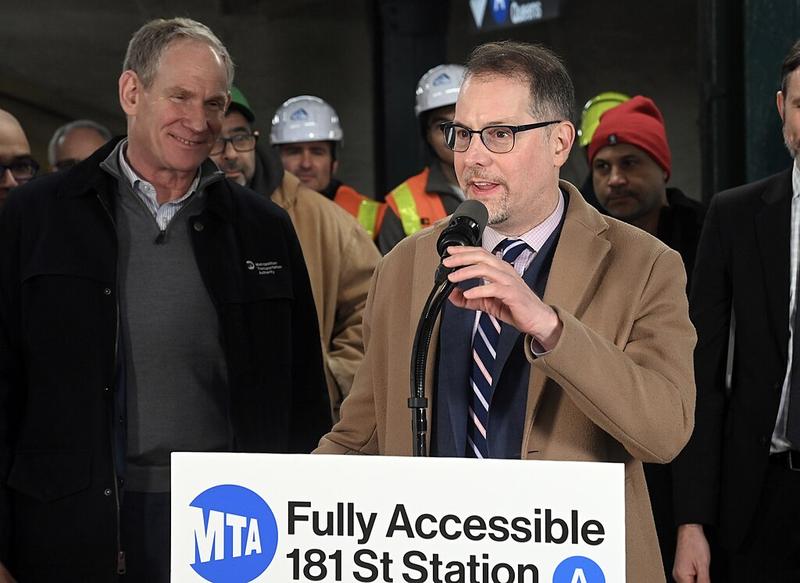
( Metropolitan Transportation Authority from United States of America / Wikimedia Commons )
[music]
Brigid Bergin: It's the Brian Lehrer Show on WNYC. I'm Brigid Bergin, senior reporter in the WNYC and Gothamist newsroom, sitting in for Brian today. Manhattan Borough President Mark Levine joins us now after his resounding victory in the race for New York City comptroller on Tuesday. He won the Democratic primary in June and faced little competition in the general election from two candidates on the Republican and Independent party lines. With this general election victory, he moves to a citywide office that's often considered a check on the mayor's office.
That new mayor, Zohran Mamdani, ran on a pledge to address the city's affordability crisis with some pretty sweeping policy proposals that will likely involve some serious investments. As the person charged with minding the city's municipal fisc, that could be a source of some tension in the new year. There are also looming cuts from the federal government in major negotiations with the state as another election battle heats up over who will lead Albany next year. Joining me now to talk through all of these issues and more is Manhattan Borough President and Comptroller-elect Mark Levine. Welcome to WNYC. Congratulations.
Mark Levine: Oh, thank you so much, Brigid. I'm thrilled to be here and really grateful for this opportunity.
Brigid Bergin: Listeners, we can take a few of your comments, questions, or concerns for the comptroller-elect. You can give us a call now. The number is 212-433-WNY. That's 212-433-9692. You can also text that number. Comptroller-elect, you and Mayor-elect Zohran Mamdani cross-endorsed one another during the campaign. Before we get into your new job, what's your take on Mamdani's victory and just the race in general?
Mark Levine: First, I want to acknowledge that this is historically a very significant moment for the city to have elected the first Muslim and first South Asian mayor. I sincerely congratulate Mayor-elect Mamdani on this victory. I'm proud of New York that we've achieved this milestone. That's not to say that we agree on every policy issue. In fact, I think you want a comptroller who works with the mayor on common goals. We share many, but also brings accountability, who is willing to push back when necessary. That really is what it means to be an independent comptroller. I've pledged to be exactly that kind of comptroller in this critical office.
Brigid Bergin: We saw some very wealthy New Yorkers spend a whole lot of money to keep Mayor-elect Mamdani out of office. Do you have any concerns about businesses leaving New York?
Mark Levine: It is extremely important that we remain economically and fiscally vibrant in New York. That requires us being a place where businesses want to locate and invest and expand, and hire people. As comptroller, I'm going to work very, very hard to ensure that New York remains economically vibrant. I don't take it for granted for a lot of reasons, one of which is that we have an assault on the economy by Donald Trump, who, through his crazy tariff policy, through his attacks on tourism by literally stealing money from New York City's budget, also puts our economy at risk. I'm going to do everything I can to be responsible in providing oversight and stewardship of the budget and the economy at this difficult time.
Brigid Bergin: Your predecessor in your new role as comptroller, Brad Lander, had a pretty adversarial relationship with Mayor Eric Adams. Politico called him Adams arch-rival, with reports highlighting some of the government's and his administration's shortcomings. How are you envisioning your role working with the new Mamdani administration?
Mark Levine: As I said, I think a comptroller needs to be totally independent. That means in cases where we share common goals, and there are a number of notable ones which I'll mention, I look forward to working together to do things like building more housing and especially more affordable housing, to tackling our serious homeless crisis for the sake of fellow New Yorkers who are suffering now on the streets and in the subways, and to restoring faith in government. We have a government which is broken in many ways, and New Yorkers feel that, and they've lost trust in local government. I know the Mayor-elect wants to address that. Those are all things that I look forward to working with him on.
Now, we may have differences in strategies, in some cases, on how to reach those goals, and I won't shy away from speaking out about that. At the end of the day, the job is to provide oversight, to be checked against corruption, but not just that. To ensure the government functions well, that it delivers great services for people of the city. It delivers values for taxpayer dollars, and that we have a budget which is balanced and responsible. I'm going to play all those roles. Again, I want to emphasize that I will do everything I can to help the city succeed.
Brigid Bergin: Sure.
Mark Levine: To help New Yorkers get the best government they can.
Brigid Bergin: Let's get into some of your priorities. You have been called a pro-housing Democrat, and you have called, previously, for investing a percentage of the city's pension funds into affordable housing. As comptroller, how do you hope to help impact the city's housing crisis? How do you hope to go about doing it?
Mark Levine: Brigid, I've been on this show many times to talk about the housing crisis in New York, and it's just getting worse and worse. We are now seeing average rents in Manhattan for market-rate apartments of well over $5,000 a month. There's just no precedent for this in New York City history. It's a threat to the future of our city, not just for low-income New Yorkers, but increasingly for working-class and middle-class New Yorkers.
There's no shortcut. We just have to build more housing in New York, probably a half million units or more. I believe we can use the office of the Comptroller to help achieve that goal in part through the way we invest our pension money. People are surprised to hear how big the pension funds are. It's over 300 billion. We have a plan to invest 1% of that in a prudent way that'll get good returns. In financing affordable housing in New York City, this is really the biggest challenge in building new housing. It's getting the financing. It's even harder than finding the locations to build, which is pretty tough.
I want to help solve this problem by investing in new affordable housing development and preserving existing affordable housing with our pension money in a way that will get good returns for retirees. We believe, Brigid, that by doing this with 1% of our pension funds that we can finance over 70,000 units over the next decade. This will be my top priority as comptroller.
Brigid Bergin: Comptroller, I want to bring in some callers who have questions on a lot of these issues. Let's start with Stephen in Astoria, since we're talking about those pension funds. Stephen, you're on WNYC.
Stephen: Thank you, Brigid. One of my favorites. Yes, I know that Brad Lander took out pension funds investing in Zionist companies in Israel, the West Bank, et cetera. Are you going to invest those funds in those companies again, or what is your stand now that Mamdani will be taking over in January? I was against the funds that we invested in South Africa under apartheid. Let's tell the truth. That's an apartheid in Israel in illegal occupation, as the world knows and the UN, despite America and Israeli flouting of international law. What is your idea how to not aid and abet horrific genocide, whether it happens in South Africa, the American South, or in Zionist Israel?
Mark Levine: Okay, well, you put a lot on the table there.
Brigid Bergin: Not exactly what I saw in the call screener description, but it's live radio, so comptroller-elect, there's a lot of opinion in there.
Mark Levine: Yes. First, just some of the facts on where pension investments are right now. We currently have about 300 million invested in equities and, to some extent, in real estate in Israel. The current comptroller, Brad Lander, has maintained that investment, roughly as it has been. There's a little more of a debate on the question of Israel bonds, which is a smaller investment, but an important part of our portfolio. I take the fiduciary responsibility of this job extremely seriously. In fact, really, the number one responsibility of a comptroller is to maintain a healthy pension fund that gets good returns and protects the finances of our retirees and future retirees.
Israel bonds have been an extremely solid investment, a part of a diverse global portfolio for New York City's pension funds. Paying good returns, never missing a payment. They've been part of our portfolio since the 1970s. What you want in a pension fund as big as ours is a truly diverse portfolio. We have thousands of investments, literally thousands, in other parts of the world, in almost every country of the world. As I said, this should be part of a diverse global portfolio.
Now ask for broader questions about policies in Israel. Look, I have criticisms of the Israeli government as I have criticisms of my own government. I've been open about that. I've also been open about the fact that I have very deep personal ties to Israel through family and friends and language, and more. At the end of the day, our investments aren't primarily about that. They're about what's good for retirees and what's good for our overall portfolio. On that measure, I think it's pretty clear that Israel bonds are a good investment.
Brigid Bergin: I want to go to Santiago in Brooklyn. Santiago, you're on WNYC.
Santiago: Hi. Thank you, and congratulations. My question is. For the past six years or so, Republican comptroller equivalents across the country, they work together to try to successfully suppress climate, social progress, and even good governance initiatives by companies, banks, asset managers. There hasn't really been, from what I can tell, any coordinated pushback from Democrats, who I know, you can look at the balance sheets, have far larger pension portfolios, and I'd argue leverage than some of those Republican financial officers to push back and say to companies and the people that you work with, "We want these kinds of things. These are good investments in the long term. We'll take our money elsewhere if you don't listen to us," which is what these Republican state financial officers have been doing.
I'm not saying to focus on ideology, more of the returns, but would you be interested in organizing and working with other Democratic financial officers across the country to try to push back on this stuff? Yes. Thank you.
Mark Levine: Thank you for this question, Santiago. Absolutely, the answer is yes. Blue city and blue state pension funds across the country have well over $3 trillion in assets collectively, which, as I think you mentioned, is far more than the red states have collectively. We need to link arms and use that influence to push corporate America to do the right thing, to not give in to the MAGA agenda, to continue a commitment to diversity, to continue with bold climate goals, to protect workers.
I've already begun speaking to some of my future colleagues who are leading in blue city and blue state pension funds, treasurers, and comptrollers around the country. I'm all in on this. I think we're going to have a really good network of like-minded leaders who are going to be ready to flex the muscle of blue states. It is truly necessary to counter the pressure from the MAGA movement. We have that power, and we need to use it.
Brigid Bergin: Comptroller, we're getting several texts and people responding to your comment about the Israeli bonds. One of the questions is, "How are there other foreign governments that the city also invests in, and are there any foreign governments that the city would not be willing to invest in?"
Mark Levine: We have thousands of investments in almost every country on earth. Israel bonds are a particularly unique instrument. There's really not something exactly like that in other countries, but we certainly have investments in other countries and with exceptions of places where there's an international sanctions regime in place. As I said, you want a globally diversified portfolio. That's how you mitigate risk. That's how you ensure you have good returns long term. This is one part of a globally diversified portfolio.
Brigid Bergin: Comptroller, you are in Puerto Rico now for the Somos El Futuro Conference, correct?
Mark Levine: Yes, I am.
Brigid Bergin: Can you tell us a little bit about the event so far? It's obviously a gathering of many of New York's elected leaders, but you are at that event in a new capacity as this city comptroller-elect, so what are some of the conversations that you are having? Who are you seeing and talking to there?
Mark Levine: Quite a contrast, Brigid, to a year ago. We got here just hours after the Trump victory, and I think we were in shell shock at that point. This year, exuberance because of the victories we had around the country on Tuesday night. Just a feeling like Democrats are back on the offensive, and that Trump's agenda, it turns out to be pretty unpopular with voters. Really thrilled to be part of this moment. Look, it's a great time to talk to colleagues in government and activists from all over the city and state. It's often extremely productive and exciting for me to be in a new role, really thinking deeply about the future of our economy and our city government. It's been an exciting and productive few days so far.
Brigid Bergin: Comptroller-elect, have you had any conversations with Mayor-elect Mamdani since his win on Tuesday?
Mark Levine: Yes, we did have a nice conversation on Wednesday morning and offered mutual congratulations and talked about ways we can work together. As I said, we share a passion for building more housing and a passion for addressing homelessness and so much more. We're certainly both committed to protecting the city from threats and attacks by Donald Trump. We talked a little bit about that and also about how tired we both were.
Brigid Bergin: I bet.
Mark Levine: Hopefully, the first of many such conversations.
Brigid Bergin: Just prior to our conversation, I was speaking with a reporter from The Atlantic about the ongoing government shutdown and the loss of food benefits even once the government reopens. What are some of your biggest areas of concern when it comes to federal spending cuts? What do you think the city can do to mitigate some of those impacts?
Mark Levine: First, I want to remind everybody that New York City sends billions more every year to Washington than we get back in federal grants. We are a major economic engine for the country. We are subsidizing plenty of red states that are receiving far more from the federal government than they're producing in taxes. It is truly outrageous that President Trump is threatening further cuts and also treating it as if it was his personal slush fund. In fact, the way federal grants are awarded is based on objective criteria.
When Donald Trump has attempted to withdraw money from the city based just on his personal desire for vengeance, we've gone to court. Attorney General Tish James has led that fight for New York and won consistently again and again, because these are federal programs that New York City qualifies for. We have a right to that funding. We're going to have to continue to be extremely aggressive in our legal strategy. I'm grateful that we have an attorney general of the caliber of Tish James to do that.
Comptroller has a specific role, I think, in being a watchdog in some of our bank accounts, one of which had $80 million literally stolen out of it by Donald Trump. Credit to Comptroller Lander for finding that. We were able to call that money back again. Then, look, there's the political angle as well. We need to take back Congress. We have a chance to do that. I think Tuesday night previewed the strengths of Democrats nationally that will also provide a critical check in Washington. This is a multi-front battle.
Brigid Bergin: We have a whole board full of callers. I'm going to sneak a couple more in. Let's go to John in Rockville Center. John, you're on WNYC.
John: Hi. I was just calling because the comptroller was talking about, or the incoming comptroller was talking about allocating funds. I'd like to explain that the comptroller, even though he's the custodian of the pension funds, there's five separate boards and there's trustees on each board. I know, particularly in the police and fire, because I was a trustee on the police fund, half the votes are controlled by the union members. When he says he's going to allocate this, allocate that, basically, what the comptroller has to do through the consultants is bring that issue to the board, and then the board has to vote on that. Comptroller does not control where the funds go. That's my point.
Brigid Bergin: John, thanks for your call. An opportunity to respond, comptroller-elect?
Mark Levine: Yes. First of all, John, thank you for your service to the city. I presume you served in the NYPD, and so grateful for that. Thank you for stepping up to help protect our retirees' assets. John is absolutely correct. We have not one pension fund. We have five. One for police, one for fire, one for teachers. A very large catch-all for most of the other employees of the city, and then one very small one for people who work for public schools who are not teachers.
Each of them has a distinct governance structure. Our public sector unions have, as they should, have trustees that vote on those boards. The comptroller does play an outsized role in overseeing the Bureau of Asset Management, which determines the investment strategies. Of course, comptroller has a trustee that votes on those boards. Ultimately, this is a democratic process, and every investment decision does need to be signed off by the board. I look forward to working with labor allies on all the issues we've spoken about today.
Brigid Bergin: Let's sneak in one more caller, Christina in Jersey City. Christina, you're on WNYC.
Christina: Hi. Thanks so much for taking my call, and congratulations.
Mark Levine: Thank you.
Christina: I'm just curious if either you or Mayor-elect Mamdani if you have the authority by some executive order to stop employers from taking-- or to permit employers to stop taking federal taxes out of our payroll paycheck. I just don't understand why we're paying federal taxes when all we're doing is paying for war. They're cutting SNAP benefits, they're cutting health care. I'd rather more of my money go to the city in the state, in my community, where people can actually be served, than to the government that is just using it to give billionaire tax breaks.
Mark Levine: Christine, I shared my outrage of the way our money is being taken here in New York, and then we're being treated as if we have no right to any federal support whatsoever. It's truly outrageous. I believe the question of transferring federal money is a state matter. If I'm not mistaken, Assemblymember Micah Lasher has a bill or policy proposal at the state level that would give us the power to withhold federal tax money in extreme cases. We're in extreme times. Definitely something that we need to explore.
Brigid Bergin: City comptroller-elect, there's some news this morning. Obviously, Republican Congressmember Elise Stefanik launched her bid for New York governor with a video that says the Empire State has fallen. Just wondering, obviously you're a Democrat, but do you have any take on her new campaign?
Mark Levine: There's been a little buzz down here at Somos about it. A bungled rollout, if you ask me. As for the basic premise, I saw that ad, and I didn't really recognize the state that she was portraying there. We have challenges here, to be sure, but this state is safer than most others in the country. New York City, in particular, is far safer than most other cities in the country, notably safer than most cities in red states. While we have challenges here, for sure, I am still bullish on the future of New York. I believe in the city.
I think we are a juggernaut. We have gotten through crises again and again and again. I don't minimize the challenges of this moment, many of which are manufactured by Donald Trump. I prefer my leaders to have a more optimistic vision. I sell not an ounce of that from Elise Stefanik in that rollout.
Brigid Bergin: Did you think there was anything-- Part of that video talked about the state's affordability crisis. That same message that was central to Mayor-elect Mamdani's campaign. She plans to use him as a lightning rod in her race. What do you make of that overlap?
Mark Levine: New York State does have an affordability crisis. I find it a little laughable that a Republican is now getting on that bandwagon when it's Donald Trump's tariffs that are probably the single biggest cause for inflation in New York right now. This is a party that ran on affordability and has simply not delivered it. Maybe Congressmember Stefanik will get on the phone and talk to the president and get him to back off his crazy tariff policy.
Brigid Bergin: Are you endorsing Governor Kathy Hochul for reelection?
Mark Levine: No official news for me today on that front, but I consider her a really important partner, and I'm looking forward to taking that partnership to the next level in my new role.
Brigid Bergin: CNN reporter Edward Isaac DeVere tweeted that you were actually the biggest vote getter in New York on Tuesday, with the most votes for any New York candidate since Robert Wagner was elected mayor in 1957. The turnout for Election Day was the largest in more than 50 years. I'm just curious what you make of that, and how do you think New York City politicians can keep all those supporters supporting?
Mark Levine: Look, whatever you think about this divisive election, I think we should all celebrate the fact that we had such massive turnout, and I'm happy to have been part of that. We now have to deliver. The people who voted for me and all the candidates up and down the ballot voted for us in part because they are not happy with this current state of New York City and New York City government. They are alarmed at the cost of housing and the broken mental health system, and frankly, have lost confidence in government.
We've got to deliver now. This won't be easy. New Yorkers need to understand some of these problems are decades in the making. It's going to take a lot of work to, in particular, fix the affordability crisis. Housing is not built in a matter of days. It takes years. We owe it to the people of the city to make progress, to restore confidence, to listen to them at every turn, no matter who they voted for. I'm proud to have had 1.4 million votes, but there were also a few hundred thousand people who voted for another candidate. I'm going to be reaching out to them, too. I want to solve their problems as well. We're done with the campaign. It's time to govern, and that means we need to come together.
Brigid Bergin: I look forward to more conversations going forward on those issues of housing and homelessness and digging in as you are building your office. We're going to leave it there for now. Current Manhattan Borough President Mark Levine and the incoming New York City Comptroller, thank you so much for joining me today.
Mark Levine: Thanks so much, Brigid.
Copyright © 2025 New York Public Radio. All rights reserved. Visit our website terms of use at www.wnyc.org for further information.
New York Public Radio transcripts are created on a rush deadline, often by contractors. This text may not be in its final form and may be updated or revised in the future. Accuracy and availability may vary. The authoritative record of New York Public Radio’s programming is the audio record.
