
The Midterms Begin
Title: The Midterms Begin
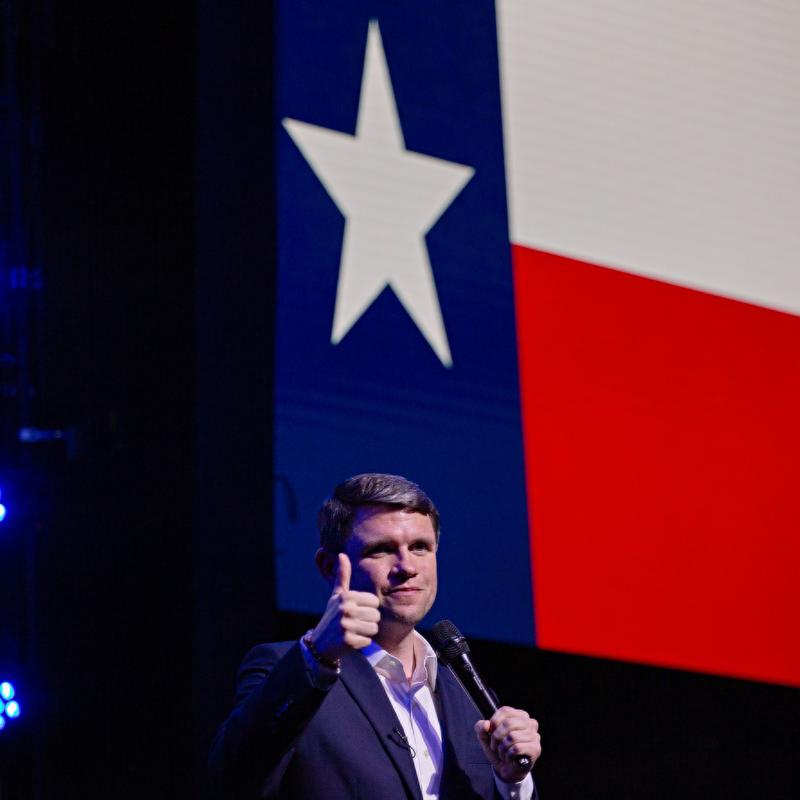
Brian Lehrer: It's the Brian Lehrer Show on WNYC. Good morning, everyone. Well, the first results of this midterm election year are in. They are from Texas and North Carolina, two states where Democrats are hoping to flip Senate seats, vital in their quest to take back the majorities in Congress. Texas is the big story where Democratic State Representative James Talarico has beaten Congresswoman Jasmine Crockett while two Republicans are heading to a runoff.
What can we learn from the primary about how things might go nationally in November? That's really the big question for today. On the Democratic side, the New York Times described Jasmine Crockett as a liberal firebrand. They described Talarico as trying to court moderates and as campaigning on a vision of progressive Christianity. The coalition he lays claim to here is a big part of what we'll talk about.
Democratic State Representative James Talarico: The number of young people who showed up to vote in this election is unprecedented. The number Texans who have never voted before but showed up in this election is unprecedented. The number of Independents and Republicans who voted in this Democratic primary is unprecedented. This is proof that there is something happening in Texas.
Brian Lehrer: Democrat James Talarico, the winner of the Texas Democratic primary for the US Senate seat now held by John Cornyn. That result became official a few moments ago when Jasmine Crockett conceded. Let's talk about all the results, including how the new war against Iran may have played as a last minute wild card with New York Times national political reporter Lisa Lerer. No relation, different spelling. Lisa Lerer reports on the intersection of campaigns, elections and political power for the Times. She's co-author of the book The Fall of Roe: The Rise of a New America. She's been closely watching these primaries. Lisa Lerer, I don't know who left the H out of your name. It's so wrong, but welcome back to WNYC.
Lisa Lerer: Thank you for having me. Even without an H. I appreciate it.
Brian Lehrer: That was your language I cited about Talarico, that he has a vision of progressive Christianity. Can you describe that vision for us a little bit?
Lisa Lerer: Yes. Talarico is someone who really came out of the gate doing something new in Democratic politics. For much of the Trump era, Democrats have been really focused, and particularly in the second term, on the question of fighting, how hard to fight back, what the fight should look like, how loud they should be. It's been really focused on how to be this resistance. Talarico took a different approach. He opposes almost every policy of the Trump administration, but he barely mentions Trump in his stump speech. Really does it only in passing.
Most of his appeal is focused on a cultural appeal to disaffected Trump voters, to moderates. He really wants to broaden the Democratic tent and welcome voters who may not agree with everything Democrats are saying into the party because perhaps they don't like the direction the country is going under Trump.
Brian Lehrer: What he said in the clip, his description of this coalition of young voters, independents, who could choose which primary to vote in, and chose the Democratic primary to vote for him and others. How much can you say if that's an accurate boast or if it's exaggerated? Because I think, as you were just indicating, this might be the most important question for whether this primary reflected something larger about voters getting turned off from Trumpism or not, who may have voted Republican in 2022, 2024. What can you say about the Talarico coalition and if there is anything larger to take away from that?
Lisa Lerer: It's really hard to say whether he's motivating the Democratic base or expanding beyond it, because Texas has open primaries, which means that you can show up and vote in whichever primary you choose. What we do know is that enthusiasm for this Democratic primary was very, very high. It broke records in early voting. It broke records in election day voting. People wanted to come out and vote in this primary.
Now, is that because of Talarico, or is that because it was an exciting race against another Democratic star, Jasmine Crockett, who has a totally different profile? She's someone who's really out there fighting and matching MAGA with her own insults. That's what she's known for. It's an exciting race with two young, dynamic Democrats. We can't really answer the question of whether these were Democratic voters and more of them coming out or he had expanded the coalition.
There are some signs that perhaps he did succeed. We know in the heavily Latino areas of the state down by the border, those places saw very high turnout, which indicates that at least some Latino voters who maybe sat out 2024, even voted for Trump, came and cast ballots in this Democratic primary. We know, as he said in the clip, a lot of young voters turned out, but the jury's still a little out on what the ideology was of all these people.
Brian Lehrer: You said the high turnout in the Democratic primary may have been in part because it was an exciting race between these two somewhat contrasting Democrats. I would add another theory. Tell me if you think it's right, that there's just a lot of Democratic enthusiasm right now to vote because they're so anxious to weaken the Trump administration.
Lisa Lerer: Oh, for sure. I also think there are some-- We know from polling that there are people who voted for Trump in 2024, particularly Latino voters, but independents as well, who are unhappy with how the direction of the country. We know that Latino voters, in particular, really don't like the president's use of ICE. They're unhappy with economic conditions. They don't feel that their lives have gotten easier in terms of cost of living. We have seen a turn among some of the people who really put Trump over the edge and helped him win in '24 outside is hardcore MAGA base. There is some piece of the enthusiasm that could also be people are unhappy with the way things have been going.
Brian Lehrer: One of the things to watch in November, I think, will be as Democrats presumably turn out in droves with a lot of enthusiasm to be anti-Trump, will the people who voted for Trump in 2024 turn out as much? They may not like Democrats, but will they turn out as much to support their local Republicans? I have seen the word bitter applied to the Democratic primary and with racial overtones. Crockett is Black. Talarico is white. What will it take for Talarico, who has now won, to mobilize the turnout he'll need to be competitive in Texas against the Republican nominee? It is still Texas, after all. If Crockett's voters, a percentage of them, feel bitter at the end of this race, they might not turn out.
Lisa Lerer: Oh, for sure. I think it'll take work. He'll have to do a lot of work, which I think Talarico knows. He's been campaigning across the state, talking to Black, asking Black voters to be their strong second choice, acknowledging that they may have preferred Crockett over him, but he wants to get them back in the general election. It will, of course, depend on Representative Crockett herself and how much she does to really boost his candidacy and get her supporters out there. Look, this is, as you point out, Texas is a Republican state. It is a place that Trump won by 14 points, in 2024, which was a much bigger margin than he won it in 2026. For Democrats to win here, everything has to cut their way. They have to fully mobilize their base. They have to make gains with independent voters and Latino voters, and they have to run a fairly flawless campaign and have the funding to do so.
Brian Lehrer: All right. To the Republican side of this primary. Senator John Cornyn, the longtime incumbent. A lot of listeners, even if they're not from Texas, know that name. John Cornyn, nobody's idea of a liberal, but he got challenged by two people who are more MAGA than he is. Nobody got 50%. There will be a runoff between Cornyn and State Attorney General Ken Paxton. They each got around 40%. One narrative, Lisa, that I'm seeing is that Cornyn overperformed, raising questions about MAGA enthusiasm possibly waning. How are you reading that result?
Lisa Lerer: We have seen splits in the MAGA coalition. We know that some Republicans, as we just said, talked about, are disaffected and unhappy with the president. Some of his policies, more moderate Republicans, independents, people who may have voted for Trump, particularly in a place like Texas. Some of those people may have voted in this Republican primary because, as we said before, it's an open primary. I think a lot of what happens next in this runoff, which will happen in May, will depend on President Trump.
He has stayed out of the race so far, and now there will be an even heavier effort to court his endorsement. We've seen that despite these cracks in the MAGA ferment, which really aren't even cracks, they're more like hairline fissures. President Trump remains the most important and most powerful figure in Republican politics. I think it really depends on whether the president gets involved, and how he chooses to get involved, and who he chooses to back, if he does so.
Brian Lehrer: Lisa Lerer, no relation, different spelling. My guest, New York Times national political reporter. As we talk about yesterday as the first real primary day with results in the midterm elections, there was another Senate primary yesterday in another state where Democrats hope to flip an all important Senate seat, North Carolina, where Republican Senator Thom Tillis, a relative moderate, is retiring after Trump threatened to work against his reelection.
In this case, yesterday's primaries were not competitive. They will now have marquee names on both sides. Former Republican National Committee Chair Michael Whatley against North Carolina's popular Democratic, former Governor Roy Cooper. Here's Cooper in victory last night. A different vibe than the Talarico clip from Texas that we played. Cooper leans into the issue of affordability.
Former Governor Roy Cooper: I cannot wait to get to Washington to finally help that parent who I talked to last week, who is paying higher prices at the grocery store, who's worried about making ends meet. I talked with a bunch of farmers just last week. They're struggling, buying their equipment because of these tariffs and seeing their bottom line evaporate. I'm talking to families who are paying higher utility bills because of what's happening out of Washington. It's time we have a senator who pays attention to the working families.
Brian Lehrer: There's Roy Cooper, former governor of North Carolina, now hoping to become its next Democratic senator. Lisa, what does this race now look like for the fall?
Lisa Lerer: Well, this race will really be, as midterm races classically are, a referendum on the Trump administration. You have this setup between Roy Cooper, who's a popular former governor who's obviously very well known, everyone in the state knows who he is, and against Michael Whatley, who is very closely aligned with President Trump. He ran the Republican National Committee for the President. It really is a question. It will test how voters are feeling about the president and the administration.
Part of why you see Cooper coming out of the gate so strongly with an affordability message is that Democrats feel that's one of their strongest messages that Trump entered office with promises to make cost of living things more affordable for voters, things like high housing costs, child care, groceries, elder care. Voters feel, and they say in survey after survey, that things haven't gotten easier for them, that Trump is focused, we've seen them say, recently, on the wrong priorities, which are not issues like cost of living, but things like mass deportations or military involvement abroad. I think that's why Cooper is coming out with that message. It's something I think we're going to hear a lot of talk about in North Carolina.
Brian Lehrer: Let me pick up on those few words that you just said, military involvement abroad, and ask you sort of point blank, Iran. There were also primaries for House seats yesterday. I know you wrote an article Monday about tensions over the war in Iran playing into at least one Democratic primary in North Carolina. I'm seeing that one is still too close to call. I'm curious if you saw it in any Republican primaries after the MAGA base saw Trump as a no foreign adventurism, no American blood for vague goals in the Middle East candidate, and now Trump is doing this.
Lisa Lerer: It's a really good question. I think it might just be a little too early to tell. In Texas, almost 2 million people voted early. Early voting closed Friday, which was, of course, before the first round of strikes in Iran. It's just unclear how many people were voting based on that issue and what the views are. I feel like it's such a fast moving, fast developing and really widening conflict that the whole situation feels fairly volatile. I'm not sure, based on the timing, that these elections could really serve as a reliable referendum on views on the conflict in Iran.
I am curious, as we move forward through primary season, if this war continues, how voters are going to respond. I could certainly see it becoming, the possibility of it becoming, depending how things go, an issue in that Texas runoff, that Republican Texas runoff. I'm watching for that.
Brian Lehrer: Before you go, there's one more thing that happened in Texas that I want to ask you about that may have national overtones. Originally, Jasmine Crockett refused to concede. She did concede this morning because there was a problem at some of the polling places in Dallas county, which is her stronghold. The issue, I gather, was whether the polls could stay open an extra two hours last night from 7 to 9 PM because there was uncertainty about whether people were disenfranchised in some last minute rules changes that affected where they were able to vote. Apparently, as I understand it, there was a deal between Democrats and Republicans that would allow people in Dallas county to vote at any polling place in the county in those primaries.
Then Republicans pulled out close to the end of primary season. Then so some Dallas Democrats showed up at the wrong polling place. Again, this is in a Jasmine Crockett stronghold. There was an attempt to keep the polls open for another two hours so people could travel to the right polling place. Then some people got disenfranchised. I guess Crockett decided this morning, since she has conceded, that if that happened, there wouldn't have been enough extra Crockett votes to make a difference.
Lisa Lerer: That's exactly what happened. There was no way, even if those votes were counted, that she could have won this race. I think it does show how fraught this whole issue of voting has become, particularly as Republicans in conservative states have worked very hard to change rules and redistricted. It's really complicated. They're constantly injecting this idea that there's something broken or rigged about our election system, which I think has the impact of putting everyone on guard and making people really start looking for fraud when there's very little evidence that fraud exists. It does raise questions. I think it should make all of us nervous about the possibility of these kinds of challenges and many, many more of them in the midterm elections.
Brian Lehrer: You went right where I was going to go, because even though this is in the weeds, in the case of Texas, it started as a bipartisan idea that people could vote at any place in the county, and then the Republicans pulled out at the last minute. It seems to be consistent with the Republican push in general this year to make it harder for people, especially in Democratic counties, to vote. Do you think what we saw in this Texas race in this respect is a bellwether for something we're going to be seeing in a lot of states between now and November?
Lisa Lerer: Well, I don't know if it will look exactly the same. We already see that Republicans are doing a lot or trying to do a lot of things to change how Americans vote and what congressional districts look like in hopes of gaining engineering an advantage in these midterm races. It's a political strategy in many ways. When you start chipping away at faith in our elections, which President Trump has been doing for a long time, it can have repercussions. It makes people skeptical. It makes them have less faith in our democratic system. It can be be a very fraught thing for sure.
Brian Lehrer: New York Times national political reporter, Lisa Lerer, different spelling, no relation. I'm always happy when I can say, there goes a really good journalist named Lerer. Thanks for coming on with us, Lisa.
Lisa Lerer: Thank you for having me.
Copyright © 2026 New York Public Radio. All rights reserved. Visit our website terms of use at www.wnyc.org for further information.
New York Public Radio transcripts are created on a rush deadline, often by contractors. This text may not be in its final form and may be updated or revised in the future. Accuracy and availability may vary. The authoritative record of New York Public Radio’s programming is the audio record.
