The Mayor-Elect Joins the Starbucks Picket Line
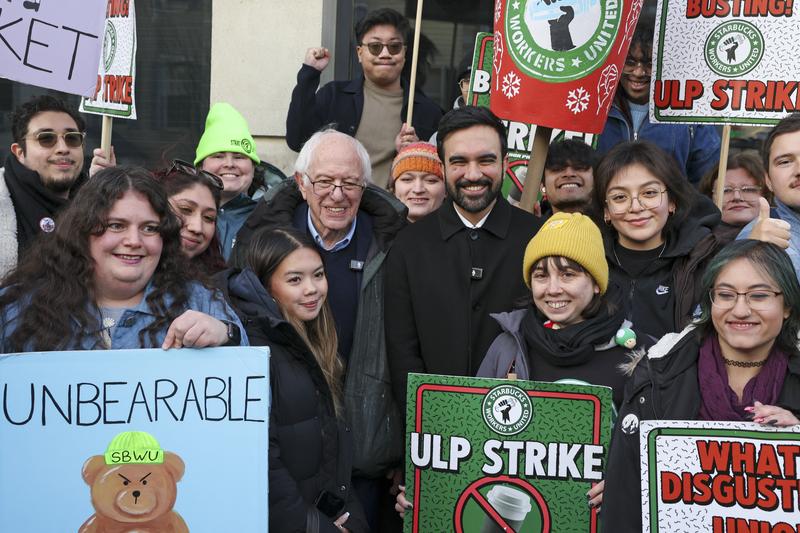
( ANGELA WEISS/AFP / Getty Images )
Brian: It's The Brian Lehrer Show on WNYC. Good morning again, everyone. For the last three weeks, in case you haven't heard this yet, workers at various Starbucks locations across the country have been on strike. This comes as the coffee giant just agreed to pay out a settlement of $38 million to workers and the New York City government after the local labor and consumer agency found systemic violations of the law at locations across the city. More on the details of the settlement and the current strike to come.
On Monday, striking Starbucks workers in Park Slope found themselves on the picket line with two of the nation's most prominent political figures, Vermont senator Bernie Sanders and Mayor-elect Zohran Mamdani. Solidarity is the word the incoming mayor focused on in his remarks to workers. Here's 30 seconds of it.
Mayor-elect Zohran Mamdani: Solidarity, as much as we speak of it, we have to remember, is not an abstract concept. It is measured in picket lines, stood on in the rain and in the sleet. It is measured in rent payments that workers do not know if they will be able to meet, child care bills they do not know whether they will be able to afford, and it is measured in strangers who have never met one another, linking arms to fight for a shared goal and a fairer future.
Brian: With me now to talk about the Starbucks strike settlement and what it might mean for the city and even the larger labor movement when the incoming mayor throws his weight behind a strike is Claudia Irizarry Aponte, senior reporter covering labor and work for the news organization, THE CITY. Hey, Claudia, welcome back to WNYC.
Claudia: Thanks for having me.
Brian: We'll talk about Mamdani in a minute, but let's start with the settlement that Starbucks agreed to with the city's Labor and Consumer Agency. This is practically brand new news yesterday. What law did the company violate if there was an admission of a violation? Was it the settlement for a repeated offense?
Claudia: The company paid the settlement to settle allegations of violations of the city's Fair Workweek law. Now, this is a law that was approved by the city council in 2017. It obligates fast food companies in New York City to give workers their schedules with 14 days ahead of time, just 14 days in advance. The details of the settlement announced on Monday reveal just the breadth of Starbucks violations of the law. We're talking about more than 0.5 million confirmed violations of the law in the period from July 2021 to July 2024.
This was a three-year investigation at all but one of their stores in New York City, more than 300 stores. They were basically operating in New York City as if this law didn't exist. The company agreed to pay $38 million, $35 million going directly to workers who were affected by this, 15,000 of them, and about $3 million, $3.5 million in fines to the city.
Brian: Meanwhile, Starbucks workers at 120 locations in 85 cities across the country, so it's a small minority of Starbucks locations, but it still adds up to 120 of them, are on strike. In New York City alone, I see there are many locations. How many stores in the city are on strike?
Claudia: It's unclear how many stores in the city necessarily are on strike right now. What we do know is that there are workers across 85 cities in the US right now who have walked off the job more than three weeks ago. Scheduling issues, of course, in New York City, we have this law that governs how far in advance fast food companies like Starbucks have to give workers their schedules. Nationally, scheduling issues have been a major sticking point of Starbucks Workers United. This is the SEIU-affiliated union that represents some Starbucks workers across the country in North America.
They've been bargaining or trying to bargain for a collective bargaining agreement for many years now, trying to seek higher wages, better scheduling, and other rights. They claim that the company has been stalling the negotiations or trying to force them to the bargaining table, and to finally reach an agreement here. Again, it's been many, many years of this fight. The settlement here in New York comes at a great timing for the union and certainly gives them leverage that Starbucks, while not necessarily agreeing to any wrongdoing according to the order, but they are agreeing to pay the settlement. I believe that really does speak for itself. That's certainly how the city and how the union are presenting the settlement.
Brian: I guess that's often how settlements go. Cash gets paid, but the person who was sued or charged doesn't actually admit to any wrongdoing. $38 million going largely to 15,000 people employed by the company for these violations of for the alleged violations of the Fair Workweek law is certainly substantial and worth talking about. With us now, in addition to Claudia from THE CITY, to give the perspective of the workers on the picket line, is Rae Shao, a union barista at a Starbucks in the financial district. Rae, welcome to WNYC.
Rae: [inaudible 00:05:53]
Brian: Tell our listeners, why are you and your colleagues on strike right now? What are you hoping to gain?
Rae: Me and my co-workers are on strike right now on unfair labor practice strike because, as the reporter mentions, Starbucks has been stalling our negotiations for years. It's been months since they really offered any real proposals for our demands. That is why we're out on the picket line. After this, I'm going to go to the Empire State Building. We're going to have a big rally there at 1:00 PM. We just need Starbucks to come negotiate in good faith and actually listen to us and listen to our demands. What we're asking for is quite simple. We need better take-home pay, we need to improve our scheduling and staffing, and we need Starbucks to resolve the hundreds of labor law violations that they've committed, the Fair Workweek law being one of them.
Brian: Your location, as I understand it, is one of only a few in New York City that's currently unionized. How does that go? How is it that some Starbucks locations are and many aren't?
Rae: We actually had a lot more union stores in Manhattan until Starbucks illegally closed down many of the union stores. I would say the reason why I think more stores aren't unionized is because Starbucks has been engaging in a relentless union-busting campaign since the first store unionized in 2021. They retaliate against the workers who try to unionize, and that's illegal as well.
Brian: Why did you and your colleagues decide to join the Starbucks Workers United union? What was the unionization process at your location like? It sounds like Starbucks wants no part of workers even being unionized at all.
Rae: I think the reason why I decided to join the union, and I'm sure a lot of my co-workers might feel the same way, is because without a collective voice, we really have no say in the company and how it's run. Even though we're the ones who are working in these stores every day, we know what happens on the floor, and yet they won't listen to us unless we can come together and really use that leverage as collective workers. I joined the union because I felt like that was the only way to really get to improve things at this company and to improve my working conditions.
Brian: Claudia, do you want to go more into it, expand on what Rae was just saying? Some listeners might be confused still about, on the one hand, there's this $38 million settlement, most of which is going to go to Starbucks employees, and on the other hand, there is this ongoing strike. Give us your journalist perspective on what the big picture is here.
Claudia: These are two things that are operating in parallel tracks. The city's investigation, which originated in 2022, obviously, predates the current strike, but it touches on a lot of the same issues that drove workers to walk off the job three weeks ago. We're talking about scheduling, we're talking about a company that was systematically violating their rights. What DCWP said, this is the city labor and consumer protection agency that investigated these allegations. They're basically saying that basically every single Starbucks worker who was in New York City, who was working in New York City from 2021 to 2024, had these rights violated.
This meant that Starbucks made it difficult for workers to schedule childcare, to schedule their jobs around their school schedule for people who are in school or seeking any form of education, to schedule any second jobs that they might have, or just anything else around their lives to pick up additional shifts and make up some extra money. The city also outlined that Starbucks actually systematically and arbitrarily cut workers' hours to keep them as part-time so that they wouldn't be able to claim additional rights as full-time workers, and actually prefer to hire additional people rather than give existing workers full-time hours.
Obviously, they violated the law in New York, but this is just a part of just the larger issues that Starbucks Workers United workers across the country have been speaking out on for multiple years now, that this extraordinarily large company logged almost $4 billion in profits last year alone has been messing with their schedules, messing with their pay, and refusing to bargain with them for many, many years now, since 2021, since the first store unionized in Buffalo in 2021 right here in New York. They're separate, but they're on parallel tracks. These are a lot of the same issues that workers are speaking out on on the picket line right now.
Brian: It sounds, Claudia, like even with this $38 million settlement for the alleged violations of the Fair Workweek law, this doesn't settle a list of other major grievances that Starbucks employees have, which is why a strike would be ongoing.
Claudia: That's right. Then, of course, this is a settlement that only covers workers in New York City. What Starbucks Workers United says is that these are issues that are happening all over the country. Obviously, a $38 million settlement, the city is saying this is the largest labor-related settlement in New York City history. It is nothing to sneeze at, but it is one settlement in one city out of 85 that are on strike right now in North America. It certainly gives workers a lot of leverage in this moment, but it is just one small piece of a much larger struggle for Starbucks Workers United.
Brian: On Monday, Mayor-elect Zohran Mamdani, along with Vermont senator Bernie Sanders, joined you, Rae, and your colleagues on the picket line and Park Slope at a Starbucks. Here's a clip of the incoming mayor speaking to workers.
Mayor-elect Zohran Mamdani: As I was walking in, Bernadette was asking me when am I going to stop attending protests and be the mayor? I said, technically, January 1st, I will be the mayor, but I also want to make a point, which is that when I become the mayor of this city, I'm going to continue to stand on picket lines with workers across the five boroughs.
[applause]
Mayor-elect Zohran Mamdani: I've said this to many of the unions that are here today, many of the rank and file, which is that we want to build an administration that is characterized by being there for workers every single step of the way. Sometimes, in the fight for decency and dignity that workers are waging, their voices are drowned out, and when you are the mayor of New York City, you have with that a platform.
Brian: Rae, what does it mean to you that the incoming mayor has promised to join your picket line and also others of other workers in the future?
Rae: I really appreciate how he is using his platform to amplify our voices and put a spotlight on the message that we are trying to tell everyday Americans. I also think even if we didn't have any support from City Hall, we would still be out there on the picket line doing what we do and fighting for what we deserve, because at the end of the day, I think that our power as workers doesn't come from the state. It comes from the work that we do.
Brian: Listeners, are you as coffee drinkers boycotting Starbucks? Were you even aware of this strike? Do you have any questions that you want to ask our guests, the journalist who's been covering the Starbucks strike and settlement for the news organization, THE CITY, Claudia Irizarry Aponte, or the striking barista who is also joining us, Rae Shao? 212-433-WNYC, 212-433-9692, or any other Starbucks employees also welcome to call up or Starbucks managers for that matter. 212-433-9692, you can call, or you can text. Rae, are you actually on strike? You have a job as a barista, but you're not going to work?
Rae: Yes, I'm on strike.
Brian: For how long?
Rae: Until Starbucks comes back to negotiate in good faith with us.
Brian: For how long so far?
Rae: Oh, my store went out on strike November 13th.
Brian: What are you doing in the meantime?
Rae: You can find me outside. [chuckles] Outside on the picket line, I mean.
Brian: It's tough to strike, right? Because you got to pay the bills somehow.
Rae: Right. We do have a GoFundMe that we've been fundraising for New York City Starbucks Workers Hardship Fund, and this is to cover any of the lost wages that we would not receive through our union's strike pay.
Brian: Are you asking customers to boycott at the particular struck locations or citywide or nationwide or anything like that?
Rae: We are asking customers to boycott all Starbucks locations until you see us working back at our stores.
Brian: What do you want to say to your other colleagues in Starbucks locations throughout the city that aren't currently on strike and haven't joined the union?
Rae: I would tell them that they should join us. The more people we have, the more leverage we have, the easier it will be to demand Starbucks to give us what we deserve.
Brian: Claudia, what's Starbucks' side of the story here?
Claudia: Starbucks, again, in their statement, they reiterated that this is not a settlement over lost or stolen wages. They reiterated that this was specifically over the scheduling issues. They also said that the law is complex and that when workers request last-minute changes to their schedule or they request extra hours, that makes it more complicated for them to comply with the law. That is their view of things. This is a law that's been in the books in New York City for many years at this point. The city council approved it in 2017. It was enacted in short order thereafter. These are issues that workers have been calling out now for multiple years all over the country. This is an investigation that dates back to 2021.
The company is free to say that the law is complex, and certainly, there's a lot that they need to do to make sure that they're complying, but I think that the settlement from the city and, again, the testimonials of workers, such as the workers on the line right now, says that this is actually quite simple. The law says you need to give us our schedule two weeks in advance. The company was basically ignoring this law, more than 500,000 violations over a 3-year period. Every single store in New York City, with the exception of 1, was found to be in violation of this law. Again, I think that the company's inaction speaks for itself.
Brian: If they have settled around that particular claim, then is it your understanding as a journalist that the strike now is about something else?
Claudia: Yes, the company agreed to comply with the law in New York City going forward, but again, the strike is not limited not just to New York, it's nationally. Just because these scheduling issues and the company has agreed to comply with the law in New York City, does not change that there are other Starbucks stores all over the country that are experiencing these same issues.
In New York, workers, just like the Starbucks workers all over the country, still don't have a contract, which is ultimately what the strike is about. They still don't have an agreement on wages. They don't have other agreements or perhaps other scheduling issues. This is an agreement, a settlement. It's a victory for workers. It certainly gives them a certain amount of leverage going back to negotiations whenever that may be the case. This is an issue that is larger than the New York City that they are on strike for right now.
Brian: Chris in Crown Heights, you're on WNYC. Hi, Chris.
Chris: Hey, Brian, thank you for having this segment. I'm a fellow union worker of another union. It's my birthday today, and Starbucks does free drinks. I'm wondering if you think in solidarity, folks should collect them and hurt the corporation by collecting those free items, or stand in solidarity and not collect free [unintelligible 00:20:32].
Brian: Rae, do you have an opinion about that?
Rae: That's a good question. I would say if you're not spending your money, but also maybe you could just avoid going inside the stores. I don't know. Just don't spend your money.
Brian: It's an interesting frame from the listener. I don't expect you to have the definitive answer for the union, but if they want to hurt Starbucks, does it hurt Starbucks more to take the free stuff and not buy anything, or to not go in at all? I guess people have to make that decision for themselves if they want to support your strike. Tomas in Lower Manhattan, you're on WNYC. Hi, Tomas.
Tomas: Good morning, Brian. Thank you for having me. First of all, a very quick story and then a question. My quick story is I'm a lawyer. Downstairs from my office is a Starbucks. I go downstairs one day on the corner, I run into a childhood friend who's also a lawyer, and I say, "What are you doing these days?" He says, "I'm organizing the Starbucks employees." Within a month, that location was closed. My question is, how much retribution are you seeing on the part of Starbucks?
Brian: Rae, would you like to answer that?
Rae: Can you rephrase that question? What do you mean by retribution?
Brian: I think retribution against employees for attempting to unionize or for striking.
Rae: Oh, yes. This is a very common story. They have closed down a lot of union stores, and they've also retaliated against me, my co-workers for participating in union activities. I did a march on the boss with my co-workers because we needed to address the chronic understaffing that was going on in our stores, and that was burning out my co-workers. I got a final written warning, and I've never been written up for anything before. That's just my own experience, but I know that my experience is a common experience among workers who are just simply engaging in their federal right to organize.
Brian: Claudia, I see that Senator Sanders said that Starbucks is violating the NLRB's laws or standards about the workers' right to unionize. For you, as a labor reporter, where is that line? Have you reported on whether Starbucks is violating it, or who says they are, and what they say about them being not in violation?
Claudia: In terms of retaliation, we've had several prominent cases just here in New York City and in New York State. I recall an incident some years ago where a lead union organizer at a Starbucks location in Astoria was fired ostensibly because of his union activity, and the union created a huge show of filed, they're known formally as charges, but really they're complaints with the Federal National Labor Relations Board. That's the US Labor Board that governs and enforces US labor law. I believe that worker was eventually reinstated.
There have been other cases with that original store that unionized. This is obviously far from New York City, but still within the borders of our state and Buffalo. Several of those organizers also had their hours illegally cut, they claim, or were fired and suspended because of their union activity. This is a pattern by the part of the company in New York City and nationally.
Then Rae also mentioned that the company in September announced that it was closing hundreds of stores across the country as part of a larger reshuffling, and that included a number of unionized stores as well. I believe more than 50. Again, Rae can speak more to this, but the union nationally and locally has said that this is part of the company's larger retaliation against union workers and trying to clamp down on organizing in their stores in New York and nationally.
Brian: Rae, did you want to add anything more to that?
Rae: Yes. In my personal experience, the cutting hours thing is very real. I've had co-workers who had to quit because they were pretty much scheduled, like one four-hour shift a week. Starbucks loves to say that they provide the best benefits in the industry, but what they don't tell you is that you need to average 20 hours a week in order to access those benefits and to be eligible for them.
Then what they do is they'll cut your hours so that the average barista is scheduled 19 hours a week, and so a lot of us don't even qualify for the benefits. My co-workers have quit because they lost their health care. I'm using the Starbucks tuition for Arizona State University, and I've had to take gaps in my education because they cut my hours so much that I wasn't able to qualify for the tuition anymore.
Brian: Claudia, that's a very specific accusation. Have you been able to verify that as a journalist, that they specifically keep baristas and other employees just below that 20 hours a week that would qualify for benefits?
Claudia: That goes right back to the settlement that the city reached with Starbucks announced just earlier this week. This exact pattern of artificially or systemically keeping workers' weekly hours low, refusing or preventing them from signing up for additional shifts to keep them below a certain level and keeping them artificially part-time so, as Rae said, they wouldn't be able to unlock certain benefits that are awarded to workers who work over a set of hours. I believe Rae said that it was 20 hours a week.
Again, this goes back to the DCWP settlement. This is exactly what the agency outlined on Monday, and settling with the company. It's important to note, again, this is an enormous settlement for New York City. It's the largest labor-related settlement in New York City history. The DCWP is a relatively small agency and their oversight powers have increased substantially in recent years, not just with this Fair Workweek law that we've been discussing, that governs fast food workers, but also another fast food worker just cause that basically requires fast food employers to give just cause when they're dismissing workers or firing them.
They also govern all the different set of laws for delivery workers, of which there are tens of thousands of them in New York City. They also work for huge employers, multimillion dollar companies like Uber, DoorDash, Grubhub. These are tens of thousands of workers of very large companies, and yet the agency's headcount, the Department of Consumer and Worker Protection here in New York City, in that same period of time, their headcount has only increased by about half a dozen workers. New York has a lot of enforcement power, but very little resources to go after these companies.
It's one reason why these investigations can take so long, not just because they're complex and because it requires a certain level of accuracy and of crossing T's and dotting I's and making sure that everything is okay, but also there's just a very real lack of resources at the agency to really go after these companies aggressively, and they know that, which is why in the case of Starbucks, they were able to violate the law more than 0.5 million times over a period of 3 years at basically every single one of their stores, according to the city. It's an enormous challenge for workers, and in this case, for Starbucks Workers United, the union, to really go after these companies.
Brian: Listeners, if you're just joining us, we have a few more minutes to talk about $38 million settlement with the city government and Starbucks employees that was announced this week in a case that was brought for alleged violations of the Fair Workweek law. Also, the ongoing strike, nonetheless, at a number of Starbucks locations in the city and around the country and the maybe surprising involvement of the mayor-elect of New York City, Zohran Mamdani, who showed up at a Starbucks picket line the other day. We played a couple of clips, and as we continue with labor journalist Claudia Irizarry Aponte, from the news organization, THE CITY, and striking barista Rae Shao. David in Brooklyn, you're on WNYC. Hello, David.
David: Hi. How are you doing? I just was basically celebrating the moment of the mayor-elect and not just Starbucks union, but just union and building union, and this new story of the $38 million. Then there's the idea that there is a community, and you can use the word "workers," I guess, for humans as opposed to this entire, whatever system that is being uprooted, should be uprooted, and it feels like to have the mayor-elect and speak the way he speaks. I'm from Queens, too.
Union also requires trust, building trust. I don't trust anybody in the Trump administration at this point. I don't trust myself sometimes, but you can tell when communities unify in a voice at Starbucks, and it is applauded by all of us. It's an exciting moment for New York City. Thank you so much for giving me the opportunity.
Brian: Thank you for your call. Claudia, let's talk more about the mayor-elect's involvement here. First of all, how unusual is this in your experiences as a labor reporter or just in the recent history of New York City at all, as you understand it, for a mayor or a mayor-elect to show up at a particular picket line?
Claudia: It certainly is striking, no pun intended, that the mayor-elect joined a sitting US senator to picket with workers earlier this week. He also deputized his first deputy mayor, Dean Fuleihan, to a Starbucks Workers United picket line several weeks ago, and he showed up there alongside transition co-chair Lina Khan, former chair of the federal FTC. Again, he's made solidarity, as he calls it, and standing up for workers a central tenet of his campaign.
I certainly can't recall Mayor Eric Adams or former Mayor Bill de Blasio joining a picket line. I may be wrong. I don't want to speak definitively here, but it certainly is notable that the mayor-elect has taken this position. Listen, his administration has also taken the position. Lina Khan, who I just mentioned, has spoken up in interviews that she is looking at local city laws, specifically governing consumer rights and a lot of the same issues that DCWP, the agency that just went after Starbucks and secured the settlement, that they have oversight on.
Again, as I was mentioning earlier, the agency is staffed full of people who really care about workers' rights and really want to do right by workers and want to enforce this law to their fullest capacity, but they just don't have the staffing. I haven't heard anything from the mayor-elect just yet on how exactly he plans to address these gaps in funding for the agency and in staffing to ensure that it can actually go after these groupless employers and enforce these laws to their fullest capacity. That's still TBD. The transition is still working on it, but that'll certainly be the story to watch over the next few weeks and months.
Brian: What kind of precedent do you think the mayor-elect is setting for himself here if he shows up at this one particular picket line in this one particular labor dispute? There are many that go on throughout the city and in the course of a four-year term. We have another caller who we're not going to get to, who says a similar situation is happening at the REI store in SoHo. I can't confirm that. I don't know exactly what's going on, but there's an example of somebody calling in to say, "Oh, this is not the only thing," and so the mayor, when he is mayor, is going to be confronted with many of these situations, and I imagine after the precedent that he set this week, may request to show up.
Claudia: That's exactly right. The mayor of New York City has a bully pulpit like no other to speak on this and many other issues, of course, but at the end of the day, his job is and his job will be to enforce the existing laws of New York City and making sure that companies are following the law and those that aren't are held accountable. That will involve fully staffing these agencies, continuing these investigations, and following through on complaints from workers. I'm curious to hear from Rae, as well, what they believe Mayor-elect Mamdani's presence at the picket line means and if it'll actually help move the needle with Starbucks, because I certainly have my ideas, but they're the expert.
Rae: I want to say I'm an expert, but I have seen Mamdani at my picket line multiple times. I did meet with the deputy mayor and the transition co-chair. I think it's really exciting for people to see that the City Hall and their representatives have their back, so to say. At the same time, like I said before, even if they were not here, we would still be doing what we're doing, and we would still be picketing and demanding that our rights be protected and demanding that companies follow the law because our leverage comes from the fact that we staff these stores every day, and we're the ones who make the stores run, and we're the ones who generate money for the companies. Without us, there would be no companies. That's my position on how I think we're going to hold these companies accountable.
Brian: Claudia, you said you have some thoughts on the actual influence that Mayor-elect Mamdani's presence might have on the actual labor situation there. What are you thinking?
Claudia: I just think I agree with what Rae said. Again, I think he's a bully pulpa like no other to speak out on these issues, but at the end of the day, to the effect that he's going to be able to move the needle is going to depend on his administration's ability to enforce these laws, his ability and the city councils', of course, to fully staff these agencies to make sure that every single allegation is investigated and every substantiated allegation is followed through with the full extent of the law.
That involves fully staffing these agencies, of course, and just following through on his mandate to New Yorker. We're yet to see that. Of course, he's not yet the mayor, but with the current mayor, Eric Adams, obviously, this is his DCWP, just building on these victories, so to speak, coupled with his outspokenness on these issues, may help workers get further ahead, but it's going to depend on the actions of his administration behind the scenes, staffing these agencies, enforcing the law.
Brian: We have a caller now who I think is going to push back a little bit on, I don't know if it's unionization in general or something in this situation. Let's hear from Thomas in Morristown. Tom, you're on WNYC. Hello.
Tom: Hi, Brian. As I'm on my car phone now, is this giving bad feedback here?
Brian: No, we can hear you fine. Just be careful out there.
Tom: Okay, thank you. No, I'm pulled over. My question is, why are we confusing unionization with enforcement of the law? I've been in unions before, they're costly, and whether they're effective or not is debatable to some. Here, we're asking them to be able to unionize and spend extra money out of our paycheck in order to have the law enforced.
Brian: Interesting question. I guess in a way, Rae, we need to separate these things, right? Because this legal action was brought by the City of New York, but at the same time, not everything in labor management relations should have to go through the legal system or the government. I assume that's why you unionize, but you give your own response to the listener. Of course, he's also asking, "This takes a percentage out of your paycheck. Why is it worth it?"
Rae: Absolutely. At my union, Starbucks Workers United, we don't pay dues yet because we don't have a contract. Starbucks, actually, their most recent offer, which was months ago, they were like, "You're either going to take this contract as is or you don't get anything at all." That contract that they offered us had no increased wages, no addressing of our scheduling and staffing issues, and so overwhelmingly, because this is a democratic process, our union overwhelmingly voted against it. Why would we pay union dues for a contract that wouldn't even increase our wage to the point where we would at the very least be able to cover that due?
I do agree that unless it is worth it to you, and that's why we've been fighting so hard for this contract, because we need this contract to be fair. I think the connection between our union and the law is because Starbucks has over 400 labor law violations that they've been found guilty of, and there's still like 700 pending. I think when we talk about the law, it's because Starbucks has been the biggest violator of labor law in modern US history, and one of our demands in our contract is for them to resolve these labor violations. I'm not necessarily drawing power from the state enforcing these laws, because like I said, at the end of the day, we're out here on the picket lines instead of at work, and that is what's really hurting the company.
Brian: Rae Shao, a striking barista at Starbucks, and Claudia Irizarry Aponte, who covers labor and work for the news organization, THE CITY. Thank you both very much for joining us.
Claudia: Thanks for having me.
Rae: Thank you so much.
Copyright © 2025 New York Public Radio. All rights reserved. Visit our website terms of use at www.wnyc.org for further information.
New York Public Radio transcripts are created on a rush deadline, often by contractors. This text may not be in its final form and may be updated or revised in the future. Accuracy and availability may vary. The authoritative record of New York Public Radio’s programming is the audio record.