
The Many Ways of Being Muslim
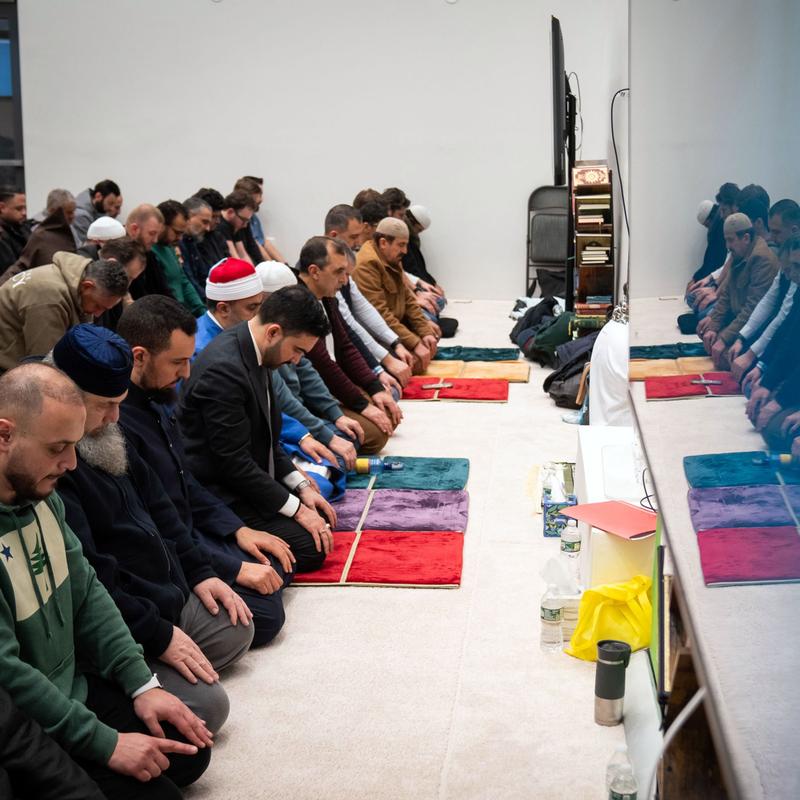
Amina Srna: It's The Brian Lehrer Show on WNYC. I'm Amina Srna, filling in for Brian today. During this month of Ramadan, we'll now take a moment to talk about the diversity of Muslim communities in New York City and across the United States. There are an estimated 1 million Muslims in New York City, part of a global community of 2 billion. Here in New York, the way Muslims observe Ramadan is as varied as the city itself. Mayor Zoran Mamdani, the city's first Muslim mayor, has been marking the season by ending his days with iftars across communities citywide. Listeners, we want to hear from you, too. How do you observe Ramadan?
What traditions does your family or community keep? How do they compare to the traditions of your Muslim friends of other backgrounds? If you're not Muslim, what do you want to know about the holiest month for our neighbors? Call or text us at 212-433-WNYC. That's 212-433-9692. There's also a new podcast that's been digging into exactly these kinds of questions. It's called More Muslim, a narrative audio documentary series exploring the Muslim experience and all of its complexities. As your calls come in, let's take a listen to a preview of the show.
Podcast Voiceover: It's when we start searching for answers that we come up against the limits of our own understanding, where clear-cut black and white answers start to fall apart, and that's where this show begins. For centuries, Muslim legal scholars didn't avoid that messiness. They debated it. They lived in it. They called it the mubah, the permissible, the space in between. It was a zone of uncertainty where some of the most fascinating legal debates took place. This is a show about that middle space, about the perennial questions and the ones that emerge from our current moment, questions about how we make sense of the world, how we preserve tradition without becoming stagnant, how we challenge injustice while holding on to faith.
Amina Srna: Joining us now, all the way from Doha, Qatar, is Sohaira Siddiqui. She's the host of the More Muslim podcast. She's also the executive director of the Al-Mujadilah Center and Mosque for Women and an associate professor of Islamic studies at Georgetown University in Qatar. Sohaira, welcome to WNYC.
Sohaira Siddiqui: Thanks so much for having me. It's great to be here.
Amina Srna: For listeners who may not know what is Ramadan? Want to tell us a little bit about the origin story or how the holy month is observed today?
Sohaira Siddiqui: Sure. Ramadan is the ninth month of the lunar calendar. Muslims observe a lunar calendar alongside, of course, the Gregorian calendar, January, February, March, April. The month of Ramadan in Islamic history is the month, where the Quran was revealed. It has a very important significance. The Quran is the holiest book for Muslims. It's understood to be a month where one gets closer to the Quran and one practices more in terms of ritual observance. The thing that sticks out the most, of course, in terms of ritual observance is the fast itself.
For 30 days, Muslims fast from before sunrise until after sunset, where they don't eat or drink anything. As you mentioned, with the mayor breaking his fast in the evening with Muslim communities, that tends to be a time for families and communities to get together to break their fast. Then there's evening prayers that happen as well. It's a time of ritual and observance, but it's also a time of community.
Amina Srna: As you mentioned, the mayor there, he's been attending iftars with different communities across New York City. He was with the Deliveristas on Monday, the NYPD on Wednesday, and tonight, he'll break fast in Bay Ridge. What does a typical iftar meal look like, if there is one, and how does it vary across Muslim communities?
Sohaira Siddiqui: I would say the thing that connects all the iftar meals is probably what people break their fast with, which is typically a date. The recommendation is to break it with a date and some milk or water. Usually, what happens is everybody sits down. If the fast is being broken in the mosque, people lay down these nice carpets, and everybody sits down, and they have their dates in water or milk. Then they pray together, and then usually, after that, people sit down. Then have their proper meal. There is no typical meal.
I would say the thing that maybe connects all the meals is that they tend to be a bit unhealthy. There's usually some fried foods, some sweet foods. Every community will have different foods that they cook, and that's part of the, I think, festivity of Ramadan is that you get to experience all of these different cultures through food.
Amina Srna: Listeners, for those of you who are observing Ramadan, maybe you want to share what's on your iftar table tonight or any night this month. Give us a call at 212-433-WNYC. That's 212-433-9692. We can share some of your stories, your reflections this month, your spiritual reflections, or anything else. 212-433-WNYC. We're in New York City, which has one of the most diverse Muslim populations in the world. We're talking South Asian, Arab, West African, Black American, Southeast Asian. How does it look different across those communities?
Sohaira Siddiqui: One thing about Ramadan is it is a celebration of unity despite difference. You have all of these communities that might be breaking their fast in a different way, or they might be having a morning meal that is different. What's really connecting everybody together is the mosque. It's prayer. It's the fact that everybody is also fasting together. I think of Ramadan not necessarily as a month in which you're starting to see all those differences between the Muslim community, but you're actually seeing the commonality, that all of us are actually doing the exact same action for most of the day.
Then when you come together, the differences might be in clothing, and they might be in food, and they might be in maybe the songs that people are singing, or the way in which they're breaking their fast. For the most part, what they're doing throughout the day actually is what connects them together, which is the same thing.
Amina Srna: Ramadan ends with Eid. What are we celebrating during Eid, and what do those festivities look like for different communities?
Sohaira Siddiqui: It's a three-day celebration. It starts off by going out and actually looking for the moon itself. There is a tradition, depending on whether there's clear skies or not. Some people say, "Now you can just go to these websites that tell you if the new moon is born. You don't actually need to go out and look for the moon." It is still a tradition in many communities to go out starting on the 28th and the 29th, which is the end of the month, and start looking for the new moon. The crescent is a sign that Ramadan is over and that a new month has now begun, and that signals the end of Ramadan. Then the three days of Eid start off in the morning with an Eid prayer. The month of Ramadan is meant to be a month of ritual observance, but how do we now take those lessons and take that spiritual high and continue to try to be better Muslims throughout the year?
You have the Eid prayer, and then after that usually is just three days of celebrations within the community. Most of the time, it involves going to people's houses. There's an exchange of gifts amongst children and amongst families. It's really just a three-day celebration where people are visiting one another's houses.
Amina Srna: We noted in the beginning of this segment that you're joining us from Doha, which is in the middle of an active conflict right now. Qatar has closed its airspace and intercepted Iranian strikes this week. Can you share a little bit about what it's like to be observing Ramadan there now in the middle of a war that is hitting Muslim communities across the region?
Sohaira Siddiqui: Yes, it's very surreal because the attacks that are coming at Qatar are coming very sporadically. You don't know when they're going to hit throughout the day. Sometimes it hits at fasting time, sometimes it hits in the morning when you're having your morning meal. I would say probably what's the most interesting thing is Al-Mujadilah, which you mentioned I'm the director of. We had this question of: do we keep the mosque open or do we keep it closed? The state sent out a circular saying, "Everybody should be remote working, and any institution that doesn't need to be open should effectively be shut during this time." For a few days, we shut, and the main state mosque was open, and some of the other large mosques were open.
Then, after a few days of reflection, we decided actually it's very important for people to gather and to be present in the mosque and for the mosque to continue to function as a safe space for Muslims. You see this even, for example, in some of the videos that are coming out from Gaza, from Lebanon, even from Iran, that the mosques continue to be open and they continue to be spaces of gathering. I think in times of war, in times of conflict, and in times of uncertainty, which is where we currently are, people need faith and community more than anything else. The mosque ends up being a type of refuge, almost where people can go and feel like, "Okay, we can pray, and we can continue to be connected even though we don't know potentially what tomorrow will bring."
I would say that Qatar still, despite the bombardment, feels relatively safe. I went to the mall today, and I still did some shopping, and the groceries are coming, and deliveries are coming. We're still living in a relatively safe zone that's getting sporadic bombs. Even in that, I think there is the sense that you want to be able to cling on to hope and faith, and the mosque represents that.
Amina Srna: Let's take a caller who wants to share his Ramadan tradition. Omer in Clifton, New Jersey, you're on WNYC. Hi, Omer.
Omer: Hi. Good afternoon, almost. I just wanted to talk about Turkish culture because we really love hospitality. Here in the Turkish cultural centers in New Jersey and anywhere that our members are, we usually like to have Ramadan dinners and iftars with our neighbors, talk to them, and show them what Ramadan is really about, and if they have any questions, because sometimes when you don't know, you're scared. There's some really long-lasting relationships that come from the end of it. It's about opening the table for others. That's what Ramadan's all about for me.
Amina Srna: Omer, thank you so much for your call. We have a listener calling in with a question: "What is the proper way to acknowledge Ramadan when you meet Muslim friends?" Sohaira?
Sohaira Siddiqui: There isn't a specific Ramadan greeting. I would say usually when we meet friends, we ask them to meet in a café, or meet over coffee, or meet over tea. Obviously, because Muslims are observing Ramadan and they're not fasting or eating, maybe find a place to meet that's in a park. Also, just knowing that around sunset is when Muslims break their fast. They tend to be around family during that time. Maybe not having meetings around sunset time is also another way to be mindful. Generally speaking, most Muslims who are fasting are continuing to work, study, go about their daily activities. It's just without food and water. Just to be mindful of where you're meeting and when you're meeting is the best thing that you can do.
Amina Srna: The listener asks, "What might be an appropriate greeting for our Muslim friends during Ramadan?"
Sohaira Siddiqui: When Ramadan starts, usually what Muslims say to one another is Ramadan Mubarak, which is literally just "congratulations, it's Ramadan." At the end of Ramadan, when you have the celebrations of Eid, you say the same thing. You just say Eid Mubarak, which is a congratulations for Eid and a welcoming of Eid. Those are the two official greetings.
Amina Srna: Let's turn to your podcast, More Muslim, before we run out of time in this show. The show launched in February. What made now the right moment for it, and what gap were you trying to fill in the podcasting space?
Sohaira Siddiqui: I think audio is such a rich space. There's so many different types of stories and podcasts that are out there. What myself and the team were observing is, despite this rich array of the audio landscape, there was a gap in terms of Muslim stories being told by Muslims from that insider perspective that really understood what's at stake in some of these stories and what are some of the challenges that Muslim communities are facing globally. We felt like, "What would it look like to create a podcast that centers the real experiences of Muslims, regardless of where they are in the world, but does so in a way that connects them to larger global questions and global experiences?" We felt like that was a real gap in the narrative podcast world, and that's what made us set out to start More Muslim.
Amina Srna: This season of the show focuses on stories told through the experiences of Muslim women, specifically. Why that lens?
Sohaira Siddiqui: I would say for two reasons. The first is this series, from an operational perspective, was powered by Al-Mujadilah, which is a women's mosque and center. We focus on Muslim women's histories and Muslim women's lives. It made sense that the first season was about Muslim women. I think beyond that, Muslims as a minority community functioning in various spaces. It's often Muslim women that carry the brunt of their voices being lost in translation or being lost in public discourses. They have this intersectional idea where their gender and their religion and their experiences all get erased more than potentially Muslim men. We felt that it was important to start with Muslim women. As we are planning for Season 2, we're opening it up, and hopefully, we'll have more voices and more stories in the seasons to come.
Amina Srna: We'll leave it there for today. My guest has been Sohaira Siddiqui. She's the host of the More Muslim podcast, and she's also the executive director of the Al-Mujadilah Center and Mosque for Women and an associate professor of Islamic studies at Georgetown University in Qatar. Sohaira, thank you so much for coming on the show, and Ramadan Mubarak to you.
Sohaira Siddiqui: Thank you so much. Have a great day.
Amina Srna: Thanks. I'm Amina Srna. This has been The Brian Lehrer Show on WNYC. Stay tuned for All Of It.
Copyright © 2026 New York Public Radio. All rights reserved. Visit our website terms of use at www.wnyc.org for further information.
New York Public Radio transcripts are created on a rush deadline, often by contractors. This text may not be in its final form and may be updated or revised in the future. Accuracy and availability may vary. The authoritative record of New York Public Radio’s programming is the audio record.
