
The Mamdani Coalition
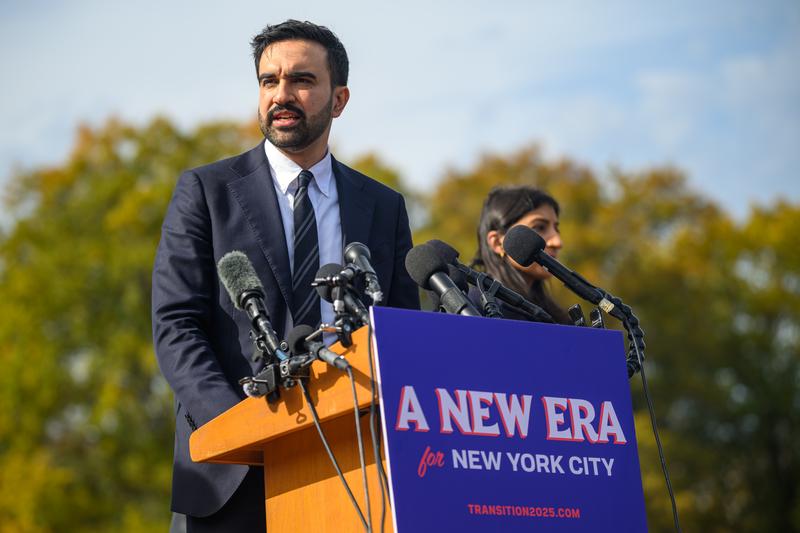
( Alexi J. Rosenfeld / Getty Images )
Title: The Mamdani Coalition
Brian: It's The Brian Lehrer Show on WNYC. Good morning, everyone. On today's show, what happens with housing development? What actually happens now that the city's ballot measures on that got approved? Also, the Supreme Court hears the Trump tariffs case. We'll hear a little bit of audio on how the justices question the two sides and why this case is being watched so closely for its impact, not only on prices, but on American democracy. We start with more about the election of Zohran Mamdani as mayor.
With us now is political analyst and sometimes organizer Michael Lange, who writes the fascinating New York politics newsletter called The Narrative Wars. How closely does he inspect New York politics? On the day before the election, he posted an article called Predicting Every Block of the 2025 New York City Mayoral Election. Maybe we'll see how much he got right.
Also, before the election, he wrote a piece called How Zohran Can Reach 50%, which Mamdani did, and one called The End of Andrew Cuomo, cheekily subtitled The Politics of Pronunciation, and most of you know what that refers to. Michael Lange's been on it. By way of background, he also formerly worked in the district office of Congresswoman Nydia Velázquez and on the successful campaign of one of the exonerated Central Park Five, Yusef Salaam, for the New York City Council. Michael, thanks for coming on at this historic moment. Welcome back to WNYC.
Michael: Oh, it's such a pleasure to be here. Thank you for having me, Brian.
Brian: How does one even try to predict every block that's more than 120,000 New York City blocks, by your count, in an election of 2 million votes?
Michael: It takes one very large Google spreadsheet and a lot of past data, and also just, I would say, a lifetime living in New York City and walking all the blocks of many of the boroughs. It's an art form for sure. I certainly did not get everything correct. There's always room for improvement, but it was a very fun exercise to do, and I'm glad it resonated with a lot of New Yorkers [crosstalk].
Brian: Of course, the fun is in what we can all learn from what you got right, what you got wrong, even what questions you chose to ask. When I clicked on your interactive map in your prediction article, it seemed to show not quite block by block, but election district by election district, which is still a Herculean feat because there are more than 4,000 of those. have you now gone through all of those to see what you got right and what you got wrong and how much we can learn from that about who this city is politically right now?
Michael: Yes, I have. I guess to start with what I got wrong, I figured that Curtis Sliwa would see some diminished support for Andrew Cuomo, kind of tarring him as a spoiler. I thought he would finish at around 11%, which, again, was lower than all of the polling averages. I think his betting market odds of finishing under 10% were only 25%. Sliwa's support across the city collapsed. He finished with only 7% of the vote. He did not win a single election district in parts of Staten Island where Trump received over 85% of the vote.
Sliwa only won around 25%, with Andrew Cuomo winning close to two-thirds of the vote. I think, again, I accounted for some late movement. This also came out before Donald Trump quasi-endorsed Andrew Cuomo, but I think there was a huge element of tactical voting that helped Andrew Cuomo ultimately get to over 41%. I am happy to say, though, that for my predictions of the Mamdani coalition, they were much more close borough by borough and then just the top line. I was never off by more than two points.
I think, given I've closely covered the Mamdani campaign since before he even announced, I am proud of that. I think it was a really interesting, just wider kind of coalition between what Mamdani built and-- I wouldn't really say the Cuomo coalition, because it really, at the end, I would say became an anti-Mamdani coalition. The map of the city, I would say, it was reminiscent of the 2009 mayoral election between Michael Bloomberg and Bill Thompson.
I also think it had echoes of 1989 and 1993. Those were the two elections where David Dinkins faced Rudy Giuliani, and that you have like one coalition which is very democratic and it's built around the working and the middle class. It's very multiracial, it's very indexed towards labor, it does well in parts of Manhattan, but not all parts, and it particularly performs well in the Bronx, Queens, and Brooklyn.
I think Mamdani's coalition, especially in this general election, was that new era of the David Dinkins rainbow coalition. Whereas Cuomo's opposition force to Mamdani, it was very wealthy Manhattanites, it was middle-class Jewish neighborhoods, it was Orthodox and Hasidic enclaves, and it was the dwindling, but still powerful kind of white ethnic New York. You also mix in some Chinese American immigrants and things like that. That was almost the new era of the Giuliani coalition, but in the last 10, 20, 30 years, that coalition was once a majority. It is now shrunk to the point where, again, Cuomo only got 41%. Those are my big picture thoughts.
Brian: I want to drill down on some of the more granular looks that you took, really interestingly, or the way you posed some of the questions just before the election to dive down deeper on some of those coalitions. You had posted four central questions. One, "Will Mamdani crack 50%?" We know now that he did, just barely, but still, that means he got more votes than Cuomo and Sliwa combined. Then you asked, "Can the first major Muslim candidate for mayor win back the city's working-class Hispanic and Asian communities that swung dramatically toward Donald Trump last November? How many Republican voters can Andrew Cuomo peel away from GOP nominee Curtis Sliwa?" I think we just covered that one.
"Will the Black electorate, older and historically loyal to Cuomo, shift to Mamdani, the Democratic nominee?" Let's take those two big ones that we haven't touched yet, one by one. The first one is fascinating: "Can the first major Muslim candidate for mayor win back the city's working-class Hispanic and Asian communities that swung dramatically toward Donald Trump last November?" How much did Mamdani do that and where?
Michael: I think for the most part, he did. I would say that there was a real contingent, especially in such a high turnout election of Mamdani/Trump voters or Trump/Mamdani voters. I think those folks, it was Puerto Rican neighborhoods, South American neighborhoods in Queens, Muslims, and South Asians. I think Zohran Mamdani performed quite well in a lot of the immigrant neighborhoods that shifted dramatically towards Trump. Corona, Queens, in particular, was a place I was watching very closely.
There is no neighborhood in the entire country that has experienced such a shift right over the last decade. Mamdani did well there. He won all of but two precincts, I believe. Again, Muslims, Hispanic voters for the most part, and then South Asian voters. He really, I think, succeeded in that, and turnout there was relatively strong. I think, and this is something that we've seen over the last couple elections in New York City, where there might be a more permanent realignment towards more moderate or "conservative" ideological politics, is in some of the city's Chinese neighborhoods, particularly.
I think some of this also has to do with class character as well. Mamdani did very well in Elmhurst, for instance, and Elmhurst, I would describe it as a very working-class Chinese neighborhood in the middle of Queens. He played Cuomo to a draw, I would say, in Flushing, which again is, I would say, described as a relatively lower-income neighborhood. In the more middle-class Chinese neighborhoods, Cuomo did dramatically better than he did in the primary, and I think that was a consequence of a lot of independents, Republicans, moderate Democrats who had maybe sat that election out moving towards him.
To give you an example, like Murray Hill in Queens, Cuomo did quite well. Bensonhurst and Bath Beach in southern Brooklyn, Mamdani won both of those neighborhoods very convincingly in the primary, but in the general, they switched back to Cuomo. I think above board, Zohran did really well in those immigrant neighborhoods, except, I would say, probably some of the more middle-class Chinese neighborhoods, which are, I would say, a symptom of a broader political realignment that's been happening in those communities for the last couple of years.
Brian: Really interesting to hear that there are any New York neighborhoods that shifted from Mamdani to Cuomo from the primary to the general, given the overall result this week. Can you hazard a guesstimate, back to the original question about Mamdani/Trump voters, of how many New Yorkers, how many humans, voted for Donald Trump in 2024 and Zohran Mamdani in 2025 who live in New York City?
Michael: Oh boy. I should drill down on this more, but I would say it's somewhere in the tens of thousands. There will be around 2.25 million people, I would estimate, that are going to vote in this election when all the ballots are counted and things of that sort, and there were 2.8 million people who voted in the presidential election. I should also give a shout-out to the CUNY Graduate Center. They have an excellent interactive map, and you can do multiple filters of voter performance and things like that.
One of the things you can do is you can overlay where Trump did well with how the candidates themselves perform this time. I think it's a very conservative estimate to say that Mamdani won tens of thousands of voters who voted for Donald Trump. I could see that number cracking 100,000, but of those numbers, it is very indexed to working-class Hispanic, South Asian, and Muslim voters. There was not quite a white working-class Mamdani/Trump voter. I'm sure there were, of course, a couple on Staten Island and things like that, but it was not an overwhelming development. Mamdani's strength was for bringing a lot of these immigrant neighborhoods back into the Democratic Party tent.
Brian: There are definitely some listeners now who are going, "No, I don't believe this. Those people don't actually exist. No person could have voted for Donald Trump and then voted for Zohran Mamdani, given how politically opposite they are in so many ways." How do you explain those voters? What were they thinking last year versus what were they thinking this year?
Michael: I think this is where Mamdani's, the cost-of-living, economic-based message, I think, really resonated. I also think that there were many, I would maybe describe them as lower propensity voters who were more disillusioned with politics, who last year were upset at Democratic neglect on a handful of issues and cast their ballot for Trump, as a hand grenade in the voting booth, per se. I think that seeing some of the chaos that Trump has brought about in the last 11 months has maybe pushed them away from the Republican Party and things of that sort.
I also think that Mamdani really ran a campaign that was very present in these neighborhoods. It was present all across the city, and he personally was present, learning languages, visiting mosques, speaking to voters everywhere. He nailed the ethos of New Yorkers who show up everywhere. I think some of this is also just an endorsement of vibes like listening, caring, that type of stuff, and I think Zohran really communicated that. That's another reason why over 1 million people showed up to vote for him, but it's not a neat ideological issue.
Brian: Listeners, we can take calls and texts on a few tracks here with political analyst, Michael Lange, who, if you're just joining us, literally takes a block-by-block approach to analyzing the New York City election results. One, you can just ask him a question about your own block or neighborhood or any trend around the city. 212-433-WNYC. Two, let's see if we have people from some of the demographics he was super focused on in the election, in the questions he posed in his words, like the one we were just talking about, "Can the first major Muslim candidate for mayor win back the city's working class Hispanic and Asian communities that swung dramatically toward Donald Trump last November?"
If you, listening right now, are a Hispanic or Asian American New Yorker who voted for Donald Trump last year and Zohran Mamdani this year, please call in. I think this is still a relative needle in a haystack ask, but if you are that person or one of those people, let us hear from you. 212-433-WNYC, 212-433-9692. Another Michael Lange question that we will get to that he was asking going into this week, "Will the Black electorate, older and historically loyal to Cuomo," as he put it, "shift to Mamdani, the Democratic nominee?"
Listeners like that, older Black listeners who maybe voted Cuomo in the primary and then flipped to Mamdani for the general, what drove that switch for you? 212-433-9692.
How about voters new to New York the last 10 years? That was a big Mamdani demographic in the primary. From what I had read and heard, if you came to this city from anywhere in the last 10 years, whether from Albany or Albania, whether from Kansas or Kandahar, whether from Minnesota or Mozambique, whether from Boston or Bangladesh, why'd you come and how'd you vote? 212-433-WNYC. Call or text for anyone who identifies with any of those questions or who just wants to ask Michael Lange a question of your own, 212-433-WNYC, 433-9692.
Michael, I'm sure it will come as no surprise to you that our lines are jumping right away. We'll get to some callers as we go. That other question that you asked, "Will the Black electorate, older and historically loyal to Cuomo, shift to Mamdani?" How much did that, in fact, happen?
Michael: It happened, I would say, dramatically. There were neighborhoods that Cuomo outpaced Mamdani in the primary by 20, 30, even 40 points that universally flipped to Mamdani, 10, 20-point wins. Cuomo's support, I guess you could say, maybe collapse is too strong because in some of these places, he still did get 30%, 35%, 40% of the vote, but it was a dramatic reversal. According to the aforementioned CUNY Graduate Center resource, the census areas with predominantly Black eligible voters were won by Mamdani by 30 points. The New York Times conducted a somewhat similar analysis that had Mamdani winning Black majority election districts by 24%.
This is also across a class spectrum from lower-income neighborhoods like Brownsville to more working-class neighborhoods like Wakefield in the Northeast Bronx, to more middle-class neighborhoods like Canarsie, like Southeast Queens. This was a universal shift. There were a couple of places where Cuomo still did hold on to eke out narrow majorities. Rochdale Village in Southeast Queens was one place where he performed relatively well. Co-op City, as well, some of the senior center precincts, he still won. This was largely a consequence of age. In the places where 65% of the electorate is over 60 years old, he would do really well, things like that.
Mamdani, not only would he have not gotten 50%, were these inroads not made, he might not have won to begin with. I think that also for as well as he did, and all the improvement that he showed over the last couple months, I think is throughout his term and the reelection four years from now, I think his ceiling with Black New Yorkers is even higher, because if you think about the cost of living crisis and pushing people in the city to the brink, the center of that story is Black New York.
No demographic group has lost a greater percentage or in larger numbers of their population in the last decade, in two decades, a direct consequence, I would say, of rising costs, particularly around housing. It's a huge story that shaped the contours of this election. Had Cuomo held on to even close to the amount of Black support that he had in the primary, he would have won. Instead, Mamdani is now over 50% going to win by 9%. It's an incredible story and one that was not, I would say, a foregone conclusion based on the primary results.
Brian: In the pre-election polls, Mamdani had mostly hit a ceiling in the 40s, 40-something percent. Does it appear to you that he cracked 50% by late deciders swinging his way?
Michael: I don't quite know if it's that, because I guess, looking at the map, he didn't win any areas that I was really stunned that he ended up winning. I think it was more just the polls once more undercounting his support, albeit less dramatically than the primary. I think, frankly, if Cuomo did not see Sliwa's collapse and also a surge of anti-Mamdani support, I think the polls would have been off, too. It was an extremely salient election that dominated attention, I would say, of New Yorkers for the better part of a year, and that's why we had such high turnout.
Cuomo is also, I would say, on pace to get the most votes since David Dinkins. It's just that Mamdani is on pace to get the most votes since John Lindsay. I think both the pro-Mamdani and the anti-Mamdani coalitions were very motivated. It's just one was larger and also growing, while the other was more declining in numbers, and this was, I would say, maybe the last gasp of the Giuliani/Bloomberg coalition.
Brian: Listener asks in a text message about their own neighborhood since you do neighborhood by neighborhood, block by block. "How did Windsor Terrace vote?" Do you have it for that part of Brooklyn?
Michael: Yes, I do. Here, I'm just going to scroll on my little map. Depends on the individual block level, but almost all of the precincts in Windsor Terrace are between 69% Mamdani and 76%, so pretty dramatic win. I thought there was a chance that he might, in a place like Windsor Terrace, get close to 80%. I believe he did in the Democratic primary, but again, Cuomo being able to also motivate his coalition in a way that, frankly, he was not able to do in the primary, I think helped him get a surge to "keep Mamdani at only 75%" in some of those neighborhoods, which still, while you would characterize them in a primary as Commie Corridor and No King, still have a non insignificant number of older white ethnic New Yorkers who have lived there for a long time, like Windsor Terrace, generations ago, home to Italian and Irish New Yorkers.
We saw some of this also in Greenpoint. There were places where Mamdani "only got 75%." It's because there's some older Polish voters, things like that. Also, the Ditmars section of Astoria, "Mamdani only getting 65%" because more of the Greek homeowners, which are not at this stage a part of the Democratic primary electorate, are still a part of the general electorate. It was a really fascinating map and fascinating exercise.
Brian: You just referred in passing to a couple of your labels for what you call the 11 types of New York City neighborhoods. I want to stop here and read the list for our listeners-
Michael: Oh boy.
Brian: -before we take some calls, and then we can talk about a few of these and where and who they are, the way you organize this. Here we go, listeners. You ready for these 11? Michael Lange calls these neighborhoods the Anti-Commie Corridor, Archie Bunker's Descendants, the Capitalist Corridor, Commie Corridor Junior, Commie Corridor Senior, MSNBC Viewers, No Kings Marchers, Open Doors, Swing States, Black Belt, and the Forgotten People. Before you get complaints, Michael, I know you mean Commie Corridor as a joke, but let me ask you to pick some of your more progressive neighborhood types apart. For example, two of them that I just read out there are MSNBC Viewers and No Kings Marchers. Are they not the same people?
Michael: I guess this is a very interesting point here, and maybe my descriptions are not perfect. I had my idea for the No Kings Marchers were more explicitly progressive, more activist type, more also, I would say, middle to older age, whereas the Commie Corridor, those neighborhoods are very young. The No Kings Marchers are places like Park Slope and Carroll Gardens, overwhelmingly Democratic. I would arguably say the city's most loyal Democratic constituencies, but their political bent is more progressive, places where Cuomo was throttled by Mamdani and Brad Lander in the primary, whereas the MSNBC Watchers, it's a little different crew.
It's a little more liberal technocratic, places where Michael Bloomberg was very popular, your Pete Buttigiegers, your Elizabeth Warrens, more concentrated in Manhattan, and where in the primary support was very split between Mamdani, Cuomo, and Lander. I expected some of those more liberal voters, even if they were maybe a little concerned with Mamdani's theoretical lack thereof of experience, he's only 34, if they didn't have super strong views around the war in Gaza and the Israeli government and things of that nature, I expected some of those places to more fall in line with the Democratic nominee.
We saw that in some parts of Manhattan, like Chelsea and Hell's Kitchen, but we also saw places that fit that description that were ironically more with Mamdani in the primary, but then gave Cuomo greater support in the general. Oh, there's also old money versus new money in there, but the No Kings are more progressive, the MSNBC folks are a little more liberal.
Brian: Here's a text message that you'll like, Michael. It says, "We love you, Michael Lange, written from the Commie Corridor."
Michael: Oh, boy.
Brian: Do you want to just say a little bit more about what you mean by that? Because maybe you coined that phrase, tongue in cheek, before Donald Trump started actually calling the Democratic nominee an actual communist.
Michael: I know. I have to ask Zohran if he's mad at me about that. I do a lot of progressive left organizing, and this was just like a joking term that we threw around almost for years. Then I wrote an article in the primary months ago, where I used that label for the first time publicly. It is tongue in cheek, as Archie Bunker's descendants is tongue in cheek as well, and as is the Anti-Commie Corridor, where, basically, it's about these young, relatively college-educated neighborhoods where a lot of people rent, and that have slowly remade New York City politics since 2016, since 2018.
Again, it's literally a corridor, it's from Astoria, and it stretches very neatly all the way to Sunset Park, it goes through Greenpoint, Williamsburg, Bushwick, Bedford-Stuyvesant, et cetera, et cetera. These were the places where the Democratic Socialists of America, the New York City chapter, they've won a lot of elections. AOC's district partially is in that, and it's, including Zohran Mamdani, where there was a real bench of already avowedly left-leaning legislators, councilmen, council members, things like that.
Mamdani in the primary not only did super well in those neighborhoods, but he produced a wider template, and it was like, "Hey, young people don't just live in these eight neighborhoods. They live in Hell's Kitchen, the East Village, parts of Upper Manhattan, like Hamilton Heights, Inwood, Harlem. They also stretch farther into Bedford-Stuyvesant or Flatbush or some of these other neighborhoods that may be previously assumed by the political class, the political intelligentsia." Yes, it is all tongue in cheek. These are just left-leaning, younger New Yorkers who are very hurt by the cost of living.
Brian: One of the groups who we've invited for this call-in is anybody in what you estimate to be tens of thousands of people, maybe 100,000 people in the election.
Michael: Yes, 100,000 people might be a stretch. I was thinking about that. Tens of thousands [crosstalk].
Brian: Okay, tens of thousands of people in New York City who voted for Donald Trump last year and Zohran Mamdani this year. Ruth on Staten Island might not be one of those people, but she thinks she lives in one of those neighborhoods. Ruth, you're on WNYC. Thank you for calling in.
Ruth: Thank you for taking my call. Yes, I'm from one of those neighborhoods, but I'm from one of the neighborhoods on Staten Island that actually did vote for Mamdani. I just had a comment, which is, I think, that Mamdani very successfully presented himself as someone who was an advocate and a champion for people who have felt that they were not being really represented.
I think it's identical to the kind of presentation that Trump has given as somebody who's going to be the champion. He says, "If you want to get to somebody, you're going to have to go through me." Mamdani has said the same thing, and I think that people are so looking for somebody who's going to be a champion for them, that Mamdani's appeal was largely in that.
Michael: Very well said.
Brian: Makes sense to you, Michael?
Michael: Makes perfect sense. I think also people are looking for community, and the Mamdani campaign, I think, really did build a community, not just of volunteers, also not a cult of personality, but about the New York City mosaic. I think they did that, and people are really looking for that in this age, and the door knocking, the events, it's all part of that. I thought that the caller put it very well that there's just such a dissatisfaction with leadership and not just with Trump, but also, I think, in the Democratic Party.
The listener ethos of Zohran, I thought, really, you can't underrate how much that resonated with people. The authenticity is such a buzzword. If people are thinking about how to be authentic, they are not being authentic. He's just himself. I say this also as someone who, I think, knew him relatively well for a number of years. This is who he is, and I think they were able to show that to people before this tidal wave of outside spending and things like that.
I'm sure if Cuomo could do it over again, they would have started these negative independent expenditures far earlier. New York is really going to look at who this guy is. He also has tremendous energy, I would say, to just keep up the pace of his campaigning. It's not even like being everywhere at once, that's part of it, but it's also showing people that you are there all at once. I think they did a really good job of creating that.
Brian: I heard from one young voter in their 20s who was not in love with Mamdani politically, was considering not voting at all, but ultimately said he voted for Mamdani because he was pulling all-nighters to campaign just before the election, while Cuomo took 10 days off right after Labor Day. Somebody actually wrote that to me.
All right. We're going to continue in a minute with political analyst Michael Lange, who takes a hyper-granular look at the election results. We have a caller, Maria Elena, in Brooklyn. Stay there. We're going to get to you right after the break. A caller who wants to talk about how much Israel-Gaza or the Israeli-Palestinian conflict, in a larger sense, was a factor in the voting this week. Stay with us. Brian Lehrer with Michael Lange on WNYC.
[MUSIC]
Brian: Brian Lehrer on WNYC as we continue with Michael Lange, who writes the fascinating New York politics newsletter called The Narrative Wars. How closely does he inspect New York politics? On the day before the election, he posted an article called Predicting Every Block of the 2025 New York City Mayoral Election. Maria Elena in Brooklyn, you're on WNYC. Hello, Maria Elena.
Elena: Good morning. Good morning, Brian. Thank you. I was wondering how come there is no mention of Palestine? In fact, I actually voted for Mamdani because of a New York Times article I read on voting day on his lifelong commitment to Palestine and the defense of it.
Brian: It's a good question. Mamdani didn't run on Israel-Gaza or the Israeli-Palestinian conflict generally, Michael. As you know, he tried to stay laser-focused on affordability, but of course, Cuomo ran heavily against him on that. In the end, Mamdani's views on the Middle East, I had read in the spring, might have helped him more than hurt him in the primary, which would be a change from the past in New York politics. Can you tell how much the issue, one way or another, contributed to the heavy turnout or what percentage of the Cuomo vote it drove?
Michael: I think it was an intensely motivating issue for his base, but also not just his base. I think the Palestine question is one of authenticity. What I mean by that is I can't tell you how many voters I spoke to in the primary and in the general who referenced the moment in the debate where, almost like clockwork, the candidates are asked, "Oh, where would you visit as mayor?" Then one by one, they're like, "Israel, the Holy Land," basically one after the other, with only a few folks saying differently.
Mamdani just said, "I'm staying in New York." Then he's like pressed on it, and he's like, "No, I want to be a mayor for all New Yorkers, and that includes Jewish New Yorkers." I'm paraphrasing, of course. He's like, "I will meet them in their synagogues and their temples, but it will be here. That's what my focus is." That answer went viral, even Joe Rogan was talking about it. I think there's that kind of moment of authenticity, but then you also add that during the course of this campaign, Israel really ramped up some of the bombing and the famine and things like that, and slowly, people were politicized and polarized against what was happening in Gaza.
I think that also, I would say, helped his message, because then here's someone who has been so consistent on this issue for not even years, decades. Then I would say, more mainstream people came around to his side of the issue, or at least saw where he was coming from. When I say it's an issue of authenticity, AIPAC and the Israel lobby, they have such influence on our politics. Then for so many politicians, as the war was really escalating, as things were getting very dire, to be relatively mealy-mouthed or silent about it, while he was not, it was a moment of, "What do you really believe? Do you care about human rights universally?"
Then it's also being injected into a local race, and he's being painted in all these terrible Islamophobic terms and things like that. I think many New Yorkers got a sense that from Cuomo and from others that those folks attacking Mamdani were not actually concerned about the plight of everyday New Yorkers. Certainly, a huge part of how he came off as an authentic person to voters. Also, I think Palestine started as a really important issue to mainly his base, but the escalation of the war really brought the issue into a broader consciousness.
Brian: Do you have turnout estimates by demographic groups, including Jews and Muslims, and how close those numbers are now, or white, Black, Hispanic, Asian?
Michael: I don't quite have those numbers. I just don't have the voter file yet. From my reading of the map, the election districts, things like that, I do think the anti-Mamdani coalition in certain Jewish neighborhoods, be they very wealthy neighborhoods like the Upper East Sides, older, more capitalist corridor, from Park to Fifth Avenue, some middle class Jewish neighborhoods like parts of Riverdale, not all, and then Forest Hills, Kew Gardens in Queens, there was an uptick in turnout, and for the most part, it benefited Cuomo, as well as in your more Hasidic and Orthodox Jewish neighborhoods, also the Sephardic Jewish population, Gravesend.
Those places did have very high anti-Mamdani turnout because not all of these Orthodox communities registered as Democrats. The general election, non-closed primary system helped boost that turnout, certainly. Also, those populations are larger than the Muslim population, the South Asian population. I think you did see a surge in the general election that ultimately boosted Cuomo's margins and dented Mamdani's margin of victory, but it obviously wasn't enough to win. Mamdani did also win several precincts that do have a large number of Jewish voters in Park Slope and on the Upper West Side and in Morningside Heights. Jewish voters, certainly not a monolith, but there was some degree of a surge against him in certain places.
Brian: Another issue that we haven't touched on, and what effect it might have had on the result, is Cuomo's sexual harassment scandal. Now, he was betting heavily on people either believing that all 11 women's claims were unfounded or voters just being ready to move on from whatever they thought he did. Can you tell how much that hurt his actual vote?
Michael: We kind of forget this because Cuomo, I think, it's fair to say he ran a fairly lackluster campaign in both the primary and the general. As little ago as 2018, Cuomo was getting, in a general election, over 80% of the vote in New York City, close to 85%. He would win Staten Island convincingly. If you cut that support in half, it's still 40% plus. I think the sexual harassment stuff hurt him more in the primary just because he was covered as the heavy front-runner, as the winner by the press.
There was a lot more attention on that, whereas in the months after leading up to the general, it was Mamdani mania. Cuomo, I wouldn't say he got a free pass, but his scandals and issues were not at the forefront of every conversation the way they were in the primary when it looked like he was potentially going to be the next mayor.
Brian: One more caller who wants to know about their neighborhood, Barbara in Bay Ridge, you're on WNYC with Michael Lange. Hi, Barbara.
Barbara: Hi. I was looking at the map of the election results in Bay Ridge, and there seemed to be a jagged line dividing line between the east and the west of Bay Ridge. The northern east corner was very blue, which I think is where most of the Arab population lives. I was surprised to see almost a line right down the middle.
Michael: Barbara, that's a great--
Barbara: Do you see that?
Michael: Yes. I think to start in the primary, I thought Bay Ridge would be closer to a swing state in the primary. Mamdani won it overwhelmingly. I see exactly what you're talking about with this map. Again, you live in Bay Ridge, so you would probably know better than I do, but from my time in Bay Ridge, I feel like this tracks with a bit of a homeowner/renter divide where it's like along Fourth and Fifth Avenue, you have more apartment houses, more two family homes, whereas Bay Ridge, Boulevard, Shore Road, towards the water, more single family homes.
I would also probably guess that among that population, there's more of the old Bay Ridge, your Italian and Irish civil servants, older voters, more retirees, whereas Fourth and Fifth Avenue and also the northern, more Arab part is younger, a little more middle class, maybe also people are moving into Bay Ridge that are looking to start families and things like that. I imagine it's more of the new middle class of Bay Ridge on one side and then the older. I would be very curious to hear your thoughts living in the neighborhood.
Barbara: No, that definitely makes sense. I would think the houses going down towards Shore Road, it's a wealthier part of the neighborhood than between Fourth and the highway there. That makes sense that there would be more renters on the outside. Yes, absolutely. I was surprised we got so many Mamdani voters, to be honest. I was very pleased to see it.
Brian: Barbara, thank you very much. Before we wrap up, I want to mention one prediction you got wrong, just because I know you're humble about this. It's really interesting that the Bronx's only Republican in city council, Kristy Marmorato, you predicted would easily win re-election from Throggs Neck and nearby neighborhoods that have a fair number of suburban-style, single-family homes and a fairly large white ethnic population. Marmorato lost to Democrat Shirley Aldebol. What happened there?
Michael: I think after I published it, I edited and said comfortably because I was like, "Easily, it sounds too assured." First of all, apologize to my friends in the labor movement who were like, "You're wrong. Shirley's going to win." You were correct. Also, to the good folks of the East Bronx who are Democrats. Kristy Marmorato won this seat two years ago in a very lower turnout, midterm council election, I guess you could say. What's interesting about this seat is that maybe like 40% of it is largely white homeowner, Italian Republican voters, and then a lot of it is very working class, very diverse.
The high turnout environment of this election helped bring out a lot of working-class voters who certainly stayed home two years ago, who voted for the Democratic candidate. I also think that, originally, I didn't foresee that Curtis Sliwa would collapse. I think Sliwa really collapsing in this district hurt Marmorato down the ballot, because I thought that Sliwa and Cuomo would both do quite well, and Mamdani here would fare less or so. I thought Mamdani would potentially hurt the Democratic nominee, but the opposite happened.
Mamdani ran very strong in the working-class parts of the district, and then the parts of the district that Cuomo ended up winning, those voters split some of their ballots between Marmorato and Shirley Aldebol. To the point where, while Marmorato did win places like City Island, Country Club, Edgewater Park, Silver Beach by very large margins, she struggled to make any of the inroads that, ironically, Donald Trump or other Republicans, even Lee Zeldin, had made with the district's non-white, but working in middle-class population. Then she ended up losing her council seat because of it.
I think this raises very interesting ramifications in terms of the math to picking the next council speaker. I will hold my hand up. Kristy Marmorato lost. I was skewed, I think, partly by all of my conversations with Democrats on City Island who were voting for Marmorato. As you can see from the map, Marmorato won over 60% on City Island. It was like a Harris plus 10 area. It's normally tiny Democratic tilt. Congratulations to Shirley and the Working Families Party and all the labor unions who supported her.
Brian: Michael Lange, who writes a fascinating New York politics newsletter called The Narrative Wars. Is that the best place for people to follow your stuff?
Michael: That and Twitter.
Brian: And on Twitter or X, as we say now. The Narrative Wars. Michael Lange, thank you very much for this hyper-granular look at the election results. It was really, really, really interesting. Thank you very much.
Michael: Thank you for having me. It's always a pleasure. Hope to be back soon.
Copyright © 2025 New York Public Radio. All rights reserved. Visit our website terms of use at www.wnyc.org for further information.
New York Public Radio transcripts are created on a rush deadline, often by contractors. This text may not be in its final form and may be updated or revised in the future. Accuracy and availability may vary. The authoritative record of New York Public Radio’s programming is the audio record.
