
The Latest Battle Over the Fate of the ACA
( Bill Clark/CQ-Roll Call, Inc / Getty Images )
[MUSIC]
Brian Lehrer: It's The Brian Lehrer Show on WNYC. Good morning, everyone. Well, for anyone who tried to just take the weekend off from the news, and the issues in the world, the world didn't let us, did it? In such short order, there was the Brown University mass shooting with two people dead and many injured. The Bondi Beach, Australia mass shooting with 15 people dead, and dozens injured, and the mass shooting outside of Brooklyn Sweet 16 party, six people shot, all 15, 16 and 17 years old, says the NYPD.
It may be of little comfort to any of the victims, or their families to say, "Our hearts go out to you from us at the radio station," but of course they do. The least I can do is say that out loud and acknowledge these tragedies that are also horrific crimes. That's all before the apparent murder of Rob Reiner and his wife yesterday, and were it not for all of those horrors, there might be more attention on the incident.
Also, since Friday's show in which a young tourist to New York was changing her baby's diaper in a restroom at Macy's, maybe you've heard this, and was stabbed apparently at random by a woman who reportedly had just spent about a year as a psychiatric inpatient, bought the knife at Macy's, and went right to the restroom to use it. Channel 7 reports that, that alleged attacker had previously been arrested in Massachusetts for threatening to kill Senator Elizabeth Warren. That cites the Manhattan District Attorney's office as the source for that.
On the Brown University attack, that gunman at last report this morning is still at large after one person of interest was detained, but then determined not to be shooter. On the Australia attack, by all indications, a targeted antisemitic attack against Jews carried out by a father and son. A 50-year-old father and 24-year-old son doing this together at a first night of Hanukkah event.
There are of course major echoes of emotion and trepidation here in New York, where anti-Jewish hate crimes have been on the rise in recent years. Mayor Eric Adams announced extra security for public menorah lightings, and synagogues in the city. Mayor-elect Mamdani, though, obviously not in charge yet, also released a statement and said in part, "This attack is merely the latest, most horrifying iteration in a growing pattern of violence targeted at Jewish people across the world. Too many no longer feel safe to be themselves, to express their faith publicly, to worship in their synagogues without armed security stationed outside. What happened at Bondi is what many Jewish people fear will happen in their communities too."
The Mayor-elect added, "When I am mayor, I will work every day to keep Jewish New Yorkers safe on our streets, our subways, at shul, in every moment of the day. Let this be a purpose shared by every New Yorker, and let us banish this horrific violence to the past." All of that unquote from Mayor-elect Mamdani.
Maybe you've also heard about, or seen the video. I watched the video, it's unbelievable, of the hero bystander, 43-year-old Ahmed Al-Ahmed, a fruit shop owner, according to Australian news reports, and a Muslim who single handedly jumped one of the shooters, wrestled his gun away from him, and saved God knows how many more lives by doing so. Mr. Ahmed himself reportedly got shot in the arm and hand, and is being treated in a hospital in Sydney, Australia.
Later this hour we'll speak with Julie Menin, the apparent incoming speaker of the New York City Council, about her approach to preventing any of these kinds of horrors in the city. Gang violence, which the NYPD thinks the Brooklyn shooting involved, preventing violence stemming from extreme mental illness, as apparently in the Macy's case, and keeping Jews safe from antisemitic violence, and everyone safe from hate crimes, but obviously, antisemitism is front and center today, so congratulations, Councilmember Menin, this is part of what you've won as the presumed next speaker, the most gruesome part of the job, we might say, as she prepares for that leadership role.
We'll also hear how she hopes to work with Mayor Mamdani on these things, and other things too, so happy first day of Hanukkah, such as it is to our Jewish listeners. We'll get to Julie Menin in this hour. Meanwhile, you know what else today is? Today is December 15th, the deadline for signing up for 2026 health insurance policies purchased on the Affordable Care Act exchanges. If you want coverage to begin on the first of the year, you can wait until January 15th, but then your coverage won't begin until February.
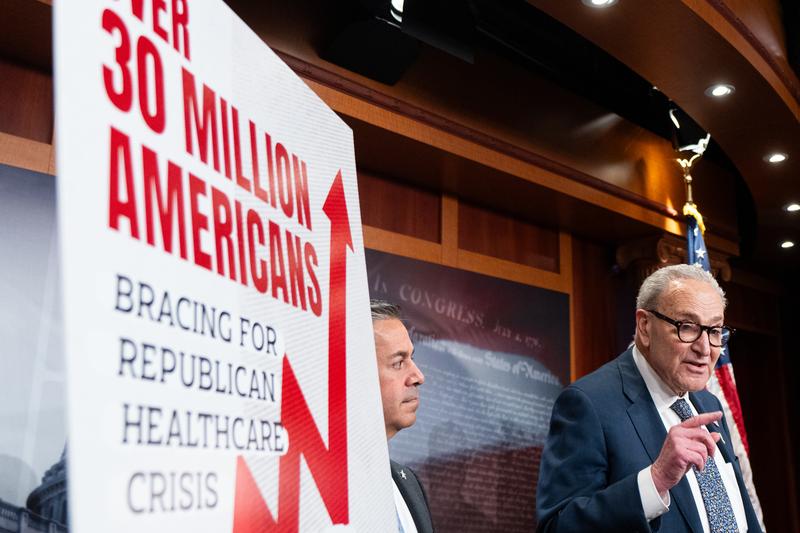
An estimated 22 million Americans get health insurance from the exchanges, as many of you know, or are experiencing yourself, premiums have been estimated to double compared to last year for a variety of reasons. Congress has not approved allowing the ACA subsidies to keep up with that. A bipartisan compromise we should say is still possible, but has so far been out of reach, and obviously, here on December 15th, it's getting late.
We'll talk now about the different visions for healthcare, and health insurance economics that Democrats and Republicans have. Also, what you are facing now as a shopper for health insurance, or for that matter as a health care provider, and the underlying causes of healthcare, and health insurance getting more expensive in the first place. Back with us for this is Julie Rovner, chief Washington correspondent for KFF Health News, and host of the weekly podcast called What the Health? Some of you know she was an NPR health reporter before that. Julie, we always appreciate your time. Welcome back to WNYC.
Julie Rovner: Thanks for having me.
Brian Lehrer: Listeners, help us report this story, or reach out for help understanding the situation if you need help. Anyone out there right now facing this signup deadline today, and unsure what to do, or anyone else with a story, a comment, or a question. 212-433-WNYC, 212-433-9692. You can call, and you can text. Julie, could you explain first in this case, because I'm not sure everybody understands it. Not sure I understand it totally. It's confusing. What exactly is today the deadline for, and for whom?
Julie Rovner: Well, you actually explained it pretty well. If you buy your own insurance on one of the Affordable Care Act exchanges, today is the deadline to sign up for coverage that starts January 1st. Open enrollment, as you say, continues until the middle of January, but anytime you sign up after today, your insurance coverage won't start until February 1st, so it's always a month in advance.
There's actually about 24 million people, at least as of last year, as of 2025, who buy their insurance through the exchanges. About 22 million of them get these tax credits from the federal government. The other thing I think that confuses people, is that not all the tax credits are going away, but the additional tax credits that Congress added in 2021 during the COVID pandemic expire at the end of December, so while premiums are only going up about 20%, people's out-of-pocket costs, the share of the premium they pay, is going to go up quite a bit, and that's are going to see their required payments more than double. It's a little bit semantically confusing, but bottom line is, if you're paying-- Whatever you're paying this year, you're likely to pay a lot more next year.
Brian Lehrer: With the deadline of today, do people have to pay for their policies today in whole, or in part if they want coverage on January 1st?
Julie Rovner: Yes, they have to pay for their first month's coverage. It's all charged on a monthly basis.
Brian Lehrer: I think this widely cited stat about premiums on the ACA exchanges doubling, and you just explained some of it, comes from your organization, KFF Health News. Can you explain in a little more detail what you were measuring?
Julie Rovner: Yes, it actually comes from my colleagues at KFF. We're the journalism arm, they're the analysis arm, and they're the ones that do these very complicated analyses, but basically what they have found is that, overall premiums are going up about 18%, and premiums are going up across the spectrum. Employer premiums are going up, Medicare premiums are going up, so health care is more expensive, which, for a variety of reasons which we can talk about, so premiums in the Affordable Care Act exchanges are going up.
Another reason that the premiums are going up, or a reason that they're going up more in the exchanges than maybe somewhere else is, because insurers are assuming that because these out-of-pocket costs are going to spike, a lot of people, a lot of healthier people will drop their coverage, and so the pool of people who are covered will be sicker, and therefore, they need to charge higher premiums to help offset those extra costs, because they don't have as many healthy people to spread it over.
That's, I think about 4 percentage points of that 18-point increase. What's going to cause the out-of-pocket costs for people to-- For most people, is the rolling back of the federal help. It's just who pays how much of the actual premium. It's shared right now between the individual and the federal government through these subsidies, and the federal government is going to make those subsidies less, so individuals are going to have to pay more. The insurance companies, I should point out, are not going to get more money. They're just going to get it from a different source.
Brian Lehrer: Do you have an estimate of how many Americans this will cause to conclude that they cannot afford the health insurance anymore, and be newly uninsured next year?
Julie Rovner: Well, the one estimate that we have comes from the Congressional Budget Office, and they estimate that four million people will drop their insurance, but that's over the next 10 years, so we don't know exactly for next year how many people will end up dropping their coverage. We do know simply from behavioral analyses that it's the people who think they need it the least who are going to drop their coverage, so the people who are healthiest, and the people who are sickest are the people who are going to do everything they can to hang on to their coverage, because they need it so badly.
Brian Lehrer: Here's a person calling who is apparently undecided about whether to renew their policy. Maybe in none of the categories you just cited as the most likely to drop it. Susan in Manhattan here on WNYC. Hi, Susan, thank you for calling in.
Susan: Oh, of course. Thank you for having me.
Brian Lehrer: Tell us your story.
Susan: My story is I'm self-employed, and so I buy my insurance on the marketplace. I'm going to be 62 in a couple of months, and my husband and I are pretty healthy. We are just trying to figure out and crunching the numbers if we could possibly do this. I also have heard, and I this was one of the things I wanted to clarify, is that there's pretty extensive penalties if you calculate your income incorrectly.
If we do it wrong, not only do we have to pay back the subsidies, but we would have to-- Any subsidies we get. Now work, we make about $95,000 between the two of us, so it's not like it didn't look like I got any subsidies whatsoever if I calculate that amount. If I'm wrong, then I'm penalized on top of it, and this was for really crappy insurance. This is for insurance that I still have almost a $4,300, I think dollar deductible. It was still up to $20,000 out of pocket. I'm trying to figure out, is it worth a quarter of my income in just paying the monthly premiums, and then on top of it, [chuckles] have to maybe come up with more money if I get sick?
Brian Lehrer: Julie, talk to Susan.
Julie Rovner: Everything she said is correct. This is a little known piece of the big budget bill that Congress passed last summer that basically increases penalties for people who misestimate their income. Obviously, even if you have a regular, a salaried job, you don't necessarily know in advance how much you're going to earn next year, and yet, that is what is required. You are required to estimate in order to get these subsidies on the Affordable Care Act.
Yes, if you're over $60,000 a year for an individual, or it's about $100,000 for a family of three, so it's right around where the caller is. For a family of two, you're likely to lose your entire subsidy, because that was one of the things that Congress changed in 2021, is they took the cap off of income for people who could get help, so a lot of people could get help for the first time, if it was-- If the premiums were more than 8.5% of their income, which for a lot of people they are. That's what's going to-- About to happen.
Also, older people can be charged more, so it's people in their 50s and 60s who are buying their own insurance, who earn just over that threshold, who are going to be hit the hardest, so this caller ticks a lot of the boxes of people who are going to be hit the hardest by these changes.
Brian Lehrer: Susan, what do you see as your alternative to re-upping for more money on the Obamacare exchange?
Susan: I'm not seeing any positive upside of keeping our health insurance. I've looked into a little bit that Amazon has a plan, where you can at least do a Teladoc visit for, I don't know, $60 or something. I thought, "Well, I guess if we got something that we could do a Teladoc visit, we could do that." Then, the other option is, I see that at New York Health and Hospitals there is a-- It looks like they have a sliding scale thing going, where you can pay for a doctor's visit, or you can pay out of pocket, but it's almost like you're getting an insurance pricing on it, versus just paying cash, just paying up front.
I don't even know. I've looked into that a little bit, and I can't even quite get a hundred percent if that's an option. I live here in Manhattan. There's a hospital 10 blocks away from me, and I thought, "Well, I guess if that's the worst case scenario, my husband and I can go there and pay a sliding scale fee," but it's hard at six-- I mean, I'm almost at the age where it's like, "Well, things could really start going wrong." [laughs]
Brian Lehrer: You said you're 62.
Susan: I don't want it to.
Brian Lehrer: You have three years before Medicare will take this problem off your plate, presumably, but I'm getting nervous just listening to those options. Julie, do you want to say anything about somebody like her? I don't think you're in the business of giving individual health insurance advice, but to go uninsured, and hope to fall back on one of those other systems.
Julie Rovner: That's what a lot of people are looking at. There really aren't a lot of other options. It really is-- This is why the Democrats have been sounding this alarm all year that these subsidies are going to-- When they put the subsidies in for the first time in 2021, it doubled enrollment in the Affordable Care Act. It made it much more affordable for lots of people, and lo and behold, lots of people signed up.
Now you have these 24 roughly million people who are seeing their costs skyrocket, and trying to figure out what to do. There are also community health centers. They're all around New York City, I know, and around most of the country. I mean, there are places that people can go, but generally they're for people who either aren't working, or have very low wage jobs. I mean, they're not intended for people who one would expect to have health insurance, and yet we now are going to see these millions of people who simply can no longer afford their health insurance.
Brian Lehrer: Susan, good luck making your decision.
Susan: Thank you.
Brian Lehrer: I guess you are literally deciding here on deadline day whether to sign up again by midnight tonight, right?
Susan: I am. It's like that, or put money in my retirement account and get ready for that. It's definitely very awful that they're putting so many people in this position. We're not big money people, but we make a living. It's like, yes, she's right, we should be able to afford health insurance.
Brian Lehrer: Can I ask you one more question? If you're comfortable with it, and if you didn't already say, and I missed it, the actual dollar amount that you would have to pay for next year, or per month to stay on your current ACA plan?
Susan: Yes, it looked like when I calculated the numbers with what we made last year, because that's the other thing. I don't even know what I've made this year yet, 2024-- I mean, 2025. To calculate 2026, so I calculated it of what I made last year at 2024, and it was almost $2,000 a month, so that's $24,000 for my husband, and then we still have to pay out of pocket.
Brian Lehrer: Unbelievable for your deductibles and everything. Susan, thank you very much for sharing your story. I think it was very instructive for other people. Good luck making whatever decision you make by tonight. Julie, there are some of the numbers, right? Because probably some people listened to the beginning of that call and thought, "Well, why should somebody, or a relatively small household making around six figures, practically six figures, get taxpayer subsidies in the first place?" I think that's part of what the Republicans say, and there were the numbers, $24,000 a year out of a $95,000 household income. Wow.
Julie Rovner: Exactly, and I think that's what people are-- A lot of these people who say, "Oh, you make this much money, why are you getting help?" Well, remember, it's not based on how much money you make. It's based on what percentage of your income your health insurance premiums are, so there's a natural dropping off point, at the point at which the premiums are less than 8.5% of your income, you're responsible for it. There are a lot of people who make $95,000, a $100,000, a $150,000 for whom these premiums really are than 8.5% of their income, and we just heard from one of them.
Brian Lehrer: Jordana in Manhattan, you're on WNYC. Hi, Jordana.
Jordana: Hi, Brian. I am just calling, because I have an employer-based plan. I also pay all of my premiums out of pocket, and that winds up being just over $20,000 a year for my husband and I. We just learned that despite our incredibly expensive, and already a high deductible plan as well, UnitedHealthcare is going to possibly stop covering any services with Cornell Weill and New York Presbyterian Hospital, which is all of our doctors. I know is true for a ton of people all over the city. This is a huge health insurance provider in the city, and they're currently in negotiations, and they say they will let us know as of January 1st that they may not be covering any of it.
Brian Lehrer: As of January 1st, and today's the deadline to sign up if your policies are on the Obamacare exchanges for whatever health insurance you choose. Is one of the choices you're facing whether to stay with a UnitedHealthcare plan that might be an exchange policy, or to move to some other company that's offering exchange plans, so you don't take that risk?
Jordana: I'm not even on the exchange. I mean, this is an employer-based problem, and I guess I wanted to just point that out that this is a-- The problems of our health care system are absolutely hitting everybody, so our premiums go up at least 12%, 15% every single year. Again, I pay my premium completely even though it's an employer plan. Our employer only uses UnitedHealthcare. Right now, that's our only option. It'll renew on February 1st.
I have a whole bunch of doctors' appointments scheduled for January that I may not be able to go to, because they simply won't be covered, and I won't even know. They haven't even told us if this negotiation is going to happen. They've already said the Medicare Advantage plan through UnitedHealthcare already they know will not be renewed with New York Presbyterian, so anybody in your listeners who has a Medicare Advantage plan with UnitedHealthcare or Oxford should know that if they are seeing doctors, they're not going to be covered.
Brian Lehrer: Jordana, thank you, and I can see even through the medium of radio so many heads nodding up and down out there saying, "Yes, me too." Thank you for alerting people to this, alerting more people to this. Julie, you're the chief Washington correspondent for KFF Health News, so I don't know if you're in touch at all with this negotiation that's taking place that would affect so many New Yorkers with Cornell Weill, and New York Presbyterian, but this kind of thing happens elsewhere too, where the health insurance plans, and the large hospitals and other provider groups have these high wire negotiations as to whether they'll even continue to have relationships with each other. What insight can you give us, as to what may be going on behind the scenes here, or what people like Jordana should do?
Julie Rovner: Well, this is nothing new. I just got a letter from my insurer that says they might break up with Tenet Healthcare, which basically runs all of the outpatient surgery centers in the Washington area. Again, they haven't said whether they're going to. I also have employer-provided insurance. These provider-insurer fights go on constantly, and it does leave the consumers hanging, particularly, in places like New York City where there are some of these very large provider networks.
If the insurer decides that they're no longer-- That they basically can't come to a deal with the provider networks, then it leaves the consumers high and dry. One of the reasons I think we're looking at another big national health insurance debate in the coming year is, because I think so many people who thought who have good insurance, are so frustrated by things like this, by their insurers suddenly saying, "Hey, we might not cover all the doctors that you've been going to for the last 10, 15, 20 years," or, "We might not cover your local hospital," or, "We might not cover this drug that you've been taking."
I think everybody is frustrated. Providers are frustrated with insurers, insurers are frustrated with providers. Nobody is happy with the way the system is working right now.
Brian Lehrer: Why are employer plans going up? If the central conversation in the news, the central conversation that we've been having so far is about the ACA, or Obamacare exchange policies with the government subsidies involved, and if those subsidies, the extended version of those subsidies lapse, people's premiums are going to be going up a lot. Employer plans, like the caller says, are going up a lot too. Why in that case?
Julie Rovner: Because health care costs are going up. Health care spending is going up. Both prices and spending are going up. We have an aging baby boomer population that, as the earlier caller mentioned, as people get into their 60s and 70s, they use more care, and it becomes more expensive. We have a lot of consolidation in the healthcare provider world that gives them the ability to negotiate higher prices, which is why the insurers are fighting with them.
Because the insurers don't want to be raising premiums, because then they're going to either lose market share, or lose their customers. We are basically the only major industrialized country that doesn't control the price of health care somehow. I hear all these complaints about overregulation, but every other country regulates health care like a public utility, and the United States doesn't, and because of that, we pay a fifth of our GDP to our healthcare system.
Brian Lehrer: Sure enough, a listener texts, "Why is it always about government subsidies, and not about lowering the actual cost of insurance, and regulating it that way?" What do you say to that listener?
Julie Rovner: Because Congress has always-- The few times they have stepped in to either regulate, or try to force down prices, there's pushback from the very powerful health sector of the economy, and they usually back down. When the Affordable Care Act was passed, there were a whole number of different taxes that were supposed to be paid by different pieces of the healthcare industry, and one-by-one, they all got rolled back, [chuckles] so now the only thing that's left pretty much is the general fund that's paying for the Affordable Care Act.
Brian Lehrer: Let's take one more call from somebody considering what to do today, or I see in this case advising someone else about what to do on this deadline for signing up for January 1, 2026, Obamacare policy, and then, Julie, you and I will get more into the actual politics of what's going on in D.C. in Congress, where they still might come to some kind of compromise, but Julia in Cape Cod before we do that. Hi, Julia, you're on WNYC.
Julia: Hi. I have a 26-year-old son who just aged out of our health insurance, and we spent hours going through his employer-backed insurance to try and figure out how to get him insurance. He makes $65,000 a year living in New York City with a four-story walk up, and it was going to cost him $9,000 to $10,000 before he saw a benefit between his co-pays and all of the other stuff that they do. I actually had to advise my kid to, instead of putting money into an employer-backed plan, put it into his own bank account, so he would be able to go to the emergency room if he needed to.
Brian Lehrer: Wow, how tough a call was that for you?
Julia: Oh, it was awful. I spent the last 26 years worried about this. He is-- This is the most important thing that this country can do is to figure out health care.
Brian Lehrer: Julia, thank you for your call. Again, I'm shaking like with the first caller, Susan, who was 62. I was shaking with nerves just hearing her story, and the prospect of her going uninsured, and trying to cover everything out of pocket, and with sliding scales at public hospitals and things like that, and now I'm having the same reaction hearing about this 26-year-old who's not going to have any insurance.
Julie Rovner, here we go, right? I mean this is part of the underlying structural issue, I think even with Obamacare, and Julia was talking about an employer plan which is not Obamacare, but the original Obamacare law required everybody to have insurance, and that included young healthy people like this 26-year-old is probably healthy, and that's why he's willing to take that risk, and his mother is advising him to take that risk of not being uninsured, but without those people also paying into the system, then it becomes much more expensive to cover the older people who are going to need more care per insurance dollar, right?
Julie Rovner: That's exactly right. The difficulty is, and this is one of the problems that Congress has had over the years with making income cutoffs is that, your income gets you different things in different places. I know how expensive it is to live in New York. I have a niece who lives in a walk-up in Brooklyn. It takes a lot. People say, "Well, you don't have to live in New York City." Well, a lot of people do, and they want to, and they're working hard, but it's really hard to afford things like health insurance.
That was why Congress expanded the subsidies in 2021, and it did make it a lot more affordable for a lot of people, but it's true. I mean, this young person, of course, it's only because of the Affordable Care Act that he was able to stay on his parents' plan until he was 26. They used to kick kids off at 18, or if they were-
Brian Lehrer: That's right.
Julie Rovner: -college at 22, so that enabled a lot of young people to get their start with jobs that maybe don't offer health insurance, or maybe offer health insurance that's too expensive, and stay on their parents' plan for a while, but at some point, they have to go on their own. This is the tricky point where it's just impossible for people to afford, because things have gotten so expensive compared to the cost of living.
Brian Lehrer: When we come back with Julie Rovner, chief Washington correspondent for KFF Health News, and host of their weekly podcast, What the Health? We will get into the situation today in Washington. They are still trying to figure out a solution, so millions of Americans don't drop their health insurance starting January 1st. Like it's been too easy just in this last half hour to find callers who are getting ready to do that, so stay with us, as we come back and talk about the politics of this.
[MUSIC]
Brian Lehrer: Brian Lehrer on WNYC, as we continue with Julie Rovner, chief Washington correspondent for KFF Health News, and host of their weekly podcast called What the Health? As we talk here on deadline day for signing up for, and paying for the first month of the 2026 health insurance policy. If you get your health insurance from the Obamacare, or Affordable Care Act exchanges, at least for January, there is a second opportunity, and that's by January 15th, but then your insurance wouldn't kick in until the 1st of February.
Now, we're going to look at some of the politics, and I'm going to start this with a couple of clips that NPR played yesterday on Weekend Edition Sunday. These are clips of Donald Trump. The first one is from 2011 on how when he was asked Republicans would replace the Affordable Care Act.
Donald Trump: I will fight to end Obamacare and replace it, replace it with something that makes sense for people in business, and not bankrupt the country.
Brian Lehrer: Without saying what that was, and here's the one from just recently.
Donald Trump: I really believe we can work on health care together, and come up with something that's going to be much better, much less expensive for the people, less expensive for our nation.
Brian Lehrer: Julie, the point is obvious. He's never had an actual plan to replace the ACA. He's saying the same thing in 2025 that he was saying in 2011. "We can come up with one." Does he have one?
Julie Rovner: Nope. He almost had one a couple of weeks ago, and it involved extending these additional tax credits. I believe it was for two years, and the pushback from Republicans on Capitol Hill was so enormous and immediate that the White House actually backed down, and did not unveil it, so as far as we know, there is no White House plan. The Republicans are very divided about this.
You have a lot of Republicans, who, as Speaker Mike Johnson said last week, have never voted for anything that accept a repeal, or a change to Obamacare. They don't want to extend those subsidies. Then, you have a number of Republicans who say, "These are our voters. These are Republican voters in many of these states who are now on these plans, and looking at these huge increases, and they're coming to us asking us to do something about it." They are still quite torn here.
Brian Lehrer: The President, when he does say something specific, he tends to say, "Give money to people, not insurance companies." Maybe our listeners have heard versions of that soundbite in the last few weeks. "Give money to people, not insurance companies." Do you understand what difference he's talking about?
Julie Rovner: Yes, he's kind of parroting what's happening on Capitol Hill, where one of the Republican aims over the past really 20, 30, 40 years has been to have people have more skin in the game, if you will, have them spend their own money, rather than have insurance reimburse things, and that way they could theoretically have a better idea what things cost, and perhaps, negotiate those prices.
Although, as we've talked about earlier, even some of these huge provider networks are having trouble negotiating prices. It's hard to imagine how an individual could very effectively negotiate the prices of health care, but some of the proposals on Capitol Hill involve putting money into health savings accounts for people, and have them spend at least the--Originally, you would have a couple of thousand dollars in your health savings account, and that would basically get you up to your high deductible, so you could have some responsibility for your routine costs, and then if something really bad happened, you would have insurance to cover it.
Now, we're seeing these huge spreads. They're talking about putting a $1,000 or $1,500 into a health savings account with, as we've heard, plans that have deductibles of $7,000 or $8,000 or $9,000. Well, that's not going to get you very far even if you can control the first thousand dollars of what you pay, where are you going to come up with that $7,000 or $8,000 before your insurance actually kicks in? This is getting more impractical as the amount of deductibles goes up.
Brian Lehrer: That phrase you used in that answer, "Skin in the game," does that suggest that the Republicans think that Americans are getting too much health care, because they don't have to pay enough out of pocket, and feel that pain personally because of health insurance?
Julie Rovner: Yes, and this dates back to when it really-- When there was a lot of first dollar coverage. The concern was that patients had no reason to worry about what care costs, because they would have $100 deductible, and then their insurance would cover everything. Then, we used to have co-insurance, where you would pay your deductible, and then you would pay a percentage of what the rest of your care costs.
That made people aware of what it costs, because if you have to pay 10% of a really big bill, that's a whole lot of money. Then, for a while, we had co-pays which were flat payments, where you would pay $10, or $20, or $30, and again, it didn't matter what the care actually cost, because that wasn't your problem, so this has been this tug of war over a long time, an ideological tug of war about how much people need to be aware of how much the care that they're consuming cost.
Brian Lehrer: Take me more into what the Republicans in Congress want. You made a little bit of a distinction there between what President Trump proposed that they rejected. Let me assume that Republican Senator Bill Cassidy of Louisiana, an MD is a serious person in this regard. You can disagree if you don't think so. Is there a Bill Cassidy-led vision for health insurance reform that you can describe and explain?
Julie Rovner: There's a-- Bill Cassidy is a very serious person, very serious legislator, and I don't doubt that he is trying to find a middle ground here, but it's really hard, even what he's proposing, because it would be way too expensive I think, to do his vision of what he would like, which as I said, is what these health savings accounts were originally meant to be, which was to fund much of, or most of your deductible, so you would have some responsibility over how much you were spending on care, unless something serious happened, and you needed the insurance, and it would kick in.
Right now, what he's proposing is such a small amount of money compared to how much the deductibles are, that these people-- Most people don't have $3,000, or $4,000, or $5,000 to bridge that gap between what would be put in this health savings account, and what their actual deductible is.
Brian Lehrer: On the politics, given what you said earlier, and I see the numbers, I think these come from KFF, or KFF Health News as well, that disproportionately, the people who get their health insurance on the ACA exchanges live in Republican districts in the country. Given that, do you see a compromise by the end of the year, so that Republicans, from their perspective, don't suffer fallout in the midterm elections?
Julie Rovner: Well, basically, we only have a week, so I don't think I see anything before the end of the year. The real question is, are they going to maybe come back in January having a little bit of buyer's remorse? As you point out, a lot of the increase in enrollment when the Democratic Congress and Democratic President made the subsidies more generous, a lot of the increase came in Republican areas. It came in states like Texas and Florida and Georgia and North Carolina.
We also know that a lot of people who are self-employed, farmers and ranchers, and small business people are also disproportionately Republican, so as I said earlier, there's a lot of Republicans who are worried, because they're hearing from their voters that their costs are going up so much, and that was not, I think, something that Republicans thought was going to happen when the Affordable Care Act originally passed. They thought it was going to be mostly Democratic constituencies, and that is not the case.
Brian Lehrer: I think we have time for one more call. Barbara on the Upper West Side, you're on WNYC. Hi, Barbara.
Barbara: Yes. Hi, nice to meet you. I'm an American from New York City, but I live in France, and I'm in the French system, which is a public system. When you go to the hospital, you're covered completely, but if you go to see a doctor, you're covered about 80%, and you top it up with private insurance, and the system. My question is always, why does France spend just 12% of its GDP on health, and the United states spends between 17% and 25% for much less return?
I think that's a question everybody has to ask themselves, why things are so much more expensive. I've even had personal experience where I've been in the States for a few months and had some health problems, and had to pay out quite a bit, and when I went back to France, I had all my papers with me, and I went to see a doctor who is representing what they call Social Security there, and she said, "Clearly, you've had a problem. We will reimburse you 100%, but at French prices," and everything was one-third as expensive, the MRI, the other.
I think that's something Americans have to think about. Why is the health care system so expensive? I think there are other ways of organizing society, and I think you have to ask yourself what kind of a society you want, and if you are in society, maybe we all are responsible for each other in the sense, and it's not just philanthropic, because as you get older, you need more health care, but when you're younger, you're putting into a system, knowing full well that when you're much older, you're going to benefit from it much more.
Brian Lehrer: Barbara, thank you, and thank you for that international comparison. Julie, we have time for one more answer from you. That was pretty revealing.
Julie Rovner: Yes, and I said it earlier, we are the only major industrialized country that doesn't control prices. Europeans, they all have different systems, some of them are public, some of them are public-private hybrids like in France and Germany and Switzerland, but they all have one thing in common, which is, that they don't let providers charge whatever they want. The providers in the United States are extremely politically powerful, and Congress and the President have just never had the will to actually do it, and that's why we spend so much.
Brian Lehrer: The providers are incredibly powerful. I guess that's the answer to this text that came in from a listener. Says, "Excellent segment with Julie Rovner on health care, but when she says nobody is happy with health insurance today, I must differ. Obviously someone is happy with it, or we would have a better system." Well put. Right? The answer is the providers.
Julie Rovner: Yes, although I don't think the providers are that [chuckles] happy right now either. I think that's why we might see something of a groundswell for some kind of change. Even the providers, I think are frustrated right now. Yes, there are a lot of people getting rich, but even some of the people who are getting rich don't think that the system is working very well.
Brian Lehrer: Julie Rovner, chief Washington correspondent for KFF Health News, and host of their weekly podcast called What the Health? We always appreciate when you come on. So informative. Thank you very much.
Julie Rovner: Always a pleasure. Thanks for having me.
Copyright © 2025 New York Public Radio. All rights reserved. Visit our website terms of use at www.wnyc.org for further information.
New York Public Radio transcripts are created on a rush deadline, often by contractors. This text may not be in its final form and may be updated or revised in the future. Accuracy and availability may vary. The authoritative record of New York Public Radio’s programming is the audio record.
