
The Last Mayoral Debate: Recap Part 2
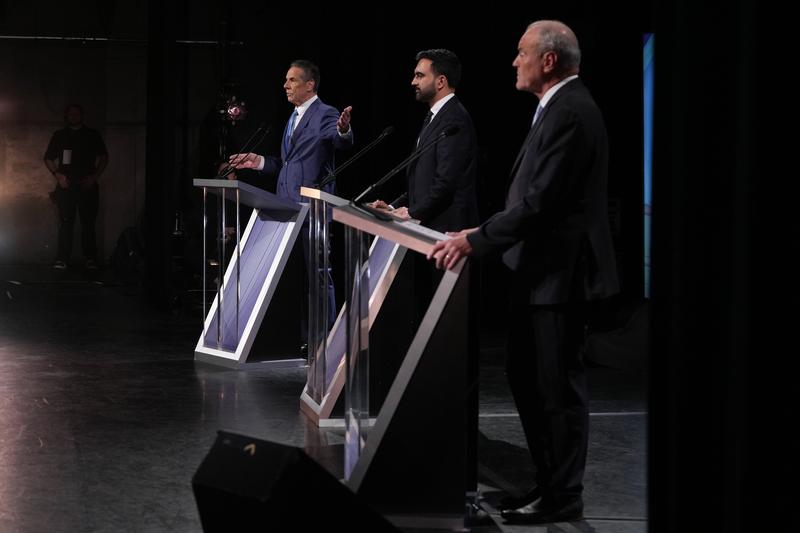
( Hiroko Masuike-Pool/Getty Images / Getty Images )
[MUSIC]
Brian Lehrer: It's the Brian Lehrer Show on WNYC. Good morning again, everyone. One more segment on the WNYC mayoral debate last night. Then we'll exhale on this last morning of the membership drive with one more 10-question quiz, which we've been doing every day, where if you get two in a row right, you can win a Brian Lehrer Show baseball cap, or our new WNYC tote bag that says "You Can't Defund The Truth." Make it true.
Today's topic for a little bit of nepo baby fun in the quiz will be a Famous People and their Famous Parents quiz. That's coming up. As many of you know, every Wednesday during the mayoral campaign, WNYC political reporter Elizabeth Kim has been coming on with us. She was on yesterday, Wednesday, as usual, when Brigit Bergin filled in for me as I was getting ready for the debate. She is back with us now for a special Thursday bonus appearance for you all because of the debate. Happy Thursday, Liz.
Elizabeth Kim: Happy Thursday, Brian. Great job on the debate last night.
Brian Lehrer: Thank you very much. What I really want to do in this segment, as you know, is replay the climate section of the debate that I felt very strongly should be in there, and we got it in there. You want to talk about the little breaking news first? Just in the last few minutes, I saw The Times was reporting that Eric Adams is going to endorse Cuomo.
Elizabeth Kim: That's right, Brian. The Times has reported that they spoke to Eric Adams, Mayor Adams, in an interview. Yes, he said that he will endorse Andrew Cuomo. Now, this is not that much of a surprise because Cuomo himself teased this endorsement by appearing courtside with Mayor Adams at a Knicks game last night, immediately after the debate. The real question people were asking was how did he get there that fast? Yes, this is not a complete surprise. The mayor himself--
Brian Lehrer: We were aware, by the way, that he scooted right out. Some of the teams stay longer, and take questions, and they want to spin it, and everything. He was right out the door. We heard shortly thereafter that he wound up at Madison Square Garden.
Elizabeth Kim: [chuckles] Right. This seems very much choreographed--
Brian Lehrer: To sit with Eric Adams.
Elizabeth Kim: Yes, to sit with Eric Adams, to smile for photos, and have those photos put out on social media. Here we are. The mayor himself had said, after dropping out, that he would consider weighing in on the election. He's made no secret that he does not want to see Zohran Mamdani win. The question, I guess, was whether he would really do it. He answered it. It's interesting--
Brian Lehrer: I don't want to linger on this too long, because we only have as much time as we have. Didn't the polls, the latest polls, indicate that Cuomo had basically already picked up all of Adams' previous support, or almost all of it?
Elizabeth Kim: That's right, Brian. You did see a surge of contributions go Cuomo's way once the mayor dropped out. The mayor himself has seen his base really erode. You see that through the approval ratings, which is in the single digits. What I will say, though, is in that Times story, the mayor said that he wanted to go out on the campaign trail and especially hit Black neighborhoods in New York City.
I've said it before on your show, the mayor is a very talented retail politician. I do wonder, with whatever powers of persuasion that he still has, whether he can maybe move the needle a little bit in terms of getting out the vote, getting out the Black vote for the former governor.
Brian Lehrer: Listener reminds us in a text message that it was very recently when Adams called Cuomo a snake [chuckles]. I guess it's like dropping out of the race, right? You won it until you do.
Elizabeth Kim: Right.
Brian Lehrer: All right. As I've been saying, one of the things I really wanted to do last night was moderate a segment on climate change and the City's climate law, which I think have gotten short shrift in most of the coverage this whole campaign season. Now, listeners, we're going to re-air that five-minute section of the debate because we know many of you listening in the morning were not listening at night.
I focused on the tension between the burden that New York City apartment dwellers will face because of the law and their responsibility, the City's responsibility to reduce emissions. You may also be surprised by at least one position that Zohran Mamdani takes toward the end of this. It begins with my question.
The city has a climate law, Local Law 97, that will require a large percentage of the buildings in the city to reduce greenhouse gas emissions by 40% by 2030 or face financial penalties. As you know, some co-ops, condos, and landlords are afraid of crushing expenses, but buildings account for 70% of the city's climate pollution emissions. Reduction would need to include that sector.
You all have taken different positions on this. I want our viewers and listeners to hear each of you, starting with Mr. Cuomo, in this case. Would you abide by and make others abide by Local Law 97 as it stands?
Andrew Cuomo: As it stands, you're going to have to be flexible in the application. What's going to happen now is many, many companies will just pay the fine because it's cheaper than actually following the rules. That's the last thing you want. That accomplishes nothing. It's just another tax, in essence, on these units. There's going to have to be flexibility. It's the right intent, it's the right goal, but how you implement it has to deal with reality and the costs. Again, otherwise I can tell you I've had this conversation with many of them. They're not even going to try. They're just going to pay the fine.
Brian Lehrer: What kind of flexibility?
Andrew Cuomo: It's going to be timing, and what do we mean, and can it be phased in?
Brian Lehrer: Mr. Mamdani.
Zohran Mamdani: The climate crisis is one of the most pressing crises facing this city, and we deserve to take it on with the urgency it requires. It is right now easier to pay the fine than to actually comply with this legislation. We have to ensure that we make it easier for condo and co-op owners to follow these laws. We do that by eliminating the application fees for J51, by extending that tax credit, but also creating a one-stop shop in New York City government that procures, at a large scale, heat pumps and the very kind of infrastructure needed to comply.
We've seen this happen before with clean energy work that's been done in Woodside houses. It's time to bring that kind of work right here so that we can ensure full compliance with Local Law 97.
[applause]
Brian Lehrer: I read that you're proposing the City buy those heat pumps and other tech in bulk and give them to landlords and other buildings for free. Is that accurate?
Zohran Mamdani: No, it's to actually ensure that they can afford the cost of these things by purchasing using an economy of scale.
Brian Lehrer: Thank you, Mr. Sliwa.
Curtis Sliwa: I'm the only one on this stage totally opposed to Local 97. 100,000 condo and co-op owners, their maintenance fees will go up 30%. They won't have enough reserve fees. You're going to see massive flight from the co-ops and condos. Now, they want to electrify everything. Well, there's a man on the stage who took Indian Point offline. That was 25% of our electrical output. We haven't been able to meet the need since.
As a result, they're now starting to build because of the City of Yes, that I'm opposed, these lithium-ion battery warehouses. Where? Staten Island 38, Brooklyn 12, 8 in Queens, 4 in the Bronx, and none in Manhattan. Oh no, they're going to electrify, and they don't have the electrical output. I say no to Local 97. When I'm mayor, I tell all my commissioners for a monkey wrench into the process, we slow it down because we want these condo owners and co-op owners to stay.
Brian Lehrer: Mr. Cuomo, you were name-checked on Indian Point.
Andrew Cuomo: I think I was. Indian Point was a danger. It was the nuclear power plant most closely located to the densest population. There was no nuclear plant on the globe that close to a city. There were 20 million people in what was called the Kill Zone. Before I became Attorney General, there had been a number of lawsuits to stop it. What we did is we brought cables down from upstate New York down the Hudson River. We have nuclear upstate, we're in rural areas to bring that nuclear power down the cables and then on that basis substitute for Indian Point's power.
Brian Lehrer: Yes or no, whenever [crosstalk]--
Curtis Sliwa: You see rates are too high to pay because of you, Andrew Cuomo. I hope you know what you're talking about.
Brian Lehrer: [crosstalk] new nuclear power plants to help bring down the rising cost of utilities in New York State. Just yes or no, Mr. Sliwa.
Curtis Sliwa: Upstate, they are already starting.
Brian Lehrer: Yes, Mr. Mamdani.
Zohran Mamdani: I think it's something worth exploring.
Brian Lehrer: Mr. Cuomo.
Andrew Cuomo: Is that a yes?
Zohran Mamdani: No.
Andrew Cuomo: Oh, yes.
Brian Lehrer: The climate and New York City climate law section of the mayoral debate last night. WNYC's Elizabeth Kim is with me to discuss that and some of the politics of the debate.
Interesting to me, Liz, in that climate exchange was that, with the rising utility bills in the city, the very end there they were all open to building new nuclear plants, including Cuomo, who closed Indian Point. Mamdani would consider it too, even though nuclear is not traditionally embraced by progressives. Did that surprise you?
Elizabeth Kim: Well, it was also interesting, Brian, in listening to that exchange, that you hear Cuomo kind of ask Mamdani first to make sure what was his answer. "You said yes?" I'm not sure whether that would have played into what his ultimate response is, but yes. My takeaway from that is this election has been so much about affordability, and this idea of rising electricity costs is shaping their answers on the subject of nuclear power, I'm not sure how the views around nuclear power have changed in communities. That, to me, is still an open question, right?
Brian Lehrer: Yes. I think that we really heard them from left to right. In this particular case, Mamdani wants to help them meet the law's requirements on time for reducing fossil fuel use in the city. It's important, as I said in the question, because it's 70% of the city's carbon emissions that come from buildings. Mamdani, if he can pull it off, wants to buy heat pumps and other green tech in bulk so that landlords and co-op and condo owners can afford to put them in in time to meet the 40% reduction in greenhouse gas emissions requirement in the 2030 law.
Cuomo talked about flexibility, letting them delay, things like that. Sliwa said he would repeal it altogether. We definitely heard left, center, and right on climate.
Elizabeth Kim: Although Sliwa, towards the end of his answer, and I thought this was confusing, was he says we have to slow it down. It did make me wonder, "Well, what does that mean? Does that mean that your answer is actually more alike, more similar to Cuomo's, that you want to give these landlords more time?"
Brian Lehrer: Well, I heard him say he was totally opposed. He said, I'm the only one on this stage who's totally opposed.
Elizabeth Kim: Yes, he says that at the outset.
Brian Lehrer: I heard to slow it down is if he's mayor, he's going to gum up the works-
Elizabeth Kim: I see.
Brian Lehrer: -and slow it down in that way. Let me touch one other thing because I know you reported on it and it's a big headline from the debate. It was Mamdani confirming a New York Times story that he would invite Police Commissioner Jessica Tisch to stay in that position if he's elected mayor. Yet I put a question to Mamdani about a position that I thought he disagrees with Tisch on, and he confirmed that, too, whether to treat 16 and 17-year-olds as adults more often in criminal cases.
Tisch said recently she wants to do that because those teenagers are not being held accountable enough for gun crimes, leading to more gun crimes. Mamdani disagrees with changing the age of adult responsibility and said so. They start out, as of last night's debate, with at least one issue between them if they're going to work together. Do you think Tisch would take the job?
Elizabeth Kim: I think that it's hard to believe that Mamdani would put out that story to The New York Times, less than two hours before the debate. It was obviously timed very intentionally. It's hard for me to believe that he puts out a story like that without having told Tisch that he's doing that. Tisch herself has told people around her that she is interested in staying on. She has herself said that this is her dream job. I would be a little bit surprised if all of a sudden if Mamdani does win and he offers the job to Tisch, and suddenly she says no. I think this was very, very carefully thought out.
My reporting has found that- sources have told me that Mamdani has been debating this for weeks, that this has been a subject that has divided his campaign, actually. Not everybody believe, not specifically on Tisch, but the idea that a candidate who has not won the general election would go ahead and name a high-ranking appointment such as police commissioner ahead of the election.
There are pros and cons. There are costs and risks to a strategy like this. One of his vulnerabilities is his inexperience. He has been attacked from the right on public safety. He was clearly seeking to neutralize these attacks heading into the debate and during- on the debate stage by making this very splashy announcement.
Brian Lehrer: WNYC's Liz Kim. Thanks, Liz.
Elizabeth Kim: Thank you, Brian.
Copyright © 2025 New York Public Radio. All rights reserved. Visit our website terms of use at www.wnyc.org for further information.
New York Public Radio transcripts are created on a rush deadline, often by contractors. This text may not be in its final form and may be updated or revised in the future. Accuracy and availability may vary. The authoritative record of New York Public Radio’s programming is the audio record.
