
The Last Mayoral Debate: Recap Part 1
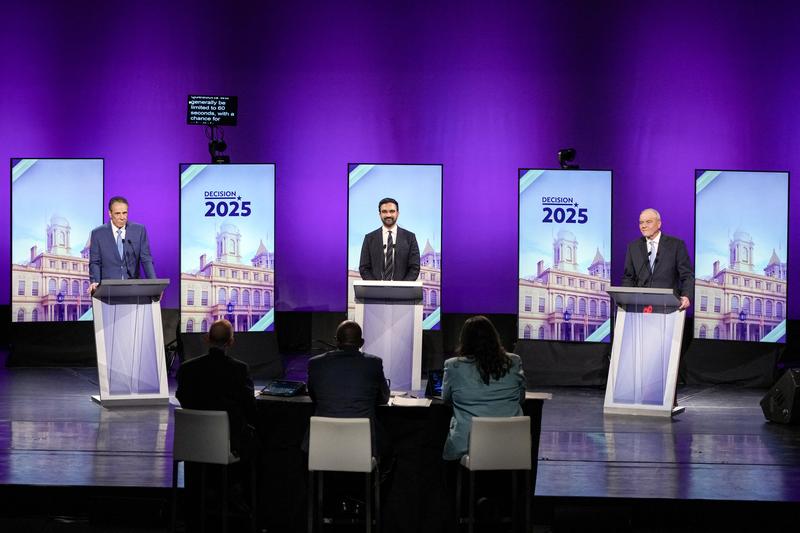
( Hiroko MASUIKE / POOL / AFP / Getty Images )
Title: The Last Mayoral Debate: Recap Part 1
[MUSIC]
Brian: It's The Brian Lehrer Show on WNYC. Good morning, everyone. It's the last morning of the membership drive and the morning after the WNYC mayoral debate. Thanks to all of you who have helped us try to show that you can defund an institution, but you cannot defund the truth. Thank you in advance for any last-day sustaining memberships or other donations.
We'll devote most of the show today to debate excerpts and analysis, and then we'll have one final membership drive quiz so we can all exhale with a little fun and hopefully give away a few more Brian Lehrer Show baseball caps and our new WNYC tote bag that says, 'You can't defund the truth." Our final quiz topic will be famous parents of famous children. Call it a Nepo baby quiz if you like, but famous parents and their famous children, some of them will surprise you. Let's get to the debate.
Let me say first that the station was honored as an institution, and I was honored as an individual to be selected to moderate this high-stakes debate along with NY1 and the publication THE CITY. Our senior political reporter, Brigid Bergin, who was good enough to fill in for me yesterday, as many of you heard, while I was out prepping for the debate, is right back with us in the guest's chair as our first analyst. Hi, Brigid. Thanks for yesterday and today.
Brigid: Glad to do it, Brian. Excellent job last night. Major kudos to you and Errol and Katie. It was such a great debate.
Brian: Thank you very much. The first excerpt I want to play is a question I asked last night about a shocking new statistic that I think isn't getting enough attention about child homelessness, child homelessness in the city. You will hear that this became one of the vehicles for a main message of both Cuomo and Mamdani versus each other, lack of experience versus experience not to be proud of. This begins with my question.
The cost of living is our next topic. You've all cited it as a major factor, and of course, so many New Yorkers are experiencing this, especially when it comes to rising housing costs. Many New Yorkers were shocked this week as a new report from the group Advocates for Children revealed that about 154,000 New York City public school students have been homeless at some point during the last year. 65,000 lived in homeless shelters.
Even more were in doubled-up situations with no home of their own. It's never been over 150,000 before, they tell us, and it amounts to 1 in 7 New York City kids. As mayor, how would each of you tackle this problem to help this vulnerable population? In this round, we're going to go Mr. Mamdani, Mr. Cuomo, Mr. Sliwa. Mr. Mamdani, you go first.
Mr. Mamdani: This is a stain on our city to see this many children in our public school system be homeless, and to know that this is the ninth consecutive year that it's more than 100,000 of those children. What we need to do is ensure that next year is not the same. We are going to do that by building the housing necessary, such that New Yorkers are not priced out of the city or forced to live in shelters. That's why my campaign is going to deliver 200,000 new affordable homes across the 5 boroughs, all while freezing the rent for more than 2 million rent-stabilized tenants.
Now, in the public school system, we also have a program called Every Child and Family is Known. It links a child who is living in a homeless shelter with an employee of the public school system. It also links that employee with the child's family. It's been shown to increase attendance records, self-esteem, a level of belonging in that school system. I am going to increase that pilot program to more than 200 schools, and we're going to do it because we have to deliver for these children.
Brian: Mr. Cuomo?
[[applause]
Mr. Cuomo: Yes. Zohran is a great actor. He missed his calling. Freeze the rent sounds great. Yes, it affects about 25% of the number of housing units in the city of New York. It's not a new idea. Bill de Blasio did it. It turned out to be a debacle, and it does nothing for 75% of the units. For the 25%, it just postpones the increase and actually causes us to lose units because landlords took them off the market.
Brian: I'm going to jump in and ask you to address the homeless children question, and we will get to rent freeze.
Mr. Cuomo: The answer to homeless children is you need more affordable housing. I'm saying freeze the rent was done under de Blasio. It doesn't work. It's a canard and just a great three-word slogan for TikTok. The way to increase availability of affordable housing is to build affordable housing. I was the HUD secretary. I did it all across the country. We have 1% vacancy rate. We're not building enough affordable housing, and you need a competent, productive government to do that. That's what I've done across the country, across the state, make government work. You get the supply up, the rents will come down.
Brian: Thank you. Mr. Sliwa?
[applause]
Brian: Mr. Mamdani, you were named, so you get 30 seconds.
Mr. Mamdani: We are in the 9th consecutive year of more than 100,000 children in the New York City public school system being homeless. That means it began when Andrew Cuomo was the governor. What did he do?
[applause]
Mr. Mamdani: What did he do about it? He did not do anything. He spent more money on a singing water fountain at LaGuardia Airport than he did on the average cost of an affordable housing unit. That is the record that we have in display. What we need is a change in the city, not more of the same.
Mr. Cuomo: If I may. The homeless issue, number of homeless since I left, has more than doubled during his administration and the state's administration. Since I left, homeless rate has more than doubled. When I left, the vacancy rate on housing was 4.5%. It's now 1%. This man never even proposed a bill on housing or education, never even proposed a bill.
[applause]
Brian: That excerpt from my child homelessness question and the Cuomo and Mamdani responses at last night's debate. Our senior political reporter, Brigid Bergin, is with us. Brigid, I guess child homelessness was as good a topic as any for Cuomo to knock Mamdani for lack of experience and Mamdani to argue that the content of Cuomo's experience is a reason not to elect him as mayor. Did you see that as a main theme, maybe the main theme of the debate?
Brigid: Brian, I think that that has been a main theme of this entire campaign, and it was absolutely on display during last night's debate. You heard repeatedly Cuomo invoking his experience as the HUD secretary, as governor of New York, being able to deliver on these large-scale capital projects like LaGuardia Airport, the Second Avenue Subway. Then hearing Mamdani's response saying New Yorkers are very well versed in your record, and they're looking for something different.
He has spent some time in the assembly, he's also spent a lot of time listening to New Yorkers and listening to what they say they are looking for in their leader, and that's how he has crafted this affordability agenda. They were going at each other in some very sharp exchanges last night, but that question of the type of experience New Yorkers are looking for in their next mayor was brought into sharp relief.
Brian: Also joining us briefly before we play our next excerpt is WNYC housing reporter David Brand on this. David, are you in the weeds enough to fact-check Cuomo's claim that when he left office, the apartment vacancy rate was more than 4% and now it's only 1%? He was defending against Mamdani's argument that he was a failure as governor on child homelessness, that it really got so bad after his tenure.
David: Hey, Brian. Yes. First off, great job last night. You, Errol, and Katie did a great job getting some good answers and some good conversation between the candidates or among the candidates here. I am in the weeds on that because every three years, the city does a housing and vacancy survey where they track the number of vacant apartments that are available to rent in New York City. The last one they did was 2023. Prior to that, they did 2021. They were supposed to do 2020, but because of COVID, they didn't.
In 2021, they did find the vacancy rate was about 4.5%, but there's some caveats in context to that. You remember back during COVID, a lot of, especially, wealthier people moved out of their apartments in the city. Those were vacant. That led to actually lower rents for a short period of time. Then people started surging back to the city, and we see what we have now, which is just around a 1% vacancy rate.
Brian: Cuomo's claim that Mamdani and the legislature had no record on housing is that fair or accurate?
David: Mamdani is still relatively new in the assembly. He hasn't been the lead sponsor on any housing bills, but he has joined onto some bills that are especially favored by progressives. One of those is to create this social housing authority that will transfer properties to nonprofit developers or to what they call community land trusts to develop. Then those would be mixed-income, where everyone would pay like 25% to 30% of their income on rent and cross-subsidize each other. That's probably the biggest one that he's participated in at Albany, but he is still relatively new as a lawmaker.
Brian: By the way, for people who haven't flown out of LaGuardia lately, what was that singing water fountain reference Mamdani made regarding Cuomo? He compared it to Cuomo spending on the average cost of an affordable housing unit. I'm not sure I get that stat, but do you understand that comparison? There really is a singing water fountain that the state funded at LaGuardia airport, right?
David: Yes. Let's clarify what a water fountain is here because it's not like you're filling up your water bottle and it's seeing top 40 hits to you or something. It's like this water feature, water sculpture with this synchronized squirts of water with music playing and a light show. I remember being there a few months ago for the first time in a while and seeing it and stopping like, "Whoa, what is this?" I did see that the cost of that was around $1 million. It was part of the LaGuardia redevelopment that Cuomo has touted for a while now.
I guess it's like a metaphor, you spend money on razzle dazzle, but what about affordable housing? I did see Cuomo's most recent five-year housing plan as governor was the state would commit $20 billion to finance the construction of 100,000 new affordable apartments and then 6,000 supportive housing apartments. That's less than $200,000 per unit. I guess that's the comparison he's making. It's not totally like an apples-to-apples comparison, but I think it's more of a metaphor.
Brian: WNYC housing reporter, David Brand. Thanks for hopping on.
David: Thanks a lot, Brian.
Brian: All right, Brigid, next clip from last night's debate. Here are the two lightning round questions, folks, that I asked in the middle of the debate. Our team, with NY1 and the publication, THE CITY, prefers substantive lightning round questions over cutesy ones. This is one of the things we talk about in our debate prep meetings. We prefer substantive lightning round questions over, like, what's your favorite color or something? You'll hear I asked about motorized bicycles and other two-wheelers and about the ballot question on moving mayoral elections to presidential election years. This begins with my question.
The city recently enacted a 15-mile-per-hour speed limit for e-bikes. Of course, there are the other motorized two-wheelers that also frequently ignore red lights and other traffic laws. If you were mayor, would you direct the NYPD to ramp up speeding tickets and other moving violations on the motorized two-wheelers? Mr. Cuomo?
Mr. Cuomo: Yes. This is a dangerous situation for many people.
Brian: Mr. Mamdani, yes or no?
Mr. Mamdani: I would actually build on the city council's progress in holding the apps accountable, like DoorDash and Grubhub, to ensure that there weren't incentives for breaking those street traffic laws.
[applause]
Brian: You would not increase ticketing the riders?
Mr. Mamdani: I do not think the police should be the ones dealing with the failures of these app companies.
Brian: Mr. Sliwa?
Mr. Sliwa: License them, register them, and yes, do enforcement on them.
Brian: I guess we don't have the second question, which was about moving the election year to the presidential election year. Those were the two lightning round questions, and we heard at least one round of answers from last night's debate. Brigid, the part that we didn't hear, broke out as one of the main storylines in the press from the debate. I want to talk about that, even though we turned out not to have the clip.
Mamdani would not take a position on any of the ballot questions for New York City voters, not that one about moving mayoral elections to presidential election years or the ones about whether to make it easier for a mayor to get housing built over the objections of city council. Do you have a take on why Mamdani would not state a position on those things that every New Yorker is being asked to vote on?
Brigid: Sure, Brian. That was one of the moments that, in watching the debate, really jumped out to my colleague Liz Kim and I, because it was a moment where Andrew Cuomo and Curtis Sliwa, who, leading up to this debate, had really been stealing the news cycle with their own personal feud over which one of them should be dropping out of the race. They came together, and they were ganging up on Mamdani, trying to press him for an answer. He did not state what his position was, and that's really in keeping with what we've seen from him in the general election on some of these issues that are not central to his affordability platform.
He's built a big tent in the wake of the primary, having won the Democratic nomination. A lot of people who had supported other candidates during the primary, who have differing positions on these particular ballot issues, have now all come behind Mamdani's campaign. I think he is trying to walk a very fine line without making it something that is central to his campaign and not trying to offend some of the people who may be on opposite sides of these ballot issues, who are all in support of him.
I think that's part of what we were hearing there. It's one of those things that has come up while he's been on the campaign trail. Reporters have asked him this question as well. It kind of feels like something you would expect him to respond to and perhaps even respond in that way. Say, I have supporters who are in favor of these ballot measures. I have supporters who oppose them. I respect their positions. My position is X. He really has deferred going any further than what we heard him say last night, which is that he has not taken a position.
Brian: We're going to come back to that on a future show before election day and take a closer look, not just why Mamdani won't take a position, but the tensions that that failure to take a position represents between who is on what side of various issues. Interestingly, on the housing one, Sliwa and Mamdani agreed that they don't want the council to give up local control over what happens in neighborhoods with development. Only Cuomo was on the side clearly of the mayor should have that power so they can push through more affordable housing. We're going to come back to that in a show or two.
On the e-bikes question, there was a real difference there on the one we heard among the three of them. Cuomo said yes, the NYPD should give more speeding and other moving violation tickets. Sliwa went all the way to licensing and registration. Mamdani said the NYPD should not be involved with ticketing riders. The only enforcement should be on the delivery apps. At a policy level, Brigid, does that represent a sort of general approach to city policy that you think extends beyond that single issue to how Cuomo, Sliwa, and Mamdani approach things and who they see their core constituents to be?
Brigid: I do think it speaks to how these candidates are responding to their constituents. Absolutely. This is the type of issue I've heard many times on this very show, Brian. When the conversation about e-bikes comes up, callers have very strong opinions on it and opinions on how the city should be taking more of a stand on it, more regulation.
At the same time, we've heard that a lot of these people who are riding these e-bikes, deliveristas, are people who are working for these larger app companies. Deciding where that accountability lies, I think what we saw there, the difference between these candidates does speak to both the philosophical approach they take to the role of government and also the way that they are listening to some of their constituents.
Brian: One more thing before you go on another topic. Mamdani noted that one of Cuomo's sexual harassment accusers, Charlotte Bennett, was in the audience and highlighted that Cuomo had subpoenaed her private gynecological records and that she could not speak for herself about that because Cuomo filed a defamation suit against her. That's what Mamdani said. Politically speaking, Brigid, does this say to you that even now, a meaningful number of voters are still deciding how much weight to give the Cuomo scandal as a factor in their decisions?
Brigid: I'm not sure if it is a reminder of the weight to give it, but I do think it was something that Mamdani's campaign and Mamdani is trying to remind voters of. It's something, certainly, that Curtis Sliwa was trying to remind voters of. At one point, when Cuomo said that he had left office, Sliwa jumped in and said, "You didn't leave, you fled to avoid being impeached by the assembly," because, of course, if he had been impeached and found guilty, he wouldn't have been able to run for office again. It is something that I think is one of the ways that some voters are remembering his administration.
Certainly, there are voters who, at the time, saw it as political and saw it as something that was being used against someone who was playing a really important role during the pandemic. We are going to see this campaign in the next few days, before we lead into early voting and then election day, I think, get as close to the gutter as it possibly can. This feels like one of those things where we're getting at just these central personal issues, the way you see this candidate. Certainly, Cuomo's campaign has come out very aggressively during that debate and in the hours since attacking Mamdani. I think it's only going to get uglier between now and election day.
Brian: WNYC's Brigid Bergin, who was up late pulling clips from the debate and getting her reporting ready for this morning. Thank you for getting up early enough to do the show this morning with us. Brigid, thanks a lot.
Brigid: Thanks, Brian.
Brian: Listeners, coming up next, more debate excerpts and analysis. My co-moderator, Errol Louis from NY1, will join us to discuss the segment that he led with the candidates about the ICE raid on vendors on Canal Street and the candidates' competing approaches to dealing with that kind of aggressiveness from President Trump. That's coming up. Stay with us.
Copyright © 2025 New York Public Radio. All rights reserved. Visit our website terms of use at www.wnyc.org for further information.
New York Public Radio transcripts are created on a rush deadline, often by contractors. This text may not be in its final form and may be updated or revised in the future. Accuracy and availability may vary. The authoritative record of New York Public Radio’s programming is the audio record.
