
The ICE Agent Recruiting Process
( GEORGE FREY/AFP via / Getty Images )
[MUSIC]
Brigid Bergin: It's The Brian Lehrer Show on WNYC. I'm Brigid Bergin, senior reporter in the WNYC and Gothamist newsroom, filling in for Brian today. Coming up on today's show, our own Nancy Solomon will join us for a recap of Ask Governor Murphy, the last edition of that show since the governor will be out of office next week. Mikie Sherrill will take his place. We' hear from Nancy about what Governor Murphy has been up to in his last days in office and about their conversation last night.
Plus, there's a preservation battle playing out on the Upper West Side over the West-Park Presbyterian Church. The church hopes to sell the dilapidated building to a developer who will build luxury condos, but it needs a waiver to sell because the building is a landmark. Many people in the community, including some well-known actors, are hoping to prevent the sale because the church has long been an affordable arts hub in the expensive neighborhood. One of those actors, Mark Ruffalo, will join us along with Peg Breen, president of the New York Landmarks Conservancy.
We're going to wrap up today's show by hearing the details about that cryptocurrency venture. Some might call it a scam that former Mayor Adams was connected to this week. My guest, who covers the industry for Fortune magazine, will share some best practices for crypto, too. First, more news involving ICE in Minneapolis this morning. Yesterday, federal officials say an ICE officer shot and injured a man there. Officials say the man was from Venezuela and was in the country illegally.
Officials also say the man was fleeing a targeted traffic stop when they caught up with him. That then evolved into a violent act where he was trying to resist arrest. Two neighbors who witnessed the attempted arrest intervened with a broom and a snow shovel. The ICE officer shot the man they had been pursuing in his leg. Outlets, including The New York Times, said they could not independently verify this official account.
The man and the ICE officer are both in the hospital. The two neighbors are in custody. This comes just a week after the fatal ICE shooting of Renee Nicole Good, which has sparked ongoing protests against an aggressive immigration sweep in Minneapolis. The Trump administration's immigration policy is being felt across the country. That's part of what prompted my next guest to try to get an inside look at just who exactly are the new ICE officers tasked with carrying out this policy.
Laura Jedeed is a New York City-based freelance journalist who reports on American conservative and far-right movements. She's author of the Substack firewalledmedia.com. Her latest article for Slate comes with this rather foreboding headline, You've Heard About Who ICE Is Recruiting. The Truth Is Far Worse. I'm the Proof. She joins me now to talk about it. Laura, welcome to WNYC.
Laura Jedeed: Great to be here.
Brigid Bergin: Laura, let's just start with some of the basic facts about your background and experience, and why you ever thought you could apply for a position with ICE.
Laura Jedeed: Yes, so on the surface, my truthful application looks pretty good. I'm a veteran. I deployed to Afghanistan twice with the 82nd Airborne Division. I was an intelligence analyst in the military. I was an intelligence analyst in the civilian life for a couple of years after I got out. A skills-based résumé makes me look like a pretty decent candidate. Something else about me, though, is that I have a very unique name, and I'm extremely Googleable.
If you type my name into any computer, you'll quickly find articles that I've written and social media posts that I've posted that make it very clear how I feel about the Trump administration and about ICE specifically. To put it mildly, I am a critic. The assumption was that I could perhaps get through the first round of interviews with ICE. Then, eventually, they would type my name into a computer, and this would be over.
Brigid Bergin: That's not exactly how it went. We're going to unpack how it did go. Just to be clear, the first line of your story actually says quite a lot. The plan was never to become an ICE agent, you wrote. Going into this whole reporting project, what was your original idea? What were you trying to learn?
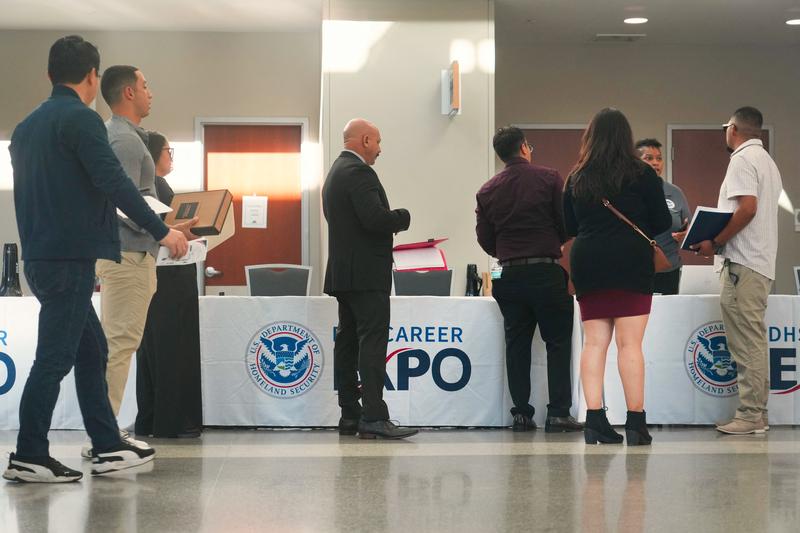
Laura Jedeed: They had this ICE hiring expo in Arlington, Texas. I thought it would be interesting to get an inside look into what that expo was like, and not just to stand at the door and interview people, but to maybe get in and get an interview myself. Just see what the actual process was for this. What they were advertising is on-the-spot hiring, where you walk in, you put in your résumé, they quickly scan you, and then they approve you, and then you walk out with a job offer. I thought the best way to find out about this would be to apply.
Brigid Bergin: I think you have helped make this point, but I want to be very clear with our listeners. As you said, you're very easily findable through Google. You are applying and have applied a pretty critical and deeply skeptical lens to some of your reporting. Just to underscore that point, you said people can find you just by searching your name. What are some of the stories they might find if they were just doing a basic background check on your work?
Laura Jedeed: They might find the story I wrote about Khalil Mahmoud, which was entitled, Khalil Mahmoud is the First Person to be Disappeared by ICE, which was extremely critical of the institution. I wrote an article also for The Nation entitled, What I Saw in LA Wasn’t an Insurrection. It Was a Police Riot. If you look at my social media on any given day, you will find extremely vehement condemnation of what the Trump administration is doing. You can go back as far as you'd like to, and you'll find mostly the same. It's not subtle.
Brigid Bergin: Not subtle by those headlines at all. Let's come back to this recruiting event you attended in Texas this summer, where you said hiring on the spot was the way it was advertised. As I recall, this summer, ICE was doing some significant marketing campaigns on social media. They were offering some pretty enticing bonuses to people who wanted to join the agency. It seemed like the place where you might see throngs of people. Tell me about what some of your expectations were going into this event, and what did you actually find there?
Laura Jedeed: I signed up through Eventbrite, which is how they were doing it, and we had to sign up for a time slot. Usually, that means that they are expecting a large group of people. They don't want to be overwhelmed all at once. I signed up for a 9:00 AM time slot. It seemed like early enough to be the full rush, but late enough to see a ton of people. As it turned out, there was no rush at all.
I stayed for a couple of hours. I never saw more than maybe 150 people inside of this giant Arlington Esports arena, where they were holding it. No line to get through security. No line to get my ticket. There was a line of six people to get the very basic interview that I went through. Then there was no way to talk to an ICE agent, which, by the way, was not part of the hiring process. That was just something we could do if we were curious.
Brigid Bergin: Wow. Listeners, if you're just joining us, this is The Brian Lehrer Show in WNYC. I'm Brigid Bergin from the WNYC and Gothamist newsroom, filling in for Brian today. I'm speaking with Laura Jedeed, a New York City-based journalist, whose latest article for Slate is headlined, You've Heard About Who ICE Is Recruiting. The Truth Is Far Worse. I'm the Proof.
Listeners, I know some of you who are listening have served in the armed forces or are members of the NYPD or other local security outfits. I'm curious, what was your application process like? What can you tell us about your training and what it taught you, particularly about when to use deadly force? What issues come up in your mind as you start to hear Laura describe both her application process, the recruiting process, and more of her reporting?
What does this incident involving Renee Good raise for you from a training standpoint? Are there de-escalation tactics that you learned that could have been deployed, or do you just have a question for my guest, journalist Laura Jedeed, who reported on her experience applying to join ICE? The number is 212-433-WNYC. That's 212-433-9692. You can call or text that number. Laura, as you said, you were interviewed on-site. You had your skills-based résumé on hand that listed your experience having served in the military. What was the interview like?
Laura Jedeed: It was incredibly basic. It was really almost just demographic information, name, date of birth, how long did I serve in the military, was I retired or just separated, and where would my duty station be? That was just about it. There was really no interest in any kind of details about why I might want to join, or what I had been doing in the years since I had done the analyst work that I described on my résumé. I went in there very determined to not lie about anything. If I'd been asked a question, I was going to answer it truthfully, but I just wasn't asked questions.
Brigid Bergin: Did you talk to some of the other recruits or applicants, I should say, who were at the event and hear any of the reasons why they said they were there?
Laura Jedeed: Everyone was pretty much keeping to themselves, and I didn't end up chatting with anybody. I can tell you that talking to the ICE agent, which, again, I just want to reiterate, not part of the hiring process, just something we could do to see if we wanted to work for ICE, but that agent wanted me to understand that I was not going to get out there and be putting cuffs on people right away. It was very important to him that I understand this.
He said, and it's quoted in the article, "I've been getting guys coming up to me and just saying, 'I can't wait to get cuffs on people. I can't wait to get out there.' I just need them to know that there's going to be probably some paper pushing for at least the first six months." I think that really speaks to the attitude of people who are coming into this event. This was really all about brutalizing people. It was also notable to me. I'd been sitting there for a little while waiting.
There was a senior ICE agent, came up on the stage, and offered to take questions. A lot of people did ask questions. Two of them asked. One of them asked about work-life balance. One of them asked about travel opportunities. Every other question was about the training process itself. It was a weirdly incurious group as far as the job itself. They were more concerned about whether they would need to get pepper-sprayed in training than what the actual job would look like.
Brigid Bergin: This, to be clear, was a room with people who were potentially people who had already gone through some type of training because they had military or law enforcement experience?
Laura Jedeed: Yes. In fact, after I completed this very short interview, basically, she said, "We are processing people with law enforcement background. We're processing their applications first. We will get to your application after we get to all of them. Some of them have been waiting since yesterday, so don't necessarily expect an answer today. It'll be in the next couple of days." There clearly were people in there with law enforcement experience. A lot of them did talk about in this Q&A session, because people who ask questions mentioned their time in police academy, especially with relations to, "Will we be getting pepper-sprayed again? Will we be getting tased again," stuff like that.
Brigid Bergin: When you were told your résumé would be reviewed, how did they explain what happened through the process after that point? From your mind, what did you expect would take place based on your experience having applied for a position in the military in the past?
Laura Jedeed: As somebody who joined the military and that's an intense process, you got to go through all kinds of medical examinations and stuff like that, and who applied for security clearance and got one, I basically expected them to run the application. I expected them to do just a preliminary background check of any kind. I guess I expected that they would immediately figure out that I'm not the recruit they're looking for. Certainly, I just didn't expect to hear from them again.
Brigid Bergin: At this point, you go through the process. You've been interviewed. You don't expect to hear from them again, but that's not exactly how it played out. I want to keep unpacking your story, but I also want to invite listeners to be part of this conversation. Listeners, particularly those of you who saw some of those ads for ICE recruitment or people who have, perhaps in the past, joined either the military, the armed forces, security forces, a police department, and can compare as you hear Laura's story to your own experience, help us understand what goes into this kind of recruitment and application process. Then what can you tell us about how rigorous your training was? Give us a call at 212-433-WNYC. Again, the number, 212-433-9692. I want to bring in our first caller, Ethan from Manhattan. Ethan, you're on WNYC.
Ethan: Hey, how are you? I just wanted to check another fact. I don't have any experience with the application or military, but I did hear something online I wanted to check with you, which was that this $50,000 bonus that they have been advertising that seems quite to incentivize probably a good amount of people that it is $10,000 a year, and that it requires a five-year commitment. If the recruit quits or leaves at any time during that five years, then they have to pay back whatever they've accrued of that bonus during that period. Is that true, or do you know?
Laura Jedeed: I've heard the same thing. I ended up declining the offer that I eventually received. Spoiler alert. I can't tell you that from personal experience, but I've heard the same thing. They're definitely saying the $50,000 part very loudly, and that part is much quieter.
Brigid Bergin: Ethan, thanks for that call. Yes, Laura, we've gotten a couple of questions related to this $50,000 bonus, which certainly is something that has been marketed as part of the recruitment for these positions. We've given away the punchline to a certain extent. We know that you were offered a position. I guess before we get to that, Laura, I'm curious. We keep going back to this because it feels like such a stark comparison that you were a member of the military. You talked a little bit about how much more extensive the paperwork and background check was that you had to complete then. I'm also curious about the kind of training that you had to go through. Before you served, what was the extent of the military training you had to complete?
Laura Jedeed: Well, we did basic training, of course. I believe that was nine weeks at the time. We went to train for our job. My job was a cryptologic linguist, so they taught me Arabic. That took about a year and a half, and then they taught us how to do the actual job, which took about six months. Of course, this was not a position where we would be doing any kind of law enforcement.
We were never taught anything about crowd control or anything like that, but we were rigorously tested to make sure that we did know how to do the job that we were told to do. As far as applying, there was a point where I did not think I was going to be able to get in. I have flat feet, and they rejected me the first time I applied. I had to go back. The medical stuff, you have to fill out. For background check, you have to fill out massive amounts of paperwork for that to happen. It was a whole process.
Brigid Bergin: Very different from what we're about to unpack in terms of what happened next for you, but we need to take a short break. We're going to have more with my guest, Laura Jedeed, who wrote about her experience applying to become an ICE officer for Slate. More of your calls in just a moment. Stick around.
[MUSIC]
Brigid Bergin: It's The Brian Lehrer Show on WNYC. I'm Brigid Bergin, filling in for Brian today. I'm speaking with Laura Jedeed, a New York City-based journalist, whose latest article for Slate is headlined, You've Heard About Who ICE Is Recruiting. The Truth Is Far Worse. I'm the Proof. Laura, we've been going back and forth between your experience applying for the military, your experience applying for ICE. The spoiler alert is, after going to that recruitment event in Arlington, you did receive an email about your ICE application. What did it ask you to do next, and what did you do?
Laura Jedeed: The email came about a week after this event, and it had a tentative job offer in it. It had a job offer that it said I needed to accept within 48 hours. It had a bunch of paperwork that I needed to fill out, which is what you would expect. There was the background check paperwork, just basic information so they could start running it, a signature to let them run it, a physical affidavit, I believe, and an affidavit that I had never been convicted of domestic violence, stuff like that.
I was not looking for it. I kept an eye out for the first couple of days just for fun. After that, I got a little bit lax. My inbox is a little bit of a disaster. I'm not proud of that, but I missed the email, didn't open it, and it sank to the bottom of my inbox. I did not fill out any of that paperwork. I didn't respond. I didn't know it was there until a lot later when I went back and looked.
Brigid Bergin: Wow. Laura, I want to bring in a couple of more of our callers who also have questions about the process you went through. Let's go to Dan in Astoria. Dan, you're on WNYC.
Dan: Hi, Laura. I guess my question concerns-- I don't know if it's something they would have confined to the background check process. In interviewing for the Coast Guard, this is back in 2018, 2019, I was told that everything was going great. Everything was going swimmingly. Then they asked whether I was currently on any kind of medication. It was asked whether I was in any kind of medication or any kind of therapy.
I said I was perfectly physically healthy, but did take an antidepressant. Along with that, that I was in therapy, that I regularly attended therapy. They said that for the sake of the boot camp process, I would need to be, I think it was 90 days, going in having not had the medication or the therapy in order to go in, because you wouldn't be able to take medication while you're in boot camp. I just heard nothing in your particular interview talk about whether they assess anything in regards to mental health.
Laura Jedeed: Yes, that's a great question. That did not come up. I would have to go back and look at the exact forms they gave me to see if the medical form they sent involved that question. I'm not 100% sure. Right off the top of my head, I don't recall seeing it. Definitely, I never filled that out. That was not something that had to happen before that got to the end of the story, which we're still getting to, but no. If they'd asked, then I would have told them that I take an antidepressant. Maybe that would have disqualified me, but that did not come up, no.
Brigid Bergin: Dan, thanks so much for that question and for your call. Laura, your email from ICE sinks to the bottom of your inbox, and something that I think is quite relatable. You essentially didn't do anything to keep the process moving, and yet you received another email related to a medical screening not long after?
Laura Jedeed: Yes, a few weeks later, I believe it was September 20-something. Apologies for not having the exact date, but I received an email inviting me to do a drug test for the ICE application process. That one, I did receive. The timing was a little unfortunate. Cannabis is legal in New York State. I had partaken about six days before the test was scheduled to happen, but you never know. I figured, worst-case scenario, I'd waste some of ICE's budget, so I went ahead. I went in and took the test and waited for results. I did expect to hear back at that point because I know they do have to call you if you fail the test. I expected to hear back that I had failed the test, and I sat back to wait for that phone call.
Brigid Bergin: What happened?
Laura Jedeed: Well, I never received it. To be fair, sometimes it takes a couple of weeks. I waited about nine days before I got curious enough to go after the information myself, but I decided to log into the ICE hiring portal for the first time in this process and see how the application was doing, so I did that. This was on October 3rd. That date is going to be important for a couple of reasons. It's October 3rd. I've logged in. What I see on the ICE hiring portal, and you can see this online, I've posted this video online. According to the portal, I had received a final offer. I had accepted the final offer.
I had an EOD, entry-on-duty date, of September 30th, so three days before I checked, and a little message that said, "Welcome to ICE." When I went ahead and went over to see the status of paperwork, some things were still pending on the temporary offer. I had never accepted it, but it did show that my medical clearance had occurred on October 6th. Again, this is October 3rd. My clearance had already occurred and was completed three days in the future. More menacingly than that, my background check was also listed as completed on October 6th, three days in the future.
Brigid Bergin: Laura, I know we have been teasing out your story here over the 25 minutes or so of the show, because when I got to that part in your article, it does have a real record scratch feel to it, like, what is going on here? Why do you think this process kept moving forward? At any point, did you ever ask ICE for a comment about why your application continued to advance through the process?
Laura Jedeed: Yes, I did reach out to them for a comment before publishing this story. They did not get back to me. They have still not gotten back to me, except for to publicly state that I'm a liar. This, to me, really speaks to the unprofessionalism of what we're seeing here. First of all, one would expect them not to know they offered me a job because the idea is that they don't seem to know who they're offering jobs to. I think any government agency that actually cared would look into this. This would distress them.
They would like to know if it was true. They have not looked into this. They have not reached out to try to confirm it. They have not asked any questions about what happened. They seem very incurious as to how this could have happened. They just simply have dismissed it out of hand. I'm not a fan of ICE. If I was an ICE officer, I would be distressed by this. I would be upset, wondering who I'm serving, especially if I'd been in for a long time.
Again, I'm not sympathetic to ICE at all. Even from the perspective of the administration, you'd think they would be interested in how this happened. The only two explanations that I can think of are either some kind of AI system automatically advanced me, I know they've been experimenting with those, or some people have suggested this is some kind of fraud and they're padding their numbers. Maybe there's a third explanation, but I haven't heard any that really explain it.
Brigid Bergin: Let's go to another caller. Jack in Brooklyn, you're on WNYC.
Jack: Hi, Laura, I saw your article and your video. I was really upset about it. I just wanted to let people know that I've been applying for a hunting rifle license that will never actually live in New York City. The process for getting a long gun in New York City is about a thousand times more invasive. That doesn't even get into the concealed carry permit pistol licenses than getting an ICE agent job. That's really alarming. To get your concealed carry pistol, you have to give up all of your HIPAA records. You have to get four signed character reference letters by people not related to you. You have to take an 18-hour class, et cetera, et cetera. It sounds like being an ICE agent. You walk in, they give you a gun, and have a good day.
Laura Jedeed: Yes, I think that's a really good comparison. I, too, live in New York City, and I've looked into trying to get a concealed permit. I immediately ran into exactly what you're describing and thought to myself, "Well, if I ever have enough money to hire a lawyer to do this for me, maybe someday." Yes, it's formidable, though hurdles are formidable. Yes, this was the opposite of that, and it is. The end result is that they are handing out guns through this hiring process, so it is a directly comparable set of things.
Brigid Bergin: Let's go to Vanessa in Brooklyn. Vanessa, you're on WNYC.
Vanessa: Hi, good morning. I'm calling in because, as I'm listening to the show, I'm giggling a bit because I almost did the same thing as Laura. I'm retired military. I served for over 20 years in the army. I've done multiple. I also pivoted career. I'm in the medical field. Out of curiosity, I also wanted to see what was really going on with ICE and the federal government. I thought about applying. My family lives in the DFW area. I saw the exact same advertisement, but I just never made it down to apply.
Laura Jedeed: Well, if you'd gone, I have to imagine that you would have gotten the same offer I did.
Brigid Bergin: Laura, just to be explicit about this, I know you've said that you declined the ultimate offer. Just so that listeners who are catching this mid-segment and to make it clear, did you ever get paid anything by ICE? When they said they had offered you a job and a start date, how did you make it very clear that you were declining the offer?
Laura Jedeed: Yes, that's a great question. I did not receive any money from ICE, and I would have declined it. That would not have been something I would have accepted. The oddity of this was there was one step that I needed to complete, which was to accept the temporary offer. Like I said, this portal showed that I had the final offer, that I had the medical clearance, that I had the start date. It was just a button that I had to press on this website, saying that I accept.
I thought about it. I thought part of me really wanted to see how far I could go with this, but another part of me knew that I am, again, pretty Googleable. I hadn't signed anything as of yet. I did not want to be in a position where I was potentially at an ICE training facility when somebody casually typed my name into a computer. This organization doesn't seem like they would be particularly thrilled about it, and they have a bit of a reputation for violence, so I did ultimately decline the offer.
Brigid Bergin: Laura, another listener texts, "Did they ever ask you if you had been convicted of a felony? I wonder if they're asking applicants who are involved in January 6th events."
Laura Jedeed: Yes, that's a great question. They sent the domestic violence affidavit, so they asked about that specifically. They did not ask about felonies. My assumption is that the background check is supposed to cover that, but it did not come up for me.
Brigid Bergin: I'm assuming you have gotten a lot of response to this story beyond just the official response from ICE denying it. Have you heard from any elected officials or others in a position of oversight in response to the story?
Laura Jedeed: I have not. I know some people in positions of power have posted about it. I believe Ruben Gallego posted about it, but I haven't heard directly from anybody, no.
Brigid Bergin: That's very interesting. Obviously, the other piece of, I think, what this experience raises is if it is so easy to get through this recruitment process, this application process, what does the actual training of new recruits look like before they begin this type of work? I know that that was not part of this story, but is that something that you're planning to look at at all?
Laura Jedeed: I'd be very interested to know. I think a lot of people are very curious what people are being trained in the very short time that they are being trained. I do want to say. I think it's very funny that ICE hired me. This is a funny story in a lot of ways, but what's not funny is we don't know who these people are on the street with masks and guns, whatever their training is. It seems like it is very subpar. Beyond that, we just don't know who they are.
Again, assuming this wasn't a glitch that only affected my application, assuming this is something that is happening to more people than me, which I think is a reasonable assumption. If not, if there's an explanation for the glitch that I experienced, I'd certainly love to hear ICE tell us all about it. Again, assuming this isn't a unique situation, we don't know how many people with domestic violence convictions are on the street right now with guns in our cities.
We don't know what kind of background people have if they were involved in J6, or God forbid, if somebody had been convicted of some kind of sex crime or crime against children. These people are running detention facilities. They have access to an incredibly vulnerable population. The more you think about this, the worse it gets. These are people that our vice president has said have absolute immunity. There's no oversight. Apparently, we don't even know who they are.
Brigid Bergin: A lot of incredibly troubling issues raised through your reporting and the questions that you still have that it raises. Let's sneak in one more caller. Let's try Alan in Brooklyn. Alan, you're on WNYC.
Alan: Hi, thanks for taking my call. Yes, I just wanted to say that in the style of yippee-style disruption, this conversation makes me think that it wouldn't be great if a million Americans started putting in applications to ICE, and we flooded them with applications. I'll take the answer offline. Thank you very much.
Laura Jedeed: [laughs]
Brigid Bergin: [chuckles] Alan, thanks for your idea and question. Laura, what Alan is raising is, obviously, a provocative idea for a form of peaceful protest. However, I think in your experience, you made some very calculated decisions about when you left this process and why. I wonder, just to make it clear for people again who might be joining late, you went into this just to understand what the application process was like. You didn't anticipate being offered a job. Talk about just, as we sum this up, what these issues were that were raised for you by the fact that you were just advanced through this process with what seemed like very little oversight.
Laura Jedeed: I think, again, having the application that looked good at a glance definitely helped. Yes, just the cavalierness, the indifference to who they're putting in these uniforms. It's like I just said, the fact that they don't seem to know. There's been speculation like, are they hiring Proud Boys? Are they hiring J6ers? Are they hiring white supremacists? The horrifying truth is that they might not know, and they don't seem to care.
Again, there's a version of reality where the response to this story was, "We'd like to talk to you about what happened so it doesn't happen again," but they don't care. They don't care. They want bodies in uniform on our streets, menacing citizens. You see what's happening in Minnesota. The person who shot Renee Good is an ICE veteran. He's been in there since 2017, which I think speaks to how God-awful this organization is in the first place. It was founded in 2003. This isn't some old institution. It's rotted from the ground up.
Last year at this time, there were 10,000 ICE agents. Right now, there are 22,000 ICE agents, 120% increase. You've got more new people than you do old people. These new people went through the same application process that I did. This is a national emergency. When they look at what's happening in Minnesota right now and across the country, and when they consider how little it takes apparently to become one of these people with the license to kill, this is a national emergency. I really hope that state governors take action. I hope they consider calling up the National Guard to protect the people who elected them, to keep them safe.
Brigid Bergin: Laura, we are going to leave it there for today. I think a lot of troubling issues raised in your reporting. Even the numbers you just quoted there about the increase, unclear if they are actual increases, or if they're increases based on people who've gone through the process like you almost did. Laura Jedeed is a New York City-based journalist who wrote an article for Slate headlined, You've Heard About Who ICE Is Recruiting. The Truth Is Far Worse. I'm the Proof. She's also the author of the Substack firewalledmedia.com. Laura, thanks for joining us.
Laura Jedeed: Thank you so much for having me.
Copyright © 2026 New York Public Radio. All rights reserved. Visit our website terms of use at www.wnyc.org for further information.
New York Public Radio transcripts are created on a rush deadline, often by contractors. This text may not be in its final form and may be updated or revised in the future. Accuracy and availability may vary. The authoritative record of New York Public Radio’s programming is the audio record.