
The Growth of DHS Detention Camps
[music]
Brian Lehrer: Brian Lehrer on WNYC. With the war in Iran taking center stage in news coverage, it's easy to lose sight of the Trump administration's main domestic agenda, mass deportation. Even within that, it's easy to miss a big aspect of it that flies under the radar, mass detention. New Yorker staff writer Jonathan Blitzer has a very good new article about that. There's also breaking news. A woman from New Jersey the last 10 years, an immigrant from the West Bank, was released from a detention center in Texas yesterday after a year behind bars there, March 13th, 2025, until yesterday, March 16th, 2026. She was emblematic of two big trends in immigration detention. One, according to the AP, she was detained while voluntarily checking in with ICE in New Jersey.
Two, she was the last of the people still being held in connection with protesting the war in Gaza at Columbia University, Mahmoud Khalil, out of detention. Mohsen Mahdawi out of detention. Now, much later and much less well known, Leqaa Kordia. Upon her release yesterday, she drew attention not just to her case, but to the larger detention issue.
Leqaa Kordia: We're going to keep fighting. There is a lot of injustice in this place. There is a lot of people that they shouldn't be here in the first place. We're going to keep fighting for them. We're not going to forget them. We're not free until everybody is free.
Brian Lehrer: Leqaa Kordia yesterday. With us now, New Yorker staff writer Jonathan Blitzer, who is also author of the much-acclaimed book from 2024, Everyone Who Is Gone Is Here: The United States, Central America, and the Making of a Crisis. He was on the show for a book interview for that at the time. His latest article is called Trump's Mass Detention Campaign. Jonathan, thanks for coming on. Welcome back to WNYC.
Jonathan Blitzer: Thanks for having me.
Brian Lehrer: It's common to hear the term mass deportation, not so much mass detention. Why did you write an article about that?
Jonathan Blitzer: Well, that's precisely why I think, at this point, the phrase mass deportation is so ubiquitous, it's become such a political talking point, such a slogan. In some ways, it's almost gotten to be this kind of abstract notion. In reality, I think what, on a daily level, the Trump administration's immigration enforcement campaign has looked like is the mass detention of people nationwide. We're looking at a period in which Immigration and Customs Enforcement is detaining more people nationwide than it really ever has in its history. The conditions in immigration detention are as bad as they've ever been. The conditions have always been actually quite bad and quite severe to start with.
Under the current circumstances, as a result of overcrowding, medical neglect, a kind of outlook of deliberate abuse, and pressure to try to force people to agree to be removed, the conditions inside these detention centers have really grown quite dire. There's been a spike, a historic spike in the number of deaths in immigration detention. One of the things that we're seeing, even as there have been cosmetic changes in leadership at different agencies at the Department of Homeland Security, and of course, at the very top of the Department of Homeland Security, the secretary was recently fired.
I think one of the key themes to follow is that the administration's larger ambitions in terms of its plans for immigration enforcement have really remained largely unchanged. The thing for us to keep our eyes on in that respect is how it plans to continue to expand the mass detention apparatus and jail more and more people nationwide.
Brian Lehrer: Yes. Just to put one number on this one stat from your article, the Department of Homeland Security is now detaining some 70,000 people in jails across the country, more than any other point since the department was founded in 2002, you report. What's the point of all this detention? Why expand immigration detention and not just deportation to that degree?
Jonathan Blitzer: Well, to begin with, one precursor for deportation is detention. This was always going to be part of the plan that insofar as the administration wanted to rapidly expand the number of people it could deport from the country, it was going to have to increase its resources for holding people. I think one of the things, one of the trend lines that we've seen in particular is that the administration has gotten, let's say, more and more creative in finding ways to detain people longer. You're seeing different sorts of people in detention. It's not just that the numbers are higher, which they are. You mentioned that right now, we're looking at a population of about 70,000 people in immigration detention.
To give you a sense, just in context, when Trump took office, that number was around 40,000. One of the reasons why the number has jumped to such a degree is, first that immigration enforcement operations nationwide have really expanded. The administration is going after more people in communities in the interior of the country as opposed to just in the U.S. borderlands. You have people with deeper ties to their communities who are winding up in detention as a result of these deliberate, high-scale, intense arrest operations of the sort that we saw recently in Minneapolis.
Then you also have, simultaneously to the increase in enforcement efforts, you also see a more concerted strategy from the administration to hold people longer. You mentioned Leqaa Kordia. She, just as an example, had been ordered released three times by judges. The administration kept her in detention nevertheless for one year. Its argument for doing that was, "Well, while we're appealing those judges' decisions, we're going to continue to detain her."
That has, I think, given us a window into a broader MO inside the administration, which is to try to hold people longer, whether they are trying to fight their immigration cases or whether the administration is simply holding them longer as a form of punishment. They're transferring people from one facility to another with more frequency. They're deliberately making it harder for their families and for their lawyers to be in contact with them and to represent them. A big part of that is to try to basically make people so uncomfortable and so desperate that they agree to essentially sign their own deportation order.
The detention system is essentially being used as a punishment against people who, it's important to say, are being detained not for having committed criminal offenses, but rather because the government is alleging that they are out of legal status, which is a civil infraction, not a criminal one.
Brian Lehrer: Let's go even a little deeper on that thought with respect to the Kordia case in particular, because from what I've read, one important aspect of the case is that she hasn't been permanently freed. All this is is that she's out on a $100,000 bond while her immigration case proceeds. That's a high bond in the first place, I think, for someone who's not considered a criminal threat in any conventional sense. The government was opposing her release on bond at all, releasing her on bond at all is what they were fighting. That's what kept her behind bars for a year. You touch on that policy in your article, no bond for detainees. Why is that a thing?
Jonathan Blitzer: Well, so there have been two parallel moves made by the administration that have to do with basically denying people the opportunity to seek bond. Her case is a little bit particular. I'm going to bracket off her case just from this other trend. The first key move was a memo issued by Immigration and Customs Enforcement known as the Lyons Memo, for the acting head of Immigration and Customs Enforcement, who in July of 2025 essentially offered a very dubious and radical reinterpretation of a 29 year old statute, essentially saying that anyone who at any point in the past entered the US without inspection now could not be granted bond regardless of what was happening in their legal case. Typically, what would happen is an immigration judge would determine whether or not someone posed a public safety threat, and or posed a flight risk. Typically, when someone was shown to have posed neither threat, they were released on bond. According to this memo from the summer of 2025, Immigration and Customs Enforcement would detain people continuously without giving them the chance to seek bond.
Then, a couple of months later, you have a arcane ruling by a body known as the Board of Immigration Appeals, which is the chief appellate body inside the immigration court system, which is run out of the Department of Justice, it should be said, that basically ruled that anyone who entered the country at any point without having been inspected when they first entered the country should not have any opportunity to seek bond at all.
When you combine these two things, the ICE memo from July of 2025 with this board of Immigration Appeals ruling From September of 2025, you had people who had committed, in many cases, no crimes whatsoever, who had lived in the United States for decades, in many instances, had family here, had deep ties to their communities, held down jobs, et cetera, suddenly finding themselves in a situation in which they were being detained indefinitely without the possibility of getting bond as they fought their cases.
One of the consequences of that was you saw a real spike in the number of habeas corpus petitions that people were filing to be released in the federal court system. People basically were recognizing that the immigration court system had, effectively, for their interests, completely imploded and gone offline. They were now appealing to federal judges. Just to give you a sense, in the last two months alone, there have been 15,000 habeas petitions filed by immigrants, but filed in federal courts.
There have been federal judges who have been so appalled by the administration's policy in this regard that they've ordered the immediate release of people, which has led now to a further crisis, because the Department of Homeland Security and the Department of Justice aren't heeding the orders of federal judges demanding that some of these people be released. We've got now not only a humanitarian crisis, but a pretty overt rule of law crisis. All of this is tied to the administration's obsession with holding people for as long as they possibly can without releasing them.
Brian Lehrer: Listeners, any questions or comments for Jonathan Blitzer from the New Yorker on mass detention, not just mass deportation, in the United States as a core part, if a less-reported part, until now of the immigration crackdown. 212-433-WNYC, call or text 212-433-9692, or maybe someone listening knows Leqaa Kordia from her last 10 years living in New Jersey or involvement with a Columbia protest just released yesterday after a year in immigration detention or about anyone else you know, facing the challenge of being held without bond or criminal charges or in bad conditions that Jonathan documents that we'll get into at some of these detention facilities with what he calls little oversight.
212-433-WNYC, 212-433-9692 call or text.
Another interesting and important aspect of the Kordia case, according to AP, this one is that they report she was detained during a check-in last March with ICE in New Jersey. I take that to mean it was one of those voluntary check-ins going through the system, and then poof, you get arrested and put behind bars, in this case, for a year. I saw you wrote an article last month, Jonathan, in the New Yorker called How Legal Immigration Became a Deportation Trap. Does this relate to that in some way?
Jonathan Blitzer: I think so. I think one of the things that the administration has increasingly done, and it's become very stark in the last year and a half, has been to go after people who have pending legal immigration cases, either before an immigration agency or before an immigration judge. The general political case in the past was that the government said it was going to go after people who had committed crimes or who were here unlawfully. In reality, what the administration is doing is it's going after anyone and everyone they can.
A month or so ago, I wrote this story for the New Yorker about the agency in charge of administering the legal immigration system. It's called U.S. Citizenship and Immigration Services. It's a fee-funded agency. For years, it has only had as its primary job the task of administering the legal immigration system, making sure that people applying for legal benefits could get those benefits. Increasingly, the administration has turned that agency into a part of its enforcement apparatus.
Now, when people are showing up for routine immigration interviews, whether it's for a green card interview, an asylum hearing, an administrative appointment, what's starting to happen is there is coordination between Immigration Customs Enforcement and USCIS Citizenship and Immigration Services. People who are expecting to show up doing everything above board, not trying to hide in any way, in fact, quite the opposite, trying to regularize their status, they're nevertheless getting arrested and detained. That is part of this broader campaign.
I know in the Kordia case in particular, she had entered the country lawfully on a student visa. Her mother is a US citizen. Her mother was petitioning to sponsor her for a green card application. I haven't followed this case as closely as I have others, but there seems to have been a moment where she fell out of status because she didn't renew her student visa because she thought that the process of her beginning to apply for her green card would cover her. Again, to your point, here she was showing up at a local ICE office, not trying to hide, trying to do everything in plain view. The result was that she was arrested just the same and detained for over a year. A nightmare.
Brian Lehrer: With Jonathan Blitzer, staff writer for the New Yorker, his latest article on the Trump Administration's Mass Detention, not just mass deportation program. Charlotte, in Jersey City, you're on WNYC. Hello, Charlotte.
Charlotte: Hi. Just wanting to address the conditions people are living in. I volunteer out at Delaney Hall and was just helping with the families and comforting. Then I ended up finding this niche, which is they all have commissary accounts, which anybody can put money into. A lot of these people don't have families. A lot of these people are the breadwinners. Their families can't put money into the accounts. They get their two, three horrible meals a day, and then they can buy snacks, they can buy phone time to talk to their lawyers from commissary accounts, but nobody can afford to put money into their commissary account.
I and another woman out there concocted a scheme. I've been doing a huge fundraising outreach for people to make like 50 or $100 deposits into commissary accounts, which I do, but they only let you do two every 24 hours. You're limited in how many times you can do it into these accounts. Then somebody will have been moved to New Mexico or someplace else, and you can't find them.
Then the women I work with try to figure out where they've gone. It's just, it's so messed up. Ramadan, the woman that I work with, called and said, "Can you get put money into all the Muslims that are there for Ramadan because they can't eat during the day, and at least they can get some snacks from the commissary at night?" They don't have any money. It's just inhuman and horrible. We're raising a lot of money. A lot of people are compassionate and giving money, but it's an unending need for years. It's just horrible.
Brian Lehrer: Charlotte, thank you for your call. That, of course, is in relation to Delaney Hall, which she said, which, for those of you who don't know, is an immigration detention center in Newark.
Jonathan, about conditions in your New Yorker article, you report that overcrowding, abuse, and neglect have made conditions far worse at various detention centers than even the fact that people are being detained for these non-criminal reasons. You wrote basic agency, Department of Homeland Security oversight, oversight has been gutted. Are you saying the standards or the conditions are worse than in "regular jails" for people accused of crimes?
Jonathan Blitzer: Well, I think that for one thing, the administration has deliberately gutted some of the oversight bodies that are tasked with at least monitoring conditions inside immigration jails. In that sense, they're more of a black box than they ordinarily are. To be clear, I don't want to whitewash the conditions prior to the current Trump administration and immigration detention. They've always been quite bad. I don't know how to compare them, say, to criminal detention. I think it's fair to say that there have been patterns of abuse and neglect going back years and years, and the few checks that have existed have now been thrown out the window.
I'm glad Charlotte mentions Delaney Hall in particular, because that's a classic example of one of the things we're seeing that is the first immigration detention center that opened under the current administration. It's in Newark. Right out of the gate, there were questions about whether the conditions at that facility were up to even just the most basic standards. Plumbing code, fire hazard. We're talking about like basic municipal standards.
There was almost immediately a fight between the New York City government and Immigration and Customs Enforcement and the private company that administers that facility, which is called the GEO Group, because local officials were saying, "Look, we can't even get on the premises to conduct basic code checks." We have very serious concerns about what it means to hold large numbers of people here if some of the most basic things that we would need to check for haven't even been screened in advance.
That has very much been part and parcel of how the administration has approached this acute tension around detention, because on the one hand, they want to ramp up the number of people they deport, but when they came into office, there weren't the detention resources available to them to hold and house such a large population. You saw a few different categories of detention center either open or reopen or be modified in ways that were meant to satisfy the particular needs of the administration at that time. One example is Delaney Hall, a facility that went up faster than it should have, that didn't go through the ordinary processes.
Another form of oversight, by the way, that has also been blocked is congressional oversight. Typically, members of Congress are allowed to show up unannounced at these facilities. After all, they're the ones who are appropriating money to these agencies. It's been written into a federal statute now for years that they have the right to show up unannounced to inspect conditions. ICE and DHS more generally have blocked a lot of those visits, despite the fact that federal judges have ruled that members of Congress have every right to show up unannounced.
You've got facilities like Delaney Hall, you've got other facilities, for example, like field offices in places like New York City, at 26 Federal Plaza, in Baltimore, in Los Angeles, where typically people are held for say, 12 hours before they're processed in longer-term detention. Because the numbers of people in custody are so high, and because the administration hasn't made plans to deal with the kind of human or practical realities of that, you have people being held in those conditions for days and in some cases weeks on end. Which means that these are facilities that are not equipped to provide people with food, showers, they're dirty facilities. That's one category of thing we've seen.
You've got like the Delaney Halls, you've got the field offices that are being essentially repurposed for longer-term detention. You've got a new form of what are called soft-sided facilities, essentially tent encampments that have sprung up to try to deal with the mass increase in the number of people who are being held.
The most notorious example of this is in El Paso, A facility called Camp East Montana, which at present holds about 3,000 people, is the largest facility in the country, and has reported the absolutely most horrific conditions, lack of medical care, lack of edible food. For the first several weeks at the very least, there wasn't phone service. People who were being held there couldn't communicate with their families or with lawyers. There were three deaths in that facility in a six-week period earlier this year. You're seeing all of these different categories of detention that maybe have existed in some form or another in the past, but have gotten increasingly grave under the present circumstances.
I'm very glad also that Delaney Hall's come up because that's one right in our backyard here that I think is really a kind of emblematic example of what we're seeing from the administration.
Brian Lehrer: John in Forest Hills, you're on WNYC with Jonathan Blitzer from the New Yorker. Hi, John.
John: Yes, thank you. You've hit on the subjects. I'm an architect, and none of these spaces, these huge boxes, meet the universe of building codes for human habitation. These laws were written a century and a half ago so that people wouldn't get tuberculosis and cholera. In Social Circle, Georgia, they're fighting because the population would exceed the capacity of the sewage.
Even before you get to that point, you can't have that many people in a space like this for even three hours without adequate toilets and egress, and ventilation. How are the feds exempting themselves from these basic building codes, which were put in for public safety ages ago? How are they getting away with this? These are basic building codes that all the places fail. You can't keep these people in here for three hours, much less 72 hours, much less longer. Comparisons have been made to the internment camps for the Japanese, but that was much more like military barracks, not a vacation. This is much, much worse.
Brian Lehrer: John, thank you. Jonathan, to his actual question, if they are violating building codes, how are they getting away with it?
Jonathan Blitzer: It's a good question. I don't know generally how this works or what the legal pushback could be. I know just because of my reporting experience that in the case of Delaney Hall in particular, the city of Newark filed a lawsuit in county court against the private prison company, the GEO Group, that administers that facility. The way local officials described to me the back and forth over the course of that lawsuit was basically to say that the courts can't quite keep up with the pace of building and the just general ambitions of the federal government.
It's been a challenge and a real uphill battle because, a county judge, say in that case, is going to request more information, is going to try to temper the government's actions, but while it's going through this slow-moving back and forth, people are being held there, and people are being mistreated there. The local officials I spoke to, who addressed directly John, your question, were quite frustrated and quite exasperated. I don't know, more broadly speaking, what legal avenues exist. I'm sure people are working on that.
I will say, to your point, though, and it's really well taken, some of these facilities that have shot up or sprung up without the usual mechanisms and processes to make sure the facilities are in working order have meant that when there have been outbreaks of tuberculosis, of measles, of COVID there aren't sometimes solid walls separating wings where people are allegedly being quarantined. There are very basic questions about the transmission of illnesses, the transmission of diseases.
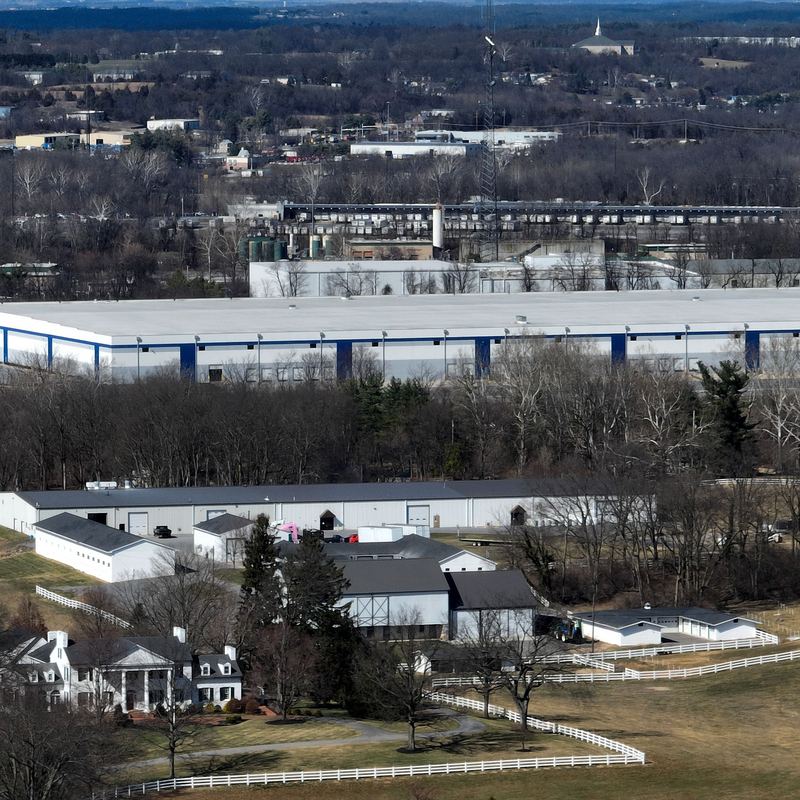
One of the more recent pushes the department has made, and we have to see what this begins to look like on the ground, and you alluded to this, John, is the fact that as a result of the President's big domestic spending bill last year, the Department of Homeland Security is now flush with cash and received essentially $45 billion to expand detention alone. One of the ways in which the Department of Homeland Security plans to expand detention is to repurpose, to buy and retrofit a fleet of warehouses across the country. This is to really scale up its capacity.
There have been ICE documents that reveal that at least the administration's plans are to scale up immigration detention to hold up to, say, 90 or even 100,000 people nationwide as a result of these giant warehouses that, in some cases, can hold between 8,000 and 10,000 people in a single place. There are all of these questions about, in some of these places where these warehouses are meant to go up, how do you pipe water in? How do you handle sewage? These are all very much open questions.
This is one of the reasons, by the way, that even in conservative communities where some of these warehouses have been bought by the Department of Homeland Security, there has been a lot of local resistance because there's really this sense of, well, the basic demands of what goes into one of these warehouses is not a capacity that our community, our county, whatever, can sustain. That's another thing to watch in the weeks and months ahead.
Brian Lehrer: I want to bring up one more major issue that a number of our listeners are calling or texting about. For example, following up on the caller regarding Delaney Hall in Newark. Listener writes, "The commissary at Delaney Hall," that she's trying to raise money to help the detainees, buy food at, "The commissary at Delaney Hall helps the GEO Group," that's company, "make greater profits by making money selling basic items they should provide for detainees."
Another one writes, "There is bigger money in detaining individuals in private prison, and those companies lobbied for detainment over actual deportation. This is all part of the grift this administration has pulled on the American public." An allegation from that listener, and I'll take one more like that on the phones. Aaron in Brooklyn, you're on WNYC. Hello.
Aaron: Hi there, Brian. Thanks for taking my call. Yes, I was wondering how many of these detention centers are privately owned, because obviously, there's therefore an economic incentive for them to hold people. It's interesting to hear that they're buying up warehouses, but I wonder if they'll be contracting them out so that economic incentive remains.
Brian Lehrer: Aaron, thank you. Yes, I know this comes up a lot, Jonathan, and I'm really curious for your take on it, because obviously these companies that run the private prisons are making money on them. My impulse is not to think that this is largely a payoff to Trump supporters in the business sector, but it's really because the MAGA folks just don't want these people here. They don't want so many people from Central America or elsewhere in the United States. It's more of a racial thing than a profit thing. But what would you say?
Jonathan Blitzer: I think both things are true. I think, my sense of this, and this is just my interpretation, is that what motivates this broad push to arrest huge numbers of people and to deport them, and then obviously to detain them indefinitely while all of this stuff gets worked out? The impulse there is, I think, by and large, a racist one, an ideological one. It has to do with people in this administration and their supporters wanting to shape and define who is American, who is appropriately here, or not. I don't think there's any question about that.
Then layered onto that, as is inevitably the case with anything associated with Trump, are the profiteering impulses. One of the interesting things, and to Aaron's question, private detention has always been a big part of immigration detention nationwide. That's not to say that there haven't been really systematic and concerning abuses in facilities, run and administered entirely by ICE, or, for that matter, this is something that's also often overlooked.
Local jurisdictions, counties, and so on, have often gotten huge federal contracts to hold immigration detainees, to hold immigrants on behalf of Immigration Customs Enforcement in local jails. That's also been a financial boon to county sheriffs and so on. That's also been a dynamic in the history of mass detention in the immigration context. One of the really interesting things lately has been that you have these core usual suspects, these big private prison companies that have really had the lion's share of federal contracts with ICE over the years.
I'm thinking about the GEO Group, two other companies called CoreCivic and LaSalle. They have typically been the entities that manage the big facilities across the country. One of the really macabre metrics every time Trump rose in the polls, say, during the 2024 campaign or after he won, was to see stock prices for these private prison companies soar on the expectation that they were about to do big business with the government.
One of the interesting developments in the Washington Post recently reported on this, and I just found it really striking, was the fact that right now the administration is scrambling so much to just find new forms of detention to meet its broader ambitions, that the administration is now contracting with other companies, fly by night operations, companies and contractors that typically haven't worked in this space. It's actually even caused further attention with some of the big players because the big players expected to have exclusive rights and opportunities in this area. The administration now is expanding the network of private contractors it can work with.
It's a really alarming, dangerous pattern. I think typically, the kind of human outgrowth of all of this is serious damage and suffering in detention.
Brian Lehrer: Last question, and it relates back to your book from 2024, Everyone Who Is Gone Is Here: The United States, Central America, and the Making of a Crisis. Among these record 70,000 immigration detainees. Do you know roughly where they're from?
Jonathan Blitzer: I think one of the things that's so striking now is that the population in immigration detention, because it's being fed by interior enforcement rather than arrests made in the borderlands, the result has been a much more diverse group of people showing up in these prisons and these immigration jails. I think it's been a real mix.
I think that's one of the things that, when you start to do these comparisons between, for example, the number of deportations in the first year of Trump's second term compared to the last year of Biden's term. Or when you try to compare just the sum total of the number of people in detention now versus different moments in the past, one thing that you lose in those kinds of numerical comparisons is the fact that now the types of people who are showing up in detention and who are, in fact, getting deported are people who have much deeper ties to the United States.
In the past, one of the reasons why deportation numbers would spike at certain moments is they would reflect arrests made at the southern border. One of the things that we saw during the tail end of the Biden administration was the composition of people showing up at the southern border seeking protection and relief by entering the United States came from a much wider array of countries. You had a major humanitarian crisis in Venezuela, something like eight million people who fled the country in the last decade or so. You had people from all over the world, from South America and beyond, as a result of political repression in different regions of the world, as a result of economic fallout related to the pandemic.
For a period of time, when I was back, when I was writing my book, one of the ways of defining the population of people seeking asylum at the southern border was to look at the fact that the preponderant number of them came from countries in Central America. One of the trends that we saw shifting toward the tail end of the Biden years was that, obviously, the numbers from Central America continued to be high, but the population became much more global.
Then, when you combine that fact with. With the reality that people who are showing up in detention now are people who have spent, in some cases, 20 years living in the United States or 30 years living in the United States, that reflects even demographic trends going back decades earlier. I think it's a wider array of people who are showing up, and it's incredibly concerning. It's one of the reasons why I think it's so important to continue to document not just the conditions inside these facilities, but to be able to actually be in communication with people who are being held there, to know more about their stories and who they are and what's happened to them.
Brian Lehrer: Doing some of that documentation and communication is Jonathan Blitzer, New Yorker staff writer. His latest article on all of this is called Trump's Mass Detention Campaign. Thank you for sharing it with us.
Jonathan Blitzer: Thanks for having me.
Copyright © 2026 New York Public Radio. All rights reserved. Visit our website terms of use at www.wnyc.org for further information.
New York Public Radio transcripts are created on a rush deadline, often by contractors. This text may not be in its final form and may be updated or revised in the future. Accuracy and availability may vary. The authoritative record of New York Public Radio’s programming is the audio record.
