
The First G20 Summit on African Soil
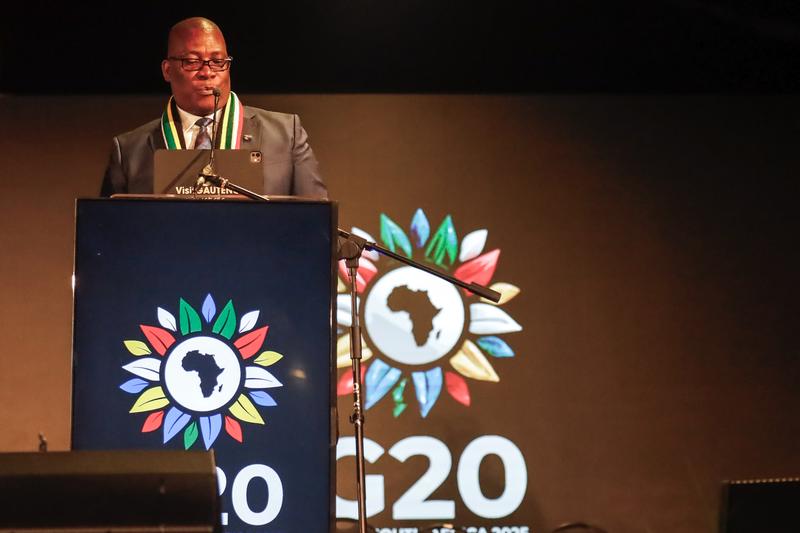
( Sharon Seretlo/Gallo Images / Getty Images )
Amina Srna: It's The Brian Lehrer Show. I'm producer Amina Srna filling in for Brian today. This weekend, the G20 convenes in Johannesburg, the first time the summit has ever been held on African soil. South Africa has hoped this would be a moment of global leadership for President Cyril Ramaphosa and symbolically for the continent. In the past few weeks, the US pulled out entirely, and China's Xi Jinping said he won't attend, taking some of the shine off of what was meant to be historic gathering.
Still, as Semafor Africa's Yinka Adegoke reports, South Africa has used its G20 presidency to elevate a set of issues that matter deeply to African nations. That includes the continent's mounting debt burden. The question of how to pay for a just energy transition, and the reality that in many countries, more money is now flowing out to foreign creditors and then coming in as new financing. What does the US Boycott actually change? What does a successful summit look like when major powers aren't in the room?
We'll get to all of that now with Yinka Adegoke, editor of Semafor Africa. Hi, Yinka, welcome back to WNYC.
Yinka Adegoke: Thank you for having me again.
Amina Srna: Listeners, if you have ties to Africa or if you follow Africa, global politics, or international development, what do you make of the US skipping this G20, and what issues do you think African leaders most need the world to hear right now? 212-433-WNYC, that's 212-433-9692. Call or text. Yinka, you write that South Africa was heading into this week expecting a major moment of global leadership until the US Boycott and Xi Jinping's no-show. How have those decisions been received in South Africa?
Yinka Adegoke: Well, we do know that President Ramaphosa had to do a diplomatic shrug and say, "Well, it's their loss not to be there." That's a direct quote from him ahead of this. Let's be clear about this. There are two things going on here. The first is that the US, or rather more correctly, the Trump administration, is very unfriendly towards what you might call multilateral diplomacy. It's not just about the G20. You can see it's with its pulling out of the WHO, the World Health Organization, from January 1st.
The United States is not at COP right now going on in Brazil. It's had all kinds of comments about things to do with the United Nations and weakening that organization. Just generally, President Trump, the Trump administration is just not a fan of multilateral organizations or just multilateral diplomacy or just this idea that. Because for him, you get the sense that everything is about doing individual deals and working with different presidents and counterparts, and not this working together.
These partnerships where we all grow together and all countries develop. It is like happy talked to these guys. This is something that they don't care about very much. The other thing that is more specific to this situation is that he really has a bee in his bonnet about this particular South African government. Ever since Elon Musk put it in his ear that there's killing of white African farmers, which is untrue, it's been proven time and time again not to be true. He's just had a real, being his bodice.
Back in May, he literally attacked President Ramaphosa in the White House Oval Office. He wants to stick to that. Basically, he pulled that up again in pulling out of the G20, calling it a disgrace that South Africa has been allowed to host this event even though it's the first time it's been held in Africa. Let's be clear, that can be seen in a certain way as well. The first time Africa hosts this, and you say we're not going, and no one from your administration should go.
If you think about it, even when we talk about President Xi not going from China and we shouldn't put them in the same basket because China is fully represented here. President Xi has not really been going to multilateral events himself in person. China gets well represented, and they are very strong partners with South Africa and other African countries, as we hear repeatedly on the United States.
Amina Srna: Well, Yinka to that bee in Trump's bonnet, as you put it. I'll just note for listeners are probably familiar that Musk is of South African origin. That is probably why this, if listeners are scratching their heads, just to mention that. Trump's nominee for US ambassador to South Africa, Leo Brent Bozell, is a conservative media personality with no diplomatic background. Bozell has talked about a so-called "white genocide." How is that rhetoric shaping how South Africans view the US boycott and the broader US-South African relationship right now?
Yinka Adegoke: I think the reality is in most countries there is, of course, a minority of white South Africans. Undoubtedly, South Africa's had a very recent history of a lot of violence, but it does not happen largely to white South Africans. At the same time, you can tell that even when you talk to white South Africans themselves, they acknowledge that they love staying in their country. They have a good life here. I'm in Johannesburg, and I flew in earlier this week, and I was talking to a white African farmer on my flight, and I said, "Where are you coming from?"
He said, "North Dakota." "What were you doing there?" He said, "Oh, I go there and work for six months of the year farming." I'm like, "Okay. So are you moving to the US?" He said, "No, no, no, no. US is too expensive for me. I like my life in free state," or wherever he was from. The reality is if white South Africans are being killed every day, this is not the thing you would hear.
You would hear about people being desperate to move. This is not what you hear. People feel defensive, feel offended. They also acknowledge a reality that there are challenges in South Africa itself for ordinary, everyday South Africans of all races, but particularly the majority who are the poorest, the black South Africans. That remains a reality that this country is trying to solve as well.
Amina Srna: Listeners, if you're just joining us, my guest is Yinka Adegoke, editor of Semafor Africa. We're talking about the G20 summit, which kicks off in Johannesburg, Africa, this weekend. Listeners, if you have ties to Africa or if you follow Africa, global politics, international development, any of that, what do you make of the US skipping this G20, or what other issues do you think African leaders most need the world to hear right now? 212-433-WNYC. That's 212-433-9692. Cal or text. Let's go to a caller, Rudolph in South Park, New York. Rudolph, you're on WNYC. Hi.
Rudolph: Hi, how are you doing? Thank you so much for the show. Yinka , thank you for coming. I have a question. Can you explain to listeners why is President Bola Tinubu going to South Africa? Initially, we are told that he was going to go there to meet with the American delegation. Now they are not going there, and he's still going knowing that they kidnapped some kids, school kids in Nigeria, in Kebbi, and they killed a general, the terrorists.
Also, yesterday they attacked the church and killed worshippers. Under that condition, why will a Nigerian president go to South Africa for G20? The other question, since these Americans are not coming, the Chinese president is not coming, can you, as somebody in the media space, make a case for Africans leaders who go to Washington and go to Russia, they are summoned, they all rush to those places for meetings. What's going on? Why is this happening?
Amina Srna: Rudolph, thank you so much for your call. Yinka, two questions there. Where do you want to respond?
Yinka Adegoke: Well, it's difficult to speak for Nigeria in this case. I am Nigerian as well, and I obviously pay attention to Nigerian politics. I would say one of the criticisms of President Tinubu has been a lack of international engagement, if you like, a lot of being very inward-looking. Actually seeing him attending the G20, if this is correct, if he does show up, would be interesting, would be unusual because he hasn't done that very often. He hasn't been out to some of the usual places, some of the usual countries that a lot of African presidents tend to go.
If the idea is he was going to go there to meet Americans, that would have made sense anyway. He would just need to engage Americans, perhaps in Washington. What was the second question again that was about African leaders in general going to all these other countries when they're invited? This is clearly a bugbear for many Africa watchers who get frustrated that every-- there's this whole thing called the Africa plus one summits where every country, Italy has an Africa summit and presidents go, and France has an Africa summit, and it's always plus one.
It's just one country, and then all these other countries that turn up. I think increasingly, as you can see with some of the protests from Gen Z and other people on the continent, there's a lot of growing frustration that these presidents are not fixing the problems. Here's the other challenge for them is that they need to also raise funds for their countries. They have these young populations, they have all the challenges around infrastructure deficits, and so many other problems. They have a lots of debt, which this is one of the big, big talking points at G20.
One of the things that South Africa has been successful with putting on the table, which is this idea that there are so many countries on the continent who spend more paying interest on their debt than they do on health or than they do on education. When you have a young population and you're not building schools or you're not building hospitals, take care of your populous, it's a recipe for disaster in the long term. They're caught between these two very difficult situations where, yes, sure, it doesn't look great politically to keep on going to these usually former colonial powers or what have you,
At the same time, if you are not negotiating and trying to bring investment into your country, you are stuck in a very, very, very tough situation. South Africa has done a good job in just getting people to think about these issues because many countries really need their debt to be renegotiated to lower interest on debts. The cost of capital for many countries is way too high, and more countries are working on this now, trying to figure out ways that they pay less on their debt every quarter.
Amina Srna: Well, explain what that looks like a little bit. You highlight that last year, 17 African countries saw more money flowing out to foreign creditors than coming in as new financing. For listeners, what does that actually look like on the ground?
Yinka Adegoke: What that looks like on the ground is that, as I was saying, schools don't get built, the governments become almost unable-- well, quite frankly, really unable to take care of their citizenship. One of the problems you see in many sorts of regions, take one like the Sahel, for instance, you have countries where half the country or two-thirds of the country is controlled by insurgents. In Burkina Faso, as one example, or Mali. Why is that? It's because the governments don't have enough resources to be able to even fund to keep their citizens safe.
How would they normally raise those funds? They would normally be able to have people paying taxes, have it running businesses, and all the rest of it, and none of that is happening. It's not just about not being competent or corruption and all the rest of it. Those are all part of the mix, clearly. There are just fundamental problems which require countries to have less-- even when they borrow, to have debt that they can actually manage. All these things are all linked together, where there's too much interest when they borrow. They're very happy to borrow the money, but then they haven't worked out how they're going to pay this back. This is the incompetence part of it.
Amina Srna: Please go ahead.
Yinka Adegoke: No, I was just going to wrap up and say, and that's how you get to the situation where they end up spending all this money on interest every quarter, to it could be banks in Europe or Wall Street, what have you. Meanwhile, ordinary people have no hospitals, have no schools, have no basic materials that they need for daily life.
Amina Srna: How central is that reality to South Africa's message at the summit? Are other G20 governments genuinely receptive to it?
Yinka Adegoke: Well, that's a really great question when you say whether other countries are receptive to it. This is the point about consensus. The fact that South Africa puts this on the table raises the profile of this topic, and then you're supposed to have a consensus where they agree to some of the-- we will keep talking about this, we will be thinking about this, we will align on some of these topics. That moves the issue forward.
They're going to hand over to the United States at the end of the year. You can imagine that some of these topics will be nowhere on the agenda. If South Africa has at least managed to put it up to assess a stage on the agenda, it forces countries to have to consider it, and then it just works its way through. That's the hope. You can only put things on the table, and they're not there at all, then what is the point of G20 for Africa?
Amina Srna: One of the people you spoke to while reporting this story is Hannah Ryder, who leads a development focus group consultancy called Development Reimagined. She agrees that South Africa has elevated the debt issue, but argues the US withdrawal still really matters, especially because Washington holds veto power at the IMF. What parts of the agenda become harder or maybe even impossible without the US engaged?
Yinka Adegoke: Well, the finance part, because so much of the way the post-World War II Bretton Woods structure was set up just means that the United States has a lot to say over World Bank. Even the IMF, even though the leadership of the IMF is often left to the Europeans, but they're all headquartered in Washington D.C. Frankly, if you want to really see just breaking news in the last few hours, that even though the United States is not here, they're still trying to affect what South Africa can, as the leader of G20 right now, what it can leave on the table.
South Africa is obviously pushing for more consensus, more unity, more alignment. The US is saying, "Well, whatever you guys decide right now cannot be recognized because we're not there. They literally put this in writing, according to some reports. The United States still matters even when they're not in the room. You can always imagine, as we've seen in so many other situations, that the Europeans in particular will tend to just go along with whatever United States demands unless it's not in their particular interest. If it's about the global south and Africans, then they'll probably just go along with whatever the US Demands.
Amina Srna: Yinka, as we run out of time in this segment, I want to get your take on some of the issues beyond debt, or one in particular. South Africa is pushing green financing and disaster response as a major agenda item. What's actually in those proposals? Given the continent's accelerating climate shocks, is this being seen as a potential pivot on climate finance?
Yinka Adegoke: Well, it's not so much a pivot as it's like something that African countries have been calling for, for a long time. Frankly, even before G20, South Africa has been a leader on this. Listen, you've heard this quoted many times before, how little the African continent contributes to the damage--
Amina Srna: Greenhouse gas emissions.
Yinka Adegoke: Greenhouse gases that man has contributed. Little of that is coming from the African continent.
Amina Srna: Compared to the US.
Yinka Adegoke: Yes, exactly, compared to the US or China. So much of the damage, so much of the impact is happening on the continent. Many of the countries, pretty much all of them, will struggle to be able to protect themselves, to upgrade infrastructure, all the stuff, all the billions of dollars you need to be able to adapt. The agenda that South Africa has raised on this is certainly something that has been discussed. Nothing has really changed in the way that everyone expected it to change by now.
Let's be frank that it feels like there has been a setback in the last year. Of course, it's one of those topics where people remain hopeful and believe that powerful nations and wealthier nations will come round to understanding that it's also in their interests to support poorer countries. Whether they're in Africa or South Asia or wherever, because people will be forced to move and all the other challenges that will happen as we start to see the impact of climate change really affect everyday people everywhere.
Amina Srna: More remains to be seen as the G20 summit kicks off in Johannesburg this weekend. We'll leave it there for now with Yinka Adegoke, editor of Semafor Africa. Yinka, thank you so much for this.
Yinka Adegoke: Thank you for having me.
Copyright © 2025 New York Public Radio. All rights reserved. Visit our website terms of use at www.wnyc.org for further information.
New York Public Radio transcripts are created on a rush deadline, often by contractors. This text may not be in its final form and may be updated or revised in the future. Accuracy and availability may vary. The authoritative record of New York Public Radio’s programming is the audio record.
