
The Constitution, For Better Or Worse
Brian Lehrer: It's The Brian Lehrer Show on WNYC. Good morning again, everyone. NYU Law Professor Melissa Murray is back with us. She has just released an annotated edition of the United States Constitution, relevant, obviously, for so many reasons right now. The 250th anniversary of a nation's founding, and so many constitutional questions in the news. We'll ask for some legal analysis of things in the news right now as well, including a federal judge in Louisiana banning the abortion drug mifepristone for the whole country on Friday, but Justice Samuel Alito reversing that ban yesterday, but only for one week. Also, the Supreme Court basically gutting the Voting Rights Act last week.
Melissa Murray is the Frederick and Grace Stokes Professor of Law at the NYU Law School. She's a legal analyst for MS NOW, and co-host of the legal affairs podcast, Strict Scrutiny, and the new book is called The US Constitution: A Comprehensive and Annotated Guide for the Modern Reader. Professor Murray, always good to have you. Congratulations on the book, and welcome back to WNYC.
Professor Melissa Murray: Well, thank you for that, Brian, and thanks for having me back.
Brian Lehrer: Can I start on the news headline of the court that placed a nationwide ban on the telehealth prescriptions of mifepristone? Only in-person prescriptions would be allowed. Justice Alito has stayed that order for one week. Justice Alito, of all people, but would you remind listeners of the basis of that case and what question the court will actually be answering in the next week?
Professor Melissa Murray: Sure. Back in 2021, at the height of the pandemic and its aftermath, the Supreme Court approved the FDA's decision to remove the in-person dispensing requirements for mifepristone, which is one of the drugs in the two-drug medication abortion protocol. That obviously was challenged at the court. There was a case back in 2023 called FDA v. Alliance for Hippocratic Medicine in which a group of pro-life doctors filed a lawsuit in Amarillo, Texas. The lawsuit made its way to the Supreme Court, and they argued that the dispensation of mifepristone violated their rights.
The court determined that the professed injuries that these doctors claimed were too attenuated from the FDA's approval of mifepristone to stand and to allow for jurisdiction in a federal court, so they dismissed the case. Again, these decisions often percolate and are reformed, and another lawsuit was filed, this time challenging specifically the in-person dispensation requirements of mifepristone in Louisiana.
Last Friday, at around 4 o'clock Central Time, 5 o'clock Eastern Time, the Fifth Circuit, a three-judge panel of the Fifth Circuit, issued an 18-page opinion in which they reinstated the in-person pickup requirements for mifepristone, which now force women to go in-person to a doctor or a licensed nurse practitioner in order to get mifepristone, and which effectively makes it impermissible to receive the mifepristone from a telehealth personnel or through the mails. Most importantly, that was a nationwide ban. The Fifth Circuit issued what's known as a vacatur, which means that no one can dispense mifepristone via telehealth or through the mails throughout the country.
That obviously has implications for the many women who use the mails and telehealth for getting these kinds of prescriptions, including in states where abortion is permitted and is less restricted than it is in Louisiana. This was challenged by Danco and GenBioPro, two manufacturers of mifepristone. Yesterday, the Supreme Court got an application. The circuit justice, who is Justice Alito, that is why he was the one who issued this, received an emergency petition from those manufacturers, and he instituted, as you said, a one-week stay. There is one week in which mifepristone's access has been reinstated. People can now receive it for this week through the mails, and the court is going to make a decision about how the case will proceed going forward in a week.
Brian Lehrer: Didn't we just see, and a few listeners have written in about this. Didn't we just see President Trump try to argue against lower courts, regional federal courts, being able to make rulings for the whole country in the case of Trump's desire to end birthright citizenship? Are they arguing out of both sides of their mouths, depending on the issue on the conservative side, or is it that in the birthright citizen case, it was a district court? In this case, it was a court of appeals, so even though it was regional, it was a higher court. I know that's an in-the-weeds question, but a number of our listeners-
Professor Melissa Murray: It's a great question.
Brian Lehrer: -have written in to ask about what seems like an inconsistency there.
Professor Melissa Murray: Well, it's a great question. It's a very fair question, and I love an educated audience. I'll explain the difference here. The Fifth Circuit issued its stay under 5 U.S.C. Section 705, which is a federal statute that governs judicial review of agency actions. In doing so, the Fifth Circuit distinguished what happened in Trump v. CASA. That was the case involving the nationwide injunction and birthright citizenship, and said that CASA, the case dealing with birthright citizenship and the nationwide injunction, was about federal courts' equitable authority under the Judiciary Act of 1789. In their defense, they're not wrong.
In that decision, the Supreme Court offered a footnote saying that the no nationwide injunction rule didn't necessarily apply to decisions vacating an administrative agency's rule under the Administrative Procedure Act. That's the rule under which this was being challenged because it's an FDA determination. This is really about the fact that this is a vacatur of an administrative agency's decision, so separate and distinct from the nationwide injunction issue at play in CASA, but you're not wrong to have your hackles up about that one.
Brian Lehrer: Are we going to know whether mifepristone is banned one week from today, or is there a longer timeline case also going forward before we really know that?
Professor Melissa Murray: I think there's likely going to be more of a procedural setting for this in a week. We're going to find out if the court is going to set this for oral arguments. I think this is likely to be appealed. It already has been appealed. The whole question is what happens in the interim while this case is pending before the Supreme Court. I think we'll know more about that next week.
Brian Lehrer: Were you surprised that Justice Alito, given his usual stances on things, imposed the stay, allowed mifepristone to continue to be dispensed even for a week?
Professor Melissa Murray: I'm not. He's the circuit justice for the Fifth Circuit. The Fifth Circuit includes federal courts in Louisiana and Texas, so he was the one to whom this emergency petition would be directed. As is his wont in these circumstances, he issues stays to reinstate the status quo. In cases where I think he's more likely to be amenable to the position of the parties, he often grants a stay that has no deadline. Here, of course, he granted a stay with a very firm one-week deadline. I think listeners can draw from that whatever conclusions they like.
Brian Lehrer: On the Supreme Court's Voting Rights Act ruling last week, they now have said, if you put their various rulings together, that partisan redistricting is allowable. If one party controls power in a given state, they can draw congressional district lines to their advantage, but racial redistricting to ensure decent minority representation is not acceptable. Here's Steve Marshall, he's Alabama's attorney general, making that case.
Steve Marshall: For far too long, states that have been subject to the Voting Rights Act have been viewed from a lens that really is kind of centered on Black versus white as opposed to other states and appropriately what should be Alabama viewed from a lens of red and blue, where a conservative state, people want to elect conservative representatives, and our legislative delegation ought to have the opportunity to be able to draw districts consistent with that sentiment.
Brian Lehrer: I assume you disagree with that argument in last week's ruling. Make your case.
Professor Melissa Murray: Well, I don't necessarily disagree with what he said. I think there's a lot in there. What I actually think is that his analysis is incredibly facile and reductive, and I think he probably knows it, too. I think one of the reasons why you cannot disaggregate race from partisan affiliation, particularly in the states of the former Confederacy, is that in those states, race and partisan affiliation often run together, which is to say that African American voters are more likely to be Democrats.
When Alabama, as he said, acts on its apparent entitlement to redistrict according to partisan affiliation, red versus blue, they will do so, but they will also obviously have implications for Black versus white, because the blue voters that they are trying to lock out of power are also likely to be African American. The difference, I think, with this case that the Supreme Court released last week, and the thing that makes it so pernicious, is that now African American voters, when they challenge these redistricting maps as impermissible racial gerrymanders, the court has required them to show intentional discrimination, which is a very high bar to reach.
Especially so when you have state officials like the attorney general saying it's not racial discrimination, it's merely partisan discrimination, recognizing that the two run together and are inextricably intertwined. The court in that decision did not say they were overruling Section 2 of the Voting Rights Act. That's almost more craven than actually just blowing the whole thing up, because what it means is that when states like California, blue states, for example, redistrict in order to advantage Democrats, for example, then non-Black voters can challenge those new maps and say that what was actually happening was that they were trying to do this as race. Again, because race and partisan affiliation are often so closely correlated.
Brian Lehrer: Right, but in a way, they use the same premise to make their argument, right? If you're going to draw lines to the Republican Party's advantage, you can exempt predominantly Black communities from that because that's where so many Democratic Party votes are concentrated.
Professor Melissa Murray: I mean, find a Supreme Court, like the one we have now, that's going to buy that, though. That's really the difference here, Brian. I'm going to be really interested to see what happens going forward, where you see these redistricting claims coming out of blue states, where non-Black voters in blue states argue that they are being discriminated against because the maps are drawn in particular ways, and when states like California defend their maps, saying that they are merely trying to consolidate Democratic advantage as opposed to Republican advantage.
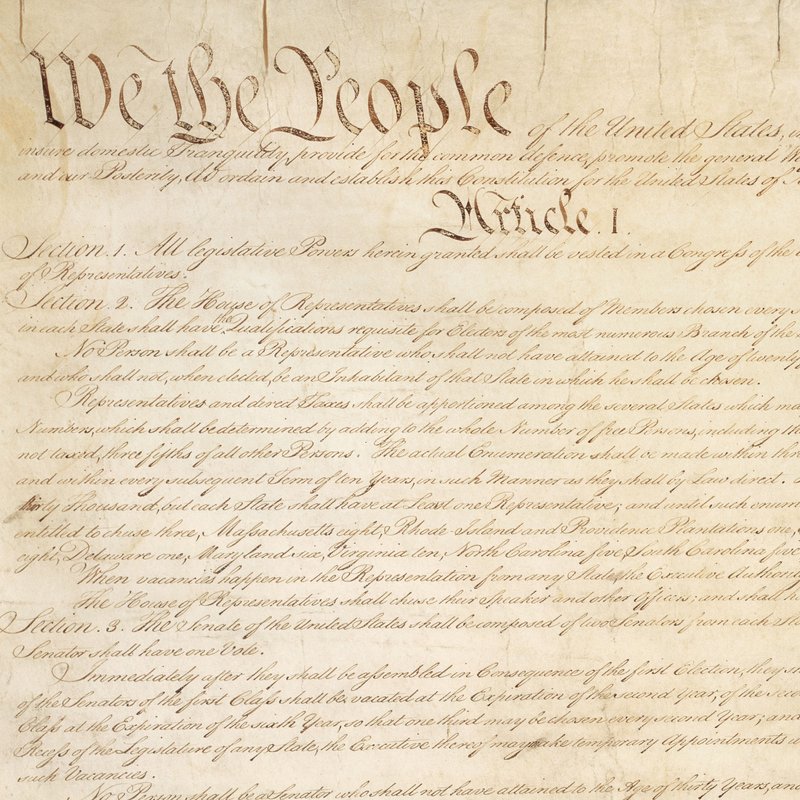
Brian Lehrer: To your book, The US Constitution: A Comprehensive and Annotated Guide for the Modern Reader. Obviously, you're not claiming to have written the United States Constitution, but you did a very comprehensive annotation that runs several hundred pages, including all of everything. The 250th anniversary this year is of the Declaration of Independence. The Constitution came more than a decade later. Everybody's talking about the Declaration. Why an annotated edition of the Constitution right at this time?
Professor Melissa Murray: First, I will acknowledge that I am not the author of the Constitution. I like to say that I am James Madison's collaborator here, and I think James Madison is probably very surprised wherever he is, that I am, in fact, his collaborator on this project. I don't think there's a better time to be engaged in the Constitution. The whole time I was writing this book, there was a constitutional issue in the news every single day. So many people asking, "Can the government do this? Can the President do this? Can Congress do that? What can courts do in these circumstances?" Those are the very questions that the Constitution was meant to answer.
When the Framers sat down in 1787 to draft a Constitution, they were working through trauma. They had gone through the colonial period with the British Crown and the British Parliament on their necks every single day. Then they had just gone through a revolutionary war in which they were pitted against the biggest global superpower in the world. They were trying to operate a government with no more than Scotch tape and friendship bracelets. I mean, it wasn't an operative government. The trauma of those two experiences, the colonial experience and trying to run the Revolutionary War effort with a inadequate government is what informed this Constitution.
They wanted to figure out how to strike this balance between having an effective and efficient federal government, but not a federal government that was so powerful it could run roughshod over the rights of the people. This is a document about limited government. Every day, we are talking about limited government. We may not talk about it in those terms, but we are asking whether the government can do this, or whether they are limited in how they intrude upon our rights, how they interact with us every day, whether it's protesters in Minneapolis or whether it is dismantling administrative agencies that were created by Congress. We are asking every single day, "What are the limits on this government?" This is the document that provides those answers.
Brian Lehrer: Limited government, to some degree, depends on where you stand, right? One group wants limited government when it comes to regulating guns. Another group wants limited government, like in the example you were just given, maybe in deploying ICE to Minneapolis, so where you sit depends on where you stand?
Professor Melissa Murray: I don't know if it depends so much on where you stand, but the whole idea of limited government is that the government can do certain things, but it can't go that far. I think that's a principle that can apply to almost every issue. Now, I think gun rights and gun safety advocates might agree. There is a proper place and time to use a gun. Maybe the Supreme Court's decision that we should look at all gun safety regulations through the lens of whether James Madison would have done it isn't appropriate in a moment where we are seeing the kinds of firearms that can do real damage, certainly damage that the Founding Fathers had not contemplated.
Again, I think the idea of limited government doesn't mean no government. It doesn't mean that the people get to do everything, but there is a balance. I think right now, we are striving mightily to figure out where that balance and where that equilibrium is.
Brian Lehrer: Listeners, we can take some calls and texts for NYU Law Professor Melissa Murray on-- Well, this is broad. Anything in the United States Constitution, with her annotated edition just out, or some of the legal issues we were talking about in the news right now, the abortion bill case, the voting rights case, or take your pick. 212-433-WNYC, 212-433-9692, call or text. Professor Murray, some of the most interesting parts of the book to my eye are your notes around the three Reconstruction Amendments, the 13th, 14th, and 15th, and the four more that you note that historians tend to overlook, the populist era ones from the late 19th and early 20th century.
Let me take the Reconstruction era's 14th Amendment, the famous 14th Amendment. There's so much in there. Birthright citizenship, obviously, in the news now, the equal protection and due process clauses, the insurrection clause, which would prohibit insurrectionists from holding office. Trump got around having that declared on him. Why is there so much in that one amendment?
Professor Melissa Murray: When the Framers were, and again, Framers is a broad label here. I think when most people talk about the Framers, they're thinking about James Madison, Elbridge Gerry. I'm talking about people like John Bingham and Thaddeus Stevens. We need to elevate those people. Frederick Douglass. The people who framed the 14th Amendment and give them pride of place in the same way that we give pride of place to the Founding Fathers, but the Framers of the Reconstruction Amendments recognized immediately that their efforts to eliminate slavery were going to be short lived if they didn't have real protections for rights in the constitution.
The 13th Amendment abolishes slavery. They recognize that that's not going to be enough. They have to figure how to bring the formerly enslaved into the body politic as citizens. That's why the Citizenship Clause exists. They then have to think about, "What are we going to do with these recalcitrant Southern states that are begrudgingly coming back into the Union, but who at any time might reconstruct the Confederacy under a different guise?" They tried to keep out those kinds of sleeper cells from government through the Insurrection Clause. They also try to change the way representation in the House of Representatives is done to prevent the South from disenfranchising African Americans.
That doesn't work especially well, and so they realize they have to have an actual amendment that prohibits racial discrimination in voting in order to allow African Americans to be able to represent themselves and to be represented in the government. They recognize immediately that going from a slaveocracy to a multiracial democracy is not going to happen overnight. It's going to require scaffolding. It's going to require changes in institutions. It's going to require changing the Constitution and the relationship between the federal government and the states, and between the federal government, the states, and the people.
That's exactly what they do with the Reconstruction Amendments. It is a second founding moment that completely reorients the nature of government and the way that we interact with both this document and the government that is limited by it.
Brian Lehrer: Are you, in a way, making the right case that birthright citizenship in the 14th Amendment was intended to naturalize people who were formerly enslaved, not the people who came here as immigrants, especially undocumented, and had kids?
Professor Melissa Murray: No, I'm not. What I'm saying is that, and what I say in the book, is that the Dred Scott decision, which the 14th Amendment Citizenship Clause repudiates completely, was a departure from the rule that had been in place since the colonial period. That was the rule of jus soli, which is that if you are born in this place, here, in the United States, you are a citizen of the United States. Dred Scott was obviously a departure from that because it said that African Americans, regardless of where they were born, could never be citizens because they were descended from African slaves.
Section 1 of the 14th Amendment is meant to repudiate that, not just for African American slaves and those who had been descended from African slaves, but for anyone. Indeed, as people like Martha Jones and Kate Masur have noted in amicus briefs before the court and in their own writing, there was a very active debate about whether immigrants would be included within the scope of Section 1 of the 14th Amendment. They made a very clear provision to include them as well.
Brian Lehrer: Let's go on to the populist era amendments that you say don't get enough press. Remind people of the economic backdrop for these in the late 19th and early 20th centuries, and what the impetus was then, maybe pick one or two to remind people about amendments that they may not be able to recite.
Professor Melissa Murray: Toward the end of the 19th century, the United States, coming out of the Civil War Reconstruction, saw an enormous industrial boom that resulted in an extravagant consolidation of wealth. This is the rise of the robber barons of oligarchy. I mean, truly the Gilded Age. There was vast income inequality. It actually rings quite true to today, where we are also similarly seeing the rise of an oligarch class right here in New York City and in the country. During that period, working-class people really came together because they were tired of the inequality.
One of the things that they really chafed under was the fact that the federal government's principal mechanism for raising revenue was to impose tariffs. They hated the tariffs because tariffs were regressive, which meant that the working class and the lower classes bore the brunt of tariffs disproportionately. What they wanted was a progressive tax, an income tax that would require the rich to pay their fair share, but that couldn't happen because Article 1 of the Constitution had a limitation that prevented the imposition of a direct tax like an income tax. The Supreme Court had confirmed that in a decision in the late 1800s.
The populace got to work. They amended the Constitution. The 16th Amendment supersedes that provision in Article 1 that prevents the imposition of a direct tax, and it allows for an income tax, a direct income tax, a progressive income tax that would tax the rich as well as the poor and indeed make them pay their fair share. They then went on with the 17th Amendment to demand the popular election of senators. In the original Constitution, senators were elected by state legislatures because our founding fathers were hugely distrustful of the working class, the hoi polloi. They thought that if state legislatures picked the senators, then a better class of people would be serving, and the people didn't want that anymore.
In the 17th Amendment, they got the popular election of senators. The 18th Amendment was prohibition, so the people had lots to say about alcohol. They later recanted that with the 21st Amendment, but then we have the 19th Amendment, which, in 1920, enfranchises women after more than a generation and a half of feminist agitation for the right to vote. With the 19th Amendment in 1920, a fight that was led, I should say, by some NYU law alumni like Inez Milholland and Crystal Eastman, we more than doubled the size of the American electorate. It is the most consequential electoral development in the history of the United States.
Brian Lehrer: Rafael in Turtle Bay, you're on WNYC with law Professor Melissa Murray. Hi.
Rafael: Hi, there, Brian. Hi, Professor Murray. My question is a general kind of step back and overview of the Supreme Court. We have seen rank corruption on the Supreme Court with justices getting involved with their emotional support billionaires like Harlan Crow. We have seen power-grab decisions like those striking down the Chevron deference. If we go back all the way to season one of this insanity, we have justices, in my view, lying to Congress during their confirmation hearing vis-à-vis precedent when it comes to Roe and striking that down. Now we have this decision that, from my point of view, basically declares racism solved. We don't need the Voting Rights Act anymore.
What mechanisms exist for everyday voters to hold-- are there anything that exists for us to hold the Supreme Court accountable when they're just acting completely lawless, in my opinion?
Brian Lehrer: Thank you, Rafael. Professor?
Professor Melissa Murray: It's a terrific question. Immediately after the revelations of the emotional support billionaires, as you say, there was an effort to get the Supreme Court to abide by a code of conduct. The Court actually did promulgate a code of conduct. It wasn't a mandatory code. Some people, including myself, thought it was a little toothless, but it did indicate that the Court understood that the public was deeply annoyed by these developments and that some steps had to be taken. I will just say, one thing that the public has going for it is that these justices read their own press. They know when the public is angry, and they know when the public is upset.
I think it's one of the reasons why Justice Alito, in the Louisiana v. Callais decision, did not blow up the Voting Rights Act entirely. Why Section 2 still stands, I think, because the Court recognizes that the public knows that this is a court with a supermajority that, for the last four years, has managed to overturn a spate of precedent from Roe v. Wade to decisions regarding the administrative state, and this might be a bridge too far.
In terms of concrete solutions, there's obviously court reform, and more and more of the public are agitating for a court reform that obviously has to proceed through Congress, which has the authority to do a number of things, change the size of the Supreme Court, alter the Supreme Court's jurisdiction. There are calls for term limits. These are actually very popular, in large part because we are the only constitutional democracy in the world with a high court that is unlimited in terms of its tenure on the bench. Some argue that to change life tenure for Supreme Court justices, you would have to amend the Constitution because the requirement of life tenure is specified in the Constitution.
Others argue, though, that if you could figure out a plan whereby justices rotated from the Supreme Court to some other federal judiciary post, the requirement of life tenure would be satisfied, and that that could be done via statute rather than through a constitutional amendment. I will say, the justices know the public is irritated, and I think they often calibrate themselves accordingly.
Brian Lehrer: On the Voting Rights Act and drawing district lines, Sam in Brooklyn has a question. Sam, you're on WNYC with Professor Melissa Murray.
Sam: Yes, hi. This is not really so much of a constitutional question, but I'm curious to know why only the discussion in the news has always been about discrimination against Black, the difference between white and Black. If you look at New York City's maps, New York State's maps, they carefully cut out the Jewish population from South Brooklyn and they added them on to Manhattan to carefully silence that group. Why is it only Black minorities that are being discriminated against? Why isn't it--
Brian Lehrer: Thank you, Sam. Professor Murray, I don't know if you agree with his characterization of that particular district, but it's certainly true that when you look at districting as a whole, it's not just Black Americans who are being taken into account consciously. If you look at the New York City Council level, Asian American majority districts, LGBTQ in Chelsea, that one goes back decades. This may all be called into question by the Supreme Court. Why is the focus just on Black and white, the listener asks?
Professor Melissa Murray: I don't know that the focus is entirely on Black and white. Certainly, the states that have been, I think, most persistent in their efforts to draw their districts in particular ways are states that are former Confederate states, so a lot of states in the South. I think that perhaps shapes some of the discourse around this, but I've always been very clear in talking about this question, certainly talking about this decision, that this decision, Louisiana v. Callais, is devastating for a multiracial democracy.
The 14th Amendment, the 15th Amendment, the promise of those amendments was not simply a democracy where Black people could participate, but a democracy that was truly a multiracial democracy. I think that's what we are working toward and working for. That's what the Voting Rights Act was supposed to do. A number of the Voting Rights Act cases that the Court heard in the 1960s were not necessarily about Black versus white. There was a case here that involved New York City's efforts to limit the voting power of Puerto Ricans through the use of literacy tests.
Brian Lehrer: Last question. Again, it comes from a listener. Listener writes, "As much as I would love to buy Professor Murray's new book, I will not bother because the Constitution is no longer relevant and worth the paper it was written on. Trump, along with his henchman Roberts, have seen to that." You do write in the book, you raise the scary prospect that some current events make clear that the safeguards the Constitution put in place to ensure democratic government may not be adequate in our volatile, politically polarized environment. Your words. What do you say to listeners who have become as cynical as the one who just wrote in? I wonder if you hear that in your classes at NYU at this point.
Professor Melissa Murray: I think there's enough cynicism to go around. Brian, I'm a Virgo, so no one's more pessimistic than me. I think one of the things I learned doing the work on this book is there's a lot of hope in the stories around the Constitution. You may not think the Constitution is worth the paper it's printed on, but I would argue that this book is worth the paper it's printed on, because there are a lot of stories about the people taking control, the people coming forward and making claims on the Constitution, and holding their government officials to account by the words that we're all supposed to live by.
The very last amendment that I cover in this book is the 27th Amendment. It's called the Compensation Amendment. It was actually first proposed in the late 1780s, along with the amendments that became the Bill of Rights. It was not ratified along with the 10 amendments of the Bill of Rights, so it's just languished there for 200 years until Gregory Watson, a student at the University of Texas at Austin, had to write a term paper. He chose to write his paper about amendments that didn't make it. He got a C on that paper. The teacher didn't think it was quite up to snuff, but he was undeterred.
He called a senator in Maine and asked him, "How do I get this amendment passed? I think this is a good idea. This is an amendment that prevents Congress from raising its compensation during a term in which it is sitting. This is a good idea." That senator put him in touch with a number of state legislatures. In 1992, Greg Watson was successful in getting the 27th Amendment ratified. Not only did he get the Constitution changed, he got his grade changed. The University of Texas at Austin determined that his C paper was now an A paper. If that's not a hopeful story about what ordinary people can do to create constitutional change, I don't know what is.
There are all kinds of stories like that in here. The women who worked and agitated for the 19th Amendment, those populists who wanted to have change and who wanted to stick it to the oligarchs. All of those stories are there, waiting to reclaim, just like this document is waiting to be reclaimed by the people.
Brian Lehrer: Melissa Murray, NYU Law professor, legal analyst for MS NOW, and co-host of the legal affairs podcast, Strict Scrutiny, and now the author of The US Constitution: A Comprehensive and Annotated Guide for the Modern Reader. Thank you so much for sharing it with us.
Professor Melissa Murray: Thanks, Brian.
