
Thanks to Trump, George Santos Is Out of Prison
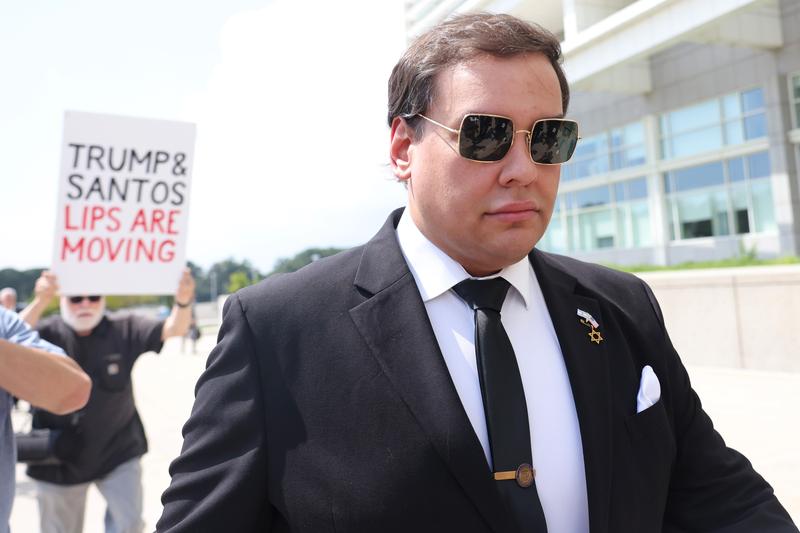
( Michael M. Santiago / Getty Images )
Brian Lehrer: It's the Brian Lehrer show on WNYC. Good morning, everyone. You may have heard over the weekend that President Trump commuted the sentence of the con man, Congressman George Santos from Long Island. These things seem to happen so often on Fridays when many people tune out of the news for the weekend. Sure enough, the reporting is that George Santos walked out of his prison cell little after 10:00 PM Friday night. Here's why I want to talk about that case here. You may think you know the worst things George Santos did because they got a lot of eyebrow-raising press. What he actually was convicted criminally of was probably worse than most of you realize. What he will now get away with has real victims, mostly Republican constituents, apparently not just a shorter prison sentence. Here's the part you prob know, as the New York Times reminded us in their article about Santos being freed. It says, "Santos claimed that he was descended from Holocaust refugees. His mother, he said, had been in the World Trade Center on September 11, 2001. He claimed to be a college volleyball star." "None of that was true," says The Times. I will add that there was also one that he first told on this show, we have to admit, after his election in 2022, referring to the post nightclub shooting in Orlando, Florida, that killed 49 people.
George Santos: My company at the time, we lost four employees that were at Pulse nightclub.
Brian Lehrer: The Times says a review of news coverage and obituaries found that none of the 49 victims appear to have worked at the various firms named in his biography. Those are the things you probably know about the conman, Congressman George Santos. Yes, those were all whoppers and contributed to him getting kicked out of Congress. Making those things up were not his crimes. His crimes, what he pleaded guilty to in court, what got him a seven-year prison sentence, was wire fraud and aggravated identity theft.
For example, according to the US Attorney for Long Island, who prosecuted Santos, he was sentenced for, among other things, a credit card fraud scheme. The prosecutor wrote, "Santos devised and executed a fraudulent scheme to steal the personal identity and financial information of contributors to his campaign. He then repeatedly charged contributors' credit cards without their authorization. Repeatedly charged contributors' credit cards without their authorization." Quote from the US attorney's statement upon sentencing.
Then there was the way he used campaign donors' money. According to the US Attorney statement, he would "Falsely tell donors that, among other things, their money would be used to help elect Santos to the House. Santos then used much of that money for personal expenses. Among other things, Santos used the funds to make personal purchases, including of designer clothing, to withdraw cash, to discharge personal debts, and to transfer money to his associates."
Another quote from former US attorney John Durham's office after Santos was sentenced in April. There was more like that. Now, and here's the real headline in my opinion, and why I'm bringing it up, President Trump didn't just give Santos a get out of jail free card. As The New York Times reports, he will no longer be required to pay more than $370,000 in court-ordered restitution to his victims. Other news outlets have that too. He will no longer be required to pay more than $370,000 in court-ordered restitution to his victims.
Apparently, if all this is accurate, Trump's commutation order deprived Santos's victims of getting their ill-gotten money, ill-gotten by Santos, their money back. Let's find out more from Grace Ashford, New York Times reporter covering New York government and politics. She's been reporting on the George Santos saga, including The Times' original investigation into his made-up resume. Grace, thanks for coming on. Welcome back to WNYC.
Grace Ashford: Hi, Brian, thanks so much for having me.
Brian Lehrer: Can we go right to that part that I've been keying on? The commutation order wipes out Santos's requirement to pay back his victims. Can you describe in any detail what that $370,000 court order was for or who it would have gone to?
Grace Ashford: Yes. You're 100% right. In the commutation order, it specifically says he's not required to pay any of this restitution. It was about $370,000 in restitution that he was required to pay. Some of that came from, as you mentioned, Republican donors in the form of literally credit card numbers that he repeatedly used for personal purposes. Then a larger portion of it actually came from the National Republican Campaign Committee, which is also the money from Republican donors, just on a nationwide level.
That relates to one of the five schemes that he was charged with and pled guilty to or pled responsible for the party program scheme, where he acknowledged that he had falsified his campaign finance reports to inflate the accounts to make it look like it was a much more successful campaign. Listeners might remember a mysterious loan for around $700,000, $800,000 that he said he made his campaign. This is what that was referring to. Prosecutors said that, in effect, it defrauded the NRCC by forcing them to give money to support the campaign.
Now, Santos has a response to this. He says, "Listen, do you really want me to pay the NRCC back? Also, I contest that it's fraud because they invested my campaign and I won." Maybe that will be enough for some Republican donors. Certainly, we have seen that in his former district on Long Island, there's been a lot of frustration and anguish.
Brian Lehrer: Would Most of that $370,000 have gone back to the Republican National Committee as opposed to individuals?
Grace Ashford: That's what Santos said. He said 85%. Now, you take it with a grain of salt, but our reporting suggests that it's certainly a large chunk.
Brian Lehrer: Interesting. I laid out in the intro that the things most of the public associates with George Santos, being what your article calls a fabulist, that is, making up so much of the life story that he ran on, are shameful but not criminal. How did his story go from one of being a fabulist to the federal charges that landed him in prison? Because those were not part of the original stories, right?
Grace Ashford: The federal charges, no, they weren't. Even in our initial report from December of 2022, we keyed in on the fact that among the many stories that he was telling himself, the story about his financial background, which was really key to the pitch he was making to voters, that he was this business whiz, that he'd worked on Wall Street, that he knew how to deliver for his district was not really adding up. We at The Times really keyed into the campaign finance issues, as did a lot of other reporters at other outlets.
Some really great reporting all across the board. Pretty soon, we also learned that the DOJ was also looking into it. I just want to stress this again, this is not one thing that he was charged with. There were five different schemes that he ultimately said that he was responsible for, even though he was only really convicted on, as you mentioned, the aggravated identity theft and wire fraud.
Brian Lehrer: Let's go over a few of those a little more. One, as you report, was using a donor's credit card to steal $11,000 for his personal use. Do you know any more details about that?
Grace Ashford: We don't have any specific details on that, but we do have a sense of where some of this money that he used for his personal use went, thanks to the House ethics report, as you mentioned. We know that he paid off some personal debts with it. We know that there were designer goods that he purchased. We know that at least some of that money went to pay for Botox and perhaps most memorably, some of it went for a subscription to the website OnlyFans.
Brian Lehrer: Was part of his sentence to pay that donor back their $11,000?
Grace Ashford: Presumably, yes.
Brian Lehrer: How about the one I read from the US Attorney's post-sentencing statement that Santos used campaign donations to make personal purchases, including of designer clothing, to withdraw cash, to discharge personal debts, and to transfer money to associates? Was any of that part of the restitution order?
Grace Ashford: Right, that would absolutely have been part of the restitution order. That I believe refers to the red strategy scheme, which we reported on. It involved Santos and an associate approaching some donors who had already maxed out to his campaign with what they said was a 501(c)(4), a super PAC that would be able to spend all of this money on ads and various things to support his campaign. Unfortunately, or I guess for those donors, that group did not exist. In fact, that money, at least $50,000 from two different donors, was used by Santos to line his pockets.
Brian Lehrer: I just want to be very clear because I don't want to overstate what he pleaded guilty to and what the therefore conviction and prison sentence were for. I read out all those things from the US attorney's office statement upon the moment of his sentencing. Are you saying that some of those things are not what he was convicted for, they're just things that the US attorney said he did, and the conviction, the guilty pleas were narrower than that?
Grace Ashford: Santos was initially charged with 11 counts. There was a superseding indictment that brought that up to 23 counts. He ultimately only pleaded to the aggravated identity theft and wire fraud. As part of that guilty plea, he publicly took responsibility for and admitted to the rest of the schemes that he was charged with. He stood in court and quite tearfully admitted that he had indeed done this red strategy scheme, had collected unemployment while in fact he was employed, that he had lied on his congressional disclosures.
Brian Lehrer: Right. That's another one we hadn't even gotten to, the unemployment scheme fraudulently claiming and receiving $24,000 in unemployment benefits during the height of COVID. This was through the New York State unemployment insurance system. How did Santos, for what he admitted to or what the US attorney charged him with, steal unemployment benefits from the taxpayers of New York?
Grace Ashford: It seems that he was, as many of your listeners, I'm sure, remember, there was a big push to get money out to people who had lost their jobs as a result of COVID. I think a lot of people saw a real opportunity there, including Mr. Santos. He filed paperwork saying that he was unemployed, and in fact, he was employed. He did not report the fact that he was employed, not only to New York State, but I believe he also did not report that on his federal filings, because at the time he was running for Congress.
Brian Lehrer: Was part of the restitution promise to pay the taxpayers back that-
Grace Ashford: It was
Brian Lehrer: -$24,000?
Grace Ashford: That's right.
Brian Lehrer: Here's a key question, I guess, and I don't know the answer to it. Could President Trump have commuted the imprisonment part of Santos's sentence, but still required him to pay back his victims?
Grace Ashford: This is a really good question. I'm no lawyer, but my reading of the DOJ section and the website suggests that, yes, I believe that President Trump could have done that. It says that remission, that's getting rid of the restitution part, any sort of fines is optional when clemency is being issued. It does seem that President Trump made the decision to also wipe this debt from his record.
Brian Lehrer: Interesting. Here's the part that might be more sympathetic to Santos. Trump posted in his Truth Social post announcing the commutation. "George has been in solitary confinement for long stretches of time and by all accounts, has been horribly mistreated," from President Trump. Now, I do see in your reporting that Santos was separated from other prisoners because of death threats. Does that mean there were death threats from other prisoners?
Grace Ashford: Yes, this is interesting. You're right that George was in solitary for almost 30 days, I believe, or a little over 30 days. That was a result of death threats that his lawyer received that he-- according to his lawyer, that he shared with the warden, and they were seeking some sort of protective custody, is my understanding. Instead, he was put into solitary confinement, or perhaps that is the only available protective custody in that prison. I'm not sure. Yes, it appears that he was indeed in solitary confinement for quite a long time.
We know a little bit about that from these columns that he was writing at the time, that had been published in the South Shore Press on Long Island. He describes it as slow-motion torture.
Brian Lehrer: In that case, it sounds like they were protecting his safety by putting him in solitary confinement. If that's true, it made him a victim in a way of threats against him, not in solitary because of any of his own behavior.
Grace Ashford: That's what we have been told by George and his attorney.
Brian Lehrer: Last question, do the victims have any other recourse to get their money back, like a civil suit to recover their money?
Grace Ashford: Yes. It's a good question. Definitely, George would be liable for a civil, or rather, he could find himself vulnerable to civil lawsuits. We have yet to see any of those, but we may, but I think just to take one step back, I think part of why this case is a little bit difficult for people to really wrap their heads around is because you know what? I think his biggest fraud in a lot of people's minds is the fraud that he perpetrated on the members of his district in the lies that he told about who he was and what his character was. George is right that those--
Brian Lehrer: As I said at the beginning, those were not crimes. Right?
Grace Ashford: Those are not crimes. That's absolutely right. In the sense that the people of the third District, some of whom have said that they felt that they didn't get representation for the time that he was in Congress, he was indeed expelled, and they have they were able to hold another election. In that sense, there was some restitution. In terms of the financial, no, he said that he does not have to pay it, and he will not if he doesn't have to.
Brian Lehrer: In sum, and to be perfectly accurate, he pleaded guilty to wire fraud and aggravated identity theft, but he promised to pay back the victims of even other things that he was accused of by the US attorney, that he didn't actually plea to, but he was going to pay that money back, and now with President Trump's commutation of his sentence, he doesn't have to.
Grace Ashford: That's right.
Brian Lehrer: Grace Ashford, reporter covering New York politics and government for The New York Times. Thank you for joining us today.
Grace Ashford: Thanks so much, Brian.
Copyright © 2025 New York Public Radio. All rights reserved. Visit our website terms of use at www.wnyc.org for further information.
New York Public Radio transcripts are created on a rush deadline, often by contractors. This text may not be in its final form and may be updated or revised in the future. Accuracy and availability may vary. The authoritative record of New York Public Radio’s programming is the audio record.