
Tentative Hope for Gaza and Israel
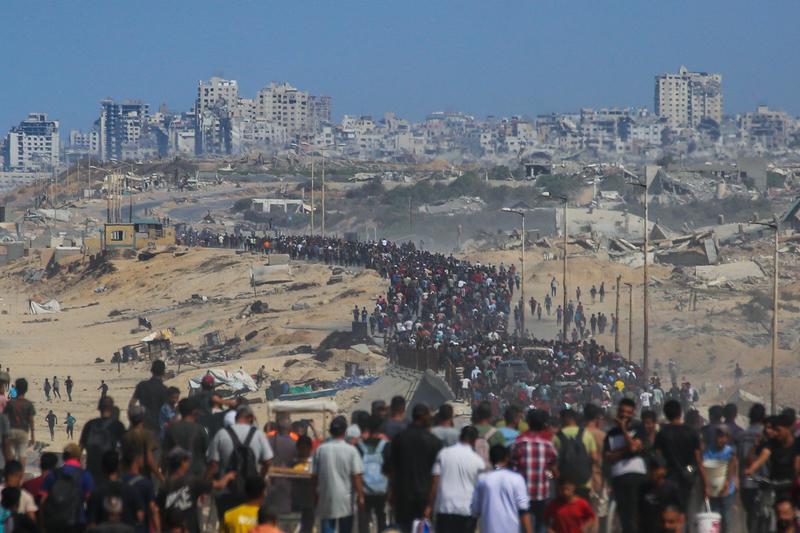
( Bashar Taleb/AFP / Getty Images )
[MUSIC]
Brian Lehrer: It's The Brian Lehrer Show on WNYC. Good morning again, everyone. The ceasefire in Gaza and hostage and prisoner exchange is one of those moments where there's a stark contrast between the tone of political leaders and that of regular people finding ways to pick up the pieces. We heard the contrast on Morning Edition today. If you were listening in the 7:00 AM hour, there was President Trump on his now-completed trip to the region. Here's 15 seconds of that.
President Donald Trump: We have confronted evil together, and we have waged war together. Perhaps, most beautifully of all, we have made peace together. This week, against all odds, we have done the impossible and brought our hostages home.
Brian Lehrer: There were tears of both joy and anguish of Israeli families whose hostages have come home, but who no others died or were murdered by Hamas in captivity, not to mention the 1,000-plus killed on October 7th. There was reference to the Palestinians. 1,968 is the last number I saw prisoners released. There was an interview with a Palestinian woman describing a little of what it feels like to her to suddenly have the war end with 60,000-plus dead, by all accounts, but she and her young daughter, Dania, still alive.
Palestinian Woman: Dania spent more than half of her age with no drinkable water, with no medical supplies for her illness, with no milk, with no diapers. Because of the famine, she grows up on canned food. She doesn't recognize the apples, the banana, and all the other kind of fruits. What I'm talking about is two years of feeling guilty for not being enough for my daughter, for not being able to secure her with all of her basic needs.
Brian Lehrer: With all of that as prelude, we're joined now by Atlantic magazine staff writer Graeme Wood, who has been over there for the events of these last few days. He joins us from Israel now. Besides being a staff writer for The Atlantic, Graeme Wood also teaches political science at Yale. In the 2010s, he wrote a book about ISIS called The Way of the Strangers: Encounters with the Islamic State.
His bio page says he joined The Atlantic after working as a translator, courier, and bootlegger in northern Iraq, and has reported from every continent, except Antarctica. His new article is called One Era Ends in Gaza, Another Begins. The subhead may surprise you, given all the uncertainties about what comes next. It says, "A moment for radical hope." Graeme, thanks for coming on this program again. Welcome back to WNYC.
Graeme Wood: Thank you, Brian, for having me again and bringing up my sordid past.
Brian Lehrer: Much of your article on your sordid present is framed around a conversation you had with the former Palestinian Authority peace negotiator, Sari Nusseibeh, who somehow is less pessimistic than you about what comes next. Nusseibeh is now 76 years old and long out of politics, you say. Why did you turn to Sari Nusseibeh?
Graeme Wood: Sari Nusseibeh has been around for a long time, and he has been a consistently humane voice trying to figure out ways to solve this conflict. I come here very infrequently compared to someone like him, who's really seen the changes over the years. He was active in the efforts to find a two-state solution 25 years ago. When I went to see him, my first thoughts were, of course, I was pleased that there's a prospect of the war ending. Also, I had some pessimism about the possibility of that end really sticking.
Specifically, I assumed at some point, and I told him this, that, eventually, Hamas, someone's going to pop up from the rubble and fire at an IDF vehicle or something, and then the violence just resumes. He seemed to think that there was a chance that that would not happen. To talk with someone who's in his eighth decade and who has seen from the Palestinian perspective so many reasons not to think that there is a future and have him say, "Cheer up a bit," was startling to me. It did bring back a moment of what he called paradoxical optimism to me as well.
Brian Lehrer: Yes, tell me more about that particular exchange with Nusseibeh that you just referenced, because that's one of the things that really popped out at me from your article. You had what looked to my eye at first like a reality check. You wrote, "Israel demands that Hamas disarm. Hamas still refuses." You wrote that you feared Hamas would pop up from the rubble and blow up an Israeli military vehicle, and the war would start again, but then you wrote that Sari Nusseibeh chided you for your pessimism. Tell me more about why he thinks something like that won't happen again.
Graeme Wood: Well, there's two reasons. One is practical. First of all, the security situation, the security platform that's going to exist going forward. There's still so many kinks to be worked out about governance and about security. He seemed to think that Israel was not stupid enough to put itself in a position where it was likely that it was going to be attacked. They've already moved back behind a line within Gaza.
It's understood that the security in the most populated areas will be taken care of by another international entity overseen by the United States. First of all, the chances that a situation that I described where it was going to happen, he thought it was less likely than I did. Then there's this moment of, again, what he called paradoxical optimism, which he said that the Palestinians, the Gazans in particular, have suffered an unimaginable catastrophe over the last couple of years with, as you mentioned, 60,000 dead, including combatants.
That catastrophe, though, at least gives a moment where, unlike he said in his youth when there was a possibility of simply having a handshake and having a two-state solution that, instead, they start from a baseline of understanding that that's not going to happen suddenly. Instead, the creation of security, the creation of prosperity, and the creation of basically a new life and dignified life for Palestinians might actually be a precondition for Palestinians having a state and the freedom that they deserve. I think he thought that, in the past, people thought that this could happen overnight. Now, no one is under that illusion. When you start by not having that illusion, you might actually get somewhere.
Brian Lehrer: I saw a New York Times columnist, David French, on television this morning describing how Hamas has carried out a number of public executions in Gaza these last few days to show the world and the people there that they are still in charge. If Sari Nusseibeh is right that Hamas has little to gain by spoiling the ceasefire in the short run, how do you see the state of Hamas in the longer run?
You wrote a whole book about ISIS at a moment when they were being weakened around 10 years ago. Now, here's Hamas in this current state, two years after Israeli Prime Minister Netanyahu declared war to destroy the group. I guess they are weakened, but they do still exist, and they do still have weapons. How do you see them as a factor in this next phase of the negotiations toward a more permanent arrangement, whatever that is?
Graeme Wood: Yes, it's very interesting to see the way that Hamas is going to factor into this because it's been stated very clearly that part of the agreement is going to be that Hamas does not have an armed role in running Gaza going forward. Also, there has to be someone who has weapons and who is actually controlling the place. Evidently, because Hamas still has weapons and is still settling scores in Gaza, it's understood that even at this very moment, it's okay that they're doing that in the limited sense that someone has to be keeping the peace, so to speak.
Now, going forward, we're in a moment of, I would say, a kind of reality check where Netanyahu has said Hamas is going to be obliterated. That's been a consistent line since the beginning of the invasion of Gaza. It's also been implausible, the ability to completely destroy Hamas. The amount of brutality to achieve that literal goal has always been horrifying and has made that goal as a literal goal just unworkable. The reality check is, now, we're talking about, what's the real goal here?
What's the actual form that Gaza is going to take going forward, given that, evidently, according to this plan, not going to be annexed by Israel, and that Hamas, although it's supposed to be disarmed and not have a role in this, is going to exist in some form, which we know. It's a moment where a lot of, I suppose, maximalist slogans are collapsing into political realities. It's happening only because of this very strange circumstance that's brought us to this 20-point plan.
Brian Lehrer: Part of your article, I want to note, is about the West Bank. It probably hasn't gotten the coverage it deserves these last two years, while the focus has been so much on Gaza. I know that before October 7th, 2023, there had been reporting that people were concerned that it was the West Bank that was really going to explode because conditions for Palestinians there were becoming so dire as they were experiencing it.
Expansionist Israeli settlers have been on the offensive in the West Bank while everybody's been looking at Gaza, driving more Palestinians from their homes, according to the reporting I've seen, trying to shrink the amount of land that could be potentially turned over to Palestinian control, and reducing the chances that there could be anything like a Palestinian state. You write about how they even managed to alienate Trump's Israel ambassador, Mike Huckabee, who arrived in Israel as a big supporter of Israel permanently owning that land, the West Bank. Tell us the Mike Huckabee story.
Graeme Wood: Yes, Mike Huckabee, when he was appointed ambassador, that did not seem like an auspicious sign, I think, for most Palestinians simply because he, from an evangelical perspective, is a strong supporter of Israel, not just within its internationally recognized borders, but pretty well beyond them. He uses the term "Judea" and "Samaria," which is used by the Netanyahu government, and is pretty much code for the way that the West Bank is referred to by people who think that Israel should control and perhaps annex it.
His appointment was not a happy occasion if it was a sign of the views of his boss, Trump. That was in July, I believe, when he arrived. There have been some signs that his view has moved. Now, he said that Israel has "title deed" to this land. I guess for him, too, there's been certain reality checks. It's clear that settler violence in the West Bank has increased over the last several years, was particularly bad in the months after October 7th, and I reported on that for The Atlantic at the time.
In the last few months, though, he has made visits to the West Bank. He has seen the places where Israeli settlers have menaced and sometimes destroyed property and been violent toward Palestinian villagers. In one case, in the village of Tayba, where a church was burned, he actually called it an act of terror, which was not a word that you're expecting probably to hear from Mike Huckabee when he was originally appointed.
I think what that reflects again is that when you actually are in a position of responsibility and not just talking about this on Fox News, when you actually are given the charge of trying to find a way to create peace or create some kind of long-term modus vivendi, then you have to deal with reality. The reality is that settler violence is a real thing, that it delegitimizes Israel, as well as making life hellish for Palestinian villagers. Probably, the long-term state of affairs in the West Bank is going to include Palestinians having some say over their own lives and politics. That's a pretty long journey that I think Huckabee might be making right now over the course of just a few months.
Brian Lehrer: I heard, by the way, on the BBC regarding the West Bank, that while Israelis have been able to publicly celebrate the return of their people, Palestinians in the West Bank have been forbidden from speaking to the media as nearly 2,000 of theirs reunite with families. Have you seen reporting to that effect or understand why that kind of muzzling if that's accurate?
Graeme Wood: I have seen reporting to that effect. I have not been in the areas where the prisoners have been welcomed back, so I haven't been able to confirm that myself. I think there's a very strong understanding on the part of the Israelis not to justify in any way, any censorship that they might have engaged in. This is a very sensitive moment. I think that some of the people who have been released have been found guilty of very serious crimes. I'm talking about the Palestinians who have been released, whereas the Israelis who have been released, by and large, concert goers.
Brian Lehrer: As I understand it, Graeme, many of the Palestinians, in addition to those who you cite, who had been imprisoned for serious crimes, many had never been charged with anything.
Graeme Wood: That's right. Many of them, just over the course of the last couple of years, have been detained under wartime conditions. There's a mix in the case of the Palestinians, those who have been adjudicated, and then those who have simply been detained.
Brian Lehrer: What was the point of those other detentions? Was it to use them, in effect, as hostages, as bargaining chips, or why detain people who are not being accused of crimes against Israelis or being part of Hamas's fighting force?
Graeme Wood: I guess you'd have to look at individual cases. I'm afraid I can't speak for the aggregate. There are certainly the prisoners who, as I say, have been adjudicated. Then keep in mind, in Gaza, as in the West Bank, there is military rule. Military rule, by definition, means that you don't have rule of law in the way that a civilian would receive. It doesn't surprise me at all that many of the Palestinians who were detained have not had a day in court. They've been kept for reasons that, in any particular case, might not be defensible.
Brian Lehrer: My guest is Graeme Wood, staff writer for The Atlantic, joining us live from Israel on his new article, One Era Ends in Gaza, Another Begins. The subhead that may surprise you, which we will get back to, given all the uncertainties about what comes next, says, "A moment for radical hope." On the Israeli side, here's a clip that's been getting a lot of attention at the big celebration over the weekend at what's known as Hostage Square. Listen to this contrast. Trump's special envoy, Steve Witkoff, lauded Trump for his efforts in the ceasefire negotiations, and then Prime Minister Netanyahu, his Trump references first. Listen to the crowd.
Steve Witkoff: The bold leadership of my friend and President of the United States, Donald J. Trump, that made this peace possible.
[applause]
Steve Witkoff: To Prime Minister Benjamin Netanyahu.
[crowd boos]
Brian Lehrer: Extended boos for Netanyahu. Thousands of people there, many of whom had been protesting Netanyahu, not on behalf of Palestinians primarily, on behalf of the Israeli hostages for many months, over Netanyahu continuing the war as he had. This kind of weird moment maybe from the perspective of a US news consumer who doesn't follow very closely where they cheer Trump but boo Netanyahu. My question to you, Graeme, as a reporter there, is how much of Israeli public opinion does that moment represent? Does it have implications for how they proceed to something more lasting two-state solution, maybe, and with enough justice as perceived by both sides?
Graeme Wood: Yes. From the perspective of Israel and, specifically, the perspective of Tel Aviv, the lack of applause for Netanyahu is the most predictable thing in the world. Remember, the hostage, the rallies, the weekly gatherings in Tel Aviv for the hostages were, in some ways, an outgrowth of an even larger protest movement in Israel against Netanyahu and reforms that he was making that his opponents considered proto-autocratic before October 7th.
Many of those gatherings are filled with people who dislike Netanyahu and who, after the October 7th attacks, blamed him because he was in charge for failing to foresee and prevent them, first of all, and then subsequently, with the war in Gaza, blame him for the brutality of the war and for the failure to bring back hostages alive, and Trump. By contrast, Trump, when he arrived the other day, he literally came down out of the clouds with a plan that he put together, not Netanyahu, not anyone on the Israeli side.
He was the one who is the catalyst for the return of the remaining hostages. They see Trump as the one who got things done. They see Netanyahu as the one who failed to get things done at the very beginning of this war and who, in the view of many of them, was destroying Israeli politics before the war, and who was simply along for the ride when someone actually came down and created a plan that ended the war. He's not the most popular figure. That's reflected in that reception that the mention of his name got in the Hostage Square.
Brian Lehrer: Here's how you put a reason for optimism about the next phase of the peace plan, that, "Any hope in the region is largely due to the fact that Trump will look like a chump if the deal collapses, and that he will do anything to avoid chump status and destroy those who would make him into one," a quote from your article. Graeme, I can hear the heads nodding in agreement with that one out there in radio land about Trump and his image, but how broadly do you mean it? Is it about getting to an actual two-state solution, which both Netanyahu and Hamas have been mortal enemies of?
Graeme Wood: I don't know if crossing that particular finish line is-- In fact, I'm sure that that's not something that Trump has wagered his reputation on. I do think that the end of the war as we know it in Gaza is something that, by the statements that he made in Sharm El-Sheikh, the speech that he gave in the Knesset, every other pronouncement that he's made, has really put his reputation on the line saying that, "I created peace. No one else could." If that peace falls apart, then he really will look like a fool. I think for someone as vain as Donald Trump, that keeping his credibility on that point is going to be very important.
In fact, you can see that in the coalition of people and leaders, countries that he got to sign on to all this. It reminds me in some ways of-- I've been at weddings where everybody's asked in the audience to stand up and say, "Yes, we're going to help the new bride and groom make sure their marriage is a good one." Kind of like that. That's how it feels with Trump. The specifics of how the peace is going to move forward, what Gaza is going to look like, those are still blurry. He has at least enlisted enough people, enough groups, enough countries where there's a fighting chance at peace, as Sari Nusseibeh put it to me.
Brian Lehrer: Well, what kind of peace? Trump said on Air Force One while flying home yesterday, "A lot of people like the one-state solution. Some people like the two-state solutions. We'll have to see. I haven't commented on that." You also reprinted the quote from Trump recently, saying he "will not allow Israel to annex the West Bank." First, do you know how he would prohibit that? I think Netanyahu wants to do that. Tell me if that's overstated, or what does this suggest for what kind of ultimate status Trump is aiming for?
Graeme Wood: Well, it is, in fact, one of the points in the agreement that Trump has gotten all these different parties to basically agree to, which is Israel will not be annexing Gaza. When he mentioned that in the Oval Office in September that he would not allow Israel to annex the West Bank or Gaza, I guess it seemed possible at the time that that was a throwaway line, that it was something that he mentioned without thinking it completely through.
When you start seeing it as one of 20 points and you see it as one of 20 points in an agreement that Netanyahu himself appears to be endorsing, then it has a lot more credibility. The fact that he muses about a one-state solution, I think that should be taken less seriously than what's actually on paper. Now, the temporary government that's described again in the most vague terms in that 20-point plan is for a Palestinian technocratic government, which has the support of the various countries and so forth that are signing on to this. I've heard that spoken of even months after October 7th, when the invasion was young.
The questions that I asked then still present themselves now. Who are these technocrats? How do these technocrats have the ability to do anything when there's much more powerful armed groups that might disagree with what they're doing? Part of the answer to that question might just be if you have Turkey, Qatar, and the UAE, and half a dozen other parties that are co-signers here, then a lot more can get done. It's true that that didn't exist on October 30th, 2023. The optimism again is born of the catastrophe that we've seen over the last couple of years. It's starting from a very, very low baseline, but it's more merited now than it has been for any point in the last two years.
Brian Lehrer: Though that scenario of who controls, at least Gaza, that you lay out, is not one in which Palestinians themselves control that territory, if I understand it correctly.
Graeme Wood: One of the things that the--
Brian Lehrer: Go ahead.
Graeme Wood: Yes, exactly. The Israelis, especially the Israeli far right, which is part of Netanyahu's coalition, has said, "We're not going to have a Palestinian security force that can threaten us." To actually rule a territory, you have to have a security force. You have to have a monopoly on violence. In that sense, it's not a Palestinian entity at all, but a Palestinian civilian group that has a non-Palestinian military adjunct ruling by its side, which I think Palestinians could reasonably say, "Yes, that's not us ruling ourselves. It's us with some people with guns who are not us pretending to rule." It's not what everybody's looking for, but it's certainly better than war.
Brian Lehrer: Well, it gets to one of the big perennial sticking points in past two-state solution plans, and that's been whether a Palestinian state has control over its own military or security, if they want to use that word. Palestinians tend to demand it as part of actual independence, self-determination. Israel rejects it because of the ongoing rejectionism of groups like Hamas, which they feel will stage attacks over the border that a Palestinian government may not be willing or may not be able to prevent.
The rejectionist groups on that side, there are rejectionist groups on the Israeli side, but the rejectionist groups on that side will continue to use violence. Palestinian control isn't enough to prevent that. Do you see that as a central obstacle today to an ultimate arrangement? Is there a solution to it that Sari Nusseibeh, your source here who used to try to negotiate these peace proposals, or anybody else can come up with?
Graeme Wood: It's an enormous stumbling block. Now, again, trying to look in the rubble for optimism here, I would point to the West Bank. The West Bank has the Palestinian Authority in charge, but under an Israeli military dispensation that prevents it from taking care of its own treasury, taking care of its own security in a way that would allow it to actually be the ruling entity in the West Bank. However, the reasons for not allowing the Palestinian Authority as its capacities grow up to have that power have been slipping away.
The so-called murder payments, that's basically public funds that were going out to people killed, Israelis, that has basically stopped. The Palestinian Authority, for a while, though, still credibly accused of corruption, has been more and more plausible as a security partner. That has been blocked by Israel. The reasons for blocking it are becoming fewer as time goes by. In Gaza, of course, there's nothing quite with even that level of credibility. The existence of such a thing might also be blocked. There are ways where something like that could grow into a partner that could become the seed of a state.
Brian Lehrer: Last thing, if they're aiming towards something more permanent after 100 years of all of this, however anybody wants to characterize it, it seems like they still have to aim for a two-state solution. Correct me if you disagree. I know there are people who disagree because there's no one-state solution that could work for both peoples, right? The Palestinian version includes no Jewish state per se. Obviously, Israelis are not going to go along with that very easily.
The Israeli version does not contain equal rights for Palestinians. If neither version of a one-state solution can work, is Saudi Arabia now a key to pushing everybody toward a two-state solution? I read that Saudi Arabia, which may have before October 7th, 2023, been willing to join the Abraham Accords, Arab countries recognizing Israel for economic purposes and to band together against Iran, that they may have then been willing to join the Abraham Accords without a Palestinian state or the promise of one.
Now, they're not. I wonder if that's your reporting as well. If you think that that may be a major storyline in the coming months, Saudi Arabia pressuring both Israel and whoever counts as Palestinian leadership to agree to a two-state solution and try again to work out all those sticking points, who controls security, who controls Jerusalem, right of return, all those difficult things.
Graeme Wood: Yes. Well, I would bet a lot of money against that happening on this time frame of months. You're right to think of Saudi Arabia as one of these wildcards that really could, in much the same way that the strange randomness of Trump has made certain things possible. Saudi Arabia, too, could be important. I've done a lot of reporting in Saudi as well. There's this city in the desert that Mohammed bin Salman, the Crown Prince of Saudi Arabia, has been building.
It's not coincidental that that city in the desert is near Israel. The amount of money that's been sunk into that city is huge. It really makes economic sense only if you think that it's going to be part of an economic development zone that includes Egypt, Israel, and Jordan. The Saudis already have plans for a day when they will not be the enemy of Israel. They've already got, of course, security arrangements with Israel. I think that the two-state solution is, for a lot of people, something that they should wait for.
Saudi, unlike, say, UAE, has not made its peace with Israel and had diplomatic relations. It's best that they hold that back until the two-state solution is something that people can talk about again. Right now, though, after two years of war and even before that, really, it really was the two-state solution as it was spoken of in the 1990s, was such a dead idea because of the extreme parties on both sides. I think that it's going to take a bit more time before that can pass the laugh test.
Brian Lehrer: Well, a lot has happened the last three days. Obviously, Graeme Wood from The Atlantic has been there and wrote his latest article called One Era Ends in Gaza, Another Begins. Thank you for laying out the hopes, as well as the losses and the fears. Thank you for joining us.
Graeme Wood: Good to be with you, Brian.
Copyright © 2025 New York Public Radio. All rights reserved. Visit our website terms of use at www.wnyc.org for further information.
New York Public Radio transcripts are created on a rush deadline, often by contractors. This text may not be in its final form and may be updated or revised in the future. Accuracy and availability may vary. The authoritative record of New York Public Radio’s programming is the audio record.