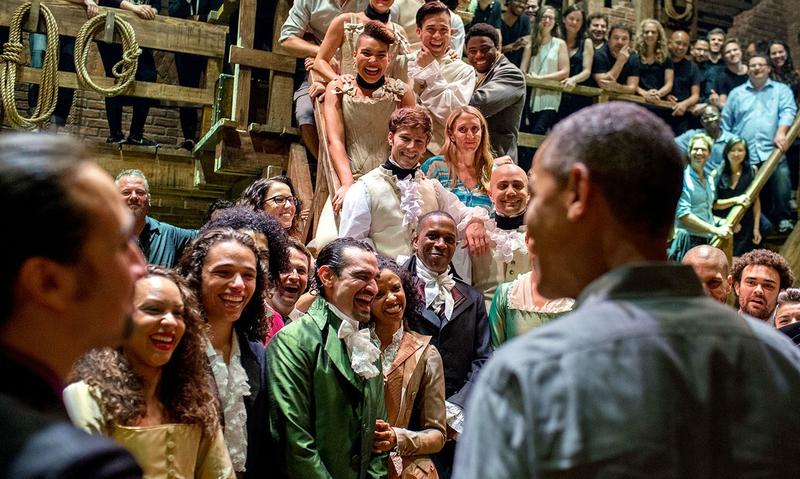
Title: Ten Years of Hamilton on Broadway [song: Alexander Hamilton]
And there’s a million things I haven’t done
But just you wait, just you wait.
Brian Lehrer: No, that's not The Brian Lehrer Show theme song. That, of course, is Alexander Hamilton from the hit Broadway musical, Hamilton. This year marks the 10th anniversary of the premiere of Lin-Manuel Miranda's musical about the Founding Father. Since then, it has, of course, grown to be a worldwide cultural phenomenon.
Frank DiLella hosts On Stage on New York 1 and joins us now. He's out with a new special called Hamilton: Ten Years - A Legacy on New York 1, where he revisits the origins of Lin-Manuel Miranda's groundbreaking musical, how it's transformed over the past decade, and how the musical is a uniquely New York story.
Frank, thanks so much for coming on. Congratulations on this piece. Welcome to WNYC.
Frank DiLella: Thank you. Thank you for having me. Such a fan. I'm happy to be here.
Brian Lehrer: Thank you. You spoke with Lin-Manuel about the Hamilton origin story. How did he wind up writing this play?
Frank DiLella: Well, he was on vacation. He had just finished his hit musical, In the Heights, to great acclaim, no less, and goes on vacation, picks up Ron Chernow's biography on Alexander Hamilton, and just goes through it and realizes that this is something. This sings. Alexander Hamilton's story sings. Originally, it was going to be a concept album. Lin was inspired by-- he's told me this many times. Inspired by the concept albums of Jesus Christ Superstar and Evita, the way Andrew Lloyd Webber and Tim Rice got together and created these concept albums, and then ultimately from there, they became shows.
I remember being at dinner with Lin at his agent's house back in 2012, and he was like, "We're doing a concept album called Hamilton Mixtape. That is what this is, this is not a production, and we'll see where it goes from there." Ultimately, as they say, the rest is history because we know what happened from there.
Brian Lehrer: Another inspiration, your piece tells us Jonathan Larson, who wrote Rent. Let's take a listen to what he told you about that.
Frank DiLella: Sure.
Jonathan Larson: He was always kind of on the soapbox of musical theater should be in conversation with the world. Why do we think musical theater has to sound like this when it has always sort of absorbed the influences of the outside world, the musical influences and otherwise, and been in conversation with the world? People used to go to the theater to hear their favorite songs. With Rent, I was a big part of bringing that back. Of having-- It was the first truly contemporary musical I ever saw.
Every time I'm writing a score, I'm just trying to have that score be in conversation with what people listen to now and the music I love. For me, the success of this and everything I write, I'm just sort of carrying that banner that he really created.
Brian Lehrer: There's more of that arc through the music and other musicals that came before. Another breakthrough, even though Hamilton is a story about the Founding Fathers, who were all white men, the musical features a diverse cast. Can you remind us what that meant at the time or how Miranda decided to cast it?
Frank DiLella: Oh, absolutely. The show reflects what America looks like today. I've been covering this show even before it was a show, as I mentioned, when it was supposed to be this mixtape experience. I remember doing a story at Lincoln Center in 2012 and hearing some of the music for the very first time, hearing the hip-hop influences and watching how people responded to that. I've interviewed countless kids who've said, "This is history that speaks to me." There's nothing traditional about Lin's Hamilton. It got me thinking, because Lin is such a student of the musical theater art form.
When I think of Hamilton and its place in the musical theater canon, I can't not think of Oklahoma! for how it changed the art form. How Hair helped redefine the sound of what a musical could sound like, and of course, Rent for its music and the way it spoke to the world. Hamilton does all of that and more. It's very much a part of that family tree, if you will. There's no denying that incredible hip-hop and rap artists have been attracted to this piece. He even put out an album years after the original Broadway cast album came out, with people like Ashanti and Busta Rhymes, and people who felt a connection to this music. They were doing covers of the music that was presented in Hamilton.
Lin is very much ahead of the game when it comes to the art form of the musical theater.
Brian Lehrer: Even though the cast is diverse, which was a breakthrough, progressive decision at the time, critics of the play say it didn't address how problematic the Founding Fathers were, especially those who were slaveholders. Others say it glorifies the Founding Fathers in a way that erases indigenous peoples. Did you deal with that at all with Lin in your story?
Frank DiLella: No. We did not cover that element to the show in our special.
Brian Lehrer: Do you think that persists to this day? I don't know if you've done any reporting on that for New York 1, but do you think that conversation persists?
Frank DiLella: What I think is amazing about Lin's project and the global phenomenon of Hamilton is the way that it brings people into the world of musical theater. As someone who is a champion of the theater and that art form, and just seeing how people are being brought to the theater who may not have gone to the theater, who thought that the theater didn't speak to them, I think that is the beauty of what Lin has done with Hamilton.
Brian Lehrer: Hamilton, as you emphasize in your special, is a very New York story. You walk around Lower Manhattan and visit some of the sites with Broadway Up Close founder Tim Dolan. Maybe talk about one or two of those. Maybe Fraunces Tavern at Broad and Pearl Street, or Bowling Green Fence.
Frank DiLella: One of the oldest and most historic bars in the city, Hercules Mulligan and Alexander Hamilton, it's been said that they went there and shared drinks there. We see that moment early on in the show. You walk throughout Lower Manhattan and Trinity Church, where many of the characters who are featured or the folks who are featured in the musical are buried. You can walk Alexander Hamilton's-- in his footsteps, and even touch some things. There's a gate actually up by Wall Street, a fence of sorts where Alexander Hamilton and Hercules Mulligan touched.
There was a statue of King George where there is now a fountain. Ultimately, George Washington ordered the Declaration of Independence to be read down there. They toppled over the statue of King George, and the gate was up at the time. When we were down during the walking tour, it was really cool. I said, "Alexander Hamilton would have touched this gate?" Tim Dolan said, "Absolutely. It's the only place you can actually touch that he's touched in New York City."
Brian Lehrer: One more Lin-Manuel Miranda clip. Of course, the COVID-19 pandemic forced Broadway to go dark. Took about a year and a half for it to reopen. Here he is at the Hamilton reopening on September 14, 2021.
Lin-Manuel Miranda: I don't ever want to take live theater for granted ever again, do you?
Audience: [applause]
Lin-Manuel Miranda: It's so sacred. This incredible company has been rehearsing. They've been rehearsing in their apartments. They've been rehearsing and keeping their bodies limber for a year and a half. They had their first rehearsal for an audience on Sunday night, and they were missing something. They were missing the most important collaborator they have, and that's you.
Brian Lehrer: That, courtesy of audio from Channel 7. Frank, it's been this long now since the reopening for you as the theater reporter for New York 1. How's Broadway doing?
Frank DiLella: Broadway, the 2024-2025 season, from a financial perspective, did the most it's ever done, beating out the 2018-2019 season. They did well over $1.8 billion. Now, in terms of people in seats, we're still a tiny bit below. 2018-2019 is still the highest season when it comes to people in terms of attendance. People always say, "How's Broadway doing?" My response is, when one show closes, there are four shows waiting in the wings to get into a Broadway space. To me, that is a great sign. There are a lot of exciting things to see right now on Broadway, and yes, go to the theater.
Brian Lehrer: Frank DiLella is Spectrum News NY1's theater correspondent and host of On Stage. He's got this special about Hamilton at 10. When can people see it?
Frank DiLella: They can see it online at ny1.com.
Brian Lehrer: Thank you so much for sharing it with us, Frank. Great to have you on.
Frank DiLella: Thanks so much.
Brian Lehrer: That's The Brian Lehrer Show for today. Thanks for listening, and stay tuned for Alison.
[music]
Copyright © 2025 New York Public Radio. All rights reserved. Visit our website terms of use at www.wnyc.org for further information.
New York Public Radio transcripts are created on a rush deadline, often by contractors. This text may not be in its final form and may be updated or revised in the future. Accuracy and availability may vary. The authoritative record of New York Public Radio’s programming is the audio record.