
Supreme Court Hears Arguments on Transgender Student Athletes
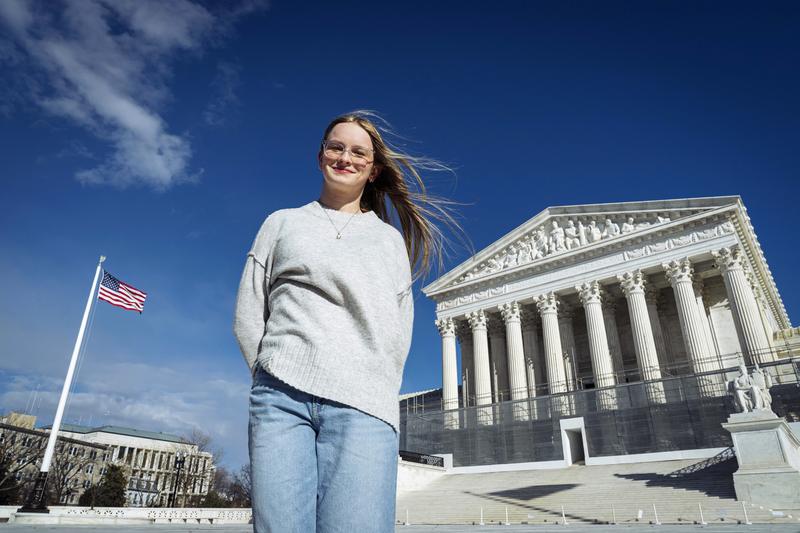
( Maxine Wallace/The Washington Post / Getty Images )
Title: Supreme Court Hears Arguments on Transgender Student Athletes
[music]
Amina Srna: It's the Brian Lehrer Show on WNYC. I'm producer Amina Srna, filling in for Brian today. Good morning again, everyone. Yesterday, the court heard oral arguments on two major cases challenging state laws that ban transgender athletes from competing on girls' sports teams. The cases involve two transgender athletes, Lindsay Hecox, who tried out for Boise State's Track team, and 15-year-old Becky Pepper-Jackson from West Virginia. Lower courts in both Idaho and West Virginia ruled in favor of the athletes, issuing injunctions that blocked enforcement of state bans.
Nationwide, 27 states have passed similar laws in recent years. The legal question facing the court is whether these bans violate the Equal Protection Clause and Title IX, the federal law that prohibits sex discrimination in education. With me now to review yesterday's oral arguments and what's at stake is Kate Shaw, professor at the University of Pennsylvania Carey Law School, co-host of the Supreme Court podcast Strict Scrutiny, and a contributing opinion writer with the New York Times. Professor Shaw, welcome back to WMYC.
Kate Shaw: Good to be with you, Amina.
Amina Srna: I started introducing the facts of the two cases argued yesterday in the Supreme Court. Can you continue there? Can you set the scene for us? Who are the individuals at the center of these cases?
Kate Shaw: Sure. Well, you set it up exactly right. One of the students was a college would-be athlete and the other a middle school would-be athlete. The first, Lindsay Hecox, wanted to run track and field at Boise State. There's a wrinkle in her case, which is that she actually is seeking to have the case dismissed. She was permitted to try out, and actually, after winning in the lower courts and, actually, didn't make the team and has decided, in, actually, really heartbreaking terms, to try to end this litigation because she just doesn't want to pursue college athletics anymore.
The publicity associated with the litigation and her desire just to focus on her studies and finish college has led her to want to dismiss the case. That was one issue that arose in her case yesterday. Will the justices decide it at all, or will they wait for another case to present the same constitutional question? Because, as you said, there is a equal protection constitutional question that these bans present, but also a statutory question. The second case involving the middle school athlete, BPJ, presents a question of whether these state bans violate a federal law, Title IX, about federal funding for school athletics.
Amina Srna: How did the attorneys representing the trans athletes argue that these rights applied to their clients?
Kate Shaw: Interestingly, I think in particular in the first case, these were actually fairly narrow arguments in certain respects. No one was challenging that schools can maintain sex-segregated sports teams, so girls' teams and boys' teams. There was even a question about whether someone who says that they identify as transgender but hasn't taken steps to actually live and pursue any of the transition-related care, whether that person would have to have their asserted gender identity respected by a school and a team.
Actually, one of the lawyers for one of the athletes said, "No, I mean, we should respect that person's self-identity, but they're not required to be allowed play if they haven't taken steps to essentially conform their life to the gender identity that they have presented." In Hecox's case and in BPJ's case, these are both individuals who have transitioned, who are living as middle school girl and a college woman in the two respective cases, and therefore, according to the lawyer for Lindsay Hecox, any argument about any kind of inherent biological advantage or unfairness that their presence on girls' or women's teams might present, are simply inapplicable.
These are individuals who, because they have hormonally transitioned, actually don't have the advantages that testosterone does confer for a lot of athletic purposes, and so the justifications the state is offering, or are offering, such as they are, are simply inapplicable in the case of athletes like the two at issue here. This is not about anybody getting to play on any team, but about a narrow group of transgender athletes who want to play on teams consistent with their lives and their gender identities.
Amina Srna: Wait, so why might the Equal Protection Clause and Title IX not apply to trans athletes? Can you just underscore that for us?
Kate Shaw: Sure. The states are arguing that essentially these are laws that don't distinguish on the basis of gender identity, the state laws essentially requiring individuals to play on teams that align with what the states refer to as biological sex. These states say, yes, these laws do distinguish on the basis of sex but not on the basis of gender identity. They're just about sex. They let everybody play sports, but everybody has to play sports that align with, again, what the laws refer to as biological sex. Somebody who is assigned male at birth would have to play sports, if at all, on a boys' sports team, even if they live and identify as a girl. That's essentially what the states are saying.
That, I think, applies both to the constitutional claim. They say there's no impermissible discrimination on the basis of either sex or gender identity under the Equal Protection Clause. They also say that Title IX is about, really, in its inception in 1972, protecting girls' and women's sports, and Title IX itself contemplates, if not requires, sex-segregated teams in order to give girls and women athletes a real chance to play at a high level. Again, by protecting the existence of girls' and women's teams, they're not preventing anyone from playing. They're simply limiting those teams to individuals who, again, as these laws describe it, are female as a matter of biological sex.
Amina Srna: These cases are about Title IX and the Equal Protection Clause, but they only affect school sports, not professional or club sports. Why is that distinction important, and do you think that factored into the justices' thinking?
Kate Shaw: It's interesting there. I'm not sure about the distinction between whether club versus other kinds of sports, whether that distinction is salient. I do think that the distinction between Title IX, which, again, is about schools and school athletics, and other federal civil rights laws, might be relevant. There are a couple of important precedents that the justices were wrestling with in the arguments yesterday. One of them is a case from 2020 called Bostock, which is about a different federal civil rights law, Title VII, which bars discrimination on the basis of sex, among other things, in employment.
In that case, the court actually ruled that the bar on sex discrimination in Title VII is also a bar on discrimination on the basis of either sexual orientation or gender identity. The lawyers for the challengers, in particular in the second case, which is really the statutory case, are making the argument, well, if you can't discriminate on the basis of sex by discriminating on the basis of gender identity, if the two are essentially inextricably linked under one federal civil rights law that bars sex discrimination, how could it be permitted to bar these athletes because essentially they're transgender under a different but very similarly worded civil rights statute, Title IX?
I do think that the justices will have to decide whether the language is different enough and whether the workplace versus school sports context is different enough that the cases could come out differently, or whether this earlier case siding with a trans employee actually does dictate victory for these trans athletes in these cases.
Amina Srna: Listeners, we can take your calls and questions on yesterday's oral arguments on transgender athletes competing in girls' sports. Are there any coaches of girls' sports teams listening? Any parents of trans kids, current or former trans athletes, how might any of the possible outcomes of yesterday's hearing affect your team, your family, or you personally? 212-433-WNYC. That's 212-433-9692. You can also text that number.
Because trans people make up such a small percentage of the general population, many Americans maybe have not met a young trans girl and may be concerned about the "biological" physical advantages those assigned male at birth have over women when it comes to athletics. How relevant is this concern when it comes to these two young women who've brought their cases to the Supreme Court?
Kate Shaw: The question, I think, potentially shakes out differently in the two different cases. There were some discussions during the course of the arguments yesterday about the state of science and medicine when it comes to really understanding these questions of inherent advantage. Yes, certainly the states argue that what they term biological males have an unfair advantage, so if teams do allow trans girls or women to compete, they're going to box out would-be biological female players, who might be cut from teams or not win medals. Certainly, that came up in the oral argument.
I think that the truth is it's a little unclear, actually, how advantage cuts or doesn't cut in some of these cases. I think the difference there, there may be among other differences. There's very little, I think, size and strength advantage that, say, a six or seven-year-old boy has over a six or seven-year-old girl. Post-pubescent, boys do have advantages in terms of size or strength, obviously, in the aggregate.
Again, one of the lawyers I thought made a really interesting point, which is that it's not actually clear that a trans girl who was assigned male at birth but has transitioned is going to have that much of an advantage, and maybe actually at a disadvantage in that a larger frame, but without testosterone because they have taken puberty blockers or other hormones, actually makes it more difficult to compete vis-à-vis somebody assigned female at birth and competing on a girls' or women's team.
I think the answer is, it's actually not totally clear. It was very clear during the oral arguments that the justices themselves are neither medical nor scientific experts. There is a real question in an area of scientific or medical uncertainty, should courts defer to state legislatures making what are scientifically-informed policy judgments, or do courts have to step in and basically say if the science or Medicine is unclear, well, constitutional equality principles mean that we can't allow these laws to go into effect if they are going to substantially disadvantage individuals either on the basis of sex, or maybe who are part of a vulnerable class that the law protects.
This is an interesting line of argument that actually Neil Gorsuch, one of the conservative justices on the court, although the author of the 2020 opinion I was just talking about, surfaced a couple of times, which is, are transgender individuals properly understood as in need of special protections under the Constitution? The Constitution says that certain kinds of classifications and certain kinds of groups do get special heightened constitutional protection.
If a law draws a distinction on the basis of race or sex, courts take a close look at it to make sure that it is not impermissible under the Equal Protection Clause. Courts have never said the same is true about laws that draw distinctions on the basis of gender identity, but Gorsuch at least seemed to be exploring that possibility. That is, I think, something to be really watched for in the way that the writings in these cases shake out.
Amina Srna: Justice Alito pressed the attorney representing the trans athletes to define man and woman for equal protection purposes. Let's take a listen to a clip of that.
Justice Alito: Do you agree that a school may have separate teams for a category of students classified as boys and a category of students classified as girls?
Kathleen Hartnett: Yes, Your Honor.
Justice Alito: If it does that, then is it not necessary for there to be, for equal protection purposes, if that is challenged under the Equal Protection Clause, an understanding of what it means to be a boy or a girl, or a man or a woman?
Kathleen Hartnett: Yes, Your honor.
Justice Alito: What is that definition? For equal protection purposes, what does it mean to be a boy or a girl, or a man or a woman?
Kathleen Hartnett: Sorry, I misunderstood your question. I think that the underlying enactment, whatever it was, the policy, the law, we'd have to have an understanding of how the state or the government was just understanding that term to figure out whether or not someone was excluded. We do not have a definition for the court, and we don't take issue with the-- We're not disputing the definition here. What we're saying is that the way it applies in practice is to exclude birth sex males categorically from women's teams, and that there's a subset of those birth sex males where it doesn't make sense to do so, according to the state's own interest.
Justice Alito: Well, how can a court determine whether there's discrimination on the basis of sex without knowing what sex means for equality protection purposes?
Amina Srna: Kate, why couldn't she provide a definition? What are you hearing in this exchange?
Kate Shaw: Yes, I thought that was a really interesting exchange, and I think it went to what I was saying at the beginning about the narrowness of the argument. That's Kathleen Hartnett arguing for Lindsay Hecox. She was essentially saying, "We're not trying to necessarily-- certainly not challenging the existence of these sex-segregated teams. We're not trying to wholesale challenge state laws that do draw distinctions. We're just saying the distinctions don't make sense in the context of the particular clients and essentially the classes of individuals from which these clients come."
I thought that in another very similar exchange, actually in the second case, I believe it was the attorney for the other student athlete, responded to a similar line of inquiry by basically saying, "Look, race, for example, is a contested concept. People disagree about how we should define and delineate race. It's not necessary to arrive at a perfect definition of race to understand race discrimination, to prohibit, to disallow discrimination on the basis of race."
I think that the lawyers were essentially saying something analogous about sex in both cases. We can identify and eliminate, where possible, sex discrimination without necessarily arriving at a definition that we can all agree on about this kind of essentially contested concept. I thought that that was what Hartnett was trying to do here, to say, again, state has a definition. We're not trying to offer a replacement definition or ask you, the Supreme Court, to wade into that fraught and contested terrain. What we have here is clear discrimination against the student-athletes in both of these cases.
Amina Srna: We have, I believe, a former student-athlete on the line. Alli in Brooklyn, you're on WMYC. Hi, Alli.
Alli: Hi. I was just calling to talk about what the point of all of this is trying to get to, because if it's about fairness. Anybody who's played sports in high school or college or whatever, there are differing levels of greatness among all athletes. There are girls that are better than boys, boys that are better than girls. If we're trying to get to the point of fairness, then are we going to start testing everybody's hormones across the board to determine what bucket they fall into for girls or boys?
I have a niece who currently plays tackle football on a co-ed team, and you can do that in wrestling when you're younger. This just seems like this-- it's ridiculous to me. There's no fairness. You can be better than a boy or better than a girl no matter what sex you are. It just seems to me like this is obviously something outside of fairness. What is really the point that we're trying to get to?
Amina Srna: Ali, thank you so much for your call. Kate, Ali brings up something that I was going to ask, which is, is it possible that this ban might be applied on an individual-by-individual basis, depending on the point in which a child maybe began their transition or how far their transition has progressed?
Kate Shaw: Let me just quickly, if I might, agree wholeheartedly with the caller, which is to say, I do think that there are lots of things that confer advantages in sports, height and speed and wingspan and how high you can jump. Michael Phelps has huge feet that almost operate like flippers. People do have lots of enormous advantages and disadvantages when it comes to competitive athletics. I do think that a lot of this hyper-focus on fairness and gender, as if it's the sole factor at issue in determining fairness in sports, I think, feels like it's about something other than just fairness. I wholeheartedly agree with that.
In terms of your question about kind of-- That essentially is what these athletes and their attorneys are asking for. It's not, essentially, that in the context of their application to athletes who are situated like these young girls and women, these laws just can't be justified. It is, again, not they're thinking of it as an as-applied challenge, laws that cannot in all of their application be lawful is essentially, I think, the way these cases have been litigated. That is what these parties are asking for, and, nevertheless, though, it seems like a pretty modest ask.
My bottom line take, which I don't think I've said, coming out of yesterday, is that the states are likely to prevail, the athletes are likely to lose, although I don't think it's 100% certain. I do think it's possible that it will be a narrow as opposed to a sweeping victory for the states.
Amina Srna: Justice Kavanaugh suggested the court should stay out of this debate, given what he called "scientific uncertainty," which you had talked about earlier in our segment, and the fact that states are divided on this. Let's take a listen.
Justice Kavanaugh: In an area of scientific uncertainty, where there are strong assertions of equality interests on both sides, and so it's going to come to this court, and we have to decide for the whole country, constitutionalize this. I guess given that half the states are allowing it, allowing transgender girls and women to participate, about half are not, why would we, at this point, just the role of this court, jump in and try to constitutionalize a rule for the whole country while there's still, as you say, uncertainty and debate, while there's still strong interest on other side?
I think one of the themes of your argument has been the more people learn, the more they'll agree with you. At least I've detected that theme in your argument, so why would we get involved at this point to constitutionalize--
Amina Srna: Kate. LGBTQ rights advocates are concerned that these cases may lead to a nationwide ban on trans athletes participating in girls' sports teams, but hearing this clip, it seems like Justice Kavanaugh is leaning towards letting the states decide this matter. Is that a correct interpretation of this clip, and is it possible that the court might decide to stay out of this issue completely?
Kate Shaw: I think the letting the states decide this matter is what Kavanaugh was gesturing towards. Of course, letting the states decide in these cases would mean the athletes cannot play because the states have decided to bar trans girls and women, but it would mean that the other states, it's about 23-ish states, do let athletes like these play on girls' and women's teams if they want to and if they make it. There's no guarantee anybody makes any teams, but at least they're not categorically excluded.
I think that that-- because you have these cases, but you also have, waiting in the wings, other cases that, in particular. on the Title IX question, not only argue that Title IX allows states like Idaho and West Virginia to exclude trans athletes, but that Title IX requires states to exclude trans athletes in order to protect girls and women. That, I think, is what is coming down the pike, and that is what Kavanaugh was trying to anticipate. Head off, I think that a conclusion that the states get to decide would mean, again, these state bans would stand, but so too would state laws allowing participation.
Essentially, that would be maybe letting the democratic process run its course as people lobby state legislatures in one direction or another, but without either federal statute or the federal constitution overriding those state-level determinations. I think that is one, possibly, narrow outcome that these two cases might result in. Maybe the first case, the constitutional argument gets dismissed, and the court just decides that Title IX allows but doesn't require these state bans. Of course, that would be a difficult loss for trans athletes, like the two who brought these cases, but it would mean that participation would remain possible in about half of the states.
Amina Srna: Let's go to a caller that I think is pushing back a little bit on what we're talking about. Susan on Staten Island, you're on WMIC. Hi, Susan.
Susan: Hi. Good morning. I think your guest is being a little intellectually dishonest. If you go through the scientific literature, the medical literature, you know the advantage that any child who has gone through puberty as a male, you know the advantage that testosterone brings to that child in upper body strength. Now, in some sports and in some situations, it doesn't matter, but in other sports it does.
I remember when this discussion first started, was it five years ago or more? I don't remember exactly when, but a couple of years ago, there was, on TV, a film. I watch a lot of sports, and this was an NCAA swim meet. This transgendered female was now competing in the swimming contest as a female. You could see that his/her upper body was different from the other girls'. He had much more upper body strength, and he had bigger hands, as well as bigger feet, and had a biological advantage swimming against biological females.
He won. He won first place, or she won first place. I think in certain situations, it's not equitable, particularly in sports competitions on a highly competitive level, where it means scholarships and things like that.
Amina Srna: Thank you so much for your call. Kate, I think Susan was talking about Lia Thomas, who tied for fifth place in that race. Just a little bit of context about that specific incident that I think the Trump administration has very much latched onto as an example of what they see as a problem with trans girls in girls' sports. Kate, anything you want to say in response?
Kate Shaw: Yes, I'll just say, I think it is right that there are a handful of examples, anecdotal or real, that loom very large in many of these debates. The problem is that these laws apply to everyone. Even if you can see that post-pubescent, the dynamics are very different, it's not clear how that fact would justify a prohibition on trans girls who are 6 or 8 or 10 participating in athletics with their friends and classmates. I think that there is this overbreadth problem with some of these laws.
I think that the vast majority of trans athletes are not going to be, in particular, the kinds who are at issue in this case, are not going to have a dramatic advantage vis-à-vis their non trans teammates or opponents. To my mind, the harm of the categorical bars and exclusion far outweighs the potential, maybe real but rare, advantage that a particular individual trans athlete may have. I do think that there are fairness concerns, probably, for many people on both sides of the debate.
Amina Srna: When should we expect a ruling on these cases?
Kate Shaw: These cases I would expect to come down, as most of the major cases do, at the end of the term, which could be late June, early July. I think there are other cases that the court is likely to try to expedite, but these, I think, are probably going to be near the end of the term.
Amina Srna: Before you go, we had teased at the top of today's show that today was a decision day and we might get an opinion on President Trump's tariff case, but it didn't happen. Any ideas when that might come down?
Kate Shaw: Yes, I very much thought it was a possibility today. This is a case that was expedited for briefing and argument heard at the beginning of November. I think there was a real thought that the court would try to accelerate its decision just as it accelerated its consideration of the case. This is obviously President Trump's signature policy initiative, these sweeping worldwide tariffs, invalidated in the lower courts, although those rulings were put on hold. At the moment, the tariffs remain in effect, and that may be why the court is not bestirring itself to decide these on a really expedited timeline.
I do expect that even though these are some of the biggest cases of the term, we're not likely to have to wait until June. We're likely to get a decision sooner rather than later. The court can move quickly when it wants to. I think that it's a complex set of legal questions, and probably they are refining the arguments, but this is one that I expect in the next couple of weeks we are likely to get.
Amina Srna: Kate Shaw is a professor at the University of Pennsylvania Carey Law School, co-host of the Supreme Court podcast Strict Scrutiny, and a contributing opinion writer with the New York Times. Kate, thanks so much for coming on today.
Kate Shaw: Thank you so much for having me.
Copyright © 2026 New York Public Radio. All rights reserved. Visit our website terms of use at www.wnyc.org for further information.
New York Public Radio transcripts are created on a rush deadline, often by contractors. This text may not be in its final form and may be updated or revised in the future. Accuracy and availability may vary. The authoritative record of New York Public Radio’s programming is the audio record.
