
Stories With The Moth
[music]
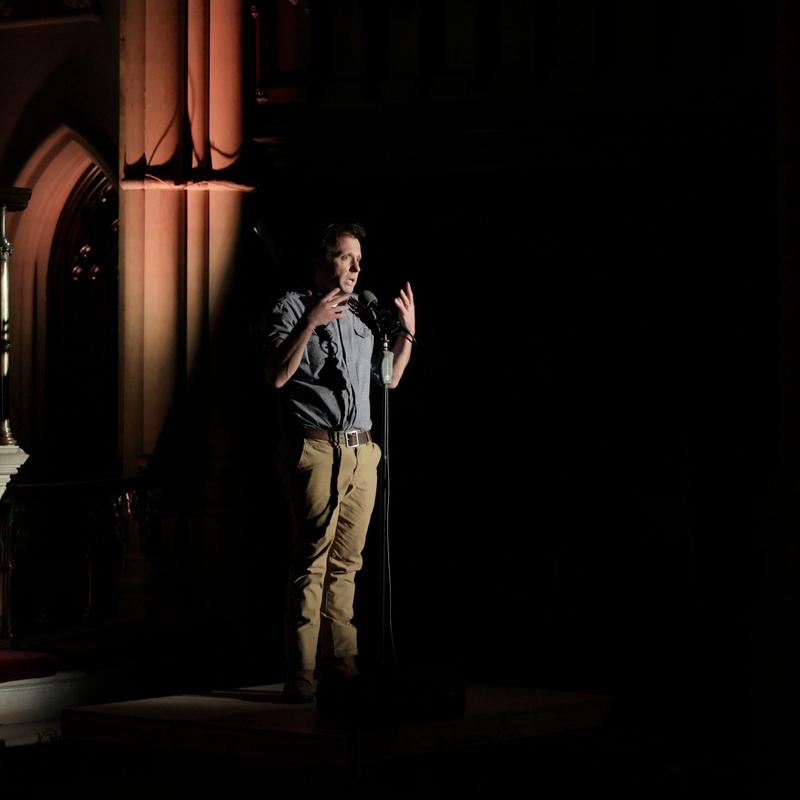
Brian Lehrer: Brian Lehrer on WNYC. Next Friday night, I'll be hosting a Moth storytelling event at the Skirball Center at NYU. It's part of the Moth series of events this year called American Dreams, as the country celebrates its 250th anniversary. This particular evening is called "What Are We Fighting For?" There's double meaning in that title. We'll talk about it. Storytellers will include a few people you may know, like Reverend Jacqui Lewis, a multiple-times guest on this show, senior pastor at Middle Church in the East Village, and New York 1 anchor Cheryl Wills, as well as others.
Let's talk about the event, the larger series, and the Moth itself, at more than 25 years old now, with Kate Tellers, storyteller, host and director of their MothWorks arm, which takes storytelling out of theaters and into workplaces and elsewhere. She is co-author with other Moth leaders of the 2022/2023 book, How to Tell a Story: The Essential Guide to Memorable Storytelling from the Moth. Kate, great to have you. Thanks for coming on.
Kate Tellers: Thank you so much for having me, Brian.
Brian Lehrer: I'll assume that a lot of our listeners, because there's been so much Moth content on the station and on public radio, know basically what it is. Tell us about your American Dream series of Moth events this year. Are you doing this around the country?
Kate Tellers: Yes. Around the country in the spring, the theme of our shows is American Dreams. As you just said, each of the American Dream show have their own subsets, since there's many ways to define and think about the American Dream. We're excited to have you there for this one.
Brian Lehrer: Yes. Our theme will be under the title "What Are We Fighting For?" It'll be five stories of reconciliation of one kind or another. One of your colleagues chose that title, and I think it's brilliant for its double meaning. "What Are We Fighting For?" As keeping your eye on the ball of fighting for things worth fighting for, but also suggesting pulling back from conflict. "What Are We Fighting For?" Do you like that idea?
Kate Tellers: I love that take on the theme. Yes. I love the theme from the beginning. I think it ties so well to storytelling because when we tell a story or a compelling story, we're talking about our values and what we care deeply about. Then, to exactly your point, are we going to fight for those values, or do our values lead us to some other type of reconciliation? Do they allow us to see the bigger picture?
Brian Lehrer: Listeners, we have a few minutes for phone calls or texts. Have you ever told a Moth story? What was it like? If you're not a professional storyteller, or any questions for Kate Tellers from the Moth? 212-433-WNYC, 212-433-9692. The stories will speak for themselves next Friday night, but I know they will be about reconciliation of various kinds. I'm not one of the storytellers, I should say. I'm just the host. I'll be introducing the people and engaging a little bit with them in the audience.
Were you involved with choosing the speakers? Because it's a really interesting list. I mentioned Reverend Jacqui Lewis and Cheryl Wills from New York 1. I know there's going to be an ACLU lawyer telling a story of a client that the person was not thrilled about representing, but they did. Were you in on this?
Kate Tellers: Yes. These are some of the most fun conversations we have at the Moth when we cast these shows, because the idea is, and as you've alluded to from these different stories, we have the theme, but what are five different takes on the theme? There'll be levity even in the lawyer story, and then there'll be America's reckoning with race in another story. We're spanning the whole gamut of the human experience in this show, but those are always lively rooms, and we try to put those stories together.
Brian Lehrer: The title of your book, the group of you from the Moth who wrote the book How to Tell a Story: The Essential Guide to Memorable Storytelling from the Moth. That suggests something that I know you do a lot of coaching for your storytellers on how to tell your story really well, because most of these people are not professional storytellers. Maybe in Reverend Lewis's case-- Reverend Jacqui, I know she can tell a good story from the pulpit because she's trained in that field.
Someone else, maybe Cheryl from New York 1 might be more used to reading copy than getting up on stage without any notes. You can't have notes when you present as a Moth storyteller and spinning something out or some of the others. How do you coach people?
Kate Tellers: Yes, well, we meet people where they are. I think an interesting thing about both Reverend Jacqui Lewis and Cheryl Wills that you talked about is that they are storytellers in their own right. Their form is different than the Moth. I've been working closely with Cheryl, and we've talked about the story, and she knows how to edit, and we've talked about what do we want to say and where do we put this here? It's a much faster way of working together.
As a journalist, she knows how to take the interesting pieces and make them compelling. With other folks, it often starts with just thinking about, like, what's an experience in your life that you feel like may have changed you in some way, and then just asking questions. The idea is that my job is to help them find their story and communicate it in a compelling way. It's not my job to tell them what their story is. How do they find a story about an experience that's changed them and that they care deeply about? Then how do I equip them to be comfortable enough to share that with sometimes thousands of people in an audience when they may have never been on stage before?
Brian Lehrer: I know Cheryl to be a very good interviewer. I would have the challenge as an interviewer to turn that around, where I'm not the one pulling out someone else's story, and helping to facilitate someone else's story, but figuring out what story of mine to tell and do it in the format that the Moth has set up and requires. It's up to 12 minutes and no notes. Why no notes?
Kate Tellers: My short answer is that's the way it's always been done. No, really, it is far more compelling, we have found, to have people tell a story without notes, because it makes them present. If you have notes, you're going to lean on your notes, and you're going to lean on your words. If you're telling it without notes, you're going to go from your emotions and your experience, and what we do as the audience, and there's science behind this, is that we start to synchronize with the storyteller on stage. When they've engaged us, our brains light up in the same way, and we're in the same emotional space with them, and we're taking that emotional journey with them. It's so dangerous with notes to turn that off, particularly because that requires a degree of vulnerability and lean on the words, and in this way, we lean on the emotion.
Brian Lehrer: Let me get at least one caller in here. Kara in Kew Gardens you're on WNYC. Hi, Kara.
Kara: Hi. Thank you. Hi. I'm a public librarian, and I was in the Moths webinar a while back about storytelling advocacy. I can't remember the title, and the power of stories. Our current president, Sam Helmick, has talked a lot about how they have won people over to support libraries just by telling stories about their experience and their work. I wanted to thank you so much for that webinar and all of that inspiration. I also, I won the drawing for some of your books, and they're gorgeous.
[laughter]
Brian Lehrer: Like what kind of books, Kara?
Kara: It's a whole stack of books. There's a deck of cards, a game of storytelling. It's fun.
Brian Lehrer: Ooh, that's fun.
Kara: Two of their collections, and a guided journal, which is my life and stories. They're beautiful, wonderful, and very useful books.
Brian Lehrer: Neat. Kate.
Kate Tellers: That is amazing. This is like the intersection of all of my loves. I'm on public radio talking about the Moth with a librarian. Could I be happier? I'm so happy to hear that the workshop impacted you and that you have our books. Yes, we do have anthologies of some of our favorite stories. Then we recently released a journal. This is all with the idea that everyone has a story, and our book will provide practical guidance. Then the journal has prompts that will help you really tease out that story.
Brian Lehrer: Kara, thank you-
Kate Tellers: I'm so glad you have them.
Brian Lehrer: -for the great story that you just told here. I guess that relates to one of the things that you're most involved with, with the Moth. The MothWorks arm, because you go out to places like public libraries, not just like people come to the theater, like we're doing at Skirball.
Kate Tellers: Exactly. Yes. I get to go into spaces, and I've had a long range of-- I've been in rooms I never thought that I would be in before. I've been at American Express, or General Motors, or with the United Brotherhood of Carpenters. My job is to help them learn how to tell a compelling story. That helps them in their work for communication and for culture building. Really, selfishly for me, allows me to hear stories from people I might never meet in another place and allow them to connect in a way that we usually don't at work.
Brian Lehrer: How do people get tickets, in our last 10 seconds, for any Moth event, the one we're doing at Skirball next Friday, or any?
Kate Tellers: You can go to themoth.org to find tickets, events, and more stories, including our podcast and radio.
Brian Lehrer: Kate Tellers, a storyteller, host, and director of MothWorks, and co-author with other Moth leaders of books, including How to Tell a Story: The Essential Guide to Memorable Storytelling from the Moth. Thanks. Maybe I'll see you next week.
Kate Tellers: I'm going to see you next week, Brian. Can't wait.
Brian Lehrer: That's the Brian Lehrer Show for today. Thanks for listening, everybody. Stay tuned for All Of It.
[music]
Copyright © 2026 New York Public Radio. All rights reserved. Visit our website terms of use at www.wnyc.org for further information.
New York Public Radio transcripts are created on a rush deadline, often by contractors. This text may not be in its final form and may be updated or revised in the future. Accuracy and availability may vary. The authoritative record of New York Public Radio’s programming is the audio record.
