
Status of Settler Violence in the West Bank
Title: Status of Settler Violence in the West Bank
Brian Lehrer: Brian Lehrer on WNYC. While the Iran war has been going on, getting much less attention in this country is Israeli settlement activity in the West Bank.
An article in The Times of Israel today says, "Settler attacks take place on a near-daily basis in the West Bank and have accelerated during the war with Iran. While there's plenty of debate about where the line is in Gaza and Lebanon, between Israel's right to defend itself against attacks from Iran-backed insurgent groups, and how much civilian death and destruction makes its response a war crime, the situation in the West Bank is to many people much more clearly wrong on its face. Israelis are kicking Palestinians out of their homes and off their land, often using violence just so Israel can have more of it."
Some headlines from just recent days, one week ago from the BBC, "Two Palestinians killed during settler attack on West Bank village officials say." Last week from The Times of Israel, "Israeli settlers seize a herd of sheep belonging to Palestinian farmers." Then in the Israeli newspaper Haaretz, "Sheep theft sent shockwaves through a Palestinian village. Then a 12-year-old boy was shot dead." We'll talk to the writer of that article from Haaretz in a minute.
Today in Haaretz, "Israeli settlers set fire to isolated West Bank Palestinian home, attack residents after weeks of harassment." Today in The Times of Israel, which is more conservative than Haaretz, the headline, "Ex-Mossad chief: Settler violence an existential threat, curbing it could spark civil war." An op-ed yesterday in The Hill center left or centrist from Washington, "Settlers or invaders? Are we using the wrong terms in the West Bank?"
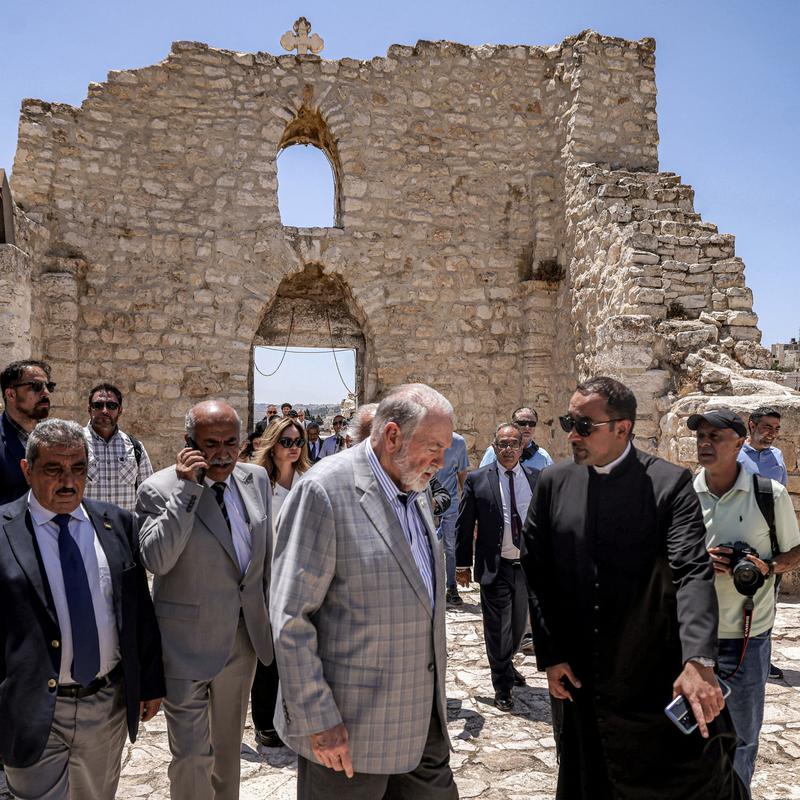
Similar in an opinion column by Ido David Cohen in Haaretz, "Jewish terrorism exists. Debate over. The only question is are you for it or against it?" This, from the Jewish newspaper The Forward here in New York, "The settlers are winning now. West bank activists aiding Palestinians are increasingly targets themselves." Even the Trump administration, which almost never criticizes Netanyahu's Israel for anything, does on the West Bank. For example, here's a clip of Trump's ambassador to Israel, Mike Huckabee, who condemned an attack by settlers in the West Bank town of Taybeh on a Palestinian church.
Mike Huckabee: It's unacceptable to commit an act of sacrilege by desecrating a place that is supposed to be a place of worship. It is an act of terror and it's a crime. We will certainly insist that those who carry out acts of terror and violence in Taybeh or anywhere be found, be prosecuted, not just reprimanded. That's not enough.
Brian Lehrer: Also, last year, President Trump said this to reporters about Netanyahu's interest in annexing the West Bank, a different tone that Trump usually strikes on Israel and its prime minister.
President Trump: I will not allow Israel to annex the West Bank. No, I will not allow it. It's not going to happen.
Reporter: Did you speak with Netanyahu about this direction?
President Trump: Yes, but I'm not going to allow it. Whether I spoke to him or not, I did, but I'm not allowing Israel to annex the West Bank.
Brian Lehrer: The point of reading those headlines and playing those clips, the situation in the West Bank sparks more universal condemnation but gets less coverage than what's happening on the other fronts. We'll talk about that now with Israeli journalist, Gideon Levy, a longtime columnist for the Israeli newspaper Haaretz and its former deputy editor.
A major critic of Israeli policy toward Palestinians, he wrote last week in a publication called Middle East Eye that the West Bank has, "been transformed beyond recognition under the cover of the recent wars. There, Israel has succeeded by means of violent settlers and an army that works in tandem with them in extinguishing the last remaining prospects for a viable Palestinian state." Haaretz columnist, Gideon Levy, joins me now from Tel Aviv. Thank you for some time today. Hello from New York.
Gideon Levy: Thank you for having me. Hello from Tel Aviv, Brian.
Brian Lehrer: Could you give us more detail about that line you wrote? That, "Undercover of the recent wars, the West Bank has been transformed." Transformed how?
Gideon Levy: You see, Brian, I am covering the occupation of the West Bank and Gaza for the last 40 years. What I witness in the last two years is really unprecedented. The West Bank is changing and rapidly. The settlers together with the army are changing it in a very violent and many times barbaric way. Part of the changes will be irreversible. You see, Brian, for us, wars are wars. For the settlers, wars are an opportunity.
The war in Gaza first and then the war in Iran were an opportunity for them to go wild like never before. The army, who according to the international law is supposed to protect the local people, the Palestinians, is collaborating totally in an open way, nothing hidden, together with the settlers to promote their plan, and their plan is very clear. They want the West Bank to be clean of Palestinians and they are doing anything possible to promote it. There are results already because there are villages which were already abandoned and there is property which is confiscated by the settlers, tens of thousands of acres taken by the settlers by force, and there is no one to protect the Palestinians. There, no one.
Brian Lehrer: Why do you say the Iran war has given them cover to do this?
Gideon Levy: It's two-way reasons. One, because all the attention, the world attention, the Israeli attention was in Iran. Under the cover of this darkness, they go wild. Secondly, the 7th of October gave them legitimacy to do whatever they want because most of the Israelis think after the 7th of October that Israel has the right to do whatever it wants after the massacre of the 7th of October.
Now, to this you have to add the fact that Israel has now the most fascist government ever and the government is very, very happy about what's going on there. The Americans are preoccupied with Iran so they can do whatever they want and there is no one to stop them.
Brian Lehrer: On the bigger West Bank picture, and we're going to get to the US Role in just a minute, and those critical clips from the Trump administration that I played from Trump and Huckabee, why did you write though that, "The settlers have extinguished the last remaining prospects for a viable Palestinian state?" There are many Americans, at least still of both US parties, I think it's fair to say, who think a two-state solution is the eventual key to justice and self-determination for both peoples.
Gideon Levy: It is still the key but it's a train which left the station unfortunately, and we better realize it, and not cheat ourselves and believe that this will ever be possible. Because with 700,000 settlers in the West Bank, including East Jerusalem, part of them, very violent, most of them supporting the violence, the militias, nobody is going to evacuate them. Now, they destroy any Palestinian life there, how will you take this train back to the station? I was a supporter of the two-state solution for decades. I'm still a supporter of the two-state solution, but I think we have to realize that the settlers took over and nobody will be powerful enough to get away.
Brian Lehrer: About the US relationship to this and whether the US could be powerful enough to get them away, as you put it, you wrote, "The Trump administration so active and resolute in Gaza, turns a blind eye to the West Bank and lies to itself about the situation there," but I played that Trump clip saying he won't allow annexation. How do those things fit together?
Gideon Levy: They fit perfectly because Israel will not annexate the West Bank officially, formally, but the West Bank was annexated long time ago on the ground. If you see what's going on in the West Bank, it is part and parcel of Israel. From any point of view, economically, militarily, it is one unit. You cannot separate it anymore. The green line is dead long time ago. To please the Americans and President Trump, Israel is very cautious about taking some legal steps, but who needs those legal steps when on the ground Israel is there, and Israel is there in order to stay there forever. Why would they care now about the legal annexation? They have the annexation on the ground.
Brian Lehrer: We also played the clip of Mike Huckabee, Trump's ambassador to Israel. A Christian Zionist is the term that people sometimes apply to him condemning settler violence on a Palestinian church in the West Bank. Again, different from what Huckabee says about Israel on other fronts. Do you think that was just because it was a church and not a mosque, or what do you make of Huckabee using the word terrorism with respect to West Bank settlers, which Trump officials rarely, if ever, apply to Israel?
Gideon Levy: What else can you make out of it? He never condemned violence toward the Palestinians. Only when it go to the Christians. What other way is there to describe it? More than this, your ambassador to Israel said clearly in an interview that he is in favor of a great Israel from the Nile in Egypt until Iraq. The whole Middle East should be under Israeli sovereignty. If those are the people that you send to Israel as official ambassadors, don't be surprised that Israel feels free to do whatever it wants.
Brian Lehrer: Can you tell us more about who the settlers are demographically or however you want to describe them, why they're willing to use violence to take Palestinian land, and what they think the future holds if Palestinians never have equal voting or other rights?
Gideon Levy: The settlers are not one entity. There are many kinds of settlers. There are many settlers who went there for cheap housing with very little ideology. They will be ready to evacuate in any given moment, I guess, if they will be compensated, but gradually, they are for sure not the most powerful group among the settlers. Then we have those who have a very clear ideology, a fascist ideology, but a clear ideology, namely that the whole land between the river and the sea belongs to Jews and only to Jews because God had promised it to the Jewish people, the chosen people.
It's a big part of the settlers. Some of them will admit it, some of them will not admit it, but that's the idea. Israel must be pure Jewish and no room for any Palestinians on this land. There is a group of really disturbed young people from all kind of backgrounds, very violent people who are violent against anyone, and they feel the West Bank, because there is such an anarchy there, because there is no law and order, so they go and express their frustrations and their violence over those who are weaker than them, namely the Palestinians.
They know that they can do anything there. Nobody will be brought to justice. Nobody is going to be punished. That's their hobby, I would say, to wake up in the morning and to go and to torture Palestinians. They do it on a daily basis. In any given moment, when we talk now, somewhere in the West Bank there is a pogrom.
Brian Lehrer: A few more minutes with Haaretz columnist, Gideon Levy, on the West Bank, which gets much less attention than the war in Iran or the war in Gaza. He says under cover of the war in Iran, Israeli settlers are going wild in the West Bank. History suggests that wherever Jews have been a minority group, they've been persecuted and killed, culminating in the Holocaust. I'm sure you agree. Could a single state with an eventual elected Arab government as that population becomes an electoral majority be a safe place for Jews to live as opposed to continuing to strive for a two-state solution of some kind despite the rejectionists on both sides?
Gideon Levy: First of all, Israel is today the most dangerous place for Jews on earth. There are more Jews killed in Israel throughout the years in wars, interactions than any other place in the world. Israel is for sure not a safe place for the Jews. Any Jew in the United States, Europe, or elsewhere is much safer than in Israel. We were now for one month, two months running to the shelters three, four times a day. That's not a safe place, but that's not the point. The point is not about the safety of the Jews, the point is about some kind of justice.
Let me tell you, I think that the only way to guarantee some kind of security for the Jews here is by having justice because as long as the Palestinians will not get their rights, they will continue to struggle and this struggle will be violent. History is full of examples like this and the Palestinians will not be any different. They will continue to struggle and Israel will not have one day of peace until they will be achieved some kind of justice also for the Palestinians. Not total justice by the way, but some kind of justice.
Brian Lehrer: I mentioned the new article in The Times of Israel, a more conservative publication than Haaretz, where you work, "Ex-Mossad chief: Settler violence an existential threat, curbing it could spark civil war. That article is about the former head of the Israeli spy agency Mossad, Tamir Pardo, and Netanyahu appointee from 2011 to 2016, who said on Israeli TV recently that pushing back on the violent settlers, many of them armed by the state, could spark a civil war, given how well connected many of the extremists are in the halls of power, according to the article. Do you agree that's a risk?
Gideon Levy: Who cannot agree to this? I saw Pardo on TV. He said some more sentences, very meaningful. It was after he was taken to a tour to see the violence in his own eyes, which very few Israelis bothered to see because it's one thing to read about it and another thing to see those criminals and gangsters behaving as they behave. He said something more powerful. He said, "It made me ashamed of being a Jew." I cannot identify myself more than with this sentence because I am experiencing it now for, as I said, decades, watching what we are doing to them and being ashamed.
Brian Lehrer: Before you go, there were elections over the weekend in the West Bank and even in part of Gaza. From what I read, the Palestinian Authority party did well in the West Bank and the informally Hamas related party in the limited voting in Gaza did not do well, but I know it's complicated. Do you have a takeaway from those elections?
Gideon Levy: Nothing. Because first of all, elections under such a brutal occupation are not really free elections, and they were very, very partial. The Palestinians lack now two basic things, which without them, they will not get very far. First of all, unity, which they are not. They are very divided. Secondly, leadership, they have no leadership. Ever since Arafat passed away, and the fact that Marwan Barghouti, the local Nelson Mandela, so to say, is in Israel's jail, they have no leadership and Israel does not let any leadership to grow and therefore elections right now are totally irrelevant.
Brian Lehrer: From Israel's standpoint, I think this is a fair description. The original sin in Gaza after Israel withdrew 20 years ago was that the people elected Hamas, which was more bent on continuing to fight and destroy Israel than to build a new peaceful, independent state for its people. Is that not, in your opinion, a fair way to look at the genesis of the constant intermittent Israel Hamas wars that of course took their most deadly turn beginning on October 7th, 2023?
Gideon Levy: Yes and no. Israel went out of Gaza without bothering to get an agreement with the Palestinian Authority. This was the original sin because if you pull out, make it in an agreement and not in an arrogant way and one-sided way in which you just go out and let anyone else take over, and Hamas took over. Hamas grew in Gaza very much also with the encouragement of Israel, because Israel wanted to divide, to weaken the Palestinian Authority in order not to face a real partner. For Israel, it's wonderful to see the Palestinian divided because then there is no pressure on Israel to go for a deal, to go for a compromise.
I think the way you describe it is a bit oversimplified. By the end of the day, the source of everything is the occupation, and we cannot break away from this. As long as the occupation will continue one way or the other, one face or the other, nothing will be peaceful in the Middle East. We have to put it deep in our minds. Unfortunately, there was until now not a single American administration who really understood it.
Brian Lehrer: Gideon Levy, columnist for Haaretz. Thank you for joining us to talk about the West Bank today.
Gideon Levy: Thank you for having me, Brian.
Copyright © 2026 New York Public Radio. All rights reserved. Visit our website terms of use at www.wnyc.org for further information.
New York Public Radio transcripts are created on a rush deadline, often by contractors. This text may not be in its final form and may be updated or revised in the future. Accuracy and availability may vary. The authoritative record of New York Public Radio’s programming is the audio record.
