
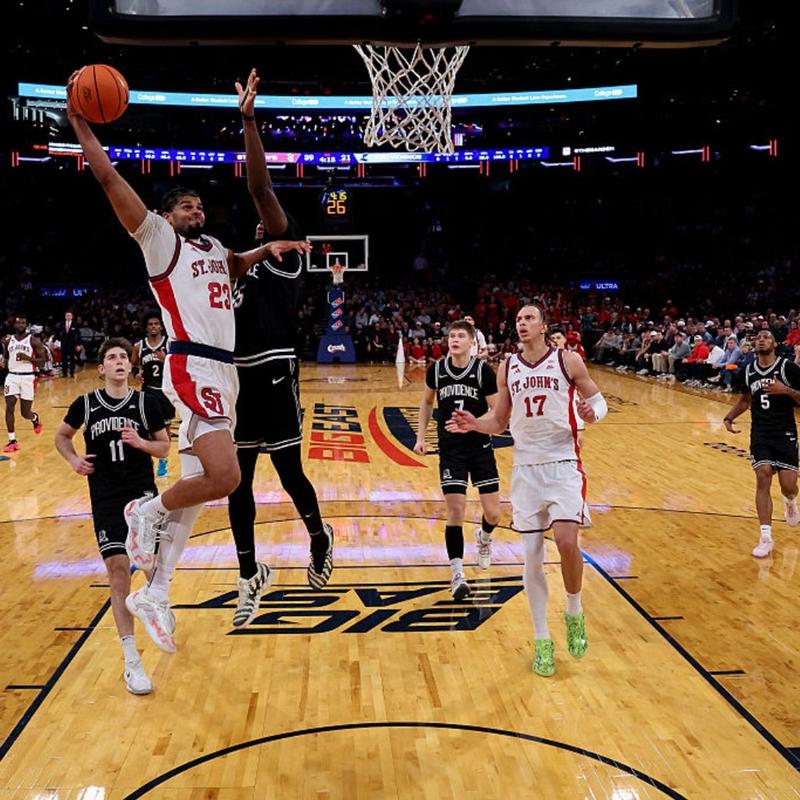
St. John's Basketball Wows
[music]
Commentator: This is going to be Darling. He's got to go. Darling puts it up. [cheers]
Commentator: St. John's is going to the Sweet 16.
Brian Lehrer: What a layup that was. Dylan Darling's buzzer beater against the basketball powerhouse University of Kansas last Sunday. The St. John's University Red Storm are into the Sweet 16 of the NCAA Men's March Madness Basketball Tournament. That was not a given. It was dramatic, as you could hear, and so far it's been quite the season for Queens' only Division 1 men's basketball team and it could still get better. They'll play number one ranked Duke tomorrow night, little after seven o'clock. If you're a St. John's alum or a college basketball fan at all, that will be must-see TV.
In our last few minutes today, we'll talk about St. John's season so far, getting this far for the first time since 1999 and invite a few calls if you're watching the Red Storm this March Madness. 212-433-WNYC. All you Johnnies out there, 212-433-9692. We've got Wall Street Journal sports columnist Jason Gay with us. He wrote a column the other day called How Do You Feel About Rick Pitino Now for Coach? He survived a couple of scandals in his long career and now is back at St. John's.
St. John's fan Katie Honan, you might also note her as senior reporter for the news organization The City and one of the hosts of the podcast FAQ NYC. Some of you may even know that Katie was one of the co-moderators with me in mayoral debates last year. Now you're here to talk about basketball, Katie. Hi, welcome back to the show.
Katie Honan: Thank you. We all contain multitudes and I'm one of them.
Brian Lehrer: Jason, welcome back to the show.
Jason Gay: Thank you. Katie, you thought the peak of the year might have been the mayoral debate, but now St. John's and the Sweet 16, it's pretty tough to top that.
Brian Lehrer: Okay. Kate-
Katie Honan: It's all very exciting.
Brian Lehrer: -you get to claim your bragging rights. Could you have imagined they get this far this year, Katie?
Katie Honan: I was let down last year when we were eliminated in the second round of the tournament, but this year I am allowing myself to dream, which I think all fans should. If you have not been following the team but you enjoy basketball, this is New York City's moment. That's the way I view it. It's particularly Queens' moment. All bandwagon fans can jump on, hop on because we need that positive energy going into tomorrow.
Brian Lehrer: That's right. Here on opening day we hope that there are two Queens-based teams that are going to go deep into the playoffs this year. Jason, what do you think St John's success so far this season boils down to after not getting this far since 1999?
Jason Gay: Adaptability. Adaptability to the new rules of college basketball. This is a sport that has changed tremendously over the last number of years because of the way that the transfer portal has opened up, allowing players to move fluidly from team to team. Of course, there's the liberation of name, image, likeness rights which allow athletes to be paid. We now have revenue sharing with athletes. There's a whole just new economy.
Basically, the pretending of amateurism is up. This is a fully professionalized sport and St. John's has gotten with the program. They have turned around this program by basically bringing in people who are ready-made to play in their system and put together a terrific basketball team. Pitino has shown an ability to cobble together, rather quickly, excellent competitive teams.
Brian Lehrer: Listener writes, "As a die-hard UConn fan, I am torn. On one hand I'm rooting for the Johnnies to beat Duke for the upset and Big East pride and I would love to get another shot at them in the Elite 8, but I am also so terrified of their momentum right now that I would almost rather face Duke at this point. Bring it on Pitino and Katie," writes that listener. How does it feel as a St. John's alumni, Katie, to have this team to root for this deep into March?
Katie Honan: It's funny. My St. John's fandom, it predates even me attending the school. Even though I am an alum, I almost don't even tie it to them. My dad went to St. John's, I grew up in Queens, and rooting for the team alongside him. I joke that even if I went to Harvard, which the joke is I wouldn't have, that I would still be a St. John's fan. It just feels great because when I was a student there, we were on the downturn, and to follow the ups and downs of the team and everything that comes with that. When you follow any team, whether it's baseball, whether it's college basketball, you experience these things collectively with all the other fans.
This season was a Garden season ticket holder, so I got to go to a lot of games. For the UConn fan listening, I really loved watching St. John's beat UConn twice at the Garden because UConn fans like to claim the Garden as Storrs South, and it hasn't felt like that this season. I would love a rematch on Sunday because if St. John's wins on Friday, I will be there Sunday. I already preemptively bought my ticket.
Brian Lehrer: Another listener simply writes, "I was born and raised in Philadelphia and now live in North Carolina. Go Duke." A listener not shy about putting it in your face. We can't do a segment on this show without bringing in controversies. Jason, you wrote in your column about Rick Pitino, "Said it before, will say it again, Pitino ain't for everyone. He will forever have his detractors skilled at ticking off all the self-inflicted controversies, chaoses, and that 2013 vacated national title that will follow him to the end." For people who don't know that history, what happened there?
Jason Gay: In Louisville's case, there were all kinds of impermissible benefits and scandals, including the use of exotic dancers in terms of recruitment. There were a number of things that Louisville was flagged for which resulted in the removal, that vacating of that championship. There's a school of thought now, Brian, interestingly, that some of that stuff seems quaint in the new world of college basketball. Now that we've fully professionalized things, now that we can actually give money, incentivize, not hide things under the table, not live in the world of impermissible benefits because the benefits are permissible, that these things just feel dated and passé.
Pitino's certainly been scandalized. He's somebody who was coaching in Greece at the beginning of this decade because he couldn't get a big college job in the United States. He has shown a remarkable amount of adaptability. He is not one of the old school people you can't adapt to the new school.
Brian Lehrer: Do you think that Pitino, with his coaching prowess, is a main reason that St. John's is getting this far this year?
Jason Gay: He's not scored a point or taken a rebound for St. John's. This begins and ends with the players on the court, but I think he's a remarkable motivator. I think he's a good X's and O coach. Again, not everybody is good at resetting this calendar every year. He's talked about this, that basically you're blowing up your roster and starting over every single year now in the way that college basketball works. That ability to just harness what you have right in front of you and recruit the talent to get in there, that's not for everybody. His ability to do that is pretty astonishing.
Brian Lehrer: Katie, you're much better known for pointing out the ethical lapses of New York City politicians. Since that's your mindset in your work, does it matter to you at all that Slick Rick, as he's sometimes called, is the one leading this team as far as it's getting?
Katie Honan: I think all those investigations were completed, things were done and the title was vacated. What he was accused of, he suffered the punishment from it. Look, I'll probably never have dinner with Rick Pitino, so it doesn't matter to me necessarily, but as long as the players feel they're treated well and as long as the program is doing everything it needs to do, that's what we care about.
Seeing these players, and there is so much back and forth of people transferring and entering the portal, you can't really get attached to too many players. I think if he's recruiting the right people, and most importantly, creating the environment for the fans to really feel embraced by the school and the team, then will help cheer them on till, hopefully, the national championship.
Brian Lehrer: Jason, in our last minute, can you give our listeners your quick take on how what they call NIL, name, image and likeness rules, which now allows these college athletes to earn money through endorsements, appearances, and the use of their image, is changing college basketball? There was an op ed in The Athletic last week with a headline, College basketball is better than ever in 2026, and we all have NIL to thank, but some people don't like it.
Jason Gay: Again, I think that they have stripped away the pretense that there was amateurism here and gone to a model that basically existed below the table for a very long time. Now everything has been legitimized. I think that it is for someone who is nostalgic for a different era of college basketball. Let's face it, the last time St. John's was very competitive in this sport, you're going back 25, 30 years ago. It was a different world. If you're nostalgic for that world, you might have a hard time wrapping your arms around it, but that's what we're at now.
Brian Lehrer: Are there any St. John's players who are big enough to be making money off this?
Jason Gay: Oh, for sure. Yes, absolutely. Their roster is listed as having close to about a $10 million NIL collective.
Brian Lehrer: Interesting. All right, Katie Honan, senior reporter at The City, co-host of the podcast FAQ NYC and St. John's University alum and fan, and Jason Gay, sports columnist for The Wall Street Journal. Thanks to both of you. As another kid who grew up in Queens, go Johnnies tomorrow night against Duke. Thanks for coming on with us.
Jason Gay: Thank you.
Katie Honan: Thank you, and let's go.
Brian Lehrer: Stay tuned for Alison.
Copyright © 2026 New York Public Radio. All rights reserved. Visit our website terms of use at www.wnyc.org for further information.
New York Public Radio transcripts are created on a rush deadline, often by contractors. This text may not be in its final form and may be updated or revised in the future. Accuracy and availability may vary. The authoritative record of New York Public Radio’s programming is the audio record.