
Spring Clean-Out
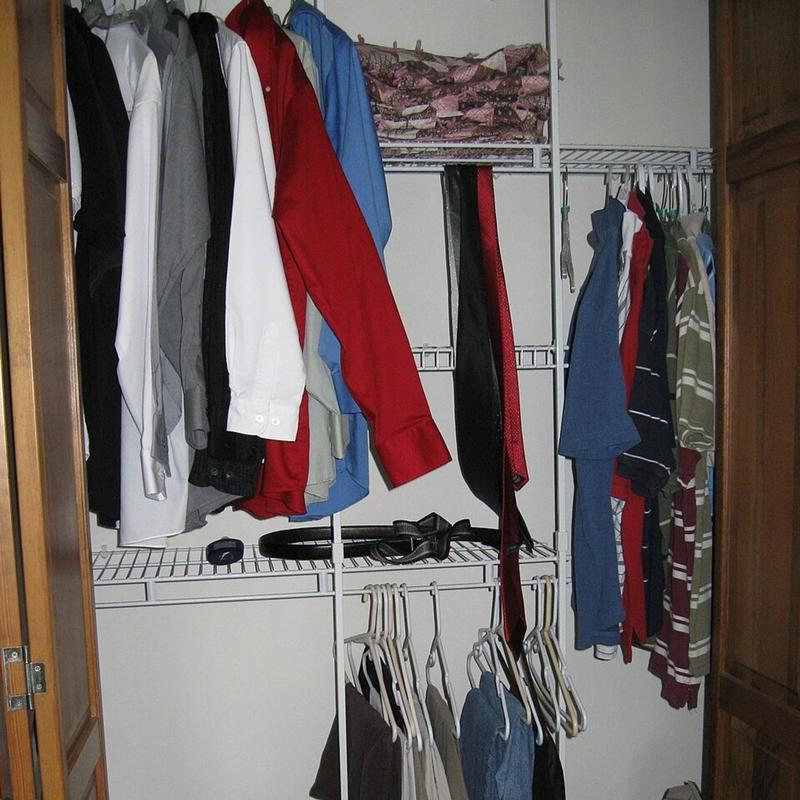
Brigid Bergin: It's The Brian Lehrer Show on WNYC. I'm Brigid Bergin, filling in for Brian today. Now that the weather's warming up, we're going to end today's show with a quick guide to spring cleaning and decluttering. We've all got clutter somewhere in our homes. Maybe it's hidden in that one closet you never want to open or bursting out of your kitchen cabinets. We all want it gone, but getting rid of our possessions is actually harder than it seems.
Decluttering can be time-consuming, and there's all sorts of logistics involved if you're doing the right thing and not just dumping your stuff in the trash. Often, it's the emotional weight of letting go of those things and living with that clutter. It can feel like throwing out memories and little pieces of our previous selves. To help you get the ball rolling on spring cleaning, we've got a professional organizer on deck here to take your calls and offer some advice, hopefully even inspire you to get started this weekend. With me now is Christina Fallon, owner of Dream It Done Organizing. Christina, welcome to WNYC. Great to have you here.
Christina Fallon: Thank you so much for having me. I'm so excited. I'm so passionate about this topic. 15 minutes is going to fly fast. Let's go.
Brigid Bergin: Listeners, you better line up. Where are you hiding your clutter? Is it under your bed or piling up on your bookshelf? Do you need help figuring out how to organize the space under your bathroom sink? For me, it is my kitchen pantry. Have you tried to get rid of stuff but stopped halfway? Maybe you're looking to start the process of Swedish death cleaning or trying to make your space more efficient for your neurodiverse brain.
Have you ever walked into the Container Store and just felt utterly overwhelmed? I have. Here's your chance for some pro bono advice. You can call or text us at 212-433-WNYC. That's 212-433-9692. Christina, apart from it being spring, why is now a great time to get organized? Help us get motivated, a quick explanation of how clutter impacts our well-being.
Christina Fallon: The whole concept of spring cleaning it's funny to me because I think of organizing as a lifestyle. Life is a constant current, and we need to set the intention of what that current is going to look like. Whether it's spring cleaning, we're about to send the kids off to sleepaway camp, and then, before you know it, it's back to school. Then it's holidays, and then we start in spring again. We have to establish healthy habits along the way to maintain order. I have a few quick tips if you'd like me to share the guidelines that I live by, the tools in my arsenal-
Brigid Bergin: Sure.
Christina Fallon: -that I've picked up along the way. It's important to start in the entryway. Set the intention right when you're walking in. There's an acronym, OHIO, only handle it once. That way, you're not second-guessing where it is. When I walk through my front door, I'm not even two steps in, and I've already offloaded. I have a place for my keys, my wallet, my sunglasses, my jacket, my ChapStick, my tissue, my mail. It's all offloaded before I'm even in. Guess what? When it's time for me to leave, I know where everything's at. It starts there, and it sets the intention in the home of, like, "We're going to maintain order."
Brigid Bergin: Christina, why is decluttering so hard for so many of us?
Christina Fallon: I think that people get emotionally attached, like you said. That's the thing is, like you said, that thing about the memories.
Brigid Bergin: Sure.
Christina Fallon: They're afraid that if they let go of the thing, that they are letting go of the memory. I think that's why it's so hard.
Brigid Bergin: I think for me, I look at a project like organizing my pantry, and I feel extremely overwhelmed. I have multiple shelves filled with cans, and then there's kids' toys, and there's cleaning products, and it's the space where I can put anything that I don't want to look at, but it is not functioning in a way that helps my life in any way. How do I even begin a project like that?
Christina Fallon: When it's all entangled like that, that can be overwhelming. We need to have an action plan in place. You need to see the forest through the trees. You have to separate things into like categories so we can understand what they are, and we can edit from there. If we're talking about a pantry, what we're going to do is we're going to look at the expired items. Go ahead and get those out. The first thing you always do, no matter what space you're in, is you're going to trim the fat.
You're going to go through, you're going to get out all the garbage, all the recycling, all the easy decisions, the things of like, "Oh, I'm never going to use this. I'm never going to eat this. I'm never going to wear this," all the easy stuff. It's the stuff that is harder with the emotions attached that you have to build your purging muscle. Right?
Brigid Bergin: Right.
Christina Fallon: We get in, we sort it all, we categorize, we edit it, and then we come up with a game plan to contain it. We look at accessibility. If I don't use it that often, it's going to go to the top. If it's heavy, it goes on the bottom. If I need access to it, it goes right in front of me, and it goes to the place where it makes the most sense.
Brigid Bergin: This all sounds so logical, and I feel like, "Why haven't I thought of all of this?" Yet it also feels revelatory. I want to bring in Jess from Manhattan, who has a question that I also feel hits very close to home. Jess, you're on WNYC.
Jess: I had a feeling a lot of people could benefit from it. I've been listening to the beginning of the segment. I have a very small apartment. I always get jealous when I know people with other houses can fit all my toys in their house, but I can't fit them in mine. I can't keep all of the older books, older toys that I'm attached to, but if my children don't play with them, I shouldn't keep them. What I would say is all this, all of the advice you give, if you have a friend or a family member that can come over and put you through it.
My family member came and helped me get rid of everything in my kitchen because I'm not emotionally attached to it, but the toys and the older baby clothes and all that, that's really hard. I just want some advice on a small apartment where you just can't fit what you want, you imagine you can have in your house.
Christina Fallon: I always think of in small spaces, I want all of the furniture to do double duty. If you are going to hang onto things, then you want storage ottomans, you want bins. As far as holding onto the toys, it probably matter more to you than it does your kid. Maybe we can take pictures of these things instead of having the physical things. It's so funny. I was talking with my daughter on the train today, and she's like, "Mom, get rid of all my LOL toys. I've outgrown them."
She's a big girl now. She's turning 11 on Monday. She's like, "I'll maybe keep three Barbies, but I don't need 500." She goes, "For me, it's harder for my clothes." She has emotional attachment to certain outfits. I'm like, "Okay, I get it, but we can't keep the whole thing. Pick one or two." I always give people with sentimentals and stuff, I say get a box per family member. We each have our own box, a decorative box that we can keep. You try to keep yourself secure rating and editing down to that box, depending on the space you have. If you have a nice garage, yes, 60-gallon tub, fine. As with smaller apartments, we have to keep rein it in and so take a photo of it if that helps.
Brigid Bergin: Christina, if some of us are hearing you now and feeling like, "Okay, you've got me motivated, you've talked about an action plan, and I think I can do that." We've started with the cleanout and the sort. How do we decide what to keep, what to donate, what to throw out, and how liberal we should be about just getting rid of stuff?
Christina Fallon: I think that you need to think about what purpose it's serving in your life at the moment. Particularly, when we have stuff from loved ones, really hard stuff, when people pass away-
Brigid Bergin: Sure.
Brigid Bergin: -and we inherit their stuff. I think about it in four different categories. We have to do it through a filter through these buckets. Am I going to display this, am I going to stow this, am I going to use this, or am I going to let it go, and which category does that fall into? I think that things have frequency. You don't want it sitting there collecting dust in a box. Make use of the things. You can donate these textiles to fashion students that can do something fabulous with it.
I have a NICU nurse that picks up items and toiletries and stuff that she can donate all this stuff to teen moms. Give the stuff life again. If it's just going to sit there, dragging you down, then let's let it go and let's let it have a chance to be fabulous in its own way.
Brigid Bergin: If you did want to donate some of these things that are still usable and functional, how do we make the donation part as frictionless as possible? I know I've looked for companies where I can donate used textiles that nobody wants. I'd want to, but I want to make sure don't end up in a landfill. Are there ways to find something like you just described?
Christina Fallon: My favorite is the House of Good Deeds. They will come, and they have a van, and they pick it up, and it's free. However, because of congestion price, I suggest $25 donation for gas, but they'll take a whole van load of stuff. Their headquarters is on Avenue D. They have a community grab. The whole community can come and get free stuff. Whole families can be outfitted in things. The guy's wife is actually a stylist. If there's stuff that still has tags on it, she takes 1% of the stuff. It's like the top of the top and the bottom of the bottom. If it's stained and ripped and torn, she'll upcycle that.
Brigid Bergin: Oh, wow.
Christina Fallon: It's cool. Then everything in the middle goes back to the community, and then you can buy nothing stuff. Within the community, people are looking for things.
Brigid Bergin: Sure.
Christina Fallon: Buy Nothing is a great resource.
Brigid Bergin: That's posting on one of those Facebook pages or whatever, where people are looking for items.
Christina Fallon: Yes.
Brigid Bergin: I want to sneak in another caller. Let's go to Martin in the Bronx. Martin, you're in WNYC.
Martin: Oh, hi. Good morning. Good topic.
Brigid Bergin: Good morning.
Martin: Like your previous caller, I have toys and toy cars that I've been collecting my whole life. I probably have at least 200 shoebox-sized cars that are in their brand-new packaging and toys as well as other things I've collected. If they're in a retail setting, they would certainly now have a value, let's say of $25 a car, let's say or more. I don't know. The retailer might say, I'll give you $10 for each of those cars. Now, they won't come pick it up. I'd have to get it to them.
If I try to hire somebody for $1,000 or something to just wind up taking it to them, then what's the point? If I wanted to donate them, nobody even really wants to come. I'm a senior. I'd have to try to bring them somewhere. What do you do? It's clutter, but it's valuable clutter. What do you do if nobody really wants it or the people who do want it are going to give you, let's say, half of their value, which is okay?
Brigid Bergin: Martin, I'm going to jump in just because we're running out of time here. Christina, I think I want to take Martin's question and tack on one more and see if we can get you to give us a quick answer, which is, what do you do with stuff that is valuable but might cost you more to donate? For the things that you want to organize, how do you figure out the bins, baskets, dividers, doodads that you would use without breaking the bank when you're buying them?
Christina Fallon: Collectible cars is a niche thing. I think Facebook for me is a great resource to find people of like-minded, people that are collectors, people that might want to take it off your hands, eBay, things like that. I don't resell items, so I would have to literally search it out in his area and put some work. You have to do the groundwork. You have to find out where the interest is. Is there a museum that wants this? We'd have to figure out a game plan for that.
Brigid Bergin: Then, in about 20 seconds, the best place to find those organizing tools.
Christina Fallon: I love the Container Store, but you can find them anywhere. You can repurpose the things that you have in your house. It does not have to be fancy, it does not have to be expensive, and it doesn't have to be plastic.
Brigid Bergin: That's great. I wish we could keep going, but we're going to leave it for there today. My guest was Christina Fallon, owner of Dream It Done Organizing. Thank you so much for your advice and for your inspiration.
Christina Fallon: Anytime.
Brigid Bergin: It's The Brian Lehrer Show. The Brian Lehrer Show's producers are Lisa Allison, Mary Croke, Amina Srna, Carl Boisrond, and Esperanza Rosenbaum. Our interim producer is Sasha Linden Cohen. Our interns are Arlo Bivens and Jack Walker. Megan Ryan is the head of Live Radio. Juliana Fonda and Milton Ruiz are at the studio controls. I'm Brigid Bergin. That's it for The Brian Lehrer Show today. Stay tuned for All Of It.
Copyright © 2026 New York Public Radio. All rights reserved. Visit our website terms of use at www.wnyc.org for further information.
New York Public Radio transcripts are created on a rush deadline, often by contractors. This text may not be in its final form and may be updated or revised in the future. Accuracy and availability may vary. The authoritative record of New York Public Radio’s programming is the audio record.
