
Special Coverage: Zohran Mamdani's Inaugural Speech
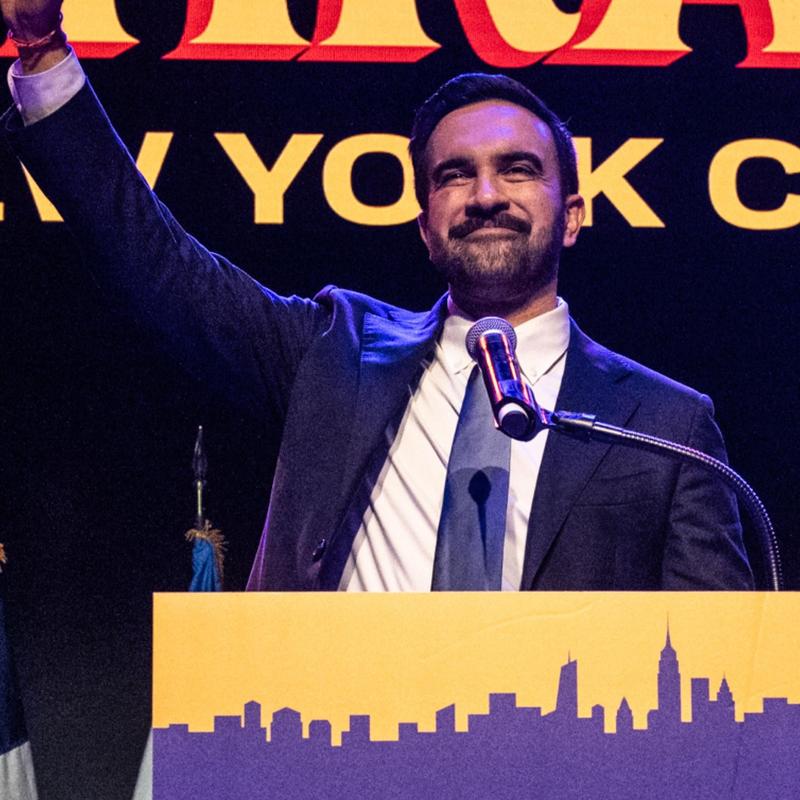
Brian Lehrer: This is Special Coverage on WNYC. Happy New Year, everybody. This is the inauguration of Zohran Mamdani as New York City's 112th mayor. Good afternoon, I'm Brian Lehrer. The ceremony is scheduled for one o'clock, so just a few minutes from now. It will include the swearing in of the mayor, also Public Advocate Jumaane Williams for a second term, and the new comptroller Mark Levine, who has been the Manhattan Borough president. There will be Mamdani's inaugural address, of course, which we will carry live to hear how the new mayor sets the day-one tone for his administration and if he makes any specific day-one policy announcements or policy proposals.
After the speech, we will open our phones and text message feed for your reactions to it or questions about it. We will get analysis from our inauguration coverage special guests who join us now as we await the start of the ceremony. They are Harry Siegel and Christina Greer, co-hosts of the podcast FAQ NYC. Christina is also a political science professor at Fordham and author of the books Black Ethnics: Race, Immigration, and the Pursuit of the American Dream and How to Build a Democracy: From Fannie Lou Hamer and Barbara Jordan to Stacey Abrams. Harry is also a senior editor at the news organization The City and Moynihan Public Scholar at City College.
Hi, Harry. Hi, Christina. Welcome back to WNYC and Happy New Year.
Christina Greer: Happy New Year. Hi, Brian. Hi, Harry.
Harry Siegel: Happy New Year, Brian. Hey, Christina.
Brian Lehrer: Happy New Era. Officially, Mamdani is already the mayor. We should say he was sworn in just after midnight, as the city does. He humbly said this during that this during that.
Zohran Mamdani: This is truly the honor and the privilege of a lifetime.
Brian Lehrer: That was just after midnight. Now let's preview the ceremony to come. Christina, I see that Congresswoman Alexandria Ocasio-Cortez will give introductory remarks and Senator Bernie Sanders will conduct the ceremonial swearing-in. What do you take from this prominent placement of Mamdani's fellow Democratic socialists?
Christina Greer: I think it's a signal to not just New Yorkers but to Democrats across the country that he is not just a Democrat, but he is a proud Democratic socialist. I think having Alexandria Ocasio-Cortez, who represents the Bronx and Queens in such a prominent position, is also a link to his relationship with a member of Congress. Obviously, Bernie Sanders and AOC have been very supportive of his campaign and various rallies that he had throughout the campaign. Obviously, he's going to have to govern in a much more centrist way at times than members of the DSA are probably going to feel comfortable with.
He'll be attacked from the right and from the left at times, but at least for today, he is signaling that this wasn't just a label that he used to get elected. This is an ideology that he fundamentally believes in. Having two of the most prominent DSA candidates at his inauguration, I think signals that.
Brian Lehrer: Harry, before I get your take on what to expect, WNYC's Brigid Bergin is at the inauguration and joins us for just a minute or two. Hey, Brigid, describe the scene and tell us how cold is it?
Brigid Bergin: [chuckles] Hey, Brian. It is real, real cold out here. I think the real feel is somewhere between 10 and 12 degrees, but there's a lot of warmth from the crowd that is building outside of City Hall. The Mayor Mamdani, arrived probably about half an hour ago via taxi cab. A really fitting arrival given all the work he did advocating on behalf of taxi drivers. Right now, you see both dignitaries, I've seen people, including Mahmoud Khalil, the Palestinian activist, and Columbia University graduate student Cynthia Nixon, a prominent figure who's active on the left as well as obviously an actress, and then many of his supporters and elected officials.
At this point, they're still trying to get people through the security gates. The lines are very, very long. In addition to the ceremony here at City Hall Plaza, there is a massive block party in the Canyon of Heroes on Broadway, where organizers say about 40,000 people have RSVPed. It's pretty much a logistical nightmare, but I think the spirit of it all is extremely upbeat.
Brian Lehrer: That block party open to the public, but they were asking people to RSVP online. Do you understand what that means? Are they checking names?
Brigid Bergin: As I understand it, people were told specific entrances to use, I think, as a way to control the crowd. Then they had some volunteers stationed at corners around lower Manhattan, directing people to various entrances where they also would have to go through a metal detector to go through. I saw truly throngs of people, many of them in Mamdani Merch, as they say, hats and buttons and pins, making their way to that block party. I think a lot of people are just here for this historic moment. The city's youngest mayor in more than a century, the first Muslim, the first African-born.
It's a moment that I think a lot of people, particularly that 100,000 volunteers that helped him run a successful campaign, wanted to be here for a culmination of a year of work.
Brian Lehrer: All right, thanks, Brigid. We'll be listening for Your reporting throughout the day. Stay warm out there.
Brigid Bergin: Thanks so much, Brian.
Brian Lehrer: Harry Siegel, as we await the start of the ceremony, besides the speech and the prominence of Sanders and AOC, which we've touched on, is there anything you will be especially watching and listening for? They're saying it'll include poets, musicians, and interfaith leaders, for example.
Harry Siegel: No is the honest answer to that. Brian, something big is happening in New York.
Brian Lehrer: An honest guest. I've been waiting for one for so-- I'm kidding. Go ahead.
Harry Siegel: It's something new, something different, a new progressive era in this city's history that matters to all of us but is being felt far behind our borders. That, of course, was Bill de Blasio getting sworn in for a second term a year after Donald Trump was first elected president by none other than Bernie Sanders. A lot of this has to be a set piece. What's different right now and what Mamdani, I suspect, is going to try to get out in his remarks and in the tone of the day, and then the rumors that he'll be walking through the block party afterward, we'll see. I don't know. That's just chatter. Is there's been all this talk of some sort of movement.
We've had Trump reelected. He's now a first-term mayor, and he's talking about again, a new era. That's the same language de Blasio used. I think what he wants to point to is that this campaign doesn't end with the campaign. That he wants to take this organizing energy, that 100,000 volunteers, the new outside groups, that it's going to be advocating for his policies and push and show that he has real political leverage, that this isn't just a ceremonial set piece.
Interestingly, the point of this set piece, before he gets down to the work of government, is to indicate the political leverage he has and that there are people who are actively involved and want to be engaged in the governance of the city and what it means, who are going to be showing up, and to set that spirit. I think it'll be a little joyous, but I think the messaging is this doesn't end here. We'll watch this ceremony. This is the thing for today. Stay tuned, but this is really a beginning, and then we'll see as the months go by how that holds and if he's able to build that up.
Obviously, Obama was not in his circumstances, Bill de Blasio, it was just the inauguration in the second term, and then back to the slog, but this does feel different.
Brian Lehrer: As we await the inauguration of Zohran Mamdani with Christina Greer and Harry Siegel, co-hosts of the podcast FAQ NYC. Christina, anything you want to pick up on from Harry's answer? I'm also curious if they've released any inaugural address language or bullet points that you've seen.
Christina Greer: And I have not seen any, but I will admit that I have not been in the country in some time. What I am excited about, though, and I think this is why Harry and I are great podcast co-hosts, because I differ just a bit. I do think that this does mean something, and it's different from when de Blasio did it. The fact that he'll be sworn in using Qurans, the fact that he is not born in the United States or was not born in the United States. We had Bloomberg and de Blasio, both Bostonites. I feel like those are such much more foreign identities for so many New Yorkers than someone being born outside of the United States.
I think that he symbolizes something for a lot of New Yorkers, whether they voted for him or not, or whether they could vote for him or not. I also think that youth is going to be something that we haven't seen in a long time. Harry and I talk about this a lot on the pod, Brian, but there's something about kind of a certain level of fearlessness that young people have. There's a certain level of energy that we just quite honestly have not seen in the Adams, de Blasio or even, dare I say, Bloomberg and Giuliani eras, where I think he's eager to do a good job. Thus far, he's not looking at another office, which we often see politicians doing, where it's like using an office as a stepping stone.
Honestly, being mayor in many ways is like a dead-end job. It's kind of like being mayor of Washington, DC. We haven't seen our mayors go on politically and do other things in higher office. As long as he maintains that and listens to the qualified people that he is surrounding himself with, I think there's a level of excitement that is palpable because it represents a real opportunity that, quite honestly, New Yorkers haven't seen in quite some time. I'm being very polite to Eric Adams right now, but even second term de Blasio, as Harry mentioned, we haven't really had a leader who's been interested in governance for quite some time.
Brian Lehrer: Harry, want to keep going?
Harry Siegel: Everything Chrissy just said. I actually think this is a big moment for people who voted for Mamdani, for people who didn't, but are hopeful for him, and even for people who are scared. It's a real changing of the guard generationally, demographically, ideologically, and like an important ceremonial day as such. I think it's significant, though, to note that we have this is going to be years 13 to 16 of Democratic mayors. They've been very different Democrats with Bill de Blasio, who's here today, and Eric Adams, who finally said he was going to be here, and now Zoran Mamdani.
It's complicated for Mamdani with all of these historic components as somebody who actually wants to do the job well and notably is staffing up with a lot of veterans, accomplished ones of previous administrations, as opposed to just new blood. That in this celebratory moment, in this exhaling, in the sense of broader vistas and horizons for people who are excited about what he's promised and who he is, the remains. All of this not routine, not rote, but very important work that is separate from the messaging.
This is the last celebratory day. It's beautiful. It's like you have a wedding and then a marriage, and this is the culmination of the wedding and then the start of what will be, as previous mayors can vouch, a pretty brief honeymoon period. Patrick Gaspard was an Obama administration person, among many other things, who's been advising him, has been talking very openly about this, that Mamdani needs to spend his political capital now. Today in this celebration, many people are out in the street in the cold, really excited to be there and with each other, is a last moment for him to build some of that political capital before he needs to start spending it.
Brian Lehrer: We know, Harry, that there is some skepticism and concern among some Jewish New Yorkers. Mamdani also has Jewish supporters, so not to minimize that, but do you expect any specific outreach in the speech?
Harry Siegel: I do, because he's been hammered so much on this. There are many Jews who supported Mamdani. There are many different Jewish groups in New York. Let's be clear, from exit polls, he lost Jewish New Yorkers by about 40 points, 70-30. That is a huge loss and among one of the largest parts of the electorate. It's what stopped this from actually being some sort of landslide. He won by just more than Cuomo and Sliwa combined, and with very high turnout. That gets treated as a huge win and a mandate. Of course, Eric Adams had a general election mandate.
Most general elections in New York, because the Democratic Party is so powerful, feel that way. Jewish New Yorkers in particular really have many of them, including people who voted for Madani. I'm talking to some concerns about this, about how he wants to handle protests and outside of synagogues, and with visibly Jewish people, and all of these questions. He seems like such a decent guy. He's spoken well and decently about a lot of this and not always been credited when he'd done so, but the rubber is going to hit the road now.
I think it's on his mind to show his sincerity in saying that without compromising his political beliefs, which really start with a virulent objection to Zionism and the idea of Israel as any sort of Jewish state. I don't know if that's entirely swearable to people who have those sympathies. He had the good fortune of running not only after Trump won, and against exhausted, exhausting Andrew Cuomo, who openly just didn't want this job. As Chrissy was saying a moment ago, Mamdani wants to be doing this job. He understands this as his last step. Cuomo sighed and said, "I could do this." He's had all that good fortune.
Not to be crude at all, but the viciousness of the Trump stuff, the pain of what was happening in Gaza before the ceasefire there, this all lined up with the message he was bringing in. The idea of a breakthrough for the Democratic Party. Now he wants to be a mayor for all New Yorkers, including Jewish New Yorkers. There are all of these suspicions, and it's going to be really interesting and a little nerve-racking to see if he can thread that needle both rhetorically in terms of his actions. Keeping Jessica Tisch as police commissioner, I think, bought him a little bit of credit, but there's deep suspicion there.
Losing that vote by 40 points is striking. It's one place I think he's mindful of the work he has to do if he wants to bridge that, or if he's building a completely different new coalition, which I'm not sure is sustainable in New York, but has gotten him this far, so we will see.
Brian Lehrer: I'm looking on my monitor at the scene just outside City Hall. Looks like they're getting close to starting. They're about seven minutes late so far, but so many people, as our Brigid Bergin was reporting a little earlier, coming through security, getting through the gate, taking their seats. I'm seeing a lot of knit hats, let's say. The kinds of hats that cover your ears as the shot that I'm seeing is from the back, looking at what will be the podium, where Mayor Mamdani and the new controller, Mark Levine, and the ongoing public advocate, Jumaane Williams, who will also be sworn in for his second term, will be speaking shortly. I think they're getting pretty close.
Christina, I want to pick up on something that Harry mentioned before, and it was a comparison to Barack Obama as president, who, like Mamdani, came in with this huge wave of grassroots support and volunteers in that 2008 campaign. I know there are some people who were very supportive of Obama who felt like he squandered the opportunity to use the movement that helped get him elected to also help get policies through. To use that people power as leverage in the streets or with big turnouts, to lobbying efforts outside Congress, whatever.
That there was a failure to really capitalize on the movement that he had started, and that that's something that Mamdani might try to learn from and do better at. Does that ring true to you?
Christina Greer: Yes and no, Brian. I think that there are a lot of comparisons we try and make between Mamdani and Obama that I think have to end at a certain point. One, mayor is not president. Two, Obama's Black, Mamdani isn't. That's a whole other racial politics conversation we can have and should have, and we probably will have throughout the course of the four years. Three, Obama had to save the banks and had to deal with the financial crisis that, if he didn't deal with that expeditiously, America could have and would have fallen off a financial cliff and dragged the rest of the entire world down with it.
I think that there were some pressures that Obama had immediately. Keep in mind, he's the first Black president in the history of the nation, and we know the history of this nation. Mamdani is coming in with a slightly different mandate and a much smaller scale, and a city that, quite honestly, isn't in crisis the way that the country was when Obama took over. I do think, though, that yes, Obama could have and should have used some of that momentum in many different ways. Keep in mind what I'm listening for today is the tone of Mamdani's speech.
If we remember that cold night in November, in 2008, Obama came in with all this-- so many people were excited in Millennium Park in Chicago. He essentially threw cold water on everyone and said, "Hey, listen, I know I made a lot of promises, but slow down, and it's going to be hard." It was a really somber tone that I think threw a lot of his supporters off quite a bit. He never really reignited that passion, if you will, in a lot of ways during his tenure as president. Obviously, he's genuinely not like the president we have today. I think there is a difference in a personality style between Mamdani and Obama, a fundamental difference in the personality style.
I've heard the term happy warrior with Mamdani quite a bit. That's not Obama. A happy warrior actually can keep momentum going in a way that a great orator like Obama's a fantastic orator, as is Mamdani, but there's a difference between a happy warrior and a great orator. This idea, a generosity and joy that Mamdani seemed to bring to his campaigning, I'm curious to hear the tone as to how he will govern and how he plans to lay out a message to New Yorkers.
Obviously, there are some similarities between Mamdani and Obama. Sure. Obviously, Mamdani is the thing that everyone feared about Obama. He's born in Africa, he's Muslim, and he's a socialist. Obama is none of those things. Mamdani is all of those things. We've evolved ever so slightly in some of these conversations, but as we know, this particular administration has pulled us back to some really dark times that represent the foundation of our nation. On a New York scale, I do think that the pressures of a mayor are exponentially different than the pressures of a president.
Not saying they're harder, but if we think about LBJ, with Vietnam and civil rights and everything going on, and LBJ was very clear, it could be worse. I could be a mayor. There's a temporal quality to what we're expecting from Mamdani. Obama had to deal with the banks and the financial crisis. Sure. If something goes wrong in New York City, if a train goes off the track or if a train is late, even though he doesn't necessarily control the MTA, that is his problem. If something happens in a housing project or a building in New York City, that is a Mamdani program. There's a temporal quality to the executive leadership of mayor that isn't really expected from a president.
Brian Lehrer: Harry, were you trying to get in there and build on that?
Harry Siegel: I just wanted to add one thing, going back to little, what you were asking me before about Jewish voters is, Bibi Netanyahu, the Israeli prime minister, was just in America visiting Donald Trump, and there was this question that was looming about whether he might show up in New York today. Then he responded to a council member who'd invited him, "'m not going to be there, but I'll be there soon." That, as Madani has repeatedly just said, "I'm focused on New York City and what matters here." When there have been questions involving Israel, Jews, Palestinians, Muslims, all that's been his pivot.
He has sworn at the same time that he's going to have the Israeli prime minister arrested if he shows up here. That is going to be one interesting thing that will come up quickly. Famously, John Lindsay, who said this is going to be a fun city that became a dark and ironical term during a transit strike, who had the snowstorm right away. There are going to be challenges in the next few months that are outside of the movement he's trying to build in this scope that, as Chrissy is saying, he's really accountable for, and in ways a president who oversees this giant, somewhat abstracted government, the federal government does not have.
He really is 300,000 city workers, 8.5 million people, so many immigrants with different statuses here. It's almost impossible to talk about now, even what undocumented means. As the Trump administration keeps changing these rules, the pressure that's going to be on us as a sanctuary city, a lot of this is going to be intense. He's thought a ton about the messengering, but there will be a fire, a police shooting, police officer shot, just all of these other circumstances, and a lot of things he hasn't wrapped his head around. You can feel that in him backing away from saying, "Let's give communities back control of the schools," which he's just done, and he wants to keep mayoral control.
There are a lot of things he has not thought deeply about that are going to force themselves on him, and he's going to have to figure out in terms of his messaging, his political movement, and his vision, but also just administering the city and understanding this. How to deal with those. As mayor, you don't get the easy decisions. You don't get to frame all the rhetoric or what we're talking about. Ask the last many mayors about this who come in thinking they're going to set the agenda, and then they respond to it and the circumstances that happen, the things that we report, it's difficult, and it's not the narrative that you want.
How he controls all that and how he actually runs this place is going to be really interesting to see and crucial. It is maybe second most difficult job. Maybe it's the most difficult, but it's an incredible job. Having run this brilliant campaign to get there is some of the answer, but we don't know the rest. This is the thing I'm hopeful but nervous that we're all about to find out. It's a very untested experiment.
Brian Lehrer: Listeners, if you're just joining us, this is live Special Coverage on WNYC of the inauguration, including the inaugural address of Mayor Zohran Mamdani. I'm Brian Lehrer with Christina Greer and Harry Siegel. We're getting very close to the start of the ceremony. We will continue our coverage right after this.
[music]
Brian Lehrer: This is Special Coverage on WNYC, the inauguration of Zohran Mamdani as New York City's 112th mayor. Good afternoon again, everyone. I'm Brian Lehrer. We are getting analysis as a preview from our special guests, who will also join us now after the speech to talk about that. They are Harry Siegel and Christina Greer, co-hosts of the podcast FAQ NYC. Christina is also a political science professor at Fordham and author of the books Black Ethnics: Race, Immigration, and the Pursuit of the American Dream and of How to Build a Democracy: From Fannie Lou Hamer and Barbara Jordan to Stacey Abrams.
Harry is also a senior editor at the news organization The City and Moynihan Public Scholar at City College. As we continue to await the start of the speech, Harry mentioned, Christina, some of the appointments. Let me go down a few of these just in the last few days that people may not have been paying attention to the news for. Helen Arteaga as deputy mayor for Health and Human Services, Mike Flynn as transportation commissioner, and for Schools Chancellor Kamar Samuels, a veteran of the system, the education news site Chalkbeat writes, as the superintendent of Manhattan's District 3.
Samuels supervises schools with widely varying demographic profiles across the Upper West Side, Morningside Heights, and parts of Harlem. Samuels has led school integration plans and played a role in a previous effort to scale back gifted programs, initiatives that Mamdani has vowed to revive. That from chalk beat. Does that appointment, Christina, signify anything specific to you? I also saw the reporting that Harry referenced just in the last day, that Mamdani has now reversed his previous call to end mayoral control of schools.
I'm curious what's actually new there because he had already, in the debate we hosted this fall in response to a question I asked him, said yes to mayoral accountability, but with more community inputs. That answer was criticized as vague, but it did have the mayor at the top of the chain. I guess the first thing I'd like to hear your take on is what, if anything, did he just actually change?
Christina Greer: I think Brigid Bergin may have said this. We're adapting to a new style of communication with this particular mayor. Each mayor has a different way of speaking. Maybe it was Katie Honan who said it, but I think that we're going to have to figure out what he's saying when he's saying it in many ways. Thus far, it seems as though people are happy with the school chancellor's choice. Kamar Samuels seems to be a well-respected individual by his colleagues and by many people who have worked with him.
I was obviously most interested in who he would choose as transportation commissioner since transportation is such a large piece of his agenda that he'll have to push forward very quickly, especially in the first six months, to be seen as a success. I think that again, Mr. Flynn seems to be very well respected by his colleagues and those who work with him. I'm not too sure what his busing experience is.
Brian Lehrer: Hang on for one second, Christine. I'm going to jump in just so we're ready when they're ready. Looks like the inauguration is just about to begin. I'm looking on my monitor at Governor Hochul, who's out now. State Attorney General Letitia James, who's out there now, Bernie Sanders, who's going to swear Mamdani in, is out there now. I will note that Bernie Sanders from Vermont is the only person I see not wearing a hat.
[laughter]
Brian Lehrer: He's got that little advantage over a lot of other people, maybe being used to it. I'll tell you all, I will stay in place and describe any visuals or ID any speakers if needed. During the ceremony, we will also hear the swearing in of the new New York City Comptroller, Mark Levine, who has been the Manhattan Borough president, and the swearing in for his second term of public Advocate Jumaane Williams. I'm not actually sure if they're going to be giving brief addresses as but of course we will carry all of it. Christina, I did jump in to interrupt to do the housekeeping there, but do you want to finish an answer about education?
Christina Greer: Yes. I think that again, this is someone who appears to be well respected. I do think that Mamdani is going to have to have a much clearer agenda as to what he thinks about education. We're one of the largest, if not the largest, school districts in the country. As Harry and I and Harry, Katie, and I have discussed ad infinitum, there's been very little conversation during the campaign about education. It was much about affordability, much about transportation.
We did not spend a significant amount of time hearing from Mamdani about a legitimate plan about how he's going to take students from universal Pre-K and 3K all the way through 12th grade. Especially with the complications around specialized high schools and gifted and talented programs. We know that at one point, he mentioned gifted and talented programs, and that was a massive explosion with folks who supported and did not support some of the things that he said about that.
I do think that there's going to be a lot of ground to make up very quickly, where we're going to have to figure out what exactly this mayor intends to do when it comes to close to one million school children, and what is it close to 150,000 who are unhoused. To say nothing of the rest of the significant percentage of New York City public school students who need special assistance in a host in a myriad of ways. Also, in addition to this, how he thinks about charter schools and what he will do to support not just charter schools, but public schools in conjunction with those colocations that are throughout the five boroughs.
Brian Lehrer: Harry?
Harry Siegel: With the education in particular, we have a chancellor now, and that was obviously a very late announcement, like days before kids are back in school. The reporting was that that was a complicated and difficult decision among the firm runners. We will see. What's clear is that this isn't an issue that Mamdani gave a ton of thought to as a candidate, and he didn't have to. Candidates spend their time on the issues that they're pressed to address, that are resonating with New Yorkers, that other candidates are forcing them to address, those sorts of things.
It was remarkable how little attention, [unintelligible 00:31:34], and a very good piece about this in The Times a few weeks ago, how little attention education received. As Chrissie was saying, we just really don't know what his philosophy is going to be. We know that the public school system has been shrinking. That it had been more than a million kids, it's fewer than 900,000 now. It would be even smaller if not for some of the migrant children who've been added recently. One big thing I'm hopeful that this administration might do that the previous one and other people in this government didn't, is study some of the education loss, both from COVID.
Then, not just the education experience of these migrant kids who've been coming in, of how they're doing as they're in New York City, as some of them are then moving elsewhere. These are giant unanswered questions that, given Mamdani's really profound and poetic concern with ordinary New Yorkers and having them represented and seen and understood, the care he's given to immigrants and to migrants in particular. Having them be treated decently in this sanctuary city, that we just don't know how much these kids are learning, how stable their lives have been.
Again, same questions with COVID is a place where there's room for an administration that cares in different ways, that wants to show government really can be responsive to the needs of people here, to step up and start getting some answers there. To work out where resources are needed, where they haven't been spent well, all of that, but we will see.
Brian Lehrer: Harry, Eric Adams, now the former mayor, has been trying to undermine or Mamdani proof some city functions in his last weeks in office. Depends on your point of view. Undermine or Mamdani proof, and he only decided at the last minute to even attend today's ceremony. Why did he almost reject this basic courtesy of electoral democracy, or say he decided to attend?
Harry Siegel: Chrissy, do you want to jump in there?
Christina Greer: I'll let you answer, and then I'll follow up. I've got my thoughts.
Harry Siegel: He feels burned. He feels burned a whole number of ways, and he feels burned, frankly, by New Yorkers. He very much wanted this job. He said that God had told him he would have this job, and then he wanted to run. He insisted he was going to run as a Democrat right up till the day of the primary, and then he dropped out. Then he said, "I'm running as an independent, but I'm here, and I'm going to show," and all these things. Then he dropped out. He's muttered a lot about how the Biden people prosecuted him. The Trump administration, of course, had the historic criminal charges against him dropped.
I think he has a lot of burnt feelings on the way out, uncertainty about what he's doing, and anger. He's somebody who tries to say, "Oh, this is all water off my back." You can see the things he's upset about and those parts, but with all that, he also has a sense of there's another side to the bet that every good politician has is a guy who got himself elected mayor. Who has real political talents and awareness, and seeing a very different coalition, the one he ran against. We can't have the radical left running things. We need a sensible Democrat and a police officer, but one who's reformed the police and was trying to straddle all these things, while often left punching.
Now, the shambles of his [unintelligible 00:35:01] all of the pettiness, all of the corruption, all the little coverage that he thinks overshadowed his accomplishments has elected the left he ran against. He is bitter and salty about it. He thinks there's a chance that some of these political winds shift, some of the national and international forces do, and Mamdani ends up exposed as a ridiculous young radical who's part of a movement of children who understand nothing. He can be someone who has some position, who's getting paid, and is there. He's bitter to the point where he kept flirting with, "I'm not going to show up. I'm not even going to sit in at this," which is really thin-skinned.
Brian Lehrer: Christina, maybe some of our listeners saw your New York Times op ed the other day in which you acknowledged some policy successes for him as mayor. You wrote Mr. Adams' real legacy might be that he has made the future for Black elected officials in New York City harder. Why might that be so?
Christina Greer: Because of his lack of seriousness. I think there's a host of literature that has shown that Black electeds are held to a different standard, a much harsher standard, because of whether it's the short tenure that we've been in office in the history of the city and the nation, but also calcified racialized perceptions of Blacks as leaders. Everything from how Black leaders dress, how they speak. I talk about politics of respectability very briefly. We can think about your Hakeem Jeffries and your Cory Booker's and your Barack Obamas are a different style than say, an Eric Adams style that many people were not accustomed to and had not seen before, and this level of leadership.
When we think about voters consciously or subconsciously thinking about Black leadership, I think he's made it much harder because, in many ways, he was unserious to a lot of people, even though he does have policy wins. To Harry's point, I think some of this ire and pettiness that we're seeing is that I'm leaving the city in pretty good shape. Why didn't you all respect that? Why didn't you all want to see me have a second term? Why am I leaving one of the lowest approval ratings in the history of New York City?
I think that we're dealing with someone who's just also a unique individual. I think Jeff Mays wrote a great piece in the Times about all the different sayings of Eric Adams. We just hadn't seen the type of politician like him before, especially a Black politician like this before. I think that threw a lot of voters off and they didn't really know what box to put him in. even though Adams reveled in the fact that you couldn't put him in a box, I think when it came time for reelection and reevaluation of him as a mayor, many people said that they did not want to sign up for another tenure of a possible quid pro quo with the president.
A scandal and corruption, surrounding yourself with people who have too much scandal and corruption. I think that there's a real bitterness, is the word that I would say surrounds Eric Adams right now. I do think, as I said in my piece, Brian, I think history will be much kinder to him, honestly, in 10 to 20 years, whether Mamdani is a success or not.
Brian Lehrer: You said Adams tried not to be in a box. He is in his seat. It would be a box seat if it was a baseball game, because it is a very good seat near the front. For all the tensions we were just describing between factions in the Democratic Party, he is sitting right there with only one person between him, who must be accompanying either Adams or de Blasio. Right next to former Mayor de Blasio, and just behind the New York State Attorney General, Letitia James. He is certainly there, and he is certainly in the dignitary section right up front.
Looks like they're getting very close to beginning the inauguration right now. I don't know how much time we have, but we mentioned the new deputy mayor for Health and Human Services. Certainly, one of the challenges that that person, along with the mayor, is going to face is that some of these stats I was seeing this morning, now that it's January 1st, and the so-called Obamacare cliff has been reached at the federal level. 150,000 low-income New Yorkers are at immediate risk of losing health care, and more than 200,000 people are likely to lose their SNAP benefits in March as a result of the so-called One Big Beautiful Bill. That's going to be an immediate public health challenge for this administration. Right, Harry?
Harry Siegel: Absolutely. As I read the Gothamist, we're also already having a record flu season, with the number of people had verified flu cases and been hospitalized. This again is another big sector of governance where, practically speaking, we don't have much sense. This is most numerous what what Mamdani is going to do and how capable he's going to be of administering this system and the really big and expensive challenges coming up that are in addition to what's been estimated as the $7 billion of additional spending promises he's already made.
Real quick, in Christina's piece, which I think is called Eric Adams Hurt More Than Just Himself, she's got this incredible opening about her grandpa, who was never a fan of the concept of potential. Then she applies this to Eric Adams, what you have when you ain't doing your job. I just want to say I am really excited about Mamdani's potential. I think he is trying to build a different sort of political movement as a means to governance and showing what democratic socialists can accomplish at a moment when mainstream Democrats have been very frustrating, when it feels like a wheat interest have been controlling too many things.
It is right now just potential, and we're now going to find out what that means. Hearing him frame this and offer his thresholds for what New Yorkers should expect for what they should be given is exciting.
Brian Lehrer: Now, I have to jump in because guess what, we take you live to City Hall. Listeners, you can check out the show notes for this special coverage for a link to the full event. They played a lot of licensed music that we're not allowed to publish as a podcast or on the web. If you haven't heard it already, go listen at the link in our show notes. We're going to present here just a portion of the event from Senator Bernie Sanders' swearing in of the new mayor, and then through Mamdani's inaugural speech. After that, we'll have more post-game analysis with Dr. Christina Greer and Harry Siegel, and listeners' calls.
Senator Bernie Sanders: Please repeat after me. I, Zohran Kwame Mamdani.
Zohran Mamdani: I Zohran Kwame Mamdani.
Senator Bernie Sanders: Do solemnly swear.
Zohran Mamdani: Do solemnly swear.
Senator Bernie Sanders: That I will support the Constitution of the United States-
Zohran Mamdani: That I will support the Constitution of the United States-
Senator Bernie Sanders: -the Constitution of the State of New York-
Zohran Mamdani: -the Constitution of the State of New York-
Senator Bernie Sanders: -and the charter of the City of New York.
Zohran Mamdani: -and the charter of the City of New York.
Senator Bernie Sanders: That I will faithfully discharge the duties-
Zohran Mamdani: That I will faithfully discharge the duties-
Senator Bernie Sanders: -of the office of the mayor of the City of New York.
Zohran Mamdani: -of the office of the mayor of the City of New York-
Senator Bernie Sanders: -according to the best of my ability.
Zohran Mamdani: -according to the best of my ability.
Senator Bernie Sanders: So help me God.
Zohran Mamdani: So help me God.
[cheering]
Crowd: Zohran, Zohran, Zohran, Zohran.
Zohran Mamdani: My fellow New Yorkers.
[cheering]
Zohran Mamdani: Today begins a new era. I stand before you, moved by the privilege of taking this sacred oath, humbled by the faith that you have placed in me, and honored to serve as either your 111th or 112th mayor of New York City. I do not stand alone. I stand alongside you, the tens of thousands of you gathered here in Lower Manhattan, warmed against the January chill by the resurgent flame of hope. I stand alongside countless more New Yorkers watching from cramped kitchens in Flushing and barbershops in East New York, from cell phones propped against the dashboards of parked taxi cabs at LaGuardia.
From hospitals in Mott Haven and libraries in El Barrio that have too long known only neglect. I stand alongside construction workers in steel-toed boots and halal cart vendors whose knees ache from working all day. I stand alongside neighbors who carry a plate of food to the elderly couple down the hall, those in a rush who still lift strangers' strollers up subway stairs, and every person who makes the choice day after day, even when it feels impossible to call our city home. I stand alongside over one million New Yorkers who voted for this day nearly two months ago.
[cheering]
Zohran Mamdani: I stand just as resolutely alongside those who did not. I know there are some who view this administration with distrust or disdain or who see politics as permanently broken. While only action can change minds, I promise you this: if you are a New Yorker, I am your mayor.
[cheering]
Zohran Mamdani: Regardless of whether we agree, I will protect you, celebrate with you, mourn alongside you, and never, not for a second, hide from you. I thank the labor and movement leaders here today, the activists and the elected officials who will return to fighting for New Yorkers the second this ceremony concludes, and the performers who have gifted us with their talent. Thank you to Governor Hochul. Thank you as well to Mayor Adams, Dorothy's son, a son of Brownsville who rose from washing dishes to the highest position in our city, for being here as well.
He and I have had our share of disagreements, but I will always be touched that he chose me as the mayoral candidate that he would most want to be trapped with on an elevator.
[laughter]
Zohran Mamdani: Thank you to the two titans who, as an assembly member, I've had the privilege of being represented by in Congress, Nydia Velázquez and our incredible opening speaker, Alexandria Ocasio-Cortez.
[cheering]
Zohran Mamdani: You have paved the way for this moment. Thank you to the man whose leadership I seek most to emulate, who I am so grateful to be sworn in by today, Senator Bernie Sanders.
[cheering]
Zohran Mamdani: Thank you to my teams, from the assembly, to the campaign, to the transition, and now the team I am so excited to lead from City Hall.
[cheering]
Zohran Mamdani: Thank you to my parents, Mama and Baba-
[cheering]
Zohran Mamdani: -for raising me, for teaching me how to be in this world, and for having brought me to this city. Thank you to my family from Kampala to Dili. Thank you to my wife, Rama-
[cheering]
Zohran Mamdani: -for being my best friend and for always showing me the beauty in everyday things. Most of all, thank you to the people of New York.
[cheering]
Zohran Mamdani: A moment like this comes rarely. Seldom do we hold such an opportunity to transform and reinvent. Rarer still is it the people themselves whose hands are the ones upon the levers of change. Yet we know that too often in our past, moments of great possibility have been promptly surrendered to small imagination and smaller ambition. What was promised was never pursued. What could have changed remained the same. For the New Yorkers most eager to see our city remade, the wait has only grown heavier. The weight has only grown longer.
In writing this address, I have been told that this is the occasion to reset expectations. That I should use this opportunity to encourage the people of New York to ask for little and expect even less. I will do no such thing.
[cheering]
Zohran Mamdani: The only expectation I seek to reset is that of small expectations.
[cheering]
Zohran Mamdani: Beginning today, we will govern expansively and audaciously. We may not always succeed, but never will we be accused of lacking the courage to try. To those who insist that the era of big government is over, hear me when I say this: no longer will City Hall hesitate to use its power to improve New Yorkers' lives.
[cheering]
Zohran Mamdani: For too long, we have turned to the private sector for greatness, while accepting mediocrity from those who serve the public. I cannot blame anyone who has come to question the role of government, whose faith in Democracy has been eroded by decades of apathy. We will restore that trust by walking a different path, one where government is no longer solely the final recourse for those struggling, one where excellence is no longer the exception. We expect greatness from the cooks wielding a thousand spices, from those who stride out onto our Broadway stages, and from our starting point guard at Madison Square Garden.
[cheering]
Zohran Mamdani: Let us demand the same from those who work in government. In a city where the mere names of our streets are associated with the innovation of the industries that call them home, we will make the word City Hall synonymous with both resolve and results.
[cheering]
Zohran Mamdani: As we embark upon this work, let us advance a new question, a new answer to the question asked of everyone who does. Who does New York belong to? For much of our history, the response from City Hall has been simple. It belongs only to the wealthy and well-connected, those who never strain to capture the attention of those in power. Working people have reckoned with the consequences. Crowded classrooms and public housing developments where the elevators sit out of orders, roads littered with potholes, and buses that arrive half an hour late, if at all.
Wages that do not rise, and corporations that rip off consumers and employees alike. Still, there have been brief, fleeting moments where the equation changed. 12 years ago, Bill de Blasio stood where I stand now, as he promised to put an end to economic and social inequalities that divided our city into two. In 1990, David Dinkins swore the same oath I swore today, vowing to celebrate the gorgeous mosaic that is New York, where every one of us is deserving of a decent life. Nearly six decades before him, Fiorello La Guardia-
[cheering]
Zohran Mamdani: -took office with the goal of building a city that was far greater and more beautiful for the hungry and the poor. Some of these mayors achieved more success than others, but they were unified by a shared belief that New York could belong to more than just a privileged few. It could belong to those who operate our subways and rake our parks, those who feed us biryani and beef patties,-
[cheering]
Zohran Mamdani: -picanha and pastrami on rai. They know that this belief could be made true if only government dared to work hardest for those who work hardest. Over the years to come, my administration will resurrect that legacy. City hall will deliver an agenda of safety, affordability, and abundance, where government looks and lives like the people it represents, never flinches in the fight against corporate greed, and refuses to cower before challenges that others have deemed too complicated. In so doing, we will provide our own answer to that age old question, who does New York belong to?
My Friends, we can look to Madiba and the South African Freedom Charter. New York belongs to all who live in it. Together, we will tell a new story of our city. This will not be a tale of one city governed only by the 1%, nor will it be a tale of two cities, the rich versus the poor. It will be a tale of 8.5 million cities, each of them a New Yorker with hopes and fears. Each a universe, each of them woven together. The authors of this story will speak Pashto and Mandarin, Yiddish and Creole. They will pray in mosques, at shul, at church, at Gurdwaras and Mandirs and temples, and many will not pray at all.
They will be Russian Jewish immigrants in Brighton Beach, Italians in Rossville, and Irish families in Woodhaven, many of whom came here with nothing but a dream of a better life, a dream which has withered away. They will be young people in cramped Marble Hill apartments where the walls shake when the subway passes. They will be Black homeowners in St. Albans whose homes represent a physical testament to triumph over decades of lesser-paid labor and redlining. They will be Palestinian New Yorkers in Bay Ridge-
[cheering]
Zohran Mamdani: -who will no longer have to contend with a politics that speaks of universalism and then makes them the exception.
[cheering]
Zohran Mamdani: Few of these 8.5 million will fit into neat and easy boxes. Some will be voters from Hillside Avenue or Fordham Road who supported President Trump a year before they voted for me. Tired of being failed by their party's establishment. The majority will not use the language that we often expect from those who wield influence. I welcome the change. For too long, those fluent in the good grammar of civility have deployed decorum to mask agendas of cruelty. Many of these people have been betrayed by the established order. In our administration, their needs will be met. Their hopes and dreams, and interests will be reflected transparently in government.
They will shape our future. If for too long these communities have existed as distinct from one another, we will draw this city closer together. We will replace the frigidity of rugged individualism with the warmth of collectivism. If our campaign demonstrated that the people of New York yearn for solidarity, then let this government foster it because no matter what you eat, how you pray, or where you come from, the words that most define us are the two we all share, New Yorkers.
[cheering]
Zohran Mamdani: It will be New Yorkers who reform along broken property tax system. New Yorkers who will create a new Department of Community Safety that will tackle the mental health crisis and let the police focus on the job they signed up to do. New Yorkers who will take on the bad landlords who mistreat their tenants and free small business owners from the shackles of bloated bureaucracy. I am proud to be one of those New Yorkers. When we won the primary last June, there were many who said these aspirations and those who held them had come out of nowhere. Yet one man's nowhere is another man's somewhere.
This movement came out of 8.5 million somewheres. Taxicab depots and Amazon warehouses, DSA meetings and curbside domino games.
[cheering]
Zohran Mamdani: The powers that be had looked away from these places for quite some time, if they'd known about them at all. They dismissed them as nowhere. In our city, where every corner of these five boroughs holds power, there is no nowhere, and there is no no one. There is only New York, and there are only New Yorkers.
[cheering]
Zohran Mamdani: 8.5 million New Yorkers will see speak this new era into existence. It will be loud. It will be different. It will feel like the New York we love.
[cheering]
Zohran Mamdani: No matter how long you have called this city home, that love has shaped your life. I know that it has shaped mine. This is the city where I set land speed records on my razor scooter at the age of 12, quickest four blocks of my life. The city where I ate powdered donuts at halftimes during AYSO soccer games and realized I probably was not going to be going pro.
[laughter]
Zohran Mamdani: The city where I devoured two big slices at Coronet's Pizza,-
[cheering]
Zohran Mamdani: -played cricket with my friends at Ferry Point park and took the one train to the BX10, only to still show up late to Bronx Science.
[laughter]
Zohran Mamdani: The city where I have gone on hunger strike just outside these gates,-
[cheering]
Zohran Mamdani: -sat claustrophobic on a stalled N train just after Atlantic Avenue and waited in quiet terror for my father to emerge from 26 Federal Plaza. The city where I took a beautiful woman named "Rama-"
[crowd cheering]
Zohran Mamdani: -to McCarren Park on our first date and swore a different oath to become an American citizen on Pearl Street, to live in New York, to love New York is to know that we are the stewards of something without equal in our world. Where else can you hear the sound of the steel pan, savor the smell of sancocho, and pay $9 for coffee on the same block?
[laughter]
Zohran Mamdani: Where else could a Muslim kid like me grow up eating bagels and lox every Sunday?
[crowd cheering]
Zohran Mamdani: That love will be our guide as we pursue our agenda here, where the language of the New Deal was born. We will return the vast resources of this city to the workers who call it home. Not only will we make it possible for every New Yorker to afford a life they love once again. We will overcome the isolation that too many feel and connect the people of this city to one another. The cost of childcare will no longer discourage young adults from starting a family-
[crowd cheering]
Zohran Mamdani: -because we will deliver universal childcare for the many by taxing the wealthiest few.
[crowd cheering]
Zohran Mamdani: Those in rent-stabilized homes will no longer dread the latest rent hike because we will freeze the rent.
[crowd cheering]
Zohran Mamdani: Getting on a bus without worrying about a fare hike or whether you'll be able to get to your destination on time will no longer be deemed a small miracle because we will make those buses fast and free.
[crowd cheering]
Zohran Mamdani: These policies are not simply about the costs we make free, but the lives we fill with freedom. For too long in our city, freedom has belonged only to those who can afford to buy it. Our city hall will change that. These promises carried our movement to city hall, and they will carry us from the rallying cries of a campaign to the realities of a new era in politics.
Two Sundays ago, as snow softly fell, I spent 12 hours at the Museum of the Moving Image in Astoria, listening to New Yorkers from every borough as they told me about the city that is theirs. We distrust. We discuss construction hours on the Van Wyck Expressway and EBT [crosstalk]-
Brian Lehrer: At three o'clock, this is WNYC FM HD and AM New York, WNJT-FM 88.1 Trenton, WNJP 88.5 Sussex, WNJY 89.3 Netcong, and WNJO 90.3 Toms River.
Zohran Mamdani: -affordable housing for artists in [crosstalk]. I spoke to a man named "TJ," who said that one day and two years ago. His heart broke because he realized that he would never get ahead here, no matter how hard he worked. I spoke to a Pakistani auntie named "Samina" who told me that this movement had fostered something too rare; softness in people's hearts. As she said to me in Urdu, "[Urdu language]."
[crowd cheering]
Zohran Mamdani: 142 New Yorkers out of eight and a half million, and yet, if anything, united each person sitting across from me. It was the shared recognition that this moment demands a new politics and a new approach to power. We will deliver nothing less as we work each day to make this city belong to more of its people than it did the day before.
[crowd cheering]
Zohran Mamdani: Here is what I want you to expect from the administration that this morning moved into the building behind me.
[crowd cheering]
Zohran Mamdani: We will transform the culture of city hall from one of know to one of how. We will answer to all New Yorkers, not to any billionaire or oligarch who thinks they can buy our democracy.
[crowd cheering]
Zohran Mamdani: We will govern without shame and insecurity, making no apology for what we believe. I was elected as a democratic socialist, and I will govern as a democratic socialist.
[crowd cheering]
Zohran Mamdani: I will not abandon my principles for fear of being deemed radical. As the great senator from Vermont once said, "What's radical is a system which gives so much to so few and denies so many people the basic necessities of life." We will strive each day to ensure that no New Yorker is priced out of any one of those basic necessities, and throughout it all, we will, in the words of Jason Terrance Phillips, better known as "Jadakiss" or "J to the Moi," "Be outside-"
[laughter]
[crowd cheering]
Zohran Mamdani: -because this is the government of New York, by New York, and for New York.
[crowd cheering]
[applause]
Zohran Mamdani: Before I end, I want to ask all of you, if you are able, whether you are here today or anywhere watching, to stand with me.
[crowd cheering]
Zohran Mamdani: I ask you to stand with us now and every day that follows. City hall will not be able to deliver on our own, and while we will encourage New Yorkers to demand more from those with the great privilege of serving them, we will encourage you to demand more of yourselves as well. The movement we began over a year ago did not end with our election. It will not end this afternoon. It lives on. With every battle, we will fight together. Every blizzard and flood we withstand together. Every moment of fiscal challenge, we overcome with ambition, not austerity, together.
Every way we pursue change in working people's interests rather than at their expense, together. No longer will we treat victory as an invitation to turn off the news. From today onwards, we will understand victory very simply, something with the power to transform lives and something that demands effort from each of us every single day.
What we achieve together will reach across the five boroughs, and it will resonate far beyond. There are many who will be watching. They want to know if the left can govern. They want to know if the struggles that afflict them can be solved. They want to know if it is right to hope again. So, standing together with the wind of purpose at our backs, we will do something that New Yorkers do better than anyone else. We will set an example for the world.
[crowd cheering]
Zohran Mamdani: If what Sinatra said is true, let us prove that anyone can make it in New York and anywhere else, too. Let us prove that when a city belongs to the people, there is no need too small to be met, no person too sick to be made healthy, no one too alone to feel like New York is their home. The work continues. The work endures. The work, my friends, has only just begun. Thank you.
[crowd cheering]
[applause]
[music]
Brian Lehrer: As Mayor Mamdani re-greets his wife and they walk off the stage together, this is live coverage of the inauguration of Zohran Mamdani as the 112th mayor of New York City. I'm Brian Lehrer with our inauguration coverage special guests, Harry Siegel and Christina Greer, co-hosts of the podcast FAQ NYC. Listeners, you can join us too if you have any reactions, too, or questions about Mayor Mamdani's inaugural address or anything else about the ceremony that started around 1:30. 212-433-WNYC. You can call or text 212-433-9692. What stood out to you as significant from the mayor's address or anything else, or any other reactions or questions? 212-433-WNYC. Call or text. 212-433-9692, and we'll discuss it all right after this.
Zohran Mamdani: We expect greatness from the cooks.
[advertisement]
[music]
Brian Lehrer: This is live coverage on WNYC of the inauguration of Zohran Mamdani as the 112th mayor of New York City. I'm Brian Lehrer with our inauguration coverage special guests, Harry Siegel and Christina Greer, co-host of the podcast FAQ NYC. Again, we're inviting you in with your reactions to anything you've heard during the ceremony or your questions. 212-433-WNYC, 433-9692, call or text.
I thought I might review just for a minute some of what happened, since I'm sure most of you didn't hear the whole thing, as the ceremony went for about an hour and a half. AOC, Alexandria Ocasio-Cortez, congresswoman from a district that overlapped the state legislature district that Mamdani represented, gave opening remarks. She made a point of celebrating the hundreds of thousands of public servants, all the city workers who were there. She said the city has chosen the ambitious pursuit of affordable childcare and chosen that over bigotry and what she called the "barbarism of extreme income inequality."
She mentioned Mamdani being the first Muslim mayor, youngest in generations and said that he will be a mayor for all of us. I think that was certainly to be a theme of his own speech, and we'll get to that, but then came the invocation by Imam Khalid Latif of the Islamic Center of New York. He's been on my morning show a number of times when he was representing or leading the Islamic Center of NYU. Now, with the Islamic Center of New York City. He asked God to grant wisdom to Mayor Mamdani and to keep him close to the realities of struggling New Yorkers and to remember that the office exists to serve the people, not rise above them.
In the early part of the ceremony, we heard various ways of acknowledging the diversity as well as the hope for unity in the city. Some of those ways, Mandy Patinkin with the PS22 Chorus of Staten Island, the inaugural address of the new comptroller, Mark Levine, formerly the Manhattan borough president. He spoke in Spanish, Hebrew, and Greek, as well as English, to begin his remarks.
We heard poet Cornelius Eady. He dedicated his poem to trans and queer and students of color at the University of Tennessee, Knoxville, where he recently retired from as an English professor.
We heard Amadou Ly, Senegalese American, discussing feeling at home as a New Yorker. When he came years ago as an undocumented immigrant, there was a 2009 New York Times story about him. He didn't get to tell why he was in the news, but I'll tell you. The Times said, "Born in Senegal, Amadou had been abandoned in New York at 14 by his mother, who wanted him to try to finish an American education. At 18, he was facing deportation as an illegal immigrant with no way to attend the college where he had been admitted before a wave of support for him when his story became public, and he was allowed to stay." So, today, he called for solidarity with today's immigrants facing deportation.
Then came the swearing in and emotional and standing-ovation-inspiring speech by public advocate Jumaane Williams. Among other things, he told the story of his family's immigrant history from Grenada, and he cried. Jumaane Williams cried as he thanked his mom for telling him, as a little Black boy, that he was worth it. He asked everyone to not let go of anyone's hands.
We heard singer Lucy Dacus performing the labor anthem Bread and Roses. Then at around 2:30, they got to the swearing-in of Mayor Mamdani by Senator Bernie Sanders. He said, "It's a time in our country when we're seeing too much hatred and divisiveness." He thanked the people of New York for inspiring our nation. He said, as democracy is challenged these days, the big volunteer turnout for the campaign was an example of the opposite, and he called on people to help Mamdani by remaining involved, as well as Senator Sanders, invoking his classic themes of fighting against concentration of wealth.
Then, the mayor's inaugural address. I'm not going to recharacterize that because most of you just heard it. Instead, we will bring on our guests, Christina Greer and Harry Siegel, from the podcast FAQ NYC. Christina is also a political science professor at Fordham and author of the books Black Ethnics: Race, Immigration, and the Pursuit of the American Dream, and How to Build a Democracy: From Fannie Lou Hamer and Barbara Jordan to Stacey Abrams. Harry is also a senior editor at the news organization, The City, and Moynihan Public Scholar at City College.
Thank you for your patience as we sat through a pretty long ceremony that started late, and our coverage began a little before one o'clock. Now, it's almost a quarter after three. Christina, start anywhere you want, your thoughts about the Mamdani address or anything else.
Christina Greer: Right. Well, I was thinking about his speech when he won in November, and he essentially said, "I'm not going to tone it down. I'm going to turn it up." This was, I think, a version of that. I think a little more direct and, dare I say, "polished," but essentially, saying, "Keep the pressure on me. We aren't actually going to be a small government. We're going to dream big."
I think that's inspiring. I mean, I think so many New Yorkers have been yearning for a leader who wants to be here, who wants to work, who wants to solve big problems in innovative ways. I am really excited. I mean, Brian, I've spent time with you all on inauguration days in the past. I think the way New York celebrates a new mayor on January 1st is really something special. It does feel like a new era, a new sense of hope.
I think his new administration, a mix of people who have been in the Adams-De Blasio-Bloomberg administrations, as well as those individuals possibly serving as mentors to a new crop of leadership in New York City, is something that a lot of New Yorkers have been yearning for. I think he's also reminding people that it's okay to actually want things from your government. If anything, you should demand things from your government because of the trauma that I think so many New Yorkers have felt with past leadership, whether it's on the local, but definitely at the national level.
This feels like a reset. I don't know how long this era of good feelings will last, but at least for this moment today, he gave so many different New Yorkers a shout out and a reason to feel hope. We know that that word "hope" came through with Barack Obama. We know that this was Jesse Jackson's "Keep Hope Alive" in '84 and '88. There is something fundamental about that feeling when it comes to a new type of politic.
Brian Lehrer: You talked about expecting excellence. We pulled a clip of just that moment of the speech, so I guess we keyed on the same thing. Here are a few seconds.
Zohran Mamdani: We expect greatness from the cooks wielding a thousand spices, from those who stride out onto our Broadway stages, and from our starting point guard at Madison Square Garden.
[crowd cheering]
Zohran Mamdani: Let us demand the same from those who work in government.
Brian Lehrer: Harry Siegel, where do you want to start?
Harry Siegel: He said at one point he wants a city that there's-- there is only New York and there are only New Yorkers. I really appreciated that. I appreciated how grounded in the full city and not just the quarters of powers the speech was. I appreciated some of the historical context for what he's going for. He brought up Mayor Dinkins and Mayor De Blasio, and even Mayor LaGuardia. He said, "Here's where the language of the New Deal was born," and "We will return the vast resources of the city to the workers who call it 'home.'"
I thought there were parts of this that were really beautiful and inspiring. Who would not want to make it possible for every New Yorker to live a life they love here once again and to restore the isolation so many feel? I really appreciated the tone and the ambition. This is a day for tone and ambition and messaging. From a mayor who said when he was running, he thought of himself, first and foremost, as a messenger.
I think it's a very nice moment to feel some excitement for people who maybe didn't love Mamdani, for people who said, "Let's give this kid a chance, given the alternatives," or who absolutely couldn't vote for him, but now that he's mayor, to give him a chance. I appreciated the notes he struck, the broad and inclusive Tony had, the warmness and the groundedness of the speech in New York.
I thought it was a really nice moment, and you should have today to bask in it and this celebration that's happening, and then it's going to be time to get to work. I very much appreciated it and I thought it had the right elements of "Hold me to the very big things I promised," almost unimaginable ones, a city where everyone can afford a home, and the humility of "I'm here, and you need to hold me to this, and I'm excited now for where we're going to go," and just a little nervous.
Brian Lehrer: Yes, and both holding himself accountable with some of that language and trying not to dampen expectations. Here's another clip where he sort of compared his inaugural address to what I guess he thinks he heard in previous inaugural addresses from various politicians after they raised expectations on the campaign trail.
Zohran Mamdani: In writing this address, I have been told that this is the occasion to reset expectations, that I should use this opportunity to encourage the people of New York to ask for little and expect even less. I will do no such thing.
[crowd cheering]
Brian Lehrer: So, Christina, there was that. Do you think he was--? I had heard somebody say recently. I'm not sure it was one of you, before we went on in the lead-up to the ceremony, or someone else on another program, but about President Obama when he campaigned in such lofty language in 2008 and came into office in the midst of the financial crisis that was going on at the time. He said, "We have hopes and dreams, but let's get real."
Christina Greer: Yes. This is a different tone. I mean, I think some of the frustration that African Americans had with Obama was that oftentimes, he would go to the African American community and say, "You understand the constraints I'm under as a Black executive, so I need you all to just hold tight while I deal with everyone else." That is part of the legacy as well.
This is day one, so it's a very different conversation. He's saying, "Put pressure on me." Now, obviously, governance is not campaigning. We know for some politicians, it takes them a moment to shift gears, and they can stay in the campaigning phase a little longer than necessary, but I think we also need to be very honest. We're looking at a once-in-a-generation politician who--
It feels as though he's come out of nowhere. Everyone talks about his mother, but if you know anything about his father, you know that he has a strong political foundation. His father was a professor at Columbia when I was there in the Political Science Department. He's now in anthropology. He has a global diasporic view of the world. This is something that Mamdani grew up around and surrounded with, not just his father's colleagues, but friends as well.
I think that we're going to see a different type of understanding of what politics can look like. Again, I think this is where age-- many people are nervous about him being 34 and in charge of such an important city, a large city, but I also think that age can be a benefit as someone who has the honor and privilege of spending a lot of time with young people and spend a lot of time with millennials over the years. There is a level of fearlessness that young people have where they can try things and hear things that sometimes those of us who are on the other side of the hill are a little reticent to move towards.
I think that we have an opportunity to really have a new vision for New York City. Based on the inauguration speech, Mamdani seems as though he's 10 toes in and is really excited to get to work to make good on all the promises that he extrapolated throughout the campaign.
Brian Lehrer: Edith in Manhattan, you're on WNYC. Hi, Edith. Did you listen to the speech?
Edith: Yes. Actually, I did. Hi, Brian. Hi, everybody. I did. I actually-- No commercials. I watched the whole thing. [chuckles] I have to say a couple of things. One is that it was a great way to start the new year. [chuckles] It makes me feel more hopeful. That's one. It was just very inspiring. The second one was that poet, that older man? What's his name? Cornelius? I couldn't get it.
Brian Lehrer: Cornelius Eady, E-A-D-Y.
Edith: E-A-D--? Okay. I have to look him up because that was a beautiful, beautiful poem. I love the whole thing. I'm still processing it because you probably are as well. I just finished it. I watched it live. I actually watched it on your sister or partner station, New York 1.
Brian Lehrer: New York 1?
Edith: [chuckles] Yes.
Brian Lehrer: Yes. We totally partner-
Edith: Yes. I love both [crosstalk]
Brian Lehrer: -on the debates. Edith, thank you very much. Gail in the Bronx maybe has a few more concerns. Gail, you're on WNYC. Thank you for calling in.
Gail: Hi, Brian. Thank you for taking my call. Well, I brought up the issue. I'm concerned, and I don't really understand Mr. Mamdani's position on lower-middle class and homeowners. I'm concerned because I have a home, a small home that I bought in 2005, thanks to working very, very hard in nonprofit arts management. My taxes have gone up. My property taxes have gone up fivefold since I worked as long as I possibly could.
I bought my house at the age of 55, and I just retired last year with no pension. I have nine more years on my mortgage, let alone what the taxes will do to it. I just don't-- I'm not hearing what a position on helping the lower-middle-class homeowners. I hear that that's an issue to help people get into homes, but what about those of us who did move and get into their own home?
Brian Lehrer: Yes. Gail, thank you for raising that. I'm not sure we heard that addressed specifically in the speech, Harry, but it was an issue on the campaign trail, inequity in the way that property taxes are currently assigned in New York City. Certainly, one of the things that Mayor Mamdani tried to do in the speech was invoke many different classes of New Yorkers, but maybe Gail didn't hear herself reflected.
Harry Siegel: It's a brutal issue, and that for reasons too boring to get into right now. Everyone agrees that the property tax system here is insane. There's people in million-dollar homes who have much lower property tax bills than perhaps Gail does, tens of millions of dollar homes. It's badly imbalanced, and it creates all these distortions. The problem is any fixes to these to create a more sensible system is going to greatly damage-- People have found homes now, and it's why no politician has had the courage. There's always panels to study it, and then nothing happens to dig in.
When Mamdani is speaking universally and sort of beautifully about a city that people can afford to live in and raise families in and implicitly remain in their homes in. To Gail's circumstance, he's actually taken, I think, a very bold position on this and repeated it after the primary was done, and he no longer had to. I'm interested in whether or not he sees that through. The issue is anything that's fairer generationally and over time and for people coming is going to create profound losers now and force some people to lose homes they've had and invested in as their tax bills go up and these sorts of things.
I understand why this is something that just gets addressed at the edge and through rhetoric at this point. I will credit Mamdani one more time here with saying there's something wrong and a real disparity with these issues. The Post then jumped on him because at one point-- I'm trying to recall. I think him, maybe just a policy paper, said the taxes are lower in a lot of predominantly white neighborhoods, like Park Slope, for instance, where Bill de Blasio owns two homes.
This is true. They said, "Thus, he's trying to create a racial war." That's absurd, but it is very challenging to repair. Taking something everyone agrees is messed up is going to create new winners and losers, and it's courageous of him to even keep bringing this up, but we'll see what he actually does.
Brian Lehrer: Yes. Let me play another clip from the speech and, Christina, we'll keep going with you, kind of on the same point, because the caller raises issues of class and for herself as a lower-middle-class homeowner, as she described herself. I thought it was one of the really interesting things in the speech when Mamdani invoked, without mentioning his name, a slogan that Mayor De Blasio, as a mayor running against as a candidate running against inequality, used, but Mamdani put it differently. Let's listen.
Zohran Mamdani: Together, we will tell a new story of our city. This will not be a tale of one city governed only by the 1%, nor will it be a tale of two cities; the rich versus the poor. It will be a tale of eight and a half million cities, each of them a New Yorker with hopes and fears, each a universe, each of them woven together.
Brian Lehrer: Not a tale of two cities, something more complicated and more individual, you might say than that, huh?
Christina Greer: Right, and a lot more nuanced. Just as the previous caller articulated, I think a lot of people felt lost in the shuffle with De Blasio, and oftentimes, when the conversation is about either those who are truly in need, the real poor, or the incredibly wealthy who always threaten to leave New York City and they never do, and so we should stop wringing our hands over that.
There are a lot of stories that need to be told. I think part of why Mamdani was successful was because he was able to articulate some of the fears and concerns that I talk about this with Harry and Katie all the time in the podcast. Those who make $40,000 and those who make $400,000, and everyone in between, are feeling this level of anxiety and squeeze when they either go to the grocery store or think about paying their taxes or see their new electric bill, or the list goes on and on, whether they're thinking about childcare or parent care.
Those are the tensions that the eight and a half million New Yorkers experience, not just those who are in abject poverty, and not just those who are in the millionaire and billionaire class either.
Brian Lehrer: Harry, I thought the speech was, in a certain way, less defiant. He certainly said, "I am who I am. I ran as a democratic socialist. I'm going to govern as a democratic socialist," but less defiant and more expansively welcoming to everyone than his election night victory speech, which was a bit in your face to President Trump, I thought, and some others. Maybe to that point, one of our listeners who texted picked up on this line from Mamdani's speech just now, the line where he said, "Where else could a Muslim kid eat bagels and lox each Sunday when he was growing up?"
Harry Siegel: Right. I think that's exactly right. What's interesting, this young man is really thermostatic. He makes rapid adjustments. He did give a very defiant speech, and it had a little bit of a chip on its shoulder in ways, I think, he then corrected from. He hit those same notes here, but he smoothed them out a bit, and they were in a longer, a little bit more polished, as Chrissy was saying, context to the A Tale of Two Cities thing, real quick.
I'm so old. I remember when Freddy Ferrer ran on that slogan in 2005, and then Bill de Blasio picked it up. I do just want to observe that we are in year 13 now, a full Democratic, essentially one-party control of New York City again. There are some stop clock elements to this. Bernie Sanders, I think, is a brilliant stop clock. What you're just saying, the rich have too much. This doesn't feel right. Something needs to give.
I think Mamdani is trying to get back to those notes to some of these New York values and the ways, and you could hear it throughout the hour and a half in his remarks and others. "We're going to stand with migrants, with all the people who are here, almost New York as its own nation with its own values, and that's going to stand by those values." I appreciated him saying that, but it was all very much done within a context. He said it explicitly at one point of "I'm here for the [audio cut] people who voted for me the most in my lifetime for any mayoral candidate. I'm here for everyone in this city."
I think that's really important, especially as we have all these new people voting, especially younger ones, but all these other people who, for various reasons, are checked out of politics, are not citizens, for different reasons, aren't voting, that having a city that's accountable for them, I do think, is like a fine moral value, one that's benefited Mamdani politically, and I was glad to sort of feel, as one of the themes of this inaugural afternoon and the start of a new year.
Brian Lehrer: He invoked people in certain neighborhoods, in particular, who voted for Donald Trump and then voted for him. Strange bedfellows, one might think, but I think it does tie back to affordability. Christina, Harry just mentioned the Bernie Sanders speech here, and we have a text from a listener that also references that in an interesting way. It says, "During his speech at Mamdani's inauguration, Bernie Sanders asked people to stay engaged during governance. Can you do a segment?"
"They're asking me to do a segment on the show about how people might do that. What does it mean to stay engaged?" I'm going to ask you this question. "What does it mean to stay engaged?" The listener asks, and "What tangible things can citizens do? It seems like people engage during campaigns but then check out or just complain on social media after elections are done." Unquote from that listener. What do you say to them?
Christina Greer: I would say what I tell a lot of my students, which is get involved in either local civic organizations who think about small issues, which, I mean, nothing in a city-- everything in a city is built on small issues that develop into one large collective, but there are community board meetings where you can talk about everything from noise pollution to liquor licenses. There are ways that--
I always tell people, "What are you--?" Ask people, "What are you passionate about?" and go from there. There's so many people in small organizations who are working on the thing that you most likely care about. If it's making your recycling and composting even more effective or efficient, whether it's getting potholes fixed in communities where you see kids on razor scooters, as the mayor mentioned. You feel like it's dangerous. Is it lobbying for or against e-bikes? I had a crusade myself about sort of e-bike batteries that were of great concern to me after some losses of individuals that I tangentially knew.
I would ask people to think deeply about what it is that they want to see improved and then find your people. The great thing is social media makes it easy to find people in your respective areas who are already doing this work, most likely, so you don't have to recreate the wheel.
Thinking about New York City as one mammoth organization is just too much, but there's so many different areas. I care deeply about transportation and making transportation equitable. There's the Riders Alliance. That's something that I care about. I care deeply about museums. Again, that's something [chuckles] that I'm involved with, with the Tenement Museum. Whatever it is that makes you tick, you can find your people.
Brian Lehrer: Peter in Manhattan found something missing in that speech, I think. Peter, you're on WNYC. Hello.
Peter: Hi, Brian. Thanks for taking my call. Yes. I mean, I thought it was great. I'm excited. I'm certainly looking forward to a new chapter in New York City. What I didn't hear, and I haven't heard much of from Mamdani is public safety. Even though they've reported crime is down and we hear all these statistics, you could just look at this past couple of days and some of the heinous crimes that have happened here in the city. I'm a big fan of Jessica Tisch. I'm happy she's staying on, but I'm concerned with public safety and the cleanliness of the city. I didn't hear much of that.
Brian Lehrer: Peter, thank you very much. Harry, did you?
Harry Siegel: No. He did make a point of reaffirming his campaign promise to create a new Department of Community Safety that would be separate from the NYPD and otherwise was really steering away from both the safety and the quality-of-life issues that just a year ago, everybody, including all the other Democrats running, thought was going to frame this election.
I think he very purposefully did not want to go there here, and that one of the dividends of having crime as low as it is and keeping Commissioner Tisch is being able to point to broader horizons without stopping in the terrible things that you don't ever want happening here. To some extent, something terrible in a city of eight and a half million is always going to happen.
If you're stopping and reading that and always thinking about that, that's going to be at your center, and I think he very much wanted to go elsewhere. Rhetorically, I get that. How he handles this going forward practically is one of the really big open questions and concerns, I think, a lot of New Yorkers, including some Mamdani voters have, is if he's going to be able to find and hold that balance.
Brian Lehrer: Christina, he did say, and I thought it was notable, right near the end, that-- I'm looking for the exact quote. He said-- well, I'm going to paraphrase it. "People all over are going to be looking at his administration and his mayoralty to see if the left can govern." He's ready for that challenge. He was willing to put that right out there just like that.
Christina Greer: Absolutely. I mean, I think many people looked at De Blasio and said-- because he was not known as the city's greatest mayor, that means progressives can't govern. I think Brandon Johnson in Chicago gets penalized because he's a progressive mayor, and they're saying, "Well, there's violence in Chicago, so that means progressives don't work."
I think Mamdani understands the pressure that he's under where if certain policies don't come to fruition or don't come to fruition quickly, or crime does start to creep back up, as crime naturally does, these are cycles at times, not just he will be seen as a failure, but the movement of progressive politics will be seen as a failure. The movement of democratic socialists could be seen as a failure. I think he understands the weight of that in trying to move forward in these next few months.
Brian Lehrer: Folks, that concludes our coverage of Mayor Zohran Mamdani's inauguration, produced by Mary Croke, Lisa Allison, and Sasha Linden Cohen. Matt Marando has been at the audio controls. Christina Greer and Harry Siegel, co-hosts of FAQ NYC, thanks so much for giving our listeners so much of your time today. Happy New Year to you.
Harry Siegel: Happy New Year, Brian.
Christina Greer: Happy New Year, Brian.
Harry Siegel: Thank you, as always, for having us on. It's a nice way to start the new year with you and with Chrissy.
[music]
[01:39:55] [END OF AUDIO]
Copyright © 2026 New York Public Radio. All rights reserved. Visit our website terms of use at www.wnyc.org for further information.
New York Public Radio transcripts are created on a rush deadline, often by contractors. This text may not be in its final form and may be updated or revised in the future. Accuracy and availability may vary. The authoritative record of New York Public Radio’s programming is the audio record.
