
Speaker Menin on Outdoor Dining, and More
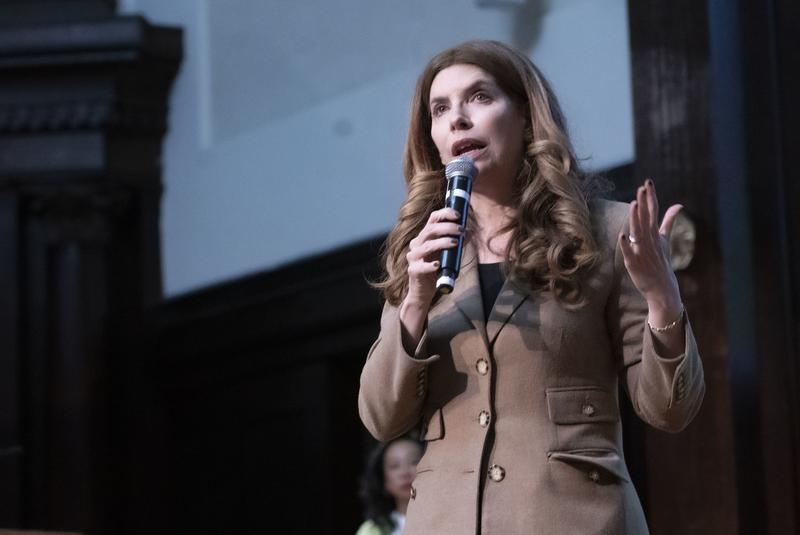
( New York City Council / NYC Council Photo )
Brigid Bergin: It's The Brian Lehrer Show on WNYC. I'm Brigid Bergin, senior reporter in the WNYC and Gothamist newsroom, sitting in for Brian today. Yesterday on the show, Brian spoke with Mayor Mamdani. Now let's hear from the other side of City Hall, another citywide office holder, the City Council Speaker Julie Menin, who represents Manhattan's District 5, where Donnie in Gracie Mansion is one of her constituents. Speaker, welcome back to the show. You're in this new role, but not new to public service, of course. Thank you so much for joining us this morning.
Speaker Julie Menin: Thank you so much for having me. It's great to be back with you again.
Brigid Bergin: Speaker, you gave a speech this week at ABNY, the Association for a Better New York, kind of New York City's version of a chamber of Commerce and highlighted some of the council's priorities. The big attention getter was bringing back year-round outdoor dining. Why is that a priority?
Speaker Julie Menin: Well, I think first of all, it is incredibly important that we support our small businesses in this city. We certainly saw during COVID that outdoor dining was a lifeline for these small businesses. I'm a former small business owner. I used to own a restaurant catering business in lower Manhattan called Vine, and I know firsthand how important it is to our small businesses for to have robust outdoor dining.
The original bill that the council passed, I had real concerns about, which I had raised at the time. The concerns I had was that we need to make outdoor dining year-round because to ask these small businesses, first of all, to put up the chairs and tables, then to store the chairs and tables, many of them are smaller restaurants. They certainly don't have the space or the capacity to do so. They're also--
I strongly disagreed with giving the outdoor dining program to the Department of Transportation. I don't know why we'd give it to a transit agency as opposed to giving outdoor dining to an agency like the Department of Consumer Affairs, which I used to serve as commissioner of, that actually has experience with sidewalk cafe licensing. I support Council Member Lincoln Restler's bill that would make the outdoor dining year-round. We are going to, however, meet with community groups next week to hear their concerns because I do understand that there's certain blocks that have oversaturation, and so we want to hear them out.
We look forward to putting forward a plan that makes outdoor dining year-round that addresses some of the concerns that some community groups have raised, and that also reduces some of the fees because the overall revocable consent fees are extremely high for these small businesses to bear. I want to reform those as well. We need to look at the numbers. We have to look at the fact that during the height of COVID, you had approximately 13,000 restaurants and bars that had these outdoor dining facilities, and now the number is basically 2,900. The reason why is not because restaurants don't want to have them, but because we've made the process far too difficult for them to do so.
Brigid Bergin: Listeners, do you have a question for Speaker Julie Menin of the City Council about their priorities, outdoor dining, how to make doing business in New York a little bit easier? Call or text us the numbers 212-433-WNYC. That's 212-433-9692. Speaker, before I could even ask, you would not be surprised to know that we have a whole board of people who want to talk to you. We're going to start with John in Manhattan. John, welcome to WNYC.
John: Hello. Thanks for having me. I spent most of the pandemic years cycling around five boroughs and documenting outdoor dining shelters. I self-published a series of six books called How We Ate. One thing that I noticed was the ones without floors were a million times cleaner and easier to clean than the ones with floors. I don't know if that's mandated in the rules now or in the new rules, but I would suggest that might be something to consider.
If you think about it, you can have a series of jersey barriers filled with water chairs, tables, and umbrellas that people could take inside at night, alleviating the fear of homeless people living there. It could be easily moved for things like snow removal and road repair.
Brigid Bergin: John, thanks so much for that call. I want to sneak in one more and then give you a chance to respond, Speaker. Let's go to Harold in Midtown.
Harold: Thank you for the program, Ms. Menin. I live on 2nd and 51st. There's a large restaurant with a large shed on 2nd Avenue. It is a bottleneck for traffic, it is a condo for rats, and most importantly, we have a very bad safety and traffic situation. It takes up a lane of traffic, left lane of 2nd Avenue cars on their way to the Midtown Tunnel. It is really terribly planned. I suggest if you want outdoor dining and you want to be charming and think you're in Paris or wherever, go on a side street. Keep sheds off of the avenues. They don't belong there. It's very dangerous and adds to traffic.
Brigid Bergin: Harold, thanks so much for that call. Speaker, some different perspectives on outdoor dining there. Want to give you a chance to respond.
Speaker Julie Menin: Thank you so much. Let me start first with John's question about the overall design of them and the floors, and some of the issues that you mentioned. One of the things that we're going to do as we put forward this new package of bills that address outdoor dining is we are going to look at issues like sanitation, design, accessibility, and neighborhood impacts, because we understand that there are myriad opinions about this on the design perspective.
We obviously want to make sure, from the sanitation perspective, from rat mitigation perspective, that we're addressing those issues. That is again why we are meeting with community groups, actually next week, in the beginning of the week to talk about some of those issues. I look forward to those conversations and ways that we might be able to address them in this legislative package that we're moving forward.
Now, Harold raises a question about 2nd Avenue and 51st Street, which is not in my district, but near my district. We're happy to take a look at that particular example. I think one of the things that we're trying to do with the new legislation is again, look at areas of over saturation. There are going to be some places where there are concerns, and we want to make sure again that traffic is flowing well and that there's no impediment, for example, to emergency vehicles. I appreciate that concern, and we look forward to trying to address it in the legislative package that we're going to move forward.
Brigid Bergin: I know you said that part of the legislative package and part of the conversations will involve talking to different city agencies. The thing that just jumps out to me when we look out on our streets now, and there's still so much snow out there on the streets and sidewalks, isn't that one of the reasons why businesses were required to take down these roadbed structures in the winter months?
Speaker Julie Menin: It's certainly one of the reasons, but again, what we're looking at is trying to come up with a way where we're not impeding traffic, and that we're looking at the suitability of the roadsheds for various streets. It's something that we have heard, and it's something that we want to address moving forward, which is why we are scheduling these meetings in advance of the bill's hearings so we can work on language that addresses some of those concerns.
Brigid Bergin: All right, listeners, we're going to shift gears with this speaker. We're going to shift away from the outdoor dining. I think we could probably spend a lot of time just talking about people's feelings on outdoor dining. However, we want to talk about some of the other things that you included in your speech and other priorities of the Council. You led your speech yesterday with a plan for a new Office of Insurance Accountability, and that is to address the skyrocketing costs of insurance for New Yorkers, all kinds, not just health insurance. Speaker, what would the office do?
Speaker Julie Menin: Thank you for raising that. We have a situation with insurance costs where New York is completely out of whack with other states in terms of insurance. Whether it is homeowner insurance, where we're seeing prices in excess of 300%, or where we're seeing small business insurance, where literally liability insurance is crushing small businesses in the five boroughs, sometimes costing four times the national average. We have a situation, homeowners' insurance premiums are increasing by 26%, auto insurance 52% higher than the national average. I could give example after example.
We have an affordability crisis, and one of the things that we have an obligation to do is build more affordable housing. For all of these different reasons, we want to tackle the insurance industry question. About two years ago, I passed a bill to create the nation's first Office of Health Care Accountability, which was focused on lowering skyrocketing health care prices and mandated that the hospitals had to disclose the price of every single medical procedure at every single New York City hospital.
Now, I want us to do the same for the insurance industry. Basically, this would mean price transparency. The state is the one that regulates the insurance industry through the Department of Financial Services, but the city where our legal purview can be and should be, in my opinion, is focused on price transparency. Basically, we're going to create a new Office of Insurance Accountability that is focused on lowering skyrocketing insurance prices, and so creating a new Office of Insurance Accountability to shine a light on pricing and the drivers of costs and to bring insurance regulators and stakeholders to the table.
It also would have insurance advocates who can help New Yorkers with issues around delayed claims, skyrocketing healthcare claims. It would also work in conjunction with our Office of Healthcare Accountability to deal with healthcare insurance issues as well. I think this is something that is going to help New York City, first of all, bring more transparency and accountability. When you shine a light on pricing, that is what can help to bring down pricing. That would help our small businesses who are being crushed with these skyrocketing Insurance costs.
It will help us to build more affordable housing because we're hearing from a lot of affordable housing activists and developers that the high cost of insurance is a real impediment to build more insurance. We need to tackle this issue once and for all.
Brigid Bergin: Let's go to Cheryl in Brooklyn, who I think has a call on this topic. Cheryl, you're a small business owner?
Chery: Yes. I have a restaurant in Brooklyn, and we're dealing with the price increase for insurances that's really strangling our small businesses. Also, even with the paperwork for the DOT, they want us to add their names to our insurance, which also brings up the cost. Finally, the structures that they want make no sense to me. I don't want it flushed to the ground. I want to be able to wash the sidewalks. I do not want Harbridge, because then we have to deal with the health department, which is another thing that strangles us.
Beyond the design and the paperwork, that is why you saw that decrease in people using the sidewalk, and we need the additional space desperately. My little place in Brooklyn is like, we're already struggling, so we don't need any more hampering.
Brigid Bergin: Cheryl, thanks for that call. Speaker, I think we had an intersection there of insurance and outdoor dining, so I'll let you tackle both.
Speaker Julie Menin: Exactly. Thank you so much. Cheryl, thank you for calling in and giving us your viewpoint on it. Look, what we're going to focus on in the outdoor dining piece is to make it easier for small businesses. We know the revocable consent fees are too high. We know that the bureaucratic steps to actually apply for outdoor dining are way too difficult and onerous. We've heard again and again, and I did the oversight hearings on this when I was the chair of the committee on consumer and worker protection for the past two years.
We did a number of very hard-hitting hearings on this topic, and we saw even submitting the architectural designs to DOT, which is why I had concerns about a transit agency administering this program in the first place, I want to add. We know that it's too difficult for these for small businesses, and that is why we're looking to pass a number of bills that make it easier that reduce the bureaucratic steps that it is taking restaurants to apply.
In the hearings we saw that DOT at that time, the last time we had a hearing last year, had actually only approved in full 10% of the applications on outdoor dining, 10% were fully approved. Some were conditionally approved, but only 10% fully approved, which is outrageous. Now, Cheryl, on your question about insurance, this is exactly why we're going to create this Insurance Accountability Office, because we know for small businesses like you're saying, that the insurance costs are skyrocketing. This, for me, is very personal.
When I owned my restaurant Vine, which I opened in 1999, it was located a couple blocks away from Ground Zero. During the tragic events of 9/11, my business was decimated on 9/11 with every single window blown out and the ash and every inch and crevice of my business. Our insurance carrier at the time, St. Paul's, took the absolutely unreasonable position that we were only entitled to five days of business interruption insurance, which is unconscionable.
What we're seeing, and I mention that story simply to show what we're seeing from insurers, is again, denial of claims for small businesses, skyrocketing prices. It's now four times the national average for these small businesses to get business interruption and liability insurance. This is strangling our small businesses, and we are going to tackle this issue head-on in the City Council.
Brigid Bergin: Speaker, I want to shift gears to talk a little bit about some of the oversight the council's going to be doing. Mayor Mamdani was here on The Brian Lehrer Show yesterday, and Brian asked the mayor about the city's efforts to get unhoused New Yorkers out of the life-threatening cold and into shelters. He acknowledged some failures, specifically with something my colleague, Liz Kim, had reported about warming buses parked outside the Staten Island Ferry terminal that no one inside seemed to know were there. Brian asked who was responsible for that communications failure, and here's what the mayor said.
Mayor Mamdani: I think at the end of the day, that is a responsibility that I have as the mayor of the city. It's never a moment to pass the buck to anyone else, and what we are doing is ensuring that the focus of our work, which is outreach workers directly reaching out to homeless New Yorkers to bring them to those warming buses, is supplemented by clear and additional signage to those buses to ensure that everyone understands that they are there. That is critical, and those are some of the changes that we're making.
Brigid Bergin: Speaker, I ask about this because I know the City Council will be holding oversight hearings next week. In general, how do you think City Hall is doing with the storm, and the cold?
Speaker Julie Menin: This is exactly why we're having oversight hearings, because we are hearing from New Yorkers and from-- So many different council members have personally spoken to me that they are hearing loud and clear from their constituents that they are obviously very concerned about the 17 lives that were lost, which are not acceptable. They are concerned about sanitation issues, accessibility issues.
On Tuesday, our Public Safety and general welfare committee are going to be having a hearing on the issues around the 17 deaths, why they happened, what could have been done better, and how could these deaths be prevented in the future? We're heading into a very cold stretch this weekend with sub-freezing temperatures. We are deeply, deeply concerned that these issues be addressed immediately. We are having this hearing to get a full accounting of what happened, how outreach efforts were deployed, what additional steps should have happened, what need to happen in the future to prevent any loss of life.
Then, also we're having another hearing on sanitation and accessibility issues because we are hearing a tremendous amount of complaints about accessibility issues, about the trash not being picked up, why there was a delay in the trash being picked up. We do need to get to the bottom of these issues. Part of that is performing our charter-mandated oversight, part of it is trying to get to the bottom of these issues, and then, of course, to try to prevent them from happening in the future.
We are beginning our oversight hearings. They'll begin immediately, next week. We urge New Yorkers to please be a part of it. You don't have to come to City Hall in person to testify. We always have a remote option. We want to hear from New Yorkers. We want to get feedback from them on all of these different topics.
Brigid Bergin: Let's go to Anya in Brooklyn, who I think has a story to share that would be very much on topic. Anya, you're on WNYC.
Anya: Hi, thanks for taking my call. I just wanted to report on something that happened several weeks ago during another code Blue when it was bitterly, bitterly cold. It was after dark, and I saw a man lying on the sidewalk. He was mumbling, he had his shoes off. I called 311 right away, and the person I spoke with basically asked me to make a decision about what this person needed. Does he look like he's homeless, or does he need an ambulance? I didn't know.
The person was actually a little impatient with me. I was trying to describe what I was seeing. She interrupted me, "We can't send somebody unless we know if he needs an ambulance or homeless outreach." I finally made the decision and said, "Send an ambulance," and then she routed me to an EMT. I spoke with the person, I described what was happening, and I said, "I'll wait in case you can't find him," because he was at an intersection. I finally had to leave, and nobody came after quite a while.
Fortunately, in the meantime, somebody else, I think from the neighborhood, was stopping and speaking with this man. At least somebody else knew he was there, but it was really frustrating and disappointing. I guess my point is, I think most New Yorkers would call 311 if they saw somebody, but then what happens next?
Brigid Bergin: Anya, thanks so much for that call. Some really important operational concerns raised there, right, Speaker?
Speaker Julie Menin: Absolutely. Anya. Thank you for your comments on that. None of that is acceptable. The onus is not on the caller to make a determination. The onus is on the city of New York. This is why we're having these oversight hearings to really get to the bottom of this. We cannot have any more deaths. The loss of even one life of any New Yorker is not acceptable, let alone 17. We are deeply concerned about this. I know my colleagues are deeply concerned, which is why we wanted to have these oversight hearings right away to get to the issue of why this is happening and what needs to be done immediately to address it.
We do know that there are those New Yorkers who are experiencing homelessness who do not have the mental capacity to be able to agree to go to a shelter. We need to ensure that we are stepping up those efforts to reach these New Yorkers, to actively connect them to resources such as warming centers and emergency shelters.
Brigid Bergin: Listeners, if you're just joining us, this is the Brian Lehrer Show on WNYC. I'm Brigid Bergin, senior reporter in the WNYC and Gothamist newsroom, speaking with City Council Speaker Julie Menin and taking your calls. We have a lot of them. Before I bring in another caller, Speaker, I want to talk about something that you did yesterday. You were on the steps of City Hall talking about what's being called the Harding Memo, which has just come to light, that detailed some of the risk facing residents and first responders after the 9/11 attacks. Can you tell us a little bit more about what this memo is and why it's now just being made public?
Speaker Julie Menin: This is deeply personal to me. I lived and worked a couple of blocks away from what is now Ground Zero on 9/11. I own my small business. It was decimated on 9/11. My husband had a 9:00 AM meeting at the World Trade Center the morning of 9/11. Thankfully, he was okay. My mother, who lived with us, had gone out for a doctor's appointment, and we could not find her to that afternoon. My mother died of a 9/11 related cancer.
Now, the federal government, and specifically Christy Todd Whitman, as the head of the EPA, told New Yorkers the air was safe to breathe. The city ratified that decision as well, because the city never disagreed with it. The city told people to remain in Lower Manhattan at the time. This Harding memo, and I really want to thank my colleague, Council Member Gale Brewer, because she did a bill that compelled the Department of Investigation to begin examining the records for nine related toxins and then to submit a report to the council. She's been very strong on demanding the release of this.
This is completely unacceptable. We're headed into the 25th year of 9/11, and we'll be obviously at the memorial. I served on the jury that picked the memorial. We will be at the memorial for the 25th anniversary, and yet the city has so far refused to release these documents. We know for a fact that nearly 140,000 responders and survivors depend on our World Trade Center Health Program for cancer treatment, for respiratory care, for mental health support.
I served as chair of the local community board, Community Board 1, for seven years. We pushed for the Zadroga Act for the creation of the World Trade Center Health Program to help both first responders and downtown residents who were sick and dying of cancer, and now, finally, we have this Harding memo. the Harding memo, what it shows is that the city knew that they would be on the hook for claims, and that the city knew that the air was not safe to breathe, and that first responders were being given faulty equipment.
It's really shocking, this Harding memo. The fact that so many have been fighting for so long to get the release of it is completely unacceptable. I want to thank the lawyers and so many who have fought for a very long time to get this. These are basic public record requests under the New York's Freedom of Information Law, and yet the city has delayed responding 10 times to the release of these documents. It is beyond time to release them. We are demanding their release. They must be released. That is the least that we can be doing for this 25th anniversary.
Brigid Bergin: Absolutely. Speaker, do you have a sense that there is much more information like that out there?
Speaker Julie Menin: We don't know, and that's the thing. We did learn that there are dozens and dozens of boxes that the law department has, hundreds and hundreds of thousands of pages, which is why one of the things that Council Member Brewer and I are pushing for is to ensure that the Department of Investigations is properly funded, because that agency honestly has been gutted. It used to have 400 individuals who worked for DOI. When I was Consumer Affairs Commissioner, I did a lot of joint cases with doi. It's an incredibly important agency, but right now the headcount is under 300. It's been diminished by almost 25%.
We need to have DOI fully funded. We've made a request of an additional $3 million in funding for DOI so that it can have the number of law and investigators to really bring back faith and trust in city government, which has really been gutted over the years.
Brigid Bergin: Speaker, before we let you go, I have a couple more questions I want to sneak in. Another item for the mayor this week, he appointed Phylisa Wisdom to run the Mayor's office to combat antisemitism. As the city's first Jewish speaker and a descendant of Holocaust survivors, I know the issue of anti-Semitism and anti-Jewish hate crimes is especially important to you. Have you worked with Phylisa Wisdom, or do you have any impression of the job she will be doing in this role?
Speaker Julie Menin: I have not worked with her before. I have not had the opportunity to meet her. I look forward to setting up a meeting to discuss with her the vital task ahead of fighting antisemitism. We have released our five-point plan, which includes a number of pieces of legislation that protect all houses of worship and schools, and that also provides increased security cameras for all houses of worship. We're also expanding upon a program that I launched about a year and a half ago that brings every eighth-grade public school student to the Museum of Jewish Heritage to the permanent Holocaust exhibition.
Studies are showing that for young people, 34% believe the Holocaust never existed or has been exaggerated. We know we've got a lot of work ahead that we need to do. I look forward to having a conversation with her. The fight against antisemitism is urgent. We know that right now, 57% of all hate crimes are anti-Semitic hate crimes, yet the Jewish population is approximately 10% of New York City. It's very disproportional right now. We have a lot of urgent work ahead of us that we need to do.
The fight is real, and we need to basically combating all forms of hate. There was a Islamophobic incident the other day that we struck strongly condemned. We now have a new committee to combat hate that is chaired by Council Member Yusef Salaam that is going to be looking at all different types of hate, anti-Semitic hate, Islamophobia. We see that also there is a lot of anti Asian hate, LGBTQ hate. We really wanted to elevate that committee so that it can do the vital work ahead, and it's going to be having a hearing in the next couple of weeks to take up some of the legislation that I just mentioned around combating antisemitism. That's going to be a very important task ahead.
Brigid Bergin: I want to bring in Bobbi from Sheepshead Bay, Brooklyn, who has a question. Bobbi, you're on WNYC.
Bobbi: Oh, hi. Thank you for bringing me on. Speaker Menin, it's good to meet you in this way. I am a constituent of Councilwoman Inna Vernikov. I live in Sheepshead Bay. I've lived in this nation 60 years or more, my whole life. I have to object that you named her as a-- I know it was a vote through the task force, but nevertheless, she got named as the co-chair of the task force to combat anti-Semitism. When I get emails from her as a constituent, she is so full of anger, and I can only say toxic language about all kinds of things.
I find it very upsetting that she makes denigrating statements about Jews like me who don't agree with her. I fear that she's in a position of power. She'll cause more harm to Jewish New Yorkers, not less. Just one more quick thing, the buffer zone bills, certain language should not be used. I'm not there to argue about this, but the synagogue that had an event, they knew there'd be a protest because they were talking about selling Palestinian land.
Brigid Bergin: Bobbi, I'm sorry, I'm going to jump in because I know the speaker has a heart out and I want to give her a chance to respond to both of the issues you raised. Speaker, if you want to respond to her concerns about-
Speaker Julie Menin: Yes.
Brigid Bergin: Go ahead.
Speaker Julie Menin: Absolutely. Thank you so much for raising the concerns. We really appreciate that. I have been very clear with Council Member Vernikov that past rhetoric and behavior is abhorrent, absolutely reprehensible, completely wrong, and totally unacceptable. I insisted that she publicly apologize for the comments she made, which she did. I have made clear to her publicly that she is now on notice, and if there is any additional rhetoric like that, I will publicly call for the Jewish caucus to vote to remove her if she engages in that kind of behavior again. There is no place for that at all.
In terms of the buffer zone legislation, to be clear, the buffer zone legislation around houses of worship and schools in no way penalizes the First Amendment right to peacefully protest. The First Amendment right to peacefully protest is sacrosanct. It's what our country is built on. We do not want to interfere with that at all. What the buffer zone is focused on is basically directing the NYPD to have these perimeters and to prevent intimidation and harassment, but in no way will it interfere with the First Amendment right to peacefully protest. That is something that can never be interfered with.
By the way, one of the models we looked for in this legislation is there was a 2008 bill that the council did to protect reproductive health centers. We did a similar bill that again, in no way penalizes free speech, but just protects it so that people can freely enter and exit reproductive centers. We're looking for a similar model around all houses of worship and schools.
Brigid Bergin: Speaker, I want to thank you so much for joining me this morning. Julie Menin is the new speaker of the City Council. I know you have a heart out, but we appreciate you taking all the questions. I can tell you there's still a lot of people who have questions they'd like to ask. I hope you come back soon back.
Speaker Julie Menin: I look forward to come on back. I'll come back anytime. Thank you so much for having me, and thank you to everyone who came in with questions. We really appreciate the conversation.
Copyright © 2026 New York Public Radio. All rights reserved. Visit our website terms of use at www.wnyc.org for further information.
New York Public Radio transcripts are created on a rush deadline, often by contractors. This text may not be in its final form and may be updated or revised in the future. Accuracy and availability may vary. The authoritative record of New York Public Radio’s programming is the audio record.
