
SNAP and the Cost of Groceries
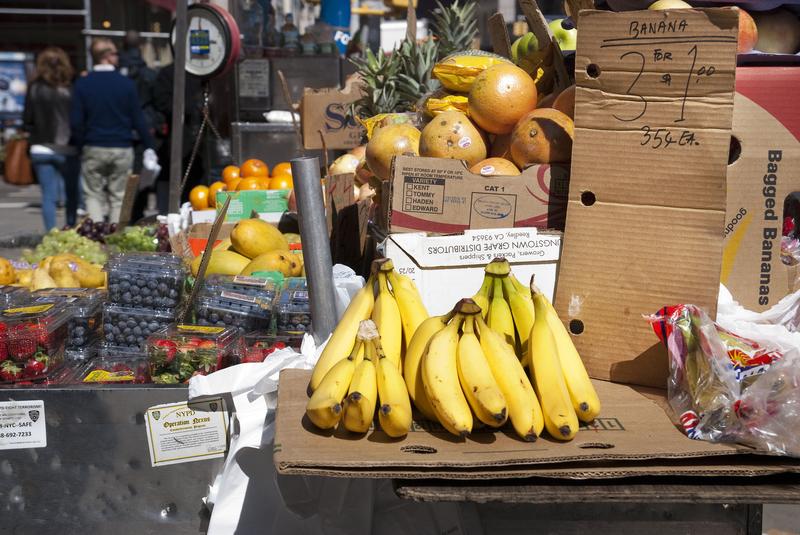
( Natalie Fertig / WNYC )
Brian Lehrer: Brian Lehrer on WNYC. Now, we're going to talk about something many of you have probably felt in your own kitchens and definitely your own wallets these last few weeks and months, not to mention years. Food just costs more. It doesn't always make sense why it costs what it does, or why the price seems to swing even from one store to the next.
Our colleagues at WNYC and Gothamist are reporting on this from two angles now. First, their price of groceries project, where they've been tracking everything from beef to milk to avocados across dozens of stores in all five boroughs. This is New York City project, finding, for instance, that at the same time an avocado was going for $2.69 at a Park Slope market, you could get four for a dollar in Flushing.
Second, as SNAP recipients waited for delayed benefits during the government shutdown and are still waiting, many neighborhood grocers saw sales drop by as much as 25%. Also, a cutback on orders, and they lowered prices just to move food off the shelves and, in some cases, even paid out of pocket to help regulars get enough to eat. The Trump administration was actually trying to stop them from doing that, as we talked about on the show previously.
We are joined now by the reporters behind that work, Karen Yi, who covers homelessness and poverty at WNYC and Gothamist, and Joe Hong, WNYC and Gothamist investigative data reporter, will talk about what they're finding, how the cost of groceries gets set in New York City, and what the SNAP interruption has revealed about the fragility of our food economy. Karen and Joe, thanks so much for this reporting. Great to have you on the show today. Hi.
Karen Yi: Hey, Brian.
Joe Hong: Hey, Brian.
Brian Lehrer: Listeners, because so many of you have your own grocery aisle strategies, no doubt, we're going to invite you on behalf of Joe and Karen to help report this story, your tips and tricks for eating and grocery shopping affordably right now, whether you're a stamp recipient or not. 212-433-WNYC. Do you shop at specific times of day or rely on particular neighborhood spot for produce or staples or particular things?
Do you go from one store because you know they have the cheapest whatever to another store, because you know they have the cheapest avocados, to use the example? Where have you seen the price of groceries swing the most? Is it between two local stores? Is it between two weeks of the month? Whatever you want to report, or ask Joe and Karen a question. 212-433-WNYC, 212-433-9692. Let's start with you, Joe. As the data reporter, what's the clearest pattern you've seen in how food prices move in New York City?
Joe Hong: Yes, so across the city, we haven't seen a huge spike or anything since we started tracking these prices in July. I guess what's been interesting is looking at the price of a basket of items that we've been tracking in a neighborhood like Park Slope, versus tracking the same basket of items in a neighborhood like Brownsville, Brooklyn. There's a food town in Park Slope, where a basket of items is $35, and then there's a CTown in Brownsville, where the same basket is $33. That might not seem like a huge difference, but the neighborhoods are vastly different compared to Park Slope, which has a child poverty rate of 9%. Brownsville has a child poverty rate of 44%. Shopping in these low-income neighborhoods isn't always going to be cheaper.
Brian Lehrer: Karen, you want to add anything to that? Maybe the avocado example in your story is relevant, or wherever you want to start?
Karen Yi: Yes, I think what I would add to what Joe's saying is I think we started this project in July, hoping for one clear answer, one simple answer, like why are grocery prices increasing so much, and what really determines what you pay at checkout? I think we're realizing that the food ecosystem in New York is so, so fractured and so complicated. The way grocers set prices has been really secretive.
We have had a hard time breaking into that and getting grocers to tell us, "What determines how you set your price of avocados? What determines how much you have customers pay for a tub of mayo," which, in some places, can be $13. It seems to be more art than science, right? It's like a little bit of gut. It's a little bit of, "What can my customers afford? How much did I pay for this? What can my community afford, whether it's lower income or higher income?" Then you have these David and Goliath, right?
You have these smaller mom-and-pop stores that really can't compete with the Aldis and the Whole Foods that can just have much more purchasing power to buy things in bulk and get better deals, and then offer those deals to their customers. It is this complicated infrastructure that we're learning about and realizing so much goes into these products when you pull it off your shelf. We have learned to understand how grocers make their profit. I think for the consumer, it can help you understand maybe what items you should buy at what kinds of stores and when.
Brian Lehrer: Would the example that Joe was giving a minute ago about it being more expensive in many ways to shop in a low-income area than a high-income area of Brooklyn, is it an apples-to-apples comparison, an avocado-to-avocado comparison, that is one place more populated by bodegas, which wouldn't have that economy of scale as compared to chains of whatever kind, whether it's Whole Foods and Aldis or Gristedes or CTown or whatever it is? Are you looking apples-to-apples in that respect?
Karen Yi: I think it's hard to make that apples-to-apples comparison because it does vary, right? That's the data point we found month-to-month, but then that could change, right? We're doing our pricing for the month again, and Joe and I were out visiting a couple of stores yesterday. It fluctuates because, again, it depends on that grocer, right? A lot of the grocers we spoke to because of SNAP are telling us, "Listen, we had to drop our prices because meats and produce, they have an expiration date. If people aren't buying, we make our profit by volume."
They can't necessarily make their profit off of more premium items like sea moss or pink pineapple or rib eye, where they can upcharge a bit. The way they make their money is by selling a lot very quickly. When they don't do that, they just have to lose profit just to get out the door, but be able to keep the customer. That calculation happens almost on a daily, weekly basis. It's hard to extrapolate that and make a blanket statement across the board for all stores in all sorts of neighborhoods for all months.
Brian Lehrer: Don in Brooklyn has an observation about shopping in the city. Don, you're on WNYC. Hello.
Don: Hi, yes, I go to the store. I'll see a sale. I put the item in my hand, and then I look closer, and the sign, it says, "Must buy two." I just like to buy one. I don't want to buy two. As a result, I can't take advantage of the sale. I noticed it with certain stores. There's a store, I guess I can say the name because I heard someone say Foodtown in Park Slope. Again, there's Associated and there's Key Food. Associated doesn't have that policy. If you want to buy just one, they're going to charge you that price for just one item. Maybe it doesn't make that big of a difference, but if you're buying a lot of groceries, it can add up.
Brian Lehrer: Don, thank you very much. Does that strike a chord in any way, Karen? I think it's standard in so many kinds of sales that if you buy in bulk, you get a cheaper rate per.
Karen Yi: Yes, absolutely. I think that the logic behind that is that grocers are trying to clear out inventory, right? Something else we've heard is, particularly in New York City, New York City actually is interesting because there's not a monopoly here. In other states, Walmart or Wegmans maybe own 60% to 70% of grocery stores. In New York City, no grocer, no company owns more than 10% of stores here. It is a very diverse marketplace, but we know rents are very expensive in New York City.
Storage, a lot of grocers don't have the storage space. They cannot hold lots of quantities of items for a long time. I think the motivating factor behind that is to clear inventory, get it out so they can bring in the next item, maybe at a better deal, maybe at a better price for them. I think that's why you see it when you see these sales. It's like three for five for Goya beans, or avocados, four for a dollar.
Brian Lehrer: Jane in Long Island City, you're on WNYC. Hi, Jane.
Jane: Hi. Thank you for taking my call. Can you hear me well?
Brian Lehrer: Yes.
Jane: Okay. In my neighborhood in Long Island City, we have a few supermarkets. I use Fairlife milk. It costs $7.99. If I walk 12 minutes away to Target, it is $4.99. There are three supermarkets in our little area, like five minutes between each other, and they all charge $7.99 for Fairlife. I'm thinking, how much of a profit are they making on the same item that is $3 cheaper, just a 12-minute walk away?
Brian Lehrer: Yes, and that's if they're paying the same for it. Joe Hong, as the data guy here, do you have anything on that?
Joe Hong: Yes, I can't speak to that example, but something like milk, we've seen. The prices are pretty stable across the months. I don't know. Karen, do you have anything to add?
Karen Yi: Yes, I think that's what we've discovered that there is this divide between these larger corporations like Target and these smaller mom-and-pop grocers, where you do see these price differentials because Target can buy in bulk. They can buy Fairlife milk and get a much better deal. They're dealing directly with the distributor, buying these items in bulk, and then they can sell it at a lower price for the customer. These mom-and-pop stores, I don't know what store, if you mentioned, that sells it at $7.99, but it seems like several stores are around this price point. They're just one store, right?
They're buying maybe a couple of crates of milk. They're not buying truckloads. They don't get as good of a deal. I will say, I think something Joe and I have learned is there is this misconception because when we go to the store, we get outraged when we see milk for almost $8. We get mad at the grocery store owner, right? They're the last line of defense. They're not really making huge profits off of this. Most grocers make 1% profit if it's a neighborhood in a lower-income area, even less than that. Oftentimes, they're selling things at a loss.
Joe Hong: Yes. One thing I will add to that, one surprising example has been Whole Foods, which has this reputation of being a premium, expensive grocery store. Because they buy in bulk, they're able to offer lower prices. Among the stores we've been tracking, we've been tracking 20 across the city, they fall in the middle. Because they design these contracts with suppliers, they are able to set prices long beforehand, and they're less susceptible to these market fluctuations.
Brian Lehrer: Joe, didn't you go to Hunts Point to talk to wholesalers and get that perspective on what feeds the prices at the retail level?
Joe Hong: Yes, totally. Karen used the phrase earlier. It's more art than science. That also applies to Hunts Point. You go there, and these buyers from independent grocery stores are there. It's real-time negotiation for prices, right? Going back to the Whole Foods example, they're agreeing to a price months beforehand. If there's a bad storm or something like that, that affects the supply of avocados. Let's say Whole Foods might be insulated from that. With Hunts Point, there's more of an immediate connection to these fluctuations and natural disasters, things like that. Yes, it's a real living, breathing organism, this whole supply chain.
Brian Lehrer: Karen, I want to turn to SNAP because when the delay hit from the government shutdown, some grocers told you their sales dropped by as much as 25%. What were they seeing on the ground, both in foot traffic and in customers' ability to buy food? What should that tell everybody else who may not be on SNAP and may not think about it all that much?
Karen Yi: Absolutely. I think even for grocers, so grocery stores, many of them-- SNAP dollars, you can really use in one place, which is food stores. The biggest beneficiaries of the SNAP program are really grocery stores and bodegas. A lot of grocery stores, half of their sales, up to 85% we've heard in some neighborhoods like in Mott Haven. They rely on SNAP dollars. When you have 85% of your sales, 85% of your customers not having access to that money, that's going to hurt your business.
What grocers were telling us is they saw a dip, 20% to 25% drop in sales. They saw customers coming in with their items at checkout, pulling out their EBT card, which is where SNAP dollars are loaded onto these debit cards, and realizing there was nothing on their cards, and either walking away in tears or maybe trying to pull a couple of essential items and putting it on their credit card.
In some cases, grocers would offer to cover some of the costs, but they're like, "We can't do it for everyone, but we want to make sure that our longtime customers have something to eat." It was a lot of just desperation and anxiety. Something else that one of the grocers told me in Elmhurst is you have the pause in benefits that hit November 1st, but he's like, "For many, many months actually, our sales have been dipping."
Part of that is because of the fear around immigration. In immigrant-heavy communities, people just aren't leaving their house as much. You have these overlapping crises that are affecting grocers. I think the other interesting thing grocers told me is, clearly, they understand the importance of SNAP because it's their revenue, but they really, really saw how important it is and how so many families really rely on it.
Brian Lehrer: I think Diane in Bellingham, Washington, is calling in about one of the things you just mentioned. Diane, you're on WNYC. Hi.
Diane: Oh, good morning. Yesterday, I was taking a Lyft like an Uber. A Lyft ride with the drivers here are always so interesting. The gentleman said his good friend in California had a trucking business that would transport food. He had to give it up because the drivers were Hispanic. When the trucks had to go to a way station, we've all seen those signs, way station along the highway. When they had to stop for the weighing, the ICE agents would be there to grab the drivers. He cannot get drivers for his trucks. He had to, as he put it, return the trucks to the bank, and that was that.
Brian Lehrer: I'm glad you told that anecdote. Joe, I don't know if there's a data story to do for you as a data reporter that might wind up with facts that the Trump administration would probably hate if they're verified. That would be a story like how the immigration crackdown on non-violent criminals is pushing up the price of your food bill.
Joe Hong: No, totally. This really resonates with what we heard from wholesalers at Hunts Point. They said labor is really one of the highest costs for them. These truck drivers, if they are feeling under threat and they need to be replaced, I could totally see that having an impact on the greater ecosystem.
Brian Lehrer: Before you both go, actually, let me sneak in one more here about another caller's speculation about what may be pushing up grocery prices recently in the city, in particular, in Manhattan, in particular. Tina in Harlem, you're on WNYC. Hi, Tina. We've just got about 20 seconds for you, so right to it.
Tina: Yes, thanks, Brian. I saw on this episode called The Bite, it's a one-minute SNAP on PBS Channel 13 between cooking shows, and this guy presents current trends in food. He says that congestion pricing is coming to supermarkets here, and then it's already arrived in Europe. This guy is a trend maker, and that's what he says.
Brian Lehrer: Tina, thank you very much. Joe, congestion pricing, can you measure the impact on food as delivery trucks have to pay that toll?
Joe Hong: That's actually something we have not heard about. Wholesalers, especially grocery store owners, are very open about their complaints generally about the system. Yes, no, we haven't heard that.
Brian Lehrer: All right. Karen, just tell everybody what's next for your price-tracking project, and if there's a way you want listeners to contribute other than those who called or texted today.
Karen Yi: Absolutely. I think the next thing we're working on is trying to develop some maybe tips and tricks for people who are trying to save money at the store. We're asking you guys, the audience, if you have anything that you figured out. Maybe a good time of the month to go visit certain stores, maybe developing a relationship with your grocer, and trying to find out when deals drop.
Maybe you have an app. I know there's Too Good To Go, apps that sell food that's about to go to waste. Any tip that you use that you don't mind sharing. We do have a Google Form on our website, Gothamist.com, on really any of our food stories around SNAP and grocery prices. If you have anything you want to share, feel free to fill that out and send it to us. We might be in touch.
Brian Lehrer: That's great. Just let me acknowledge. After I referred to the immigration crackdown on non-violent criminals, somebody texted, "Non-violent criminals? These people aren't even criminals." Yes, if I wasn't clear, that's exactly what I was saying. They say they're going to crack down on violent criminals, and they crack down on people who aren't violent criminals, including a lot of food industry workers who aren't criminals at all. Just in case that was unclear to anybody other than that one listener who texted. Karen Yi, who covers homelessness and poverty at WNYC and Gothamist, and Joe Hong, WNYC and Gothamist investigative data reporter, thanks for this. Thanks for sharing it with everybody.
Karen Yi: Thanks, Brian.
Joe Hong: Thank you.
Copyright © 2025 New York Public Radio. All rights reserved. Visit our website terms of use at www.wnyc.org for further information.
New York Public Radio transcripts are created on a rush deadline, often by contractors. This text may not be in its final form and may be updated or revised in the future. Accuracy and availability may vary. The authoritative record of New York Public Radio’s programming is the audio record.
