
Sewer Socialism? Start Here, City Hall
( Stephen Nessen / WNYC )
[music]
Brian Lehrer: Brian Lehrer on WNYC. To end the show for our last 15 minutes, we're going to do one of our occasional hyperlocal call-ins about news from your neighborhood. In this case, hooked to the mayoral election and the change of administration that's coming. We want to invite you to call in and mention on the air a small, everyday piece of public infrastructure that shapes life on your block or in your neighborhood that needs some attention from city government. 212-433-WNYC, 212-433-9692.
We talk about all these sweeping issues, free universal childcare, everything else, but what's the tiny fix that your block really needs? 212-433-WNYC. If you have the ear, and you may well, because people from all sectors of New York City politics often listen to the show, if you have the ear of anybody who's going to be connected to the incoming Mamdani administration, what's the hyperlocal fix that your block really needs? 212-433-WNYC, 212-433-9692.
The mayor elect ran on fighting inequality. This is one of the things where, arguably, there is a lot of inequality. Some neighborhoods, some blocks get more attention to their particular hyperlocal needs than others. What about on your block? The trash can that vanished. The crosswalk that's faded to nothing. The puddle that never drains after it rains. What is it on your block? 212-433-WNYC, 212-433-9692.
We're going to play a clip relevant to this because Mayor Elect Mamdani talks about something he calls sewer socialism. As the Wisconsin Historical Society defines it, often referred to as sewer socialism, for their back-to-basics strategy, Milwaukee socialists sought to reform the legacy of the Industrial Revolution- this is like 100 years ago- on the local level by cleaning up neighborhoods and factories with new sanitation systems, municipally-owned water and power systems, community parks, and improved education systems. There's a little bit of historical context.
Way back in October 2024, in the infancy of his mayoral candidacy, when I had barely heard of Zohran Mamdani, he was a caller to the show, and he riffed on the concept of sewer socialism itself. The topic that day was 100 Years of American Socialism. That was in 100 Years of 100 Things series. We did 100 Years of American Capitalism one day, 100 years of American Socialism another day. Zohran Mamdani, October 2024, was a caller and said this:
Zohran Mamdani: One of the things that comes to mind for me is the concept of sewer socialism, which was a term that was coined by a delegate to the Milwaukee convention of the Socialist Party of America to describe the project of municipal government that transformed that city, where you had socialist mayors who went on to build public health infrastructure, publicly-owned power system, improving workplace conditions, expanding education, truly putting the needs of the working class at the center of city government.
Brian Lehrer: As a caller in October of last year. Now, we invite you in that context, what's the tiny unglamorous infrastructure fix that your block really needs? Call or text, 212-433-WNYC. Maybe it will go beyond you and me to people in the incoming Sewer Socialism Administration. 212-433-9692. Call or text. We'll hear what they are right after this.
[music]
Brian Lehrer: Brian Lehrer on WNYC. Now, to those unglamorous infrastructure fixes that your block really needs, that the new administration may pay attention to. Let's see, our first two will come from Brooklyn. Listener writes, "At the end of my block in Bushwick, near Bodega, there's always so much trash strewn about. I'm talking about food, diapers, just disgusting trash all around without fail. There's always trash and dog poop. I always tell people to walk very carefully around the neighborhood." Maybe something can be done about that. Greg in Brooklyn, you're on WNYC. Hi, Greg.
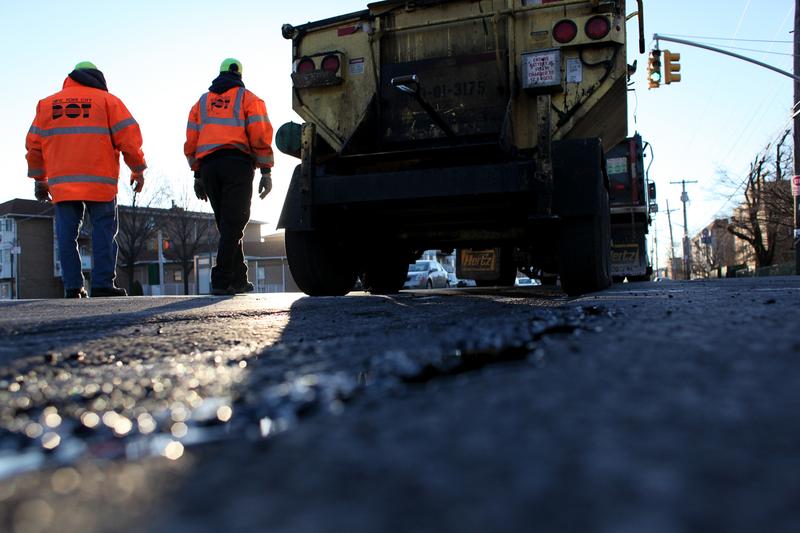
Greg: Hi, Brian. How you doing? Thanks for having me on. I just wanted to talk about the road work that they're doing on Dean Street between 6th Avenue and Vanderbilt. It's really [inaudible 00:05:24], it's been going on for [inaudible 00:05:25] your bike artery eastbound. As a cyclist, I live in Crown Heights, I work in Red Hook, and it makes for a pretty miserable ride home at the end of the day because there's so many steel plates, potholes, and the road surface is just extremely uneven. I'd love it if Mayor Elect Mamdani would commit some resources to getting that work finished up.
Brian Lehrer: Finish that road work. Thank you very much. Another one in a text. "There are not enough streetlights all along Ocean Avenue on the park side of the street and the building side. I live near Lincoln Road," writes that listener. Here's Dan in upper Manhattan here on WNYC. Hi, Dan.
Dan: Hi there. We've had an ongoing issue with a construction project that's taken over five years now. We've lost maybe 400 to 500 parking spots. We've lost sidewalks, and we have a continuous open construction area that, when the wind blows, things blow against windows. It's dangerous, it's unsightly, and we need to get back to a way of life that's acceptable for this neighborhood.
Brian Lehrer: Another street project. It sounds like the incoming transportation commissioner is going to have some work on their hands. There's yet another one. I'm not just going to keep going on these same kinds of things, but yeah, people are very frustrated, apparently, with road work that is not being completed in their neighborhoods. Let's go next to Kathleen in Kew Gardens here on WNYC. Hi, Kathleen.
Kathleen: Oh, hi. Hi, Brian. There was no problem that we could see, but apparently, someone had some issue with crossing a street at a T at the corner of Union Turnpike and Grenfell. They put up a stoplight. Now, ever since, there is beeping going on all along the street. We're woken up early every morning. The quality of life has changed. There's always a backup. It's made an imbalance. The worst thing that I wouldn't have even thought of is the previous block has a stop sign. It's a two-way thing. There are four different crosswalks that people can go, but now the cars are rushing through the stop sign to beat this light when it turns green at the next corner, and so they've made the previous block more dangerous for pedestrians, and there was no problem before, but there is now. I wish it could just disappear. I don't know why they put it there. It's sad. It devalued our lifestyle slightly. It's not earth-shattering, but it's a bummer.
Brian Lehrer: There you go, Kathleen. Thank you very much. Another one in a text. "I live in Prospect Lefferts Gardens in the block of Lincoln Road between Flatbush and Ocean, where there are bus stops, a subway, a grocery store. Many other shops need to be prioritized by the Department of Transportation. It should, in my view, be pedestrianized and only allow buses and delivery vehicles with a dedicated bike lane. This road is a constant deadlock of traffic and should be reviewed," writes that listener in Prospect Lefferts Gardens.
How about, let's see. Isabella in Brooklyn, you're on WNYC. Hi, Isabella.
Isabella: Hi, Brian. My community has been trying to get the MTA's attention to clean up a drug use group that's emerged at Franklin and Fulton, just at the shuttle station. There's a big construction storage area that's hiding all of the construction elements for the escalator improvement inside the station. Sadly, there's a lot of now drug use, and you can see all sorts of people just hanging out there all the time. People are crossing the street dangerously to avoid it. Hopefully, the MTA and the community boards can help us get that fixed really soon.
Brian Lehrer: Thank you for shouting that one out. Listener writes, "Speaking of sewer socialism, there's a foul smell of sewage in the air in East New York near the Conduit and Pitkin," I guess, intersection. "It is right near a school. That poor air quality has to be bad for the whole neighborhood."
Jeff in Astoria, you're on WNYC. Hi, Jeff.
Jeff: Hi, Brian. Good morning to you. I'm actually, I guess, a constituent of the mayor elect. On 31st Avenue, he signed or he put his name to a project that ultimately resulted in a bike lane going diagonally across the intersection or the junction and then head-on into one-way traffic coming at it with no protection, as well as the return leg of that bike lane just literally ending. Just ending in the middle of the block. This was all done so they could basically create two blocks of permanently open street with a bunch of one-way pinch points.
While the traffic flow has somewhat adjusted for cars, it's unexplainable how anybody would think this was advantageous, never mind safe to literally put cyclists diagonally through an intersection and then head-on into traffic, and then have the opposite leg of the bike lane just end, like, end in the cars with no--
Brian Lehrer: 31st Avenue in Astoria. Jeff, thank you very much. Now here's Neil in Kips Bay, whose concern about cyclists. Runs in another direction, I think. Hi, Neil.
Neil: Good morning, Brian. I support bikes 100% and I would love to safely ride a city bike, but walking around Kips Bay and other neighborhoods in New York, I feel like I'm constantly dodging the e-bikes that are going much, much faster than a bike in a bike lane should really be going. They don't obey any of the traffic laws. It creates a real quality of life issue because every time you try to cross the street, you run into a bicyclist that just isn't following the law. I'd love to see some sort of infrastructure fix for this. I think enforcing these laws is very difficult, but there must be some intelligent, holistic e-bike solution to protect pedestrians.
Brian Lehrer: Definitely a topic for the incoming administration. We'll end with a text from the Bronx, "On my block in Parkchester, the street light that keeps going out, leaving residents in the dark as they get off the bus in front of it. It's unsafe."
Thank you for your calls on your hyperlocal, often unglamorous, need-to-be-fixed-on-my-block phone calls. We will pass these along to the incoming administration. That's The Brian Lehrer Show for today, produced by Mary Croke, Lisa Allison, Amina Srna, Carl Boisrond, and Esperanza Rosenbaum. Our interns this term are Amanda DeJesus and Miranda Santos. Megan Ryan is the head of live radio. Milton Ruiz and Shayna Sengstock at the audio controls. Alison is next.
Copyright © 2025 New York Public Radio. All rights reserved. Visit our website terms of use at www.wnyc.org for further information.
New York Public Radio transcripts are created on a rush deadline, often by contractors. This text may not be in its final form and may be updated or revised in the future. Accuracy and availability may vary. The authoritative record of New York Public Radio’s programming is the audio record.
