
Sen. Mark Kelly’s ‘Illegal Orders’ Warning and the Pentagon’s Response
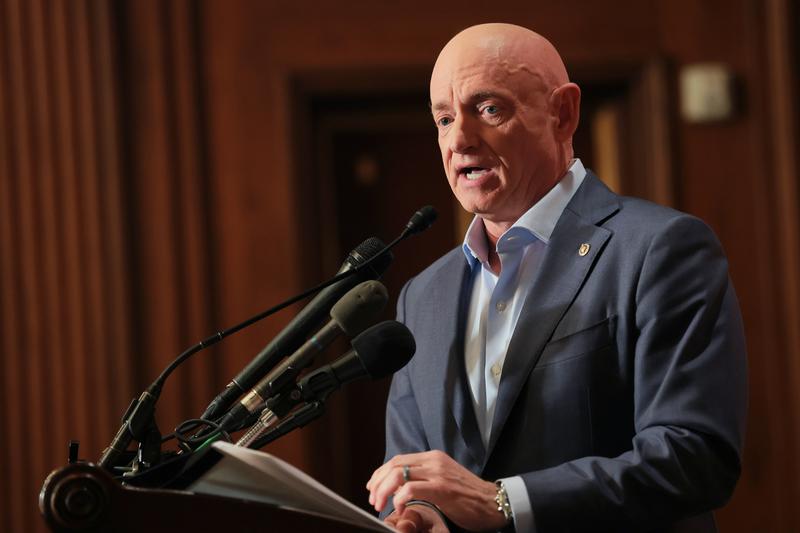
( Anna Moneymaker / Getty Images )
Brian Lehrer: It's The Brian Lehrer Show on WNYC. Good morning, everyone. In just a minute, we're going to use the luxury of time that we have on the show to play the full audio from the video of the Democrats in Congress who called on US troops not to obey illegal orders from the Trump administration. We'll discuss what has happened since, including calls from any of you who have served in the military about your training when it comes to illegal orders. Before we get going, today is Giving Tuesday, as you may have heard, the global day dedicated to giving back to the nonprofit organizations that make a difference in your life and make a difference in the world. WNYC, of course, is a nonprofit organization. We're hoping this morning that you will call or go to our website right now to make one of your Giving Tuesday gifts. Thank you for considering it at WNYC.org or 888-376-WNYC.
During our show this morning, we have an opportunity to get a lot of extra money for the station, and we want a little bit of your help for that. The Charles Spear Charitable fund will add $20 to any donation you make during The Brian Lehrer Show today. Again, the Charles Spear Charitable fund will add $20 to any donation you make during The Brian Lehrer Show today. Yes, that goes for any donation, no matter how small. If you chip in $20 as a Giving Tuesday gift, they'll chip in $20 as a Giving Tuesday gift, and that'll become $40. If you donate $40, that'll become $60. It's a $20 add-on to any donation you make on this Giving Tuesday right now.
Let's see how much we can help fund the station with your Giving Tuesday gift plus their $20 between now and twelve o'clock. Will you help us maximize that offer? Make your Giving Tuesday donation, no matter how small. Of course, you could give $1,000, and then it'd be $1,020. We're expecting and really only asking for a lot of small donations because these $20 from the Spear Charitable fund will add up if [inaudible 00:02:26] chips in. 888-376-WNYC, 888-376-9692, or right from the homepage at WNYC.org. All our usual thank-you gifts are in effect. Take one for yourself, or maybe get one little piece of holiday shopping done.
I'll just say one thing about what Giving Tuesday is because some of you know, some of you don't. I think it's a worthy thing after Black Friday and Cyber Monday. Before you spend all your end of the year walking around money on holiday gifts, for those of you lucky enough to have enough money to make charitable donations, the nonprofits of the world banded together a few years ago and established this Tuesday after Thanksgiving as Giving Tuesday. Their hope is that you'll support a few different nonprofits. Speaking for myself, I support that idea.
My pitch is not for you to only give to WNYC, but to pick a few nonprofits whose work you support on this Giving Tuesday, and make a few modest donations if you have the means to do that. Obviously, we're asking that you make WNYC one of them. We have this special offer. During this show today, from now until noon, if you chip in $20 as a Giving Tuesday gift, that'll become $40.
If you donate anything, the Charles Spear Charitable fund will add $20 to the donation that you make today. Thank you for considering it. Thank you for doing it. Thank you for being a Giving Tuesday giver to the station, if you can. One more time, the phone number, 888-3762-WNYC, 888-376-9692, or you can do it right from the homepage WNYC.org. Thank you all so much.
Now, we want to use the luxury of time that we have on this show to play some longer audio clips of really one of the most important legal, human rights, and patriotism conversations taking place in our country right now, and discuss them with a journalist who is covering the story, and with you, if you have ever served in the military. Maybe you know the basics.
A few weeks ago, some Democratic members of Congress released a video urging US service members not to obey illegal orders. They didn't give an example, but the video seemed to stem from concern about some of the orders given recently by the Trump administration, including Pete Hegseth, the secretary of defense, what Trump prefers to call the secretary of war, such as killing scores of people on suspected drug boats in the Caribbean, rather than arresting the alleged smugglers and bringing them to justice, and also deploying the US military domestically to American cities.
Hegseth and Trump responded by calling the video seditious, rather than by saying, "Of course we follow American law and the laws of war." No, they called the video seditious. The president posted things like-- Did you see this one? That George Washington, George Washington, would have had the Congress members hanged for saying things like that, and they should be arrested and tried. Sure enough, he ordered an FBI investigation on them. Plus, there's a Pentagon investigation of Senator Mark Kelly in particular.
Then came The Washington Post story over Thanksgiving weekend that said Hegseth ordered the military to kill two survivors from one of the boats the US attacked at sea, people who were apparently defenseless, after the boat was destroyed and the other crew members were dead. Maybe you know that much. We're going to dig in a little bit now with this extended audio and a guest. As I say, we will also invite anyone listening who has ever been in the military to call in and say how you were trained regarding the Constitution, the laws of war, and when it might be right or necessary to actually refuse a command from your commanding officer.
Again, with the luxury of time we have on this show, I'm hoping we can give you a better understanding of this crucial conversation about who we are as a nation, politically and morally. The first thing I want to do is play for you the full video posted by those members of Congress. It's self-explanatory about who they are. They say who they are and why they think they are the right people to make this statement. This runs about a minute and a half.
Senator Elissa Slotkin: I'm Senator Elissa Slotkin.
Senator Mark Kelly: Senator Mark Kelly.
Representative Chris Deluzio: Representative Chris Deluzio.
Congresswoman Maggie Goodlander: Congresswoman Maggie Goodlander.
Representative Chrissy Houlahan: Representative Chrissy Houlahan.
Congressman Jason Crow: Congressman Jason Crow.
Senator Mark Kelly: I was a captain in the United States Navy.
Senator Elissa Slotkin: Former CIA officer.
Representative Chris Deluzio: Former Navy.
Congressman Jason Crow: Former Paratrooper and Army Ranger.
Congresswoman Maggie Goodlander: Former intelligence officer.
Representative Chrissy Houlahan: Former Air Force.
Senator Mark Kelly: We want to speak directly to members of the military-
Senator Elissa Slotkin: -and the intelligence community-
Congressman Jason Crow: -who take risks each day-
Representative Chris Deluzio: -to keep Americans safe.
Senator Elissa Slotkin: We know you are under enormous stress and pressure right now.
Representative Chrissy Houlahan: Americans trust their military.
Representative Chris Deluzio: That trust is at risk.
Senator Mark Kelly: This administration is pitting our uniform military-
Senator Elissa Slotkin: -and intelligence community professionals-
Congressman Jason Crow: -against American citizens.
Senator Mark Kelly: Like us, you all swore an oath.
Congresswoman Maggie Goodlander: To protect and defend this Constitution.
Representative Chris Deluzio: Right now, the threats to our Constitution aren't just coming from abroad,-
Congressman Jason Crow: -but from right here at home.
Senator Mark Kelly: Our laws are clear. You can refuse illegal orders.
Senator Elissa Slotkin: You can refuse illegal orders.
Congressman Jason Crow: You must refuse illegal orders.
Senator Elissa Slotkin: No one has to carry out orders that violate the law-
Representative Chrissy Houlahan: -or our Constitution.
Congressman Jason Crow: We know this is hard-
Senator Mark Kelly: -and that it's a difficult time to be a public servant.
Senator Elissa Slotkin: Whether you're serving in the CIA,-
Congressman Jason Crow: -the Army,-
Representative Chris Deluzio: -or Navy,-
Representative Chrissy Houlahan: -the Air Force-
Senator Mark Kelly: Your vigilance is critical.
Senator Elissa Slotkin: Know that we have your back,-
Congressman Jason Crow: -because now, more than ever,-
Representative Chrissy Houlahan: -the American people need you.
Senator Elissa Slotkin: We need you to stand up for our laws,-
Representative Chris Deluzio: -our Constitution,-
Senator Mark Kelly: -and who we are as Americans. Don't give up.
Representative Chris Deluzio: Don't give up.
Congressman Jason Crow: Don't give up.
Senator Elissa Slotkin: Don't give up the ship.
Brian Lehrer: Those Democratic members of Congress calling on US troops to refuse to obey illegal commands. Now, in fairness, they did not get specific about anything Trump or Hegseth had ordered that might have prompted the video, so Republican Senator Lindsey Graham released one of his own. Here's the first part of that.
Republican Senator Lindsey Graham: I was a military lawyer for 33 years. I was a prosecutor, defense attorney, and a military judge. If you're listening to this program tonight, I find no evidence that President Trump or anyone in your chain of command has issued unlawful order to you. To the people who made these accusations, I'm going to write you a letter tomorrow, and I want you to tell the country what orders you think are unlawful. What did President Trump do wrong as commander in chief?
You owe that to the men and women of the military to be specific about what you're talking about. If you're in the military, you need to follow the lawful orders of your commanders. Article 92, check it out. What these senators and House members did was unnerving, and it was unconscionable to suggest that the President of the United States is issuing unlawful orders without giving an example. The hatred of Trump cannot spill over to putting our men and women in the military in jeopardy. You're going too far.
Brian Lehrer: Senator Lindsey Graham. That was on Fox. Then came the specific report in The Washington Post this weekend, he was calling on people to get specific, that said, "Hegseth ordered the military to kill two survivors from one of the US attacks at sea, people who are apparently, reportedly, defenseless after the boat was destroyed and the other crew members were dead." Even Republicans in Congress now seem very concerned about that. Here, for example, is Senator Jim Justice of West Virginia.
Senator Jim Justice: I'm not comfortable with the two blow. If that really happened, I'm not comfortable. I just think it's unacceptable. To me, I'm not happy with all the drug issues and everything, and they're cannibalizing us in lots of ways and lots of bad stuff, but I think it would be really harsh to think that we have defenseless people and we do a second strike. I don't understand that.
Brian Lehrer: The second strike, as he called it, is in play as a topic for political scrutiny and moral scrutiny, even for people like very conservative West Virginia senator, Republican Jim Justice. Now, as for Senator Mark Kelly, who was in the original video, Democrat from Arizona, he held a news conference yesterday as this all continues to develop, in which he called President Trump a bully for saying Kelly and others should be arrested or saying George Washington would have had them hanged. Listen to some of that.
Senator Mark Kelly: While he's never seemed to do much else right, for most of Donald Trump's career, bullying people has worked out for him, but not now, because I won't let it happen. The American people won't let it happen. President Trump is trying to silence me, threatening to kill me for saying what is true. He sent his secretary of defense after me, and it's not going to work.
Brian Lehrer: That was one thing Senator Kelly said yesterday about Trump's language. Here's one more extended bite. This runs a little over a minute, and it speaks for itself.
Senator Mark Kelly: My family knows the cost of political violence. My wife, Gabby, was shot in the head and nearly died while speaking with her constituents. The president should understand this, too. He has been the target of political violence himself. The speaker of the Minnesota House of Representatives, Melissa Hortman, and her husband were murdered in their home this year.
The Governor of Pennsylvania, Josh Shapiro, had his house firebombed this year. Then, Charlie Kirk was assassinated at Utah Valley University, a place I visited just a few weeks ago with Republican Senator John Curtis. Faced with a wave like this, every other president we have ever had in the history of this nation would have tried to heal the country, but we all know Donald Trump, he uses every single opportunity to divide us, and that's dangerous.
Brian Lehrer: Senator Mark Kelly at his news conference yesterday. We've got some revealing clips of Secretary Hegseth yet to play that indicate what he may have personally known about killing defenseless survivors in the boat attack, the second strike, as Senator Justice called it, or Hegseth's official views on following the laws of war at all. We'll get to those. With us now, Zach Cohen, national security and Pentagon reporter for CNN. Zach, thanks for joining us. Welcome to WNYC.
Zach Cohen: Hey, good morning. Thanks for having me.
Brian Lehrer: Listeners, I want to invite phone calls from any of you who have served in the military about your training when it comes to illegal orders. 212-433-WNYC, 433-9692. Again, I want to invite phone calls from any of you who have served in the military about your training when it comes to illegal orders. 212-433-WNYC. This is tricky, right? Where's the line between an order you don't agree with and one that is actually illegal? Where's the line between you just refusing to do your job and taking a moral stand that makes our Constitution actually mean something?
Anyone who has ever served, your calls are welcome now on these questions and your reactions to the national conversation taking place about this right now. 212-433-WNYC, 212-433-9692. As people's calls are coming in, Zach, starting with the video of those veterans in Congress, they did not get specific in the video. What prompted them to make that video, as far as your reporting can tell?
Zach Cohen: Yes, you're right, they were not specific, and that does seem to be intentional. Around the time that this video was put out there, there were already pretty significant concerns on Capitol Hill, bipartisan concerns, about the legality of this ongoing military operation in the Caribbean, and then subsequently has shifted to the eastern Pacific as well. In Latin America, there's obviously the related tensions with Venezuela that the Trump administration continues to stoke, even as recently as yesterday. That military operation in the Caribbean, there was some real debate on Capitol Hill as to whether or not those strikes that had been carried out to that point were on their own legal.
That was before the revelations in The Washington Post story. The Trump administration, we've reported, is relying on a classified legal opinion that was created by the Justice Department that effectively argues the president has broad authority to conduct military operations. It qualifies, in their mind, what the administration argues, these alleged drug runners, traffickers as enemy combatants. It essentially draws a line back to what we saw during the war on terrorism, where these individuals are being considered by the Trump administration to be enemy combatants. Thus, the administration argues they have the authority to essentially kill them without any legal due process.
Now, that's not a consensus view among lawmakers or even some within the administration itself, who have questioned the underlying justification for this operation. That has not stopped the military from conducting these strikes. We know there's at least 83 people that have been killed in these strikes in total. Lawmakers have made a point, though, because in a couple of these strikes, there have been survivors.
In one case, they were picked up and detained briefly on a US Navy ship and sent back to their home countries of origin. Lawmakers have raised this question and wrestled with themselves of if you can rescue some of these survivors, why do you feel that you have the justification to just unilaterally kill the others that have been targeted in these strikes?
Brian Lehrer: It looks like we have some really interesting and relevant calls coming in from people who have served in some relevant positions, but let me ask you one more question before we go to some callers. The incident with the drug boat, the second strike, or reported killing of the two defenseless survivors, The Washington Post story, which only came out a few days ago well after the video, although the incident itself took place back on September 2nd, I see, does it appear that the Congress members knew of that specific incident when they made this video urging service members not to obey illegal orders?
Zach Cohen: That's really unclear at this stage. We've obviously heard from Republicans and Democrats on the Hill who have said that this reporting from the Post and from my colleague here at CNN as well, that these allegations need to be thoroughly investigated. Lawmakers on both sides have said that they don't have all of the facts as of right now, and that they want to hear from Secretary of Defense Pete Hegseth, they want to hear from Admiral Bradley, who the secretary pointed to as the person who authorized the second strike after confirming it.
It doesn't seem very clear what exactly lawmakers knew when they put the video out about the second strike, but even beyond that, the legal questions about this military operation in the Caribbean were already really a cause for consternation on Capitol Hill before that time.
Brian Lehrer: Let's take a phone call. Dave on Staten Island, you're on WNYC. We really appreciate you calling in. Hi, Dave.
Dave: Hi, Brian. Thank you for having me. I am a judge advocate. I have served in the Middle East. I've deployed to several countries in the Middle East. My understanding of the law firm conflict comes from that perspective. It's always been a counter terrorism environment where we have been restricted from doing a lot of things. We've engaged in conflict in the Middle East in urban warfare, and it's not like it was in Vietnam or World War II, where it was a peer-on-peer conflict.
I'm analyzing this from the perspective of a COIN environment. I cannot understand the legality of these strikes. I'm struggling with it because anyone who's practiced or practiced military law or national security law knows the LOAC principles. Any strike has to squarely fall within those four LOAC principles. I'm struggling to see how any of these strikes in the Caribbean fall into those principles.
My final comment was going to be double-tapping. Soldiers at every level, it gets drilled into us that you are not supposed to double-tap. That is a war crime. What occurred here is, either by admission or by action, I think, clearly a double-tap situation. They could have gone-- In fact, it is their duty, if there are survivors, to go round up the survivors and hold them as prisoners of war or enemy combatants at the very least. You can't just willy-nilly kill people. It's illegal. Thank you.
Brian Lehrer: Do you have any, if I may follow up, examples from your career where any service member did in fact disobey what they considered an illegal order?
Dave: No, unfortunately, I do not, or fortunately, I do not, I have to say that.
Brian Lehrer: Ah. [chuckles]
Dave: I've had the honor of working with commanders at all levels that respected the opinion of the lawyer and learned and listened, and did not do anything that was blatantly unlawful.
Brian Lehrer: In this case, like you say, not having any examples of that indicates the lawfulness with which the military has often or usually conducted itself. Dave, we really appreciate your call. We're going to go right on to someone else on the same track, I think. Jerry in Mamaroneck, you're on WNYC. Hi, Jerry. Thank you for calling in.
Jerry: Good morning. I wanted to say that the congressman and the senator basically had exactly the right message to military soldiers, but not just to the soldiers and the sailors, to the generals and the admirals as well. There's a really important message here. You have to understand that young soldiers are taught from the very beginning that if they receive an illegal legal order, they are not to follow it. That's just the Uniform Code of Military Justice. It's exactly as the politicians stated it was.
Brian Lehrer: What's your relationship to this in your career? I understand there is one.
Jerry: Yes. I've taught Uniform Code of Military Justice several times to thousands of soldiers, so I had to have understanding of that particular issue. There's a lot of issues, of course. Then I had experience as an officer serving on general court martials, special court martials, and I had summary court martial powers. I think I had a pretty good understanding of what it takes. Now, I'm like the officer that you just talked to a minute ago. I don't have any personal experience where somebody has actually used that rule or had to use that rule because they believed an order was unconstitutional.
Brian Lehrer: Jerry, thank you very much for your call. We really appreciate it. Those two callers are really interesting, Zach. Any reaction from you just as a reporter on this beat as you listen to them?
Zach Cohen: Yes. They both raised and captured what I think the ongoing debate overall that's happening right now is. I think as far as the double strike scenario that we in the Post have reported took place during that first strike on September 2nd, both callers were correct that the law of armed conflict also makes very clear, and my understanding is service members are very explicitly told that of all the potential scenarios, survivors of a shipwreck in the middle of the ocean are the most immune or protected under the laws of that armed conflict, and they're not supposed to be just followed on with another strike to ensure that they're killed in this situation specifically.
That doesn't even get into the underlying legal questions that the Trump administration is using to justify this operation more broadly. I think there's questions from a macro sense about the operation itself and these numerous strikes that have killed over 80 people without any due process, without, based on what my sources have said, any evidence presented to Congress that shows the Pentagon or the administration has a really clear sense of, one, who these individuals are, two, that they are trafficking drugs that are an imminent threat and headed to the United States.
That's really a cornerstone of what our understanding of their legal justification is. Problem is we haven't seen it because the Trump administration has refused to unclassify it and share it with Congress.
Brian Lehrer: These members of Congress, all military veterans in the video, obviously on the same page as our two callers, they're all being investigated now by the FBI as if they did something wrong. Secretary Hegseth seems to be making a particular example of Arizona Senator Mark Kelly, who is in the video. Why Senator Kelly, if you know?
Zach Cohen: There's a distinct overlap here. There's some irony to it as well. Senator Kelly retired as a captain in the Navy. He was among the group of Democrats who appeared in that video, had achieved the highest rank, had the longest tenure, and because of that, he had a secured pension where the others had not. Now, technically speaking, based on my conversations, that means that if Pete Hegseth decided he wants to go this route, he could technically try to recall Senator Kelly into active service and then court martial him based on allegations that aren't super clear as far as what he believes Senator Kelly violated, as far as the US military code of justice is concerned.
He has floated a few different statutes within that code of justice, which is obviously the laws that govern the military justice system. He suggested that he believes Senator Kelly did violate some of those statutes. There is a mechanism technically for him to attempt to prosecute him for that. Now, at the same time, a coalition of former judge advocates and military lawyers issued a pretty rare statement the other day in response to our reporting about Hegseth's threat to investigate and potentially prosecute Senator Kelly, saying that it's clear to them that this is partisan in nature, any prosecution would be legally baseless and compromised by Hegseth's own comments about the issue itself.
There is this juxtaposition of Hegseth and the administration arguing that what they're doing in the Caribbean, as far as these strikes are concerned, are adhering to the military law of armed conflict. At the same time, it does appear that they are trying to bend the military justice system in order to target their political critics on the other side of the political spectrum.
Brian Lehrer: We can continue in a minute with CNN Pentagon reporter Zach Cohen. We'll play a clip of Defense Secretary Hegseth seeming to admit he knew exactly what happened with that drug boat, even as he apparently is trying to pin any killings of the defenseless survivors on someone below him in the chain of command. That's coming up.
[MUSIC]
Brian Lehrer: Brian Lehrer on WNYC. Still with us, Zach Cohen, national security and Pentagon reporter at CNN, as we discuss the video by members of Congress calling on US troops not to obey illegal orders and the very possibly illegal orders given in September to kill defenseless survivors after the first strike on a suspected drug boat in the Caribbean, that reported by The Washington Post.
Our phones and text message threads remain open for anyone who has served on how you were trained on when, if ever, to disobey orders you considered illegal yourself. 212-433-WNYC, 212-433-9692. Let's take another phone call right now from James in Mount Vernon, who was in the Air Force, I see. I think he's going to say some version of this obey if it's illegal is really hard in practice. James, you're on WNYC. Thank you for calling in.
James: Good morning. I have another twist that I was thinking about as I was listening to you, and that is, before I went to Istanbul, I was in Oregon, and I went to Oregon State University at night. I worked from 8:00 to 4:00 for the Air Force. At night, I was carrying 12 credits at Oregon State University. When Martin Luther King was murdered, I was a member of the Black Student Union at Oregon State. Three of us went on a television show within a few days of his murder to talk about his assassination. I opened my mouth and said that the reason he was killed was because of his stance on Vietnam.
When I got back to the base the next day, this older sergeant came to me and said, "Man, you're in a world of trouble." I said, "Why?" He said, "According to what you said on that TV show last night?" I said, "I was within the rights of my rights. According to the UCMJ, the Uniform Code of Military Justice says that you can participate in a public event not as a member of the military. You cannot identify yourself as being in the military, and you cannot have your uniform on."
Because I said that, he said, "Man, they don't give a damn about that. You said some things they didn't like, and your butt's going to be sent out to Southeast Asia. I already know that." He said, "Do you have any volunteer statements already on the books?" I said, "Yes, I have requested to go to Turkey or Greece." He said, "Don't say anything to anybody. Let me get back to you in a couple of days. In a couple of days, I had orders to Istanbul.
Brian Lehrer: Which is not where you wanted to go.
James: I did. I wanted to go to Turkey or Greece.
Brian Lehrer: Oh, you did want to go. I see. You tell me, what's the moral of the story?
James: The moral of the story is you have to obey orders. I was obeying orders. I knew before going on that television show that I had to not say anything about being a member of the United States Air Force because that would have been a violation, so I followed orders. On top of that, when you go into the military, you sign so many papers, and you take oaths, and so you've already committed yourself to doing whatever you're told to do as long as it's legal. If you don't want to do it, you might have a crisis of conscience, but you got to be ready to pay the price. There were people I saw in there who were sent to Southeast Asia while they were in there, and they didn't want to go. They have to then go to court.
Brian Lehrer: Thank you very much for sharing that really interesting and somewhat disturbing experience, James. One more for now. Lawrence in Chelsea, you're on WNYC. Hello, Lawrence.
Lawrence: Hey, good morning. You have a great show. I recall in basic training back in 1968, we were in a course on how to turn ordinary items into weapons to protect yourself, like a pen, or cigarettes, or things like that. The course was two days. The instructor, who was just so proud that he could kill people, also repeated you cannot do this unless you're really threatened and someone's threatening you. Otherwise, it's illegal. You just can't kill someone. I remember these courses multiple times when I was in the service. This goes back to '68 through '74. That's my statement.
Brian Lehrer: In your experience, did people always follow that? Was there any incident that you were ever involved with where you thought, "Gosh, maybe I should disobey an order for what they're asking me to do here."?
Lawrence: I never ran across that. All the soldiers that I served with, we followed orders. I never came across an incident where I had turned down and refused an order. I do remember that drill instructor telling me over and over again, when you poison someone with a cigarette, you can turn a cigarette into a poison. That's one of the things they taught us, by soaking it in water, and it becomes a nicotine, which becomes a poison. He said, "You just don't do this to civilians. You can't do this unless it's really necessary for you to defend yourself, or you are killing your enemy."
Brian Lehrer: In light of that experience, how are you viewing this current debate that's taking place in the country right now?
Lawrence: I can say it angers me because every soldier knows this. When I heard Lindsey Graham, come on, he knows better. He knows this. One of my closest associates in the army was a lieutenant colonel who was Korean War, Vietnam War. Real, real soldier, real hero. He would say that to me. We used to go fly around in helicopters to keep his hours going, his flight hours, and training.
He would take me along, and he would tell me, "I can't go longer than this. I don't want to do that." He understood the rules. You don't break the rules, and you don't disobey an order. I did not see anybody have to do that, but I do know we were instructed constantly about it. Every time I went to a different fort, this was reintroduced to me. That's how I remember it.
Brian Lehrer: Thank you very much for your call and your story. My guest is Zach Cohen, Pentagon reporter for CNN. These are some really powerful stories from vets. It's so fascinating to hear them rather than just the political analysts and-
Zach Cohen: Absolutely.
Brian Lehrer: -members of Congress. Go ahead.
Zach Cohen: It really underscores, I think, the dilemma that service members are being faced with right now and also explains the reason behind the video that was put out by those Democratic lawmakers. I think that reminder, as Senator Kelly called it, reminding people that they do have a duty to refuse illegal orders is also a reminder to service members that, ultimately, the onus is on them to determine. Now, it's equally as challenging, as our callers just described, for those service members because they are taught that a an order is supposed to be interpreted as inherently lawful. There has to be something that would jump out to them to make them think otherwise.
At the same time, I think the way that we're seeing the aftermath and the shifting of blame by the White House and Defense Secretary Pete Hegseth for this double tap strike really underscores the third part of this, which is that the White House and President Trump have shown that, at the end of the day, if there is something that is questionable in its legality, the service members and the ones in uniform all the way up the chain of command are going to be the ones that are ultimately almost certainly left holding the bag, if you will.
There is this concern among sources that I talked to in the military that the White House and Defense Secretary Hegseth are actively in the last 24 hours trying to shift this blame onto. Not only Admiral Bradley, but on anybody below him who was involved in this second strike, on these two strikes on September 2nd, and then potentially any legal questions that arise about the other strikes as well, because those are, again, questionable in their legality as well. That is something that will ultimately be debated, but the ones that have skin in the game are the service members themselves. The politicians are very adept at navigating that, I think, in a way that service members are not.
Brian Lehrer: Again, for people just joining us, what you refer to as the double strike or the double tap strike is about The Washington Post story from over the weekend that orders that would appear to be illegal were given in September to kill defenseless survivors after the first strike on a suspected drug boat in the Caribbean. Who is this Admiral Mitch Bradley, who they're now saying might be more directly responsible for the second strike on the boat than Secretary Hegseth, and do they appear to be making him a fall guy?
Zach Cohen: Admiral Bradley is a very seasoned operator commander. He is in charge of special operations units. He is the highest-ranking uniformed officer, it sounds like, who was involved in this specific strike and the subsequent strike on September 2nd. Admiral Bradley, and this is a concern I'm hearing, and I've heard from multiple sources over the last 24 hours, that it does appear the White House and Secretary Hegseth are actively trying to move the blame in his direction. That's something he's going to have a chance if he chooses to take it to explain to Congress, who is demanding that he comes in and walks them through what happened.
It's also interesting, too, because despite the White House saying that Secretary Hegseth authorized Admiral Bradley to do this effectively, that doesn't release Hegseth from any culpability as far as how that would work from a legal standard. Whether this is analyzed as a potential war crime, violation of the armed conflict, law of armed conflict, or if it's analyzed as an extrajudicial killing along with the rest of these strikes, even if Hegseth authorized Admiral Bradley to make the call, Hegseth is still in that chain of custody, if you will. Ultimately, it remains to be seen how this will play out, but there does seem to be a blame-shifting being initiated by the White House and the secretary.
Brian Lehrer: Here's a piece of evidence that might indicate that Hegseth is even more directly responsible than that. On MS Now this morning, the former MSNBC, they played a clip of Hegseth indicating that he personally viewed the video of the attack on that boat. Here's that clip.
Secretary of Defense Pete Hegseth: I can tell you that was definitely not artificial intelligence. I watched it live. We knew exactly who was in that boat, we knew exactly what they were doing, and we knew exactly who they represented. That was Tren De Aragua, a narco-terrorist organization designated by the United States, trying to poison our country with illicit drugs.
Brian Lehrer: Zach, are you familiar with that clip?
Zach Cohen: I am.
Brian Lehrer: Is he referring to that specific same incident?
Zach Cohen: It does appear he was. It's the same tone we've heard from Hegseth publicly as he's sought to paint himself as the man in charge, specifically as it relates to this operation in the Caribbean, which makes it interesting that now he's suggesting that maybe he wasn't as in charge now that questions are being raised about the legality of one of these strikes. At the end of the day, what he said is in substance about the strike, knowing exactly who these people were, who they were affiliated with.
I think the reporting bears out to date that that is not a full retelling of the truth, that there are still significant questions about the identities of these individuals that the administration claims are alleged drug traffickers. There's significant questions about where these boats were actually headed. Secretary Rubio telling lawmakers about this strike, that the boat appeared to actually be headed toward Trinidad and Tobago, not the United States.
Secretary Hegseth's lack of qualifications do come to mind here as well. While he did serve in the military, he did not even achieve a higher rank than Senator Kelly did. He's not a seasoned commander himself. Frankly, sources tell us that he has been, in the past, very deferential to the uniform commanders when it comes to operational and tactical decisions. At the same time, we know that his primary goal and objective while being secretary is to show his boss, the president of the United States, that he is a competent secretary of defense.
Those are two competing motivations that Hegseth seems to have here. It would explain the discrepancy between his comments that you just played and what we're hearing right now from him about his role, or lack thereof, in this supposed second strike.
Brian Lehrer: It was interesting to me that you referred to his tone in that video. Here's one more Hegseth clip, something that he said weeks ago about his whole relationship to even the idea of the laws of war. Listen to the tone and listen to the content.
Secretary of Defense Pete Hegseth: We're training warriors, not defenders. We fight wars to win, not to defend. We also don't fight with stupid rules of engagement. We untie the hands of our war fighters to intimidate, demoralize, hunt, and kill the enemies of our country. No more politically correct and overbearing rules of engagement. Just common sense, maximum lethality, and authority for war fighters.
Brian Lehrer: Now, we certainly could discuss, and we're almost out of time, if that in and of itself is un-American in principle and maybe shows a propensity to order that second strike. Last question, is President Trump losing his confidence in Pete Hegseth?
Zach Cohen: I think that's been a question about Hegseth really since the controversy over his use of Signal to communicate classified information about an ongoing or an operation against the Houthis rebels in Yemen that had not happened yet, one that a reporter was accidentally added to the Signal group chat. That's how that revelation came out. That has been a persistent headache for the White House. There's been questions about Hegseth's qualifications, his competency throughout his tenure this year.
We've seen him really try to publicly reinforce the opposite. That clip you just played, I believe, is actually from a really unusual gathering that Hegseth called where he demanded all of the top commanders that serve in the US military around the world travel to the East Coast, I believe it was in Virginia or in Maryland, and attend this speech that he gave in person, which the setting of that, given the context and the tone, makes it even more interesting.
Brian Lehrer: Zach Cohen, national security and Pentagon reporter for CNN, thank you for giving us so much time today.
Zach Cohen: I appreciate it. Thank you.
Copyright © 2025 New York Public Radio. All rights reserved. Visit our website terms of use at www.wnyc.org for further information.
New York Public Radio transcripts are created on a rush deadline, often by contractors. This text may not be in its final form and may be updated or revised in the future. Accuracy and availability may vary. The authoritative record of New York Public Radio’s programming is the audio record.
