
SCOTUS: TPS Arguments & Voting Rights Decision
[music]
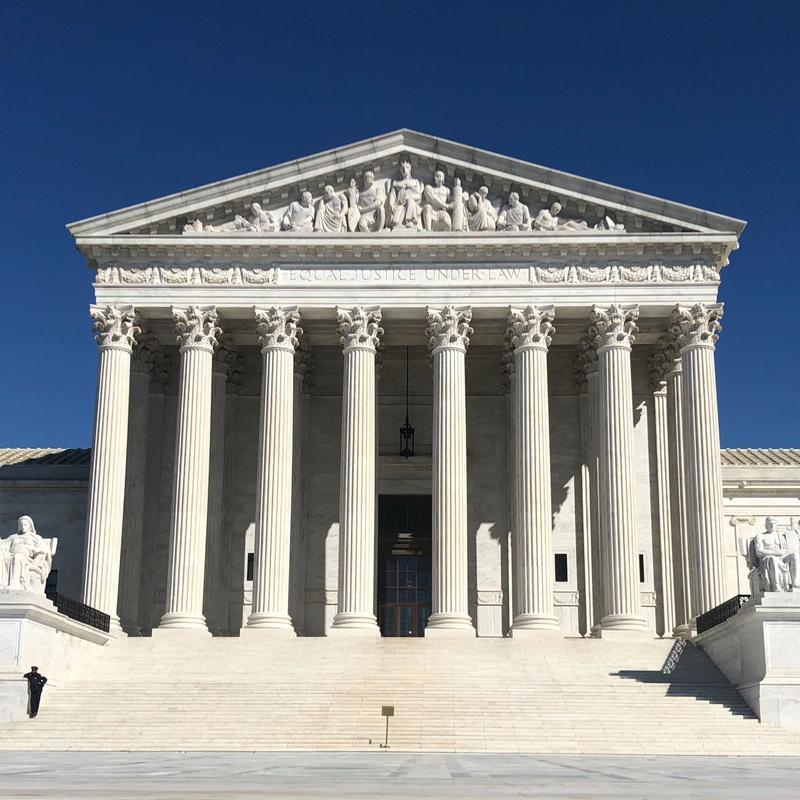
Brian Lehrer: It's The Brian Lehrer Show on WNYC. Good morning, everyone. Beginning in about 15 minutes, the Supreme Court will hear oral arguments in a case that could result in the deportation of more than a million immigrants who are in this country legally. I'll say that again in case you didn't believe your ears. Today's Supreme Court oral arguments are about the mass deportation of people who are in this country legally.
The case is known as Mullin v. Doe. Mullin, originally Noem v. Doe, until Markwayne Mullin replaced Kristi Noem as Secretary of Homeland Security. It's about immigrants here legally under the program known as temporary protected status, or TPS. The government's position, maybe oversimplified, our guest will correct me if it is, is that even if a TPS recipient faces danger if they're deported to their country of origin, the US can still deport them if their presence isn't considered in the national interest.
That's not a claim the Trump administration only wants to make about individuals. It's a judgment of immigrants from whole countries. In this case, anyone from Haiti and anyone from Syria. Depending on how this case goes, it could be applied to people from anywhere. According to the stats I've seen, the administration is trying to cancel TPS status for anyone from 13 different countries, with possibly more to come.
If we can get a good audio feed from the Supreme Court, which I think we can, we'll dip into a little of the oral arguments for a live sample, if we can. Let's discuss this case now with Emily Bazelon, who writes about the law and how it affects people for The New York Times. She also teaches at the Yale Law School and is co-host of the Slate Political Gabfest podcast. We'll also touch on some other legal news if we have time, including the latest attempt to prosecute former FBI Director James Comey. Emily, always good of you to lend us your brain. Welcome back to WNYC.
Emily Bazelon: Thank you, Brian. Great to be here.
Brian Lehrer: I took a layperson stab at describing the basic premise of today's case. Would you like to correct or add anything right from the jump?
Emily Bazelon: No corrections. I would just add. Congress enacted this idea of temporary protected status in 1990, and the idea is that sometimes things are really dangerous in a foreign country because of a natural disaster or an armed conflict, for example. Then, people can receive two years of permission to live in the United States and to work here. If the government wants to revoke that status later, they have to go through a detailed process to take it away. The issue in this case is whether the Trump administration properly went through that process, or whether it just arbitrarily, the standard is arbitrary and capricious, whether it just took this away in the middle of a grant that people had already received. That's the issue that the justices will be weighing.
Brian Lehrer: Right. I see this case generally being called Mullin v. Doe. Dahlia Doe is a pseudonym for a TPS recipient from Syria. There's also another case that it got combined with, Trump v. Miot. I read that Fritz Emmanuel Lesly Miot is a Haitian neuroscientist who studies Alzheimer's disease who's been in the US since 2011. If that sounds right, do you want to talk about the individuals in these cases, or should we only think of them as about any one from those countries?
Emily Bazelon: Well, I think it's important that they are real plaintiffs, like real people with stories like the one that you just described. Also, this is a group designation, right? It's possible that some of the individuals will have other claims for staying in the United States. Most of these, more than 300,000 people, will be vulnerable to being deported because the reason they were being allowed to stay here is about the government's ideas of the conditions in Haiti.
I actually did a story recently for The Times about the Department of Homeland Security. One of the people I interviewed was one of the government career employees who had participated in revoking this status for Haiti. That wasn't something she wanted to do, but that was her assignment. She said it was a farce, the process that the government went through, that they just had this direction. Now, all we care about is our idea of the national security interest. It wasn't like the conditions in Haiti had really become safer in her view. It was just an order from on high to say that.
Brian Lehrer: Well, this is one of the Trump arguments. I don't know if it's a legal argument or just on policy grounds, you tell me, that temporary protected status is supposed to be just that, temporary, until the crisis in the country of origin subsides. You said it's originally just for a two-year period. For Haitians, after the earthquake in 2010, they say Haiti isn't in that emergency anymore. It's 16 years later. Temporary should go back to meaning temporary. Is having the right to deport based on that an issue here?
Emily Bazelon: Well, I think that is like a completely sensible argument. It could make sense. The question is whether it truly reflects the conditions in Haiti or in Syria, another country which continues to be war-torn and a difficult place to live. The government is supposed to affirmatively find that these places are no longer dangerous. They're not supposed to only consider their own idea of the United States' national security. They're supposed to also care about what it's actually like in those countries, whether it's safe to return there.
That's the question is whether the Trump administration really gave that due consideration. The court will be focused on American national law, but there's also an important principle of international law at stake here that you don't return people to danger. It's called "non-refoulement" in French. To people who care about international law, even though the Supreme Court is unlikely to treat it as the paramount or even important issue here, that is also at stake.
Brian Lehrer: Listeners, are you a Haitian or a Syrian here under temporary protected status? Would you like to call up and tell your story a little bit, or maybe you just know anybody who's here under temporary protected status from Syria or Haiti or any country? That could also be you, of course, from any country. I believe there are 17 countries that currently have temporary protected status for people from them here. 13 of them already en route to being canceled. Four are still under consideration. 212-433-WNYC. You are invited to tell your TPS story or that of anyone you know, or call with a comment on any side of this issue or a question for Emily Bazelon, who covers legal affairs for The Times. 212-433-WNYC, call or text, 212-433-9692.
Emily, the government argues that ending TPS for these countries "rested on multiple foreign policy and national security determinations." The other side argues, the pro-immigrant side argues, that these determinations were arbitrary and capricious, they use that phrase, and with discriminatory intent. Do you expect those things to be the core of the oral arguments that are about to begin, trying to show this was based on discrimination versus the government having to prove that the national interest is somehow at stake by allowing these TPS recipients to remain in the US?
Emily Bazelon: Yes, exactly. To just break these arguments into different pieces, one argument is about the Administrative Procedure Act. This is the law that governs how administrative agencies, federal agencies, go about making decisions. If Congress lays out a process in the statute, then they're supposed to follow it. If they don't, a court can overrule them by saying that what they did was arbitrary and capricious. That's one claim.
Another claim that applies to the Haitians, or at least that the Haitian plaintiffs say happened in their case, is this accusation of racial discrimination based on the very derogatory comments that President Trump has made about Haitians and Haitian immigrants during his campaign, but also in his presidency. The Haitians are saying, "We didn't stand a chance. This isn't really about the idea that it's safe for us to go home." This is a president who has a particular prejudice against Haitians. That is a second argument that the Haitians could possibly win on that is separate from this question of whether the Trump administration properly followed the procedures.
Brian Lehrer: On one piece of the national interest argument, I read an amicus brief in the case from the American Enterprise Institute think tank on the side of the immigrants that argues that their continued presence is in the economic interest of the United States, while, apparently, the government claims the economy is one of the reasons to deport. Do you think they'll get that specific, like debating economic impact of Syrian and Haitian refugees, and the justices will have to make a determination on the economics of that?
Emily Bazelon: That seems like it lies outside the four corners of the law in this case, but you can see why a group would file that brief because it's reminding the justices that most of these people are working. They have work permits. They're authorized to work. Haitian immigrants, in particular, have been a real part of the workforce for things like nursing homes and elder care and home nursing.
I think what AEI is doing is reminding the justices, like, "Look, these people are not here as guest workers, but they are being productive." The economy does depend on this kind of labor, which it has been difficult to get Native-born Americans to do, at least at the same relatively low wages. It's really not something that should determine the outcome of the case, but you can see why, as a policy matter adjacent to the legal issues, people care about this.
Brian Lehrer: How did this case get to the Supreme Court? From what I read, it looks like the Trump administration was challenged on trying to deport people from at least these two countries. I'm going to ask you about other countries in a minute. They lost in the lower courts, correct?
Emily Bazelon: Correct, yes. Both for the Haitians and the Syrians, federal judges blocked the government from ending the temporary protected status program. The US district judge, with regard to the Haitians, said that she thought it was "substantially likely" that the Department of Homeland Security had ended TPS for Haitians because of what the judge called hostility to non-white immigrants. That was part of her consideration here.
Brian Lehrer: This is a last-ditch effort in a sense by the Trump administration. They're saying, "Hey, Clarence. Hey, Amy Coney. Hey, Brett, bail me out here. You give me rights and all kinds of things that lower courts say I don't have. Would you do it again, please?" Is it something like that?
Emily Bazelon: Well, we'll see. One thing that's also important, or at least curious, about this case is that the court earlier in the year allowed the Trump administration to cancel temporary protected status for Venezuelans. The court did that on its emergency docket. It didn't explain why. It didn't really say anything. There was a heated dissent from Justice Ketanji Brown Jackson. Now, we're having a full-airing, briefing argument today. We'll find out how the justices are thinking, or at least what questions they're asking about this.
When they said the Trump administration could cancel TPS for Venezuelans, it seemed like they were going to give the government lots and lots of leeway, and that the court was not persuaded by these arguments about the process being arbitrary and capricious. That backdrop, I think, has made a lot of people nervous about how, at least, the conservative majority on the court is thinking about these immigration programs.
Brian Lehrer: Let's take a phone call from a lawyer, who I think represents some clients who have TPS. Taylor in Queens, you're on WNYC. Hi, Taylor.
Taylor: Hi, good morning. Thank you for taking my call. I'm not a lawyer. I'm an accountant.
Brian Lehrer: Oh, okay.
Taylor: That's number one. I do tax work for lots of clients who have TPS here in Queens. Lots of them have been here. Mostly Salvadorians, Central Americans, Hondurans, and Salvadorans, even Guatemalans. Most of them have been in this country for well over 20 years with TPS. Personally, I don't see how it makes sense to just have a blanket deportation of all these individuals. It's a huge tax base. What it would be like, what I would call public policy, it just simply doesn't make sense.
Brian Lehrer: Wait, you mean immigrants pay taxes? That's a joke.
Taylor: Yes, they do. You'll be amazed that not only are they adding to the tax coffer, tax revenue of this country, they will never get Social Security benefits unless they are citizens or residents. It's like paying rent. You can live here, pay rent for 100 years, you'll never own anything. It's as simple as that. The tax base, watch out for your Social Security when it starts decreasing. You're blaming the rich. No, you're blaming the poor that are no longer here paying the tax base that you need.
Brian Lehrer: Right. You don't mean blaming the poor, but blaming the government for locking out a lot of immigrants who are working here and paying taxes, but not into the Social Security system?
Taylor: Well, these TPS people, not paying Social Security taxes. If they were to retire right now, they get nothing because they don't have--
Brian Lehrer: They won't get Social Security, right.
Taylor: No, anything other than a green card holder or US citizenship, you don't get those benefits, period. You will pay into the system regardless.
Brian Lehrer: Can you say anything about how any of your clients are talking about this to you or their feelings at this moment?
Taylor: Well, all I get to see the fear in their faces. I have one specific client who told me, "Look, when we're doing a tax return, we file an extension." She said to me, "If all goes according to plan, I have to go back in September to El Salvador. Now, I came to this country in 1998. I'm in my 50s," she said. "I've been paying taxes for the past 20-plus years, and I'll get none of that back, and so I'm going back to a country that is completely different than what it was when I left in the 1990s." I said, "Well, that's true. It's still temporary." She said, "Yes, I understand that, but it doesn't make sense." She pays easily over $10,000 worth of federal and Social Security taxes every year. I can tell you. I can vouch for that.
Brian Lehrer: As her accountant. Taylor, thank you so much for telling your story and that of some people you work with. Emily Bazelon is my guest as we talk about the Supreme Court, which should be hearing oral arguments starting around now in this case about deporting whole countries' worth, that is, anybody from each of two countries, in this case, 17 countries by implication, who have temporary protected status legally here in the United States.
Listeners are texting. One writes, "This case is not at all about immigration, legal or illegal or national security. This case is 100% about legitimizing and legalizing racism against people of color." Emily, a lot of people think that, one of the arguments from the immigrant side here. Do you think they're going to explicitly be debating whether this is racism based on which countries TPS is being suspended and which aren't, if any aren't, or anything like that? We know about Trump's past so-called Muslim ban and versions of that that didn't pass the Supreme Court, versions of that that did, that were watered down a bit. Are they going to be debating whether the Trump administration is racist in this policy explicitly?
Emily Bazelon: Well, they definitely will be debating that with regard to Haiti, or at least the lawyers for the Haitians will bring that up, because that is a claim here. One thing to remember are the travel ban cases from the first Trump administration, where this was absolutely part of the challenge to Trump's executive orders, because some of the countries in the beginning, most of the countries that were banned were majority Muslim. Trump had said things that were anti-Muslim that the plaintiffs wanted the court to take into account.
With those cases, in the end, that argument did not win the day. They're a little different or maybe somewhat different from the case today because the travel ban, as you might recall, the Trump administration went back. They did that over again after the lower court judges saying there was no process. They went and started over. They have not gone back and started over with the process this time, and tried to essentially cleanse it of what looked like racial bigotry at the outset.
I think one of the things that's very likely to come up today is whether the Trump administration needs to go back and do that the way they did for the travel ban before the Supreme Court can bless what the administration is doing this time. In that sense, too, like racial bigotry, this kind of question of, if the President is saying these overtly racist, derogatory things, can we really pretend that that is separate from the policymaking process? Sometimes courts are reluctant to poke beneath the surface, but these are such overt statements that, yes, they will be part of the argument.
Brian Lehrer: Some texts coming in. Listener writes, "Many people with TPS care for the elderly. With baby boomers aging, nothing is more stupid than ridding our country of people who perform such a valuable service." Another listener writes, "How can we call something temporary? People have been doing it for 20-plus years in some cases. Is the government not winning the authority to exercise the temporary part?" Another listener writes, "People who have lived here and contributed positively to the US should be offered citizenship." Another person along those lines writes, "Question, can TPS recipients apply for naturalization after a certain period of time?" Can you answer that question? Do you know if there's anything like that?
Emily Bazelon: Well, it's a really good question. I think what all of these good texts that you're reading from get to is, like, there are just these tensions in American immigration law, right? On the one hand, this is only for two years, and Congress designated it that way. It didn't say that people get to stay here forever. On the other hand, Congress did say to the government, "If you're going to take away the status, you have to go back and really make sure that it's safe for people to return."
Then, when you have that status renewed over and over again, and people really build their lives here, and they're working, and they have their families uprooting them starts to seem cruel and actually at odds with American, at least economic self-interest, even though that's not really the reason that they got protected status in the first place. I think that's why your callers understandably are wrestling with, like, what are the limits here? What happens next to these people? Some of them can apply for other kinds of green cards and other kinds of status, but that process has gotten incredibly slowed down and indeed paused entirely from people from a bunch of countries. People really are vulnerable to getting deported here.
Brian Lehrer: I said we might dip into the Supreme Court oral arguments if we can. It turns out, though, they were scheduled to begin at 10:15. They haven't begun yet because the Supreme Court also, in these first 20 minutes of their session today, they've issued a couple of pretty major decisions. One on redistricting, one on a crisis pregnancy center case from New Jersey.
We're going to take a break. When we come back from that, we will say to the best of our ability, because this is just breaking, what those rulings are and what the implications are. Emily, we're going to put you on the spot and see if you can do a little breaking news, instant legal analysis of these things, see if we can make sense of them, at least a little bit on first blush. We're going to do that, and then we will try to listen into a little bit of the oral arguments on the temporary protected status case, if we can. Stay with us.
[music]
Brian Lehrer: Brian Lehrer on WNYC as we continue with our Supreme Court coverage this morning with Emily Bazelon, who writes about the law and how it affects people for The New York Times. She also teaches at the Yale Law School and is co-host of the Slate Political Gabfest podcast. We've been talking about the case known as Mullin v. Doe, about whether the Trump administration can kick out of the country more than a million people, ultimately, who are here legally under what's known as temporary protected status.
The Supreme Court has also issued a couple of interesting decisions this morning. I'm going to read from a few different news sources here to try to give you an early sense, as this is just breaking around us. From the AP, "Supreme Court voids majority Black congressional district in Louisiana, boosting Republican chances." This is considered a major redistricting case. "Supreme Court voids majority Black congressional district in Louisiana, boosting Republican chances."
Amy Howe from the website SCOTUSblog, which follows the Supreme Court, says the court does not strike down Section 2 of the Voting Rights Act as unconstitutional. Justice Alito wrote the majority opinion. Justice Kagan wrote the dissenting opinion. Kagan wrote, "I dissent then from this latest chapter in the majority's now completed demolition of the Voting Rights Act."
Alito writes, "Compliance with Section 2 as properly construed can provide such a reason. Correctly understood, Section 2 does not impose liability at odds with the Constitution," I know this one's legalese, "and it should not have imposed liability on Louisiana for its 2022 map. Compliance with Section 2 of the Voting Rights Act thus could not justify the state's use of race-based redistricting here." Emily, those are some basics. What do you make of it?
Emily Bazelon: Well, this case is a big deal. Immediately speaking, there's going to be a question about whether a group of seats in the South are going to redraw their maps, try to do that in time for the 2026 midterms. Analysis that Nate Cohn did for The New York Times suggested that between 10 and 15 seats that are currently in Democratic hands could all switch to Republican hands if all of these states try to redistrict before their primaries.
That's the kind of political headline and potential consequence from this. We'll have to see how quickly the states try to move. Legally speaking, what's happening here is that this is the provision of the Voting Rights Act that the court previously said protected the dilution of power of minority voters. Then, there has been some tension between that idea and the idea that it's not legal to do what's called a racial gerrymandering, right?
If, on the one hand, you're trying to protect minority voters' political power, then you take race into account in the way you draw districts. On the other hand, racial gerrymandering is not allowed. Louisiana fell right into that, what they called the Scylla and Charybdis of those two requirements. First, Louisiana drew a map where they only had one safe seat for minority voters in Congress. One out of six. That got struck down in court.
They went, and they drew another map that had two representatives that Black voters could presumably succeed in electing. That's the case. That's the district that was at issue here. The majority opinion from Justice Alito, which the conservatives signed onto, said that Louisiana was wrong to try to draw that second district because that was a racial gerrymander. This dissent from Justice Kagan makes it clear that while the court has not actually struck down Section 2, it is treating it in a way that will make it very, very hard.
Kagan essentially says impossible for minority voters to get any relief when they are being not able and anymore to elect the candidates of their choice as long as the state has any race-neutral justification. That's what Kagan is saying. It will really, really just limit the effectiveness of Section 2, which, until now, has been really important in states that continue to have racially polarized voting, which is mostly the Deep South.
Brian Lehrer: How much of this redistricting war that's taking place in more Democratic versus more Republican states this year might this affect?
Emily Bazelon: It's really the states in the South that we're talking about, so Louisiana, Mississippi, Alabama, but some other states as well. Traditionally, what happened was that states drew these maps so that there was, basically, a safe seat often represented by a Black Democrat. For a while, states did that by packing Black voters together. They would be able to have one representative, but their political power was not necessarily maximized because they weren't able to support electing a Democrat or a minority opportunity candidate in another district.
There are a bunch of states, especially in the South and Southwest, that operated that way. There's a long-running fight over the map in Texas that has to do with the power of Hispanic voters to elect their candidates of choice. Texas has already gone through its redistricting. We already had a political fight over that, but there are a bunch of states in the South that have these, what have been "safe Black seats."
Now, the state legislatures controlled by Republicans can try to redistrict to take away those seats. Remember, there is this really strong parallel between racial gerrymandering and partisan gerrymandering, where you're talking about minority opportunity candidates, but you're also usually talking about Democrats. What the court has said now is that partisan gerrymandering is a perfectly legal justification for redistricting.
Brian Lehrer: Emily, they also released another opinion in the last few minutes. I'm not as familiar with this case, and I don't know if you are to give us any analysis of it, but this has to do with a pregnancy center in New Jersey. The AP says, "Supreme Court sides with anti-abortion pregnancy center raising First Amendment concerns about state investigation." Can you give us anything on what that means?
Emily Bazelon: I'm having trouble remembering exactly what this one is about. I don't want to get it wrong, so I would need another minute to go remind myself. [laughs]
Brian Lehrer: Right, okay. We will both bone up on that, and maybe we'll get to it by the end of the segment, or maybe not. It's just breaking news. Of course, we will have analysis of that, especially because it's a local case, later in the day. Seems like it has First Amendment implications, according to the AP, having to do with the so-called crisis pregnancy centers, which have anti-abortion politics. We'll get to more on that as soon as we can study up on it, either during this segment or later in the day elsewhere on the station. Back to the TPS case. Why is the case just about people in those two countries, Haiti and Syria, when Trump is ending TPS for 13 countries with possibly more to come?
Emily Bazelon: Yes, it's a good question. It's nominally about them because those are the plaintiffs who sued and whose cases the court accepted, but it's really about everybody. Because if the court allows TPS to be taken away from the Haitians and Syrians, then, presumably, it will open the door to letting the government cancel it for everyone else, especially since the government was already allowed to cancel it for the Venezuelans earlier this year.
Brian Lehrer: Let's take a call from Richard in Brooklyn, who says he's an immigration lawyer who maybe represents some Haitians with temporary protected status. Again, listeners, if you're just joining us, this case that the Supreme Court is about to hear oral arguments on has to do with legal immigrants, legal because they've been given temporary protected status because of conditions in their countries of origin. Trump is trying to end that for whole countries at a time, people from Syria and Haiti, in one fell swoop, in this particular case. Richard, you're on WNYC. Hi.
Richard: Good morning, Brian. Thank you for taking my call. Good morning, Ms. Bazelon. I wanted to clarify the answer to the questions about whether people with TPS can apply for naturalization, or can they legalize in any other way? The answer is almost invariably and completely no. TPS does not, by statute, lead to permanent status. There has to be a separate avenue, a separate way that people are getting the green cards.
The majority of people in that situation who are covered by TPS, it's an umbrella of protection that prevents deportation and allows you to work. It gives you no other rights. If people had a way of getting green cards and naturalization is off the table, unless they have green cards for five years, if they had some other way of getting a green card through petition based on a family or a marriage or work, they already would have done that, and the case would be in process.
The vast majority are not going to, unfortunately, be able to-- If the Supreme Court rules for the defendants, rules for the government here, folks are going to have nothing else. The last thing, Brian, is that maybe they could apply for political asylum, but I've represented people for decades in immigration court on asylum cases. Unfortunately, in today's climate, where the good liberal judges have been fired and are being fired, chances of winning an asylum case right now, filed 20 years after somebody has been here from Haiti, I think they're pretty slim.
Brian Lehrer: There are all these categorizations. Asylum that you just referenced. Refugee status, which also has to do with staying here because of dangers in your home country, and this temporary protected status, which also does. Are they all, that's kind of the same thing, under the law ultimately?
Richard: No. The difference between-- Oh.
Brian Lehrer: Go ahead, Richard.
Richard: You want--
Brian Lehrer: Yes.
Richard: Okay, the difference between being an asylee and a refugee. A refugee already has been adjudicated as a refugee abroad prior to entering the United States. You've already got your refugee status. A year later, you apply for your green card. An asylee. The difference between asylee and a refugee is where they get the status. They get it abroad. They're a refugee. You're already entering with that lawful status. A lot of times, it's used as a misnomer to say, "Oh, all of these refugees are entering." They're not.
Brian Lehrer: An asylum is something you come to the country first, like so many people who did in the earlier part of this decade, and then say, "Please grant me asylum status because of the risks in my home country," right?
Richard: Correct.
Brian Lehrer: Richard, thank you very much for contributing as an immigration lawyer. Emily, did you want to add anything to his answer?
Emily Bazelon: Well, I think that was a really helpful set of clarifications. Again, this goes back to this hash of immigration laws we have, right? We don't really necessarily think through all the implications of having a temporary program that gets extended for a number of years, but has to be renewed every two years, versus whether people qualify for asylum, which is a more permanent status when you get it, but it's individualized.
It has to be about being part of a particular social group that is not being protected at home, or the government in a foreign country won't protect you against someone who's going after you. Yes, that's, I think, why the caller was saying that it's harder to get asylum. If you have your TPS taken away from you, it's going to be a tough road to then win an asylum case in a lot of cases.
Brian Lehrer: Andy in New Paltz is our next caller on, let's say, the intersection of two things that, folks, you may not have expected to come up in the same breath. The Supreme Court and the visit by King Charles yesterday. Andy, you're on WNYC. Hello.
Andy: Hi, Brian, thanks for taking the call. I was just reading The Times. I read the guest list to the state dinner with the king last night. All six conservative justices were invited, and none of the liberal ones were. I guess it points to the hyper-politicization of at least the Supreme Court, and I guess everything else Trump does in the government. I was just interested in Ms. Bazelon's view on how normal or abnormal that was, and what that says about the legitimacy of the court in a hyper-politicized environment.
Brian Lehrer: Thank you, Andy. Yes, I'm seeing from The New York Times, from CNN, that what Andy describes was the case yesterday. Only the six so-called conservative justices were invited to meet with the king, not the others. Emily, it's kind of shocking in a way, right?
Emily Bazelon: Yes, it should be shocking anyway, right? We think of the court as one entity. If the executive branch is going to, in a respectful way, invite the justices as a co-equal branch, you would think, and I'm sure, historically, they would invite all of them, treating them all as co-equals and not making this very frankly partisan distinction because it's not just that those six judges tend to vote in a conservative direction. It's also that they were all appointed by Republican presidents. Three of them, of course, were appointed by President Trump.
Brian Lehrer: They've just started the oral arguments on the temporary protected status immigration case. We'll see if, by the end of the segment, they get to any media exchanges that we can dip into live, that'll be worth listening to live. In the meantime, Emily, while you're here, maybe we can touch on a few other things. You contributed to Times investigations published this month, looking inside the Department of Homeland Security, maybe relevant to today's case because immigration comes under them. The newest one, looking inside Kash Patel's FBI. What were you looking for? In brief, what did you find?
Emily Bazelon: Yes. With colleagues Rachel Poser and Matt Purdy, we've been doing these investigations where we've been trying to understand what it's like to work for these agencies, the FBI, DHS, in the Trump era. There are lots of federal employees who have left. They're in a position to describe what they saw before they left and what kind of transformative changes they think the Trump administration is trying to make. I would say the gist of the FBI story is really about an agency that prided itself on nonpartisan independence from the White House. This post-Watergate, post-J. Edgar Hoover set of principles that governed the FBI.
They weren't always successful, but they really tried. It's important to their self-identity. They feel like that has all just been deliberately changed in this era in which Kash Patel has politicized the agency, in which agents are being asked to undertake very political investigations, including the one that has now led to this indictment of James Comey. At the Department of Homeland Security, there is more a sense that this agency has always been a strange federal concocted entity, right? It was born after 9/11. It has these different parts to it. How well has it ever worked as a whole?
At the same time, there is this really transformative change. Relevant to our talking about people with protected status or people asking for green cards or asylum, the part of DHS that provides immigration and citizenship services, it's called USCIS, has really been transformed, according to former and current employees, and is now being used as a tool of enforcement, gathering data that is used for ICE to scoop people up. Really, a lot of the work of green card citizenship, trying to help people be here legally, has either been halted entirely or just delayed, even though people are still paying millions of dollars in filing fees.
Brian Lehrer: You mentioned the indictments of former FBI Director James Comey. The new one came out yesterday. A critic of Trump, obviously, these days, but the charge is that by posting a photo of seashells on a beach that spelled out the numbers 8647, Comey was inciting people to assassinate Trump. Of course, they came out with this indictment a few days after the White House Correspondents' Dinner assassination attempt. 86 means, broadly, get rid of. 47 could mean the 47th president, Trump. Will this be a legal argument over how specific the term "86" is to assassination, or just more broadly, "You know, we don't like this guy"?
Emily Bazelon: Comey's going to argue that he was exercising his free speech. The government is going to try to prove that he was making what's called a true threat against an individual, meaning against President Trump. I'm going to start by saying that when Comey realized that people thought that that was what he was doing, he took the post down. He wrote at the time that he thought these seashells represented a political message and didn't realize some people associated those numbers with violence. He said, "It never occurred to me, but I oppose violence of any kind, so I took the post down."
Okay, so the government is going to still have to prove, despite his statement, that he really intended this as a message of violence against President Trump. There is a high bar. We have a lot of protection for free speech in this country. In a lot of other cases, the Supreme Courts and lower courts have said, "To prove a prosecution of a true threat against an individual, you have to show an intent to commit violence." Unless there's some evidence that is not in this indictment that we don't know about, it's going to be really hard for the government to make that bar in this purported prosecution of James Comey.
Brian Lehrer: Previously, and maybe the earlier Comey case or maybe some others, where the courts really struck down this kind of indictment as being arbitrary and capricious and maybe political in a way that the Justice Department isn't supposed to politicize prosecutions, it doesn't seem to have mattered. Yes, maybe the person wasn't convicted, but at least it doesn't seem to have mattered in that they keep coming back and trying it again, like in this case.
Emily Bazelon: Absolutely. When the direction is from the top, and prosecutors and US attorneys' offices are being directly told, "President Trump expects this, is demanding this of the Justice Department," then someone, we are learning, is going to do the bidding of the President. I think it's also relevant here that the acting attorney general, Todd Blanche, also seems to be auditioning for the job of getting to stay on permanently as the attorney general. We're seeing a lot of evidence of Blanche trying to please the President.
Brian Lehrer: All right, they've started the oral arguments now in this case, where the Trump administration is trying to suspend temporary protected status for anybody from Haiti, anybody from Syria, even if they've been here legally in that status for a long time. Let's dip in for just a couple of minutes to get a little sampling of the questioning. We'll try to give you some context here.
Justice Ketanji Brown Jackson: Let's see. Bowen used the language. Any determination of the amount of benefits under the Medicare statute was in the judicial review bar. We said that provision "simply does not speak to challenges mounted against the method by which such amounts are to be determined rather than the determinations themselves." We drew a clear distinction that included the word and concept of determination, so how do you distinguish that from this?
Solicitor General John Sauer: As to Bowen, the statute in Bowen actually had an affirmative grant of the power to judicial review. As to the Part A Medicare benefits that were issued there, the statute said we are affirmatively granting judicial review of those.
Brian Lehrer: This is Justice Ketanji Brown Jackson questioning Trump's solicitor general, John Sauer. Emily, you have any idea why they'd be bringing up Medicare in the context of this case?
Emily Bazelon: I think so. I think what Justice Jackson is getting at here is the government's claim that the courts have no power to review these administrative decisions. In other words, the Trump administration can just cancel TPS, and the courts should not look under the hood at all. What Justice Jackson is doing is bringing up a case where the government made a decision about changing Medicare benefits, and the courts did review it. The solicitor general, John Sauer, is saying, "That doesn't matter because judicial review was in the text of that other statute, and it's not in this one."
Brian Lehrer: That was really good. I didn't think you could do that because it was so legalese and so obscure. Let's step in one more time and see if they've moved on to another facet.
Justice Sonia Sotomayor: It requires that she consult with department agencies, and she doesn't.
Brian Lehrer: Justice Sotomayor.
Justice Sonia Sotomayor: Let's assume that none of those procedural steps required by the statute are reviewable. That's your position?
Solicitor General John Sauer: Correct.
Justice Sonia Sotomayor: The agency could have said, Congress could have said any termination of TPS status is unreviewable, but it didn't. It did a different formulation. It did determination of termination. That seems to me very close to McNary, where we said you can't challenge the substantive conclusion, but you can challenge the procedural or policies underlying that choice. I don't see how you differentiate McNary.
Solicitor General John Sauer: I would point to three things to distinguish McNary. Keep in mind, our position is that there is no McNary exception here at all. If there is, the court disagrees--
Justice Sonia Sotomayor: Well, what you're basically saying is Congress wrote a statute for no purpose because it set forth procedural steps that had to be followed. The Constitution, as we have said, due process applies to any alien who lives in the United States. It applies to all people living here. I know you have said unlawfully, but at least these people, until the termination, are here lawfully and with permission, they're entitled to due process. Now, Congress has given them a process. It may not be a court process, but that's okay. It's a process. You're saying that it's unreviewable whether the President has followed that process.
Solicitor General John Sauer: The Secretary, and what Congress said--
[crosstalk]
Justice John Roberts: Excuse me. You said a moment ago that there were three points in response to my colleague's question. Could you just briefly mention those?
Brian Lehrer: Justice Roberts.
Solicitor General John Sauer: Sure, yes. Two buckets, and the first has three points. The first bucket is we say there is no McNary exception. That's implied by this statute. McNary differs in text. There's textual differences in the statute. There's the subject matter. The decision that is exempted from judicial review, as I said at the beginning, is the sort of thing that is traditionally entrusted to the political branches, and then there's the historical background that we discussed with Justice Thomas in the beginning. If you look at the textual differences, a determination where both McNary and Reno said that determination is used in specialized sense.
Justice John Roberts: Thank you.
Solicitor General John Sauer: That particular statute is different than any determination with respect--
Justice John Roberts: Thank you.
Brian Lehrer: All right. Well, Emily, Justice Sotomayor really got to the heart of the case there, I think, right? Can Trump just say, "No, the procedures that Congress set out in the law for disqualifying immigrants or countries from temporary protected status, those procedures don't matter. I can just say, no, we wipe it away. You're all out"? Does the court even have the authority to review his action in that case? Was that the heart of the case really distilled right there?
Emily Bazelon: Yes, that's the heart of the claims that are about administrative process, right? One of the things Sotomayor brought up was whether the Department of Homeland Security consulted with other federal agencies as the statute requires. She may have been thinking about something that came up in the evidence in this case, which is that there's one email exchange between DHS and the State Department about the Haitians, in which DHS asked State Department to advise about canceling TPS. The response came 53 minutes later. It just said, "The state believes there would be no foreign policy concerns with respect to a change in the TPS status of Haiti," so that's it. This pro forma instant response about this dramatic change to whether the United States considers Haiti dangerous or not.
Brian Lehrer: Emily Bazelon, who writes about the law and how it affects people for The New York Times. She is also co-host of the Slate Political Gabfest podcast and teaches at Yale Law School, which I think, Emily, should give you an honorary PhD in substantive legal analysis improv for your performance in this segment. Thank you very much for joining us, and on short notice, no less, this morning. Thank you very, very much.
Emily Bazelon: Thanks so much for the great questions, Brian.
Copyright © 2026 New York Public Radio. All rights reserved. Visit our website terms of use at www.wnyc.org for further information.
New York Public Radio transcripts are created on a rush deadline, often by contractors. This text may not be in its final form and may be updated or revised in the future. Accuracy and availability may vary. The authoritative record of New York Public Radio’s programming is the audio record.
