
Saturday's 'No Kings' Protests
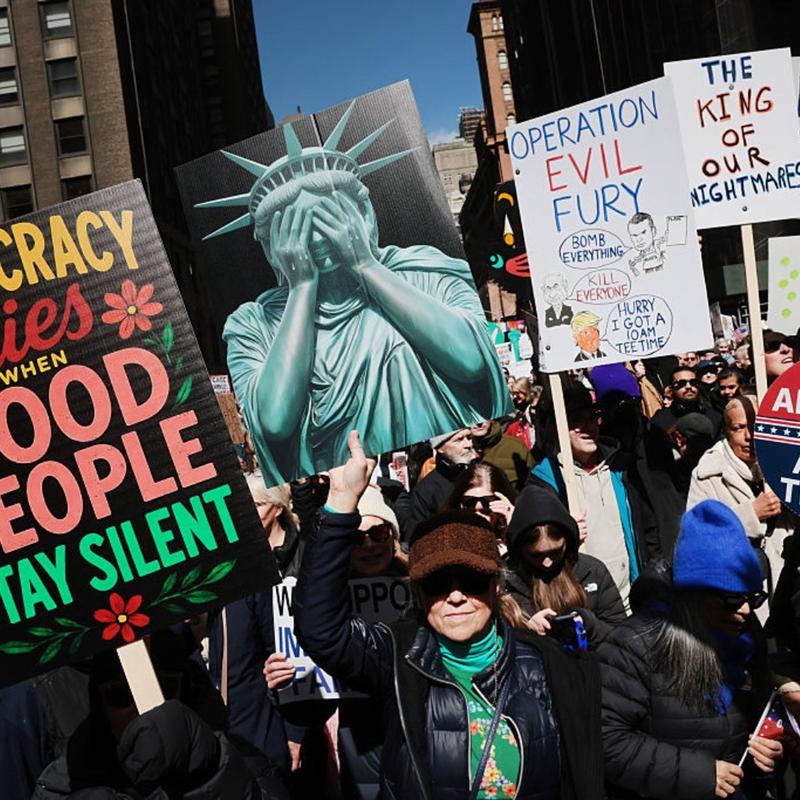
Brian Lehrer: It's The Brian Lehrer Show on WNYC. Good morning, everyone. Well, it was a weekend for the base of each party to make their voices heard. The Republican base at CPAC, the Conservative Political Action Conference in Grapevine, Texas, the Democratic base joined, they hoped, by many people in the center on the streets in every state, with the third No Kings Day protests. At CPAC, some speakers opposed President Trump's war in Iran, but reports are that most attendees embraced it. Here's a clip from the speech by Reza Pahlavi, who wants to be the new leader of Iran.
He's the son, as some of you know, of the late Shah of Iran, who the United States supported before the 1979 revolution and who the United States helped install with a CIA-backed coup in 1953. You will hear Pahlavi urge Trump to escalate the war until he topples the regime, not just degrades their military, and the crowd will cheer.
Reza Pahlavi: The path which finishes the job once and for all will leave a legacy of peace and prosperity that historians and scriptwriters could only dream of. That legacy will belong to the heroic people of Iran and to the only president of the United States who had the courage and the character to see this mission through.
[applause]
Brian Lehrer: "See this mission through." CPAC heard cheering for a more aggressive war in Iran. The No Kings Day protests around the country obviously included opposition to the war, also to Trump's immigration enforcement, attempts to make voting harder and more, and, underlying it, opposition to authoritarian tactics to implement those policies. Hence the name, No Kings Day, obviously. One major rally was in Minnesota in the Twin Cities, where protesters Renee Good and Alex Preti were killed by ICE agents this year, as you know, and where Bruce Springsteen sang a song he wrote in response.
[MUSIC - Bruce Springsteen: Streets of Minneapolis]
Brian Lehrer: Bruce Springsteen in Minneapolis. With us now, Leah Greenberg, co-founder and co-executive director of the progressive political group Indivisible, which has organized the No Kings Day. Did I say something different? Somebody told me I said the wrong word. The group Indivisible, which has organized the No Kings Day. Leah, thank you for coming on with us. Welcome to WNYC today.
Leah Greenberg: Pleasure to be here.
Brian Lehrer: Listeners, this is for you, too. If you were at a No Kings Day event on Saturday in New York, where we are, or anywhere else in the US or the world, you're invited to call or text to say what you were mostly there to express. 212-433-WNYC, 212-433-9692. Also, tell us why you think this can matter to the cause or what comes next. If anyone wants to push back on the messages of No Kings Day, maybe you were at CPAC, you can call or text, too. 212-433-WNYC, 212-433-9692, or anyone with a question. Questions always and certainly welcome. Today, for our No Kings Day leader guest, Leah Greenberg, co-founder and co-executive director of the progressive political group Indivisible, which has organized the No Kings Days. 212-433-WNYC. Leah, how'd it go from your perspective?
Leah Greenberg: From our perspective, it was an extraordinary day of mass defiance. It was the largest single-day protest in American history, with more than 8 million people turning out across 3,300 protests around the country and around the world on all continents. It was a demonstration of the extraordinary breadth and depth of their outrage at Donald Trump, at the MAGA coalition, at their secret police terrorizing our communities, at illegal and catastrophic wars abroad that are hurting innocent people and driving up our costs. What we saw was that this form of Trumpism is being rejected pretty much everywhere and en masse.
Brian Lehrer: A lot of what I saw, a lot of what I've been hearing, is opposition to the policies, the immigration policy, the war policy. People brought up the economy, but that's different than being opposed to authoritarianism. Did the "kings" part of No Kings Day get lost at all this year?
Leah Greenberg: Fundamentally, No Kings is a metaphor. It is a frame for imperious, unaccountable governance that doesn't take into account what the population wants, what the people actually are looking to for their leadership. When we talk about immigration, we talk about sending masked secret police into communities that do not want them and that are trying to protect each other.
When we talk about launching a war that nobody in America wants without Congress's consent, without trying to buy the American people in, that's immediately pulling expenses from our healthcare and our schools to pay for bombs abroad. Those are all examples to us of the way that Donald Trump has governed, which is as if he thinks he's a king.
Brian Lehrer: Where did you protest?
Leah Greenberg: I was in the Twin Cities. I was proud to be around a crowd of around 200,000 people who really, I think, speak to the best of America and who were very powerfully out, ready to once again protect and support their neighbors.
Brian Lehrer: Do you think it matters to the movement, maybe even hurts the movement, a contrarian version of that, that celebrities like Springsteen, Jane Fonda, Robert De Niro were prominent in the press coverage or were prominent in some of the rallies?
Leah Greenberg: I think it shows that this is a broad movement that attracts people from all walks of life. I think anytime The Boss is willing to come to your protest, is willing to come to be with the people of the Twin Cities who have gone through so much, I think it was a powerful demonstration of the fact that we are building collectively together a broad cross America coalition. One of the really extraordinary things about the stats this time, as we were looking through who's showing up and where are they showing up, is that about two-thirds of our RSVPs this time were actually coming from outside of major urban centers.
We are seeing massive growth in the discontent with Trump and Trumpism in suburban and rural areas, not just the big blue cities where you see the big footage of the crowd by drone, but in little tiny towns in red areas. There are people everywhere who are collectively disgusted and horrified and starting to organize.
Brian Lehrer: We have a lot of calls and texts coming in. Let's hear from some people who mostly participated in No Kings Day protests in various places. Here's Joytina in Bayville, Long Island. You're on WNYC. Hello, Joytina.
Joytina: Hello. Thank you so much for taking my call. Can you hear me?
Brian Lehrer: Yes. Turn your radio off so you're not getting feedback coming back 10 seconds later. Where were you on Saturday?
Joytina: Okay, great. I was in Mineola in front of the Nassau Courthouse, and the numbers were great. Can I--
Brian Lehrer: I think you've still got a radio going there.
Joytina: Hello?
Brian Lehrer: You've still got a radio going there.
Joytina: Turn the radio off?
Brian Lehrer: Yes, turn the radio off. You're hearing yourself 10 seconds on delay.
Joytina: Okay, great.
Brian Lehrer: If you say a word we're not allowed to say, we can bleep you out, but go ahead.
Joytina: I was in Mineola in front of the Nassau Courthouse, and the day was beautiful. The crowd was exuberant. As I spoke to the person on the phone, I couldn't help feeling that until Congress moves, we feel good for the moment, but nothing can happen until they stop Trump and the policies of this administration. The one thing that was so wonderful was that there was a food drive, and the outpouring was amazing. They collected so much food, so people felt like they could at least do something to help somebody.
Brian Lehrer: Joytina, thank you very much. Leah, what about that? That, of course, goes to the fundamental question that a lot of people are asking. How does this make a difference? It's always good in a country with freedom of speech that people can express themselves, but we don't see the Republicans doing anything differently in Congress as a result, or the president doing anything differently, unless you disagree.
Leah Greenberg: I think her comments actually really capture a bunch of the key features and purposes of No Kings because, first of all, it is a mass demonstration of defiance. It is a signal that opposition to Trump and Trumpism reaches everywhere in a way that should make Republicans nervous. Even if they're too locked into the MAGA coalition to change what they're doing, it should put them on notice that even in their home turf in red and rural areas, there are people who are organizing and who are going to push back and who are going to show up, knock doors, and canvas, and get for the vote out on Election Day as well.
Second, it's actually a massive community recruitment and organizing vehicle. She talked about a mutual aid food drive. That is the ongoing work that the people who organize these events are regularly doing. Each No Kings is an opportunity to recruit a large number of new people in because, fundamentally, we got a lot of people who come out to a No Kings because it is the first time they've ever been to a protest.
Our goal is to make sure that that is not the last political engagement that you do, that it is the first step to getting into an in-real-life relationship in your own community with an organizing vehicle that can help you do more, whether that is immigrant defense work, whether that is mutual aid and support of your community, whether that is advocacy to hold Congress accountable. It's all an ongoing cycle of getting more people involved in civic engagement because that is fundamentally how we will change power in this country.
Brian Lehrer: Martin in Red Bank, you're on WNYC. Hello, Martin.
Martin: Hello. I'm very concerned, and I did the No Kings in Freehold, New Jersey. We had about 2,000 people there, and it's our ninth one, and it's not just No Kings. We've been doing others, but I think the No Kings movement is really awesome, and I'd like to tell you why I was there. I was there because Donald Trump seems to be looking forward to an autocratic regime. I fear that he's going to do something for the midterms to neutralize the vote. He already lopped the head off the DOJ and the CIA, the FBI, which is typical of an autocratic regime. Then he defunded WNYC and journalism. They got rid of Stars and Stripes, not rid of it, but they're on their strict rules now.
Brian Lehrer: The military newspaper. Martin, thank you for that. It goes to a question I was asking you before, Leah. In a way, if No Kings Day really meant No Kings Day, no authoritarianism at its core, maybe people would've been emphasizing things like the politicization of the Justice Department and justice in America, therefore the attacks on journalism, the attacks on academic freedom, more than whether you like this policy or that policy.
Leah Greenberg: I would take it a step back and talk about the strategic rationale that led us to start No Kings back last year, because fundamentally what we saw last year with Donald Trump taking office was a very rapid effort at autocratic consolidation, where there was a determined attempt to consolidate power at the federal level to shut down and bully and intimidate alternate sources of power. When you look at their shakedowns of corporations, when you look at the tech companies rushing to bend the knee, when you look at their attacks on universities and freedom of the press and media, on law firms, all of these were part of the same plan to basically compel American society into compliance and obedience with an authoritarian regime.
The original thinking behind No Kings in June of 2025 was, we need to demonstrate that the opposition to Trump is really actually everywhere in the country, that it is big, that it is broad, that it is growing. We need to invite a lot of people in. We need to tell them that they don't need to be afraid, and we need to ask them to take on more as we collectively build towards mass defiance. That was the original theory of the case. Every individual, No Kings is an invitation to people to bring the things that are most animating them to the events, to the stories, to the speaking agendas, to make it about our collective fight together to uphold our values as a democracy, the kind of society we want to live in.
We're not going to try and have an individual protest on every single thing that Donald Trump is doing, because we would be protesting five times a day every day, and we would burn ourselves out. What we're going to do is have a massive show of force where we actually hold up everything that we are concerned about together as a collective movement in solidarity. You might come because you are concerned about the war. I might come because I'm concerned about civil rights. Someone else might be out here because DOGE cuts have really endangered their community.
That is all collectively part of the same story of a president who is out of control, does not believe himself to be accountable to the people, is shaking down the US government for his own personal benefit, and is making all of us less safe, less free, and poorer.
Brian Lehrer: A listener writes, "I'm a member of Indivisible and was in Paris on vacation on Saturday. I was walking near Notre Dame Cathedral on Saturday afternoon and came across several hundred, possibly a thousand, disciplined, peaceful No Kings marchers with signs in many languages. We waved and cheered enthusiastically as they passed us. What a wonderful end to a great vacation." That's from a listener who was on vacation in Paris. Do you have other reports from these taking place even outside the United States?
Leah Greenberg: Oh, yes. We've got reports of No Kings protests on all seven continents, including Antarctica. What we are seeing is that backlash to Trump is global. It is nearly universal that there is just horror at what is being done, at the role the US is playing. There is enormous concern about this illegal, catastrophic war and the ways that it is imperiling people all around the world. What we saw was that people came out pretty much everywhere.
Brian Lehrer: Here's a listener who writes, "I've attended all three No Kings demonstrations here in Republican Sussex County," it's western New Jersey, "and turned 90 yesterday." This person says, "Loved these days because so many who are in agreement, hate not there. Anger was, though. Loved signs. A favorite, 'DEI stands for Donald Employs Idiots,' and the only monarchs that are here--" Oh, I have a better version of that in a photograph that somebody sent me. "The only orange monarch I'm interested in is a butterfly." Leah, you could say some of your favorite signs if you had any, but then I'm going to ask you about something that that listener wrote.
Leah Greenberg: One of the things that I love about No Kings is that people bring their own creativity, their funny signs, their unicorn and frog costumes, their joy, and their passion to the work, because fundamentally, when we are doing one of these, it is designed to invite people into something that is irresistible, that is joyful, that is an invitation to feel their own power. Part of that is inviting people to be funny.
Brian Lehrer: Here are some other photographs of signs that a photographer I know sent me. One of the shots has a few different teardrop-shaped, like water-droplet-shaped signs, and they say, "ICE melts." Another one says, "Shut down this Lyin' King," L-Y-I-N, apostrophe "Lyin' King." "Shut down this Lyin' King." Another one, the classic Smokey Bear, "Only you can prevent forest fires," photograph or image, but the caption says, "Only you can prevent fascism." Those are a few from the New York rally that a photographer I know sent.
I said I was going to come back to something that that texter wrote. She mentioned that she turned 90, and we have this other text that says-- sorry, I had it a minute ago. Here we go. This is from a Manhattan protester. "The crowd was huge, my third time attending, but the demographics this time were disappointing or even alarming. I'm 78, and most of the crowd was around 60-plus years old, and also almost 98% white. I stopped in at the Museum of Modern Art on the way home, and it was packed with 20-somethings."
Now, I will say, Leah, even before you respond, that I've seen other coverage that says there were more younger people this time than at the first two No Kings Days, but in general, it's still an older crowd, a very white crowd. What does that mean to you?
Leah Greenberg: I think we have to think about the context in which we're operating in. The Trump administration has made racial profiling a state policy through its secret police force. We are coming off of an era of extraordinarily serious crackdowns on students who have protested on campuses against the Gaza genocide. We have seen a lot of organized repression of both youth protests and of people of color who have been protesting. One of the conversations that we have with our own activists, for folks who are white, who are older, who might be more settled in their lives, is this is a moment when it's really important for us collectively to show up.
Those of us who think we're going to be less vulnerable to police repression, those of us who think we're going to be able to use our privilege in this moment, this is a moment where it's incumbent on us. If we don't want what is happening, what is being done in our names to stand, we actually have to collectively organize and be in the streets. With every protest, we try to reach out. We try to build bigger. We have definitely gotten a lot of reports suggesting that there was more demographic diversity, more youth diversity in this protest. We also think that's going to be a continuing work in progress. Fundamentally, what we think is important is just to continue to build and deepen those ties with every action we do.
Brian Lehrer: I'll just note that some people dispute the application of the word genocide to the war in Gaza. A listener writes, "Hello, I was at the Doylestown, Pennsylvania, No Kings protest, the largest I've seen since the '80s Dump the Pump rally. My chief issue: due process for all. It's fundamental to several of the illegal excesses of the Trump regime, from immigration to secret police, no ID masks, to attack on free press and speech, to voting rights, et cetera."
Another person writes, "I was at the protest in very red Apache Junction, Arizona. We had a big turnout for a small MAGA town. Many of us were surprised to see people who agree with us, whether they were fellow protesters or drivers who honked their horns and gave us thumbs up, or even showed supportive signs in a right-wing area. It was heartening to see rainbow and trans flags and all kinds of people, though most were elderly in a retirement area in Arizona." John in Essex County, New Jersey, you're on WNYC. Hi, John.
John: Thank you, Brian Lehrer. Long-time listener, first-time caller.
Brian Lehrer: Glad you're on.
John: I really appreciate it. Yes, I marched in West Caldwell, New Jersey, with my wife, Holly. I think there were certainly more people protesting, but what I really noticed was in prior protests, there were always a number of people driving by expressing their disapproval, often with an obscene gesture. There were also people that would come by and honk support. What I noticed this time is that there were very, very few people driving by and expressing their disapproval, and a huge number of people that were driving by expressing their approval, beeping their horns in support, and waving. To me, it heartened me that the support for No Kings and what they represent is expanding in the number of people who may not protest, but who support what it is it stands for.
Brian Lehrer: John, thank you very much. Another listener writes in response to our exchange about demographics of these rallies. The listener writes, "I'm older and white. I know I need to put my body out there, and that many people of color would be at much greater risk." Rachel in Nyack, you're on WNYC. Hello, Rachel.
Rachel: Hi. Thank you so much for taking my call. I was in Nyack for the No Kings. It was lovely. I was on one side of the river, Indivisible Rockland, and then as well in Westchester, had people on the Tarrytown side. It was like a call and response.
Brian Lehrer: Right. For people who don't know where Nyack and Tarrytown are, that's the towns on either side of the Tappan Zee Bridge. Go ahead, Rachel. Sorry.
Rachel: Exactly. Yes. That was really lovely. Besides that, really importantly for me, no kings, no autocratic regime. This week was a really intense week for me. I do stay very updated. The year that we now have a president who's not only putting his signature on a dollar bill, but we are going to have a coin, a $1 coin, with his picture on it, the first time ever that we will have a currency with both the picture of a living president and the signature of our president. Both terrifying things to me because that's what they do in both monarchies and autocracies.
Then the other thing is the way that he's weaponizing the court this week as well, and calling them treasonous. The judges that don't agree with the things that he agrees are treasonous and criminals. I think that those are also things that kings do. I just think that those are two things in the past week that remind us what this movement was about and what we're trying to stop. Where we go from here-
Brian Lehrer: Go ahead.
Rachel: -it's up to Congress. I worry also that he's going to try and do something like your past caller said during the election.
Brian Lehrer: Right. A very No Kings caller, Leah, indicating that story in the last few days about Trump saying he's going to put his signature on US currency now. He would be the first president to do that. Calling judges who rule against him on things traitors or treasonous. Of course, the ways that he might try to stop free and fair voting in the midterm elections. Then she concluded by saying, "Now it's up to Congress." We're getting a few texts like this, Leah. A listener writes, "I showed up for protests in New York and New Jersey Saturday. We not only have to show up, we have to act. We are the two-thirds supermajority of the electorate that did not support this man. We have to pressure our representatives and leave them no choice but to support." Then this listener calls for impeachment.
On this notion of putting other pressure on members of Congress so that the rallies won't just be expressions of people's thoughts and feelings, I saw you quoted as being involved with planning a nationwide general strike for May Day, May 1st, described as, "No work, no school, no shopping." Do I have that right?
Leah Greenberg: We're calling for "No Business As Usual." What we're asking folks to do is to mobilize to however you can, stay home from work, desist from shopping, and that's right, stay out of school and to collectively test our economic power and flex our muscle as a movement to protest the continued overreaches of this administration, to protest on behalf of workers everywhere in the spirit of May Day. Yes, we are part of that, and we are excited to build for it.
Brian Lehrer: How will you organize for that, and how will you measure the success of that? Certainly, you can say that No Kings Day 3 on Saturday was a success in that, by independent media accounts as well as your own claims, there seemed to be a good number of more people on Saturday than there were at the one in October or the one before that. You can measure success to some degree that way. What about this call for No Business As Usual on May 1st? How widespread would that have to be to be a success?
Leah Greenberg: Look, I'm superstitious. I don't put a number on how many people we're expecting before No Kings, and I'm not going to put a number on how many people we're going to aim to get out for May Day. What I will say is that we think a lot of people around the country are looking for ways to make their voices heard, some of whom maybe don't want to go to a protest, but are open to participating in something that they feel can really send a message to power, can send a message to billionaires, can send that message of No Business As Usual while the government is preying on its people.
Brian Lehrer: A listener writes, "My third No Kings. Each time I wear a Palestinian keffiyeh and hold some sort of pro-Palestine sign. What makes me the happiest is the abundance of older Jewish activists with Elder Jews for Palestine, so grateful for these brave people and important not to let what's still happening in Gaza be overlooked." Do you have examples of that in addition to the one that that listener just wrote about, people with different backgrounds and maybe primarily interested in different issues, or who may not be so obviously in unity with each other demographically or whatever, coming together at some of these marches?
Leah Greenberg: Absolutely. What we see is that people understand the call of No Kings as a broad call for freedom. When we talk about No Kings, we are talking about unconstitutional and illegal wars abroad. When we talk about No Kings, we are talking about freedom and justice for all people. When we talk about No Kings, we are talking about opposition to Trump's policies domestically and opposition to them abroad. We've absolutely seen a lot of overlap and a lot of coalition coming together, including some unlikely allies. Fundamentally, when we talk about this moment, we think that we are facing a would-be authoritarian who wants to consolidate power, crush us all, put us all in danger. What that means for us is that we want to organize to the left and to the right.
I regularly tell my folks the measure of how seriously you take this moment is that you are in coalition with people that you don't agree with on everything, because we're not trying to agree on exactly the top 10 points in the policy platform. We are trying to collectively stop fascism at home and abroad, and we can come together and find common ground on that, whether or not we're in alignment on everything else.
Brian Lehrer: Here's Jenny in Westchester, who I think did some protest-hopping on Saturday. Jenny, you're on WNYC. Hello.
Jenny: Thank you, Brian Lehrer, and thank you, Leah Greenberg, so much for all your leadership. I'm a co-leader of an Indivisible group in southern Westchester, and we organized our own local protest in New Rochelle. There are other grassroots protests that have been taking place weekly in Larchmont and Mamaroneck for the past year. We promoted all three of those protests. I think I fibbed with your screener because I said I attended all three of those. I actually attended two of them, helped promote and organized the other one, and then we had a whole group of us that took the train to New York City for the big march.
What I want to say about the No Kings, to reinforce what Leah said, is this is all about recruitment for people to do more actions. For example, the protests in Nyack and Tarrytown was very successful as an event, but it is also a recruitment tool to get people to help mobilize against Congressman Mike Lawler. That's the heart of his district. He's up in November, and everybody wants him out. I'm in southern Westchester, where it's very blue.
We are going to be mobilizing people through the No Kings and the weekly protests to get them to go to CD 17, where Mike Lawler is representing, and to help canvas and spread the word that he must be replaced. That's just one other example of what No Kings is good for. It's not just a feel-good party, though it is that it gives everybody joy and motivation, but it's also a means to an end. May 1st is the next step, and then the elections.
Brian Lehrer: Jenny, thank you very much. That's a very interesting call, Leah, I think. If you're just joining us, our guest for just another few minutes is Leah Greenberg, co-founder and co-executive director of the progressive organization Indivisible, which organized the No Kings rallies. One of the ways that it might wind up being very tangible is in helping to mobilize turnout in swing districts like the one she was describing, where Republican Mike Lawler is the incumbent member of Congress right now. I will say that Mara Liasson, political analyst for NPR, over the weekend, said that's one way that there could be an impact from the turnout, that it's a sign of Democratic Party enthusiasm.
It may be more likely as a result of events like these that Democrats actually show up at the polls in November and potentially thereby have an impact that helps change the outcome in some of the swing districts. To what degree is that the point?
Leah Greenberg: Look, No Kings is a nonpartisan coalition. It's got a lot of folks involved who are very clearly thinking now about how do they flex their electoral power at the polls as well. We know that there is a long-standing and well-established relationship between protest and electoral outcomes. There have been fascinating studies of both Tea Party protests and Women's March protests in 2017, where the researchers look at places that had a protest scheduled, and it happened, versus places that had a protest scheduled, and it was rained out.
It's your classic randomized control sample. What they find is that there are measurable, significant differentials in voter turnout based on whether the place actually had those protests, whether they had those mobilizing events that get a lot of attention, that signal local disapproval, that bring together new coalitions of people working together, and that recruit all of those attendees into ongoing engagement to turn out their own communities and neighbors. What we know is that these events, they kick off a lot of local organizing in the lead-up. They kick off a lot of local recruitment and ongoing absorption in the follow-on, and that has measurable electoral impacts.
Brian Lehrer: Here's some pushback texts, all from different phone numbers. One says, "Your dopey listeners are out protesting for illegal aliens." Another one says, "If I dared to carry an Israeli flag, I would've been mauled." Another one says, "In Canada, they need to show voter ID." You can respond to any of those individually if you want, but my question around those and the cluster that we're getting of some like that, do the No Kings marches risk alienating people and backfiring in that way?
Leah Greenberg: I think the proof is in the pudding. What we are seeing is that each time we do one of these, it grows. I cannot speak proudly enough about what an extraordinary coalition is collectively coming together to put these on. It is our organization, but it is so many incredible partners. It is over 200, 300 national and state organizations putting this together. Extraordinary participation and involvement from the labor movement, including our friends at AFL-CIO, AFT, SEIU, so many more. We are collectively seeing faith leaders, civil rights organizations, veterans organizations.
What we are seeing is a broad-based societal backlash to imperious, unaccountable governance that threatens all of us, our freedoms, our lives, our safety, and our neighbors. What we are seeing is that every time we do one of these, as one of the previous callers noted, more people come out and fewer people respond negatively. There are fewer negative reactions because, fundamentally, Donald Trump is losing support. His support is being chipped away at or is bleeding on a daily basis because of his own actions, because of the harm he is causing to his own coalition. Our support is growing as we invite more people in.
Brian Lehrer: When's the next No Kings Day, or don't know yet?
Leah Greenberg: We have not set a next No Kings Day. Like I said, each of these is a massive recruitment and absorption moment. Now we really focus in on what does it take to turn all of this energy into ongoing local activism and engagement. We're excited for May Day. We are going to continue to build, but we're going to have to work with everybody across that incredible coalition to figure out what the next day is, then when we all show up together.
Brian Lehrer: About May Day, a listener texts, "Will you support boycotting small businesses?"
Leah Greenberg: I think everyone is going to have to determine their own bounds on this one. Fundamentally, what we are talking about is a day in which we flex our economic power as workers, as consumers, as students, in whatever ways are necessary to get the attention of our elected officials and of corporations that take us for granted.
Brian Lehrer: A little bit of pushback from maybe the left of you. A listener writes, "Many of the younger, mostly queer, and people of color activists I'm involved with and who I follow online have expressed some disappointment in the No Kings movement because of its perception as sanctioned by the fact that many of them have permits to operate, and police are invited to be present by the organizers. Police are not our friends, and we've seen how they react to protests that have the potential to cause real upheaval, such as Black Lives Matter protests, pro-Palestine protests, anti-ICE protests, et cetera." What do you say to that listener who thinks, I guess, that you went too mainstream and establishment on this?
Leah Greenberg: I think it's important to think of No Kings as one tactic in a broader strategy about fostering mass defiance. We are creating, once a quarter, once every several months, a space where there is a collective, mass popular disapproval signaled of the Trump administration, where there is a message sent to all of our elected officials, Republican and Democratic, that we expect them to fight hard against it, or else there will be consequences. Where we invite people who are new into an on-ramp to activism and engagement that is going to look different in different places, but really is aimed at how do we actually show up?
How do we protect ourselves? How do we protect each other, and how do we fight back against this extraordinarily harmful governance? What I would say is we definitely recognize that it's not going to be for everyone. Also, we want to use these as one of the tactics in the broader toolkit of popular opposition to this administration's attacks on our lives and our neighbors.
Brian Lehrer: Leah Greenberg, co-founder and co-executive director of the progressive organization Indivisible, which organized Saturday's No Kings rallies all around the country and even around the world. I really appreciate that you gave us this time today after what I'm sure has been an incredibly busy and nonstop weekend for you. Thank you very much for coming on.
Leah Greenberg: It's great to be here. Thank you.
Copyright © 2026 New York Public Radio. All rights reserved. Visit our website terms of use at www.wnyc.org for further information.
New York Public Radio transcripts are created on a rush deadline, often by contractors. This text may not be in its final form and may be updated or revised in the future. Accuracy and availability may vary. The authoritative record of New York Public Radio’s programming is the audio record.
