
Robert Mueller's Legacy
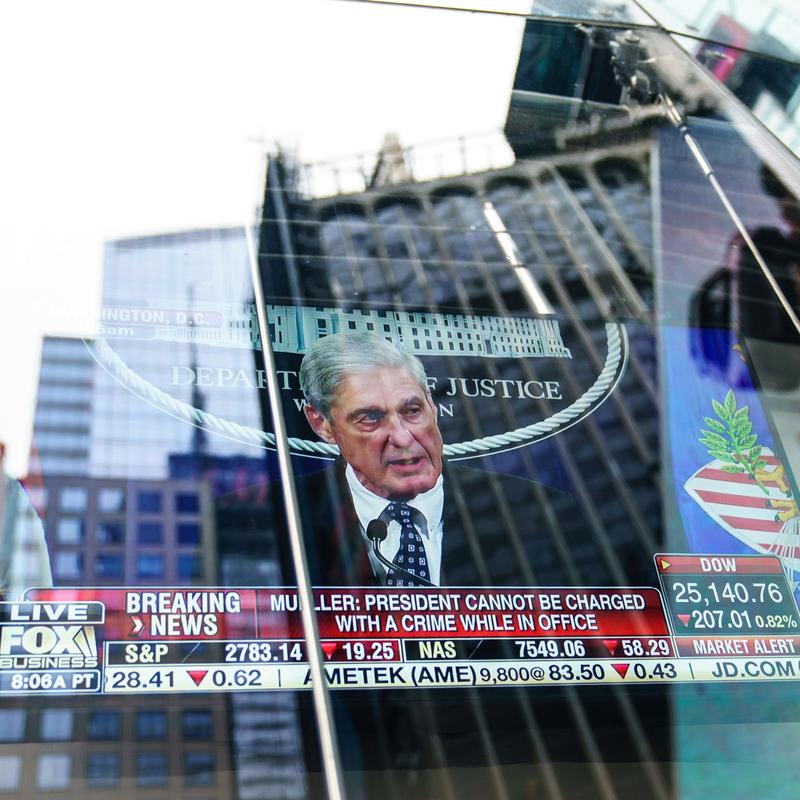
Brian Lehrer: Brian Lehrer on WNYC. With the passing announced this weekend of former FBI director and Vietnam veteran Robert Mueller, best known in his later years as leading the so-called Mueller investigation of the first Trump presidential campaign's involvement with Russia, also known as the Russia investigation. We'll get some thoughts now from a lead prosecutor on Mueller's investigating team. After that investigation, Andrew Weissmann wrote the best-selling book called Where Law Ends: Inside the Mueller Investigation.
In that book, Weissmann was fairly critical of Mueller largely for being too cautious in that probe, leading to conclusions that may have been too much of letting Trump off the hook. Andrew Weissmann has also been general counsel for the FBI under Mueller, co-hosts the MS NOW podcast called Main Justice, and has a new book coming out in May called Liar's Kingdom: How to Stop Trump's Deceit and Save America. Andrew, we appreciate that you're giving us some time today. Welcome back to WNYC.
Andrew Weissmann: Nice to be here, Brian.
Brian Lehrer: Before we get to the Mueller investigation and his legacy around that, would you like to eulogize the man a little more broadly first? You knew him for a long time and before he became a household name in relation to Donald Trump.
Andrew Weissmann: Sure. Well, I think people know that he devoted his life to public service. As you noted, he was in the Marines and was a decorated Marine. He is somebody who volunteered to be in the military after growing up in a very well-to-do background, having gone to Princeton, and then chose to serve his country. He then chose to serve his country throughout his life, dedicating his time to not being in private practice but to serving all of us from beginning to end.
One thing I think is worth noting is a lot of people have said, with his passing, that he's sort of a dying breed in terms of somebody who lived such an upright life and a man of principle. The one thing I would take note is that he has instilled in generations of people in the Department of Justice, where he was revered by me and many, many others. He's instilled all of those values in so many people, and I feel like that is part of his legacy.
Brian Lehrer: Though we should say that Mr. Mueller was critical of your book, I read quotes of him calling it disappointing and based on incomplete information. In the book, you characterize Mueller's final report as mealy-mouthed, among other things. Can you give us a short reminder of why you described it that way? Did it have anything to do with what you just praised him for, that kind of maybe old-world version of being a straight-up guy?
Andrew Weissmann: I disagreed with him on certain decisions he made. I don't purport to have the same amount of information that he had or the big picture that he had. An example is that I thought that our report should have reached a conclusion with respect to each of the areas that we were tasked to investigate. For instance, whether the president had obstructed our investigation. While I disagreed with Mueller for various reasons, I do think it's important to note that my disagreement with him was, I think, good faith on both sides.
I think it's important to note that the reason that Director Mueller, then Special Counsel Mueller, thought that there shouldn't be a conclusion is out of fairness to Donald Trump in that because the special counsel was not able to actually bring a criminal case because of Department of Justice rules, in other words, you cannot indict, under Department of Justice rules, a sitting president, he did not think it was fair or appropriate to reach a conclusion that the president would not be able to refute in court. That comes out of a deep sense of due process and fairness and justice.
My disagreement was that I thought that was a decision for the Attorney General to make, and that the special counsel was supposed to issue a report to the Attorney General. I'm getting very much in the weeds, but I want to make sure that the issue of the disagreement about how one would have gone about doing things has nothing to do with his being or not being a man of principle and a person who cares deeply about the rule of law and justice in America.
Brian Lehrer: Well, they did ultimately indict quite a few people, mostly Russians, but also Trump campaign leader Paul Manafort and retired General Michael Flynn, who was briefly Trump's first national security adviser. To your eye, if there had been a more conclusive Mueller report, would it have said that the underlying suspicion about Trump breaking the law by colluding with Russia in the campaign ultimately proved to be founded, or what kind of involvement with Russia would have actually been a crime?
Andrew Weissmann: There were three things that we were looking at. One was the issue of what Russia was doing, and that's something that I think is beyond peradventure that we concluded that Russia was trying to interfere in the election, and it was trying to do so in favor of Donald Trump. A bipartisan Senate report found the exact same thing. I think Russia has actually admitted that they wanted to see Trump win. That was thing one.
Thing two is whether there was any coordination with the Trump campaign. Thing three was whether Donald Trump in any way obstructed our investigation. With respect to the second issue, the report concluded that there was insufficient evidence of that coordination, that yes, the Trump campaign wanted it, wanted that help, yes, that the Russians wanted to give that help, but there just never was a meeting of the minds. I'm giving you a shorthand.
With respect to obstruction, the third thing, that is where I thought there was mealy math language, where it was very hard to follow. I think it became double or even triple negatives. I thought that was where the report could have been just straight out and said either we think there was obstruction or we didn't. I think the consensus, in my view, would have been that there was obstruction. I think that Director Mueller, when he testified, testified that there were statements that he thought were made by the president to the special counsels, often writing that he thought were not true. That's where I think that more could have been said.
I think this is obviously such a huge issue in terms of the last thing that Robert Mueller did as a public servant. I think it's really important to put it in perspective of his entire career, serving for 12 years as the director of the FBI and before that as an ssistant United States attorney, as head of the criminal division, having done so much for the country and having served and started the bureau just one week before 9/11, and having to take on really transforming the bureau into an intelligence agency, to be forward-looking and to be thinking about prevention, not just prosecution after the fact.
Just a remarkable career and man. It's hard when you haven't worked with him to understand just how deep his commitment was to justice and fairness. He drove himself harder than anyone in terms of what he felt was the obligation to the public that you have as a public servant, and that he viewed it as a complete privilege to be in that position and one that he took seriously every single day, and you felt it being in his presence.
Brian Lehrer: Good to remember the fullness of his career in that way. Even as I guess you framed it before, his sense of fairness, leading to pulling the punches, if I can call it that, that you became critical of him for. A lot of people at the time heard this one clip of Trump during the 2016 campaign that I'm going to replay now and thought, "Well, why doesn't that prove it on its face this thing that he said right out in public, way out loud, asking Russia to interfere or get involved in the election in this way?"
Trump: Russia, if you're listening, I hope you're able to find the 30,000 emails that are missing. I think you will probably be rewarded mightily by our press.
Brian Lehrer: It sounds like A, he's asking Russia to get involved, B, he's offering a quid pro quo. Well, he didn't say rewarded by my administration if I get elected. He said rewarded by the press. Nevertheless, why doesn't that in itself constitute a crime of soliciting election interference by a foreign adversary?
Andrew Weissmann: That is not necessarily soliciting interference as opposed to finding emails. To be clear, if you read a very lengthy report that was issued, and unlike Jack Smith's report, which has been kept partially under wraps by Judge Cannon, you can read our entire report; there's no question that Russia was doing things to interfere in the election and was doing it primarily to help Donald Trump. There is also, as we found in the report states, no question that there were people in the Trump campaign who wanted that foreign help.
You can also go back to not just the clip that you played, but also the Trump Tower meeting, where one of Donald Trump's children was saying that it would be very much helpful to have that and particularly noted a time period where it would be particularly helpful to have that assistance. In order to have a criminal conspiracy, among other things, you have to have a meeting of the minds of the principals that you're going to have that interference and not just simply somebody wants something and is doing stuff on one side, and somebody on the other side is acting in a way that's in conformity that there isn't actually a criminal conspiracy.
I know for many people they're going to think, "Isn't that tantamount to being so close to a conspiracy?" That close doesn't work when you're talking about criminal liability where you-- That's one of the reasons the report says there was insufficient evidence, not no evidence, but insufficient evidence. We lay out all of the types of proof, but says this would be insufficient to prove a case beyond a reasonable doubt, which is the standard.
For those people who think that that is pulling your punches, I would just note that the standard that Robert Mueller was looking at was in contrast to what we're seeing today, where you saw the prosecution of Letitia James or James Comey, where, in my view, those cases were never going to be, based on the public evidence, be able to be proved beyond a reasonable doubt.
I think it's worth contrasting that, which is that you want somebody who's in government who takes that standard deeply and isn't going to charge somebody unless and until they feel like they can prove that with that level of certitude and isn't just going to charge somebody just for the sake of charging them, even though it's fanciful to think that there ever would be a successful criminal case.
Brian Lehrer: I mentioned in the intro that Mueller, who has now passed at age 81, said your book was disappointing to him and based on incomplete information. Did you and he, for all the work that you did do together over quite a few years, end on bad terms?
Andrew Weissmann: I don't think so. I mean, I knew that he is a man who, as you know, does not speak to the press and doesn't like even testifying in Congress, even when he had to. He's a very private person. I knew that my view, which was that I thought for history, it was really important to have a document from an insider of what we did so people could assess it. I think I was trying to be as critical of ourselves and not just be critical of what I thought the Trump administration was doing.
Even though that's not his style and way of interacting with the public, I do think that when I wrote it, I was very much thinking about how he would perceive the honesty of what I was saying, even if he disagreed ultimately with the judgments. Just to be fair, he's the boss. I mean, he gets to make those decisions. He had a lifetime of experience and judgment that far exceeded mine.
Brian Lehrer: Trump said this weekend, pretty disgustingly, to almost anybody's ears, he wrote, "Good, I'm glad he's dead. He can no longer hurt innocent people." On one level, I mean, can you imagine the reaction of people said that about anyone in Trump world, or if Obama or someone else had said that about anybody? I want to give you the opportunity to react to that personally. Also, the Mueller investigation, as we've been discussing, ultimately seemed to help Trump politically more than it hurt him, making this he can no longer hurt innocent people even more crass. Anything you want to say about that?
Andrew Weissmann: There's so much time that we have going forward to talk about Donald Trump. I think this is a moment to talk about Robert Mueller and his legacy. If we have time, I'm going to give you just one quick anecdote. I remember when I was working for Robert Mueller as general counsel of the FBI, and the FBI had some training material that was to say unfortunate is an understatement in terms of what it said about Muslims and how to train people with respect to the Muslim community. We did a thorough investigation at Robert Mueller's insistence.
What then happened is he met with Muslim leaders who he invited to the bureau. He canceled all of his meetings that day, sat down with them, answered personally each and every question as to what had happened, what was found, what was being done. He insisted he was not interrupted until each person had an opportunity to ask every question and get an answer from him. He wasn't going to have it delegated to anyone else.
He also, in following the lead of Director Louis Freeh, who had insisted that FBI agents, as part of their training, go to the Holocaust Museum, also had agents go to mosques precisely so that they could be exposed to, on the one hand, what can happen in an authoritarian regime. That's the Holocaust Museum. Also, so they were exposed to different types of religions and understood the variety that is the strength of the United States. That's just one anecdote that gives you a sense of the man and his living his principles.
Brian Lehrer: On the Trump quote, somebody writes, "People did say," reminding me, "people did say that about Charlie Kirk." It was a huge kerfuffle for them, as the person writes. Obviously a backlash in that case when people said that about him. We're almost out of time. I will mention that I know you have a new book coming out in May. You are hereby officially invited to come on for a book interview at that time. I see it's going to be called Liar's Kingdom: How to Stop Trump's Deceit and Save America. Do you want to preview it with just a brief response?
Andrew Weissmann: Sure. It's about political lies in this country, and comparing how other countries around the world deal with the problem that we're facing with political lies. I'm not here to talk about my book today. I think it's wonderful that you've devoted this segment to Robert Mueller. I think he's such a wonderful model for all of us going forward, particularly people who think that our democracy is facing unique challenges and that it's important to live by principle and the rule of law. He has set that example for so many people in this country who revered him and still revere him and will hold that legacy of his in our hearts as we go forward.
Brian Lehrer: Andrew Weissmann, thank you very much. Talk to you in a couple of months.
Andrew Weissmann: Thank you.
Copyright © 2026 New York Public Radio. All rights reserved. Visit our website terms of use at www.wnyc.org for further information.
New York Public Radio transcripts are created on a rush deadline, often by contractors. This text may not be in its final form and may be updated or revised in the future. Accuracy and availability may vary. The authoritative record of New York Public Radio’s programming is the audio record.
