[music]
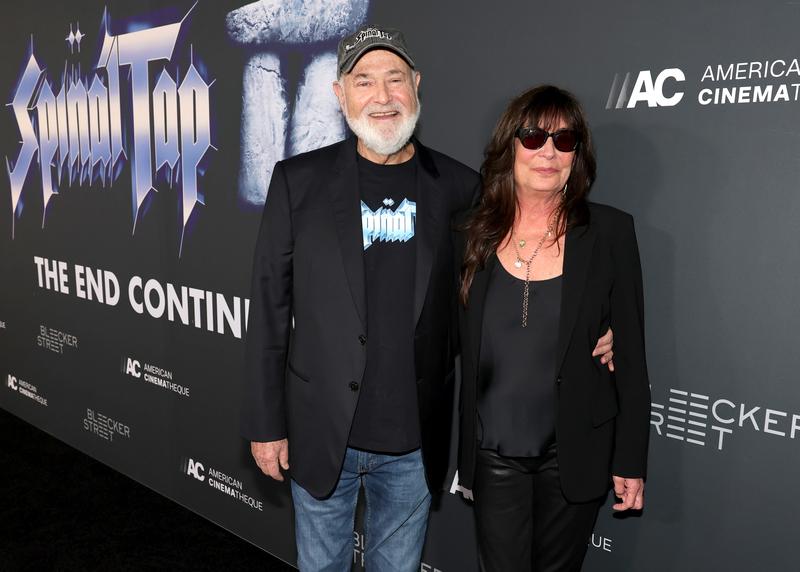
Brian Lehrer: Brian Lehrer on WNYC. The murder was obviously shocking. President Trump's reaction to the murder was obviously shocking. Let's remember Rob Reiner and his wife Michelle Singer Reiner, who had a significant career of her own and were both murdered in their home over the weekend, presumably by their son, so it seems. Listeners, what was your favorite Rob Reiner movie or other thing that he did? Who else wants to remember Rob Reiner for anything else, in particular? 212-433-WNYC, 433-9692. This is Spinal Tap, Stand By Me, The Princess Bride, When Harry Met Sally, A Few Good Men. Oh, yes, All in the Family.
Rob Reiner: This guy, and everybody knows it, is always putting this country down. As far as he's concerned, nothing is right unless it's left.
Carroll O'Connor: Hey, hey, I happen to believe in this country more than you do.
Rob Reiner: Why was that?
Carroll O'Connor: That's right, because I believe it's strong enough to accept some changes.
Rob Reiner: It ain't going to accept communism, buddy.
Carroll O'Connor: Who's talking about communism? I'm talking about civil rights.
Rob Reiner: That's communism.
[laughter]
Carroll O'Connor: You know something, your thinking is really Neanderthal.
Rob Reiner: Listen, you're going to talk to me, talk American, or clam up.
[laughter]
Brian Lehrer: Rob Reiner and Carroll O'Connor in the old classic sitcom All in the Family. With us, Richard Rushfield, chief columnist at The Ankler. Richard, thanks very much for joining us. Sorry, under these circumstances. Welcome to WNYC.
Richard Rushfield: Thanks very much for having me.
Brian Lehrer: Let's just dive right into the middle of this. I mean, his acting and directing career span such a wide range of genres. When you step back and look at it as a whole, do you see anything as a common thread or the thing that made a Rob Reiner film feel like a Rob Reiner film?
Richard Rushfield: The word that comes up with him on screen and off about everything he did, everything he touched, every room he was in was just humanity. That he just brought such a human warm presence to everything he did, whether it was as an actor or as a director, as a writer or as an activist, and just a presence in Hollywood. With All in the Family, which was probably the biggest TV show of the 1970s at a time when being a big TV show really meant something, it really hinged on that relationship between him as a young professor and his taxi driving father in law and Archie Bunker and how they came to every episode, they would find a way to relate to, understand each other, and have a larger concept of the world and that is what held that show together. He carried that through into his directing and his whole life beyond that.
Brian Lehrer: Let's take a remembrance from Jules in Greenpoint. You're on WNYC, Jules, thank you for calling in.
Jules: Hi, thanks for taking my call. Yes, I probably don't speak for only myself, but I feel like there's a Rob Reiner movie for every decade of my life. That's really close from Princess Bride to most recently him and The Bear. My big story was that the first day I ever went to school on my own, I took the bus, my dad put me on the bus, and he said, "Have fun. Storm in the castle." My 11 year old is just now started to go to school on his own a little bit. I think of that like every weekday.
Brian Lehrer: Ah, so you're thinking like a Rob Reiner movie for every decade of your life.
Jules: Yes, for sure. Now for my kid's life too.
Brian Lehrer: Yes. Jules, thank you. Something similar, I think, from Virginia in Midwood. Virginia, you're on WNYC. Thank you for calling. Virginia, you're there?
Virginia: Yes.
Brian Lehrer: Hi. Your remembrance--
Virginia: Turn off my radio.
Brian Lehrer: Oh, yes, turn off your radio and then go for it with your remembrance of Rob Reiner.
Virginia: Thank you, Brian. I grew up with All the Family on the TV, and Meathead was the one that spoke for us all. He was the voice of reason, so I liked him. Then when I was in college, Spinal Tap came out, and I'd seen all the Beatles movies and the Led Zeppelin movies, and every in-joke was perfect. I just thought, "He can do this too?" Then I just continued to like his work. I love Albert Brooks, and he made a movie about him, and I was just-- For everybody-- I work with kids who struggle with mental illness and addiction and stuff, and I just know a lot of people, and it just seemed like they as parents tried really, really hard. It was just heartbreaking that you can try that hard and it can just sometimes not work. You can't save your kid.
Brian Lehrer: I hear you, Virginia. Thank you very much. Thank you very much. I hear how you're relating to the tragedy. Also, the first two callers had a similar theme of Rob Reiner related through so many genres and through so many generations. Here's a little montage from a number of his films. Some of the famous lines.
Rob Reiner: You can't handle the truth.
Inigo Montoya: Hello, my name is Inigo Montoya. You killed my father. Prepare to die.
?Female Speaker: I'll have what she's having.
Brian Lehrer: There we go. Richard, you want to comment on either the callers or-- That was less there in the montage than I realized there was going to be. You still get the idea.
Richard Rushfield: I mean, he was almost a classic Hollywood filmmaker. That's why, for a lot of people, this is feeling like a passing of old Hollywood. He just was a great storyteller. He wasn't a pompous auteur, but he told these stories with wit and intelligence. They were dismissed at the time by some as middlebrow. You can see now they were great storytelling. They never talked down to anyone. He walked, whether it was great rom-com or courtroom drama, like A Few Good Men, he just applied with wit and humanity to everything he did, and just touched so many people in so many ways.
Brian Lehrer: Joni in Brooklyn, you're on WNYC. Hi, Joni.
Joni: Hi, Brian. It's a pleasure to talk to you. I just wanted to say I think Rob Reiner is an incredible filmmaker, and I was hoping we'd get another film from him. I went to photo school with Michelle back in the day. Michelle Singer.
Brian Lehrer: Uh-huh. You want to say anything about her?
Joni: She was a powerhouse even back then. My friend Sheila and I would hang out with her, and she was a very daring photographer. I was thrilled when I saw that she was photographing in movies.
Brian Lehrer: Somebody told me that she shot the cover of Trump's book, The Art of the Deal. Do you know that to be true?
Joni: Wow. I do not know that to be true.
Brian Lehrer: Joni, thank you for your call. Richard?
Richard Rushfield: Yes, I believe that is true. The famous story that he told also is that he wrote Harry Met Sally. It had a sad ending of them separating about the-- He was divorced and going through a difficult time about the impossibility of romantic relationships. Then he met her on the-- she working on the set of it, and fell in love and realized he had to change the ending to a happy ending because he saw that romantic relationships were possible.
Brian Lehrer: I don't want to ignore Rob Reiner as a public political figure. I'm going to ask you in a second how his activism intersected with his filmmaking. I think we have to at least mention this. Even a lot of Republicans are calling really grotesque reaction from President Trump when he posted, "A very sad thing happened last night in Hollywood. Rob Reiner, a tortured and struggling but once very talented movie director and comedy star, has passed away together with his wife Michelle, reportedly due to the anger he caused others through his massive, unyielding, and incurable affliction with a mind-crippling disease known as Trump Derangement Syndrome." It goes on from there.
Obviously, there is no reporting that indicates that he died from-- The implication there is that he inspired his son to be angry at him because he had Trump Derangement Syndrome. Oh my God.
Richard Rushfield: This is such a horrific tragedy. A person who was such a symbol of kindness and decency and warmth to come to such a horrible end, you just can't imagine anything worse. For anybody to have a reaction like that is just-- You just can't imagine that anyone's humanity could be so twisted that that would be your response. To have that come from the President of the United States is just unbelievable.
Brian Lehrer: Who's supposed to be the healer in chief? What else can we say? Did Rob Reiner's activism intersect with his films?
Richard Rushfield: Yes, I think as later on, his activism grew, and he was less focused on his filmmaking. His films are very much about a capital P, Progressive ideal of government doing good for people and helping others. He became very relevant. As activists go, he was incredibly consequential. He led to a-- Actually got a ballot proposition passed here in California in the 1990s that raised the cigarette taxes and used the money to fund early education. He was very consequential and very involved. He was not just a dilettante. He took what he did seriously, and he did it with a real passion and goodness to him.
Brian Lehrer: We have a minute left. Let's see if we can get one or two more callers in with remembrances. Zul in Manhattan, can you do it in 20 seconds?
Zul: I can. Rob's death in the midst of all the violence throughout the world this weekend, it's heartbreaking and really shows that perhaps this is all rooted in mental illness and sociopathy. I worked on Harry Met Sally. Rob would never say that. He would say we made Harry Met Sally. He was gentle, loving, and real working-class hero.
Brian Lehrer: Thank you. One more. Julio in the Bronx, we have 20 seconds for you.
Julio: How are you? It's a pleasure. This is a real big sad moment in Hollywood. My favorite part, though, as a current casting that he did was with Wolf of Wall Street. It's sad to say that tantalizes with the reality that happened. You had Leonardo DiCaprio, who was his son in that movie, who again had his own struggles with success that brought him to parts of his life that in the story probably wasn't so happy. Right?
Brian Lehrer: Right. Thank you very much. Callers, thank you. Richard Rushfield, chief columnist at The Ankler, which covers the entertainment industry, thank you very much.
Richard Rushfield: Thanks for having me.
Copyright © 2025 New York Public Radio. All rights reserved. Visit our website terms of use at www.wnyc.org for further information.
New York Public Radio transcripts are created on a rush deadline, often by contractors. This text may not be in its final form and may be updated or revised in the future. Accuracy and availability may vary. The authoritative record of New York Public Radio’s programming is the audio record.