
Reflections on Interfaith Holiday Traditions
( Joan Slatkin/Education Images/Universal Images Group / Getty Images )
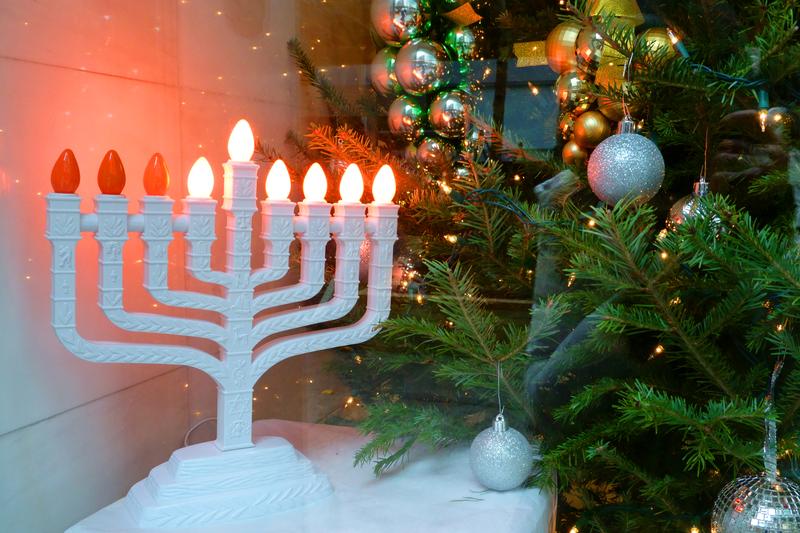
Amina Srna: It's The Brian Lehrer Show. I'm producer Amina Srna filling in for Brian today. Good morning again, everyone. Now we'll talk about family faith and the rituals that make a home feel like a home, especially when that home holds more than one tradition. In a recent New York Times newsletter, Jessica Grose describes a moment she looked around her living room at a Christmas tree, her great-grandmother's menorah from Vienna, National Lampoon's Christmas Vacation on the TV, and yes, a twerking Christmas cat on the mantle. That was the moment she realized her interfaith family had finally created a holiday world that felt organically theirs.
She writes about the years of worrying whether she'd put her thumb on the scale toward Judaism. Then, the surprising ease that came as her daughters grew older and began making their own choices about what traditions mattered to them. Today, how do families blend traditions, beliefs, and holidays? What does it mean to raise children with a combination of actual religious observance and cherished objects and in-jokes that become their own? What can we all learn from how kids engage with these rituals? Jessica Grose is an opinion writer at The New York Times, and she joins us now. Hi, Jessica. Welcome back to WNYC.
Jessica Grose: Hi. Thanks so much for having me back on.
Amina Srna: You write about a long period of trial and error with some of these traditions. What were the questions you found yourself wrestling with in those early years before things finally got settled?
Jessica Grose: My husband and I were not raised super observant. We both went to church and/or temple. Neither of us had faith that we necessarily felt like we knew exactly how to pass down to our children. Then, it's another layer of difficulty or challenge or thoughtfulness, however you want to put it, of the fact that we obviously come from different religious traditions. When our kids were little and everything has to be didactic when your kids are in preschool, and they barely understand what you're talking about.
Anyway, I actually remember one of my younger daughter's classmates told her that when it rained, that meant Jesus was crying, and she was just like, "I don't know what any of those words mean." [laughter] From osmosis, from them being in the world, having to explain and contextualize a lot of things even when they are in one faith, one church tradition. I think we felt more uncomfortable when they couldn't give us feedback, when their understanding of observance and faith was minimal. Just because cognitively, you're not going to have a deep conversation with a three-year-old. You're still explaining to them how the world works.
What has been such a pleasant surprise for me as they're older, they're now 9 and 13, they have really strong feelings about the rituals we do about attending faith services on both sides. A lot of readers had a feedback like, "Oh, isn't this confusing for them?" They don't seem confused at all. Look, maybe they'll take it up with their therapist in 15 years, but it does feel like we have blended it successfully in a way that makes sense for our family and the values that we are trying to teach our children.
At the end of the day, it is those core values of religion and faith that-- and the family gatherings that occur around these holiday moments. That is what is important to us, and it is what appears to be important to our kids.
Amina Srna: Listeners, if you're in an interfaith family or a family that blends traditions of any kind, what rituals have you created that feel uniquely yours? Jessica Grose was just talking to us about some core family values. What do those traditions and rituals maybe incorporate from your values, what worked for you, and what did your kids teach you along the way? 212-433-WNYC. That's 212-433-9692. You can also text that number. Jessica, you've said that you didn't want to "put your thumb on the scale toward Judaism," but you also didn't want your kids to absorb only the default culture around them. How did you try to find that middle path as a new parent?
Jessica Grose: When I was growing up, both my parents were Jewish. We never had a Christmas tree. On the Christian holidays, my dad actually usually worked and covered for his colleagues because he thought that that was the right thing to do as someone who wasn't observing the holidays. It was very clear to me that we were outside the mainstream culture. I felt like we had to be a little bit more intentional about teaching them about Judaism, because even here in Brooklyn, which has, I believe, the greatest percentage of Jews anywhere in the United States, the predominant religion of their peers and also of American society is Christianity.
They're going to understand the holidays that exist outside the Jewish faith without us having to do anything. I did feel like we had home court advantage because my in-laws are in San Francisco. My kids see them several times a year, but it's not the same as with my parents, who they're seeing every single week. I didn't want to feel like we were overbearing and over-indexing on our traditions without really bringing in his side of the family and the things that were important to them and the traditions and cultural moments that aren't necessarily deeply religious.
You mentioned the twerking cat; obviously, that is not going to mass on Christmas Eve. Just including all of these little things, and it's decisions and moments that add up over the years, and can be included into one cohesive whole.
Amina Srna: Let's go to a caller. We have Mari calling from Switzerland. Hi Mari, you're on WNYC.
Mari: Hi. Thanks for taking my call. I told your screener I grew up Lutheran and obviously always celebrated Christmas. I married a Jewish man and converted to Judaism. I did miss Christmas when I was growing up. My uncle's birthday is December 24th, so we always had red velvet cake for Christmas Eve and celebrated his birthday with him. A few years after getting married, our daughter was born on December 24th, so now we celebrate her birthday on Christmas Eve with red velvet cake. We have the same tradition; it's just through the birthdays instead of through the religious holiday.
Amina Srna: Oh, that's so interesting. Mari, thank you so much for calling us all the way from Switzerland. Again, listeners, we welcome your calls and stories here. If your family mixes traditions or holidays from different backgrounds, what have you come up with and what feels like your own way of celebrating? Tell us what you do and how it works for you. 212-433-WNYC. That's 212-433-9692. Jessica, you describe the way young kids sometimes interpret religion through their own logic.
You had mentioned the Jesus crying anecdote, and also you write about how your daughter was asking whether nuns in The Sound of Music were Jewish because they resisted the Nazis. What did moments like that teach you about how children come to understand belief?
Jessica Grose: I don't think moments like that taught me about how children come to understand belief, but I do feel like conversations with my children over the years absolutely have because they are making sense of the world in their own ways, even outside of the religious history or faith-based knowledge that they are getting through Hebrew school or through just the history of religion that they have been learning in their actual regular school. I actually find that the deepest conversations that I have with my children about their beliefs are in random moments.
I think my older daughter is an unusually existential child. Since she was eight or nine, she will ask us questions about the afterlife, and she will ask us questions about what if the reality that she is living is not the only reality. It's like, "Where did you come up with that?" [laughs] It's amazing. It is amazing to have these conversations with both of them. What we don't have in my household is a "there is only one answer to these questions." I think if you are much more observant in various denominations, your family may have only one answer to these questions, but that's not the culture or belief system of our family.
It has been so beautiful, honestly, to watch their little minds work and to watch them making sense of not only our family's tradition or what they're learning, but just what's going on in their minds.
Amina Srna: Let's take another call. Brandy in Brooklyn, you're on WNYC. Hi Brandy.
Brandy: Hi. How are you? Good to talk to you. I'm so appreciative of this conversation, so thanks so much for having this. Jessica, you're hitting everything that is my family's experience so far. I was raised Christian, my husband is Jewish, I'm Black; my husband is white and Jewish. We have biracial interfaith kids who are being raised here in Brooklyn. They go to Hebrew school, but their Hebrew school is super interfaith, and we sought it out because of that shout-out to Fig Tree. We sought it out because they are interfaith, and the person who started it has also a Black husband that was raised in a more conservative Jewish faith and wanted her kids to not feel out of place in synagogue or anything.
I also take my kids to church out in Queens. There's our Greater Allen A.M.E. Church, so they get a Black and cultural experience, as well as the religious understanding of that side of their family. We also celebrate Kwanzaa, which is not a religious holiday, but a cultural-- We roll up all of these cultural and religious experiences into almost an educational way of talking to our kids about it. I think anybody would do, if you're Christian and you're talking to your kids about Judaism, you would explain it as, "Well, they believe this," or vice versa, like, "Christians believe this."
We explain it like that because we're not super religious, but we do-- we celebrate Shabbat, we do the High Holidays, we go to church on Christmas and Easter, but explaining it in a way that is almost educational and informative rather than doctrine and like, "You must believe this or that," which I guess if you're super religious, that would be hard for you. For my kids, they understand it because they understand it as like, "Oh, well, these people believe this, these people believe that. We can choose which one to believe, when we're older, we can pick one if we want."
I think that it's been great for us to teach them in a way that teaches from a longer lens rather than beating it into them like, "This is what you must believe." I think they appreciate it a lot more and understand not just their own cultures, but other people's as well, from the standpoint of, "Wow, you believe this. That's really interesting."
Amina Srna: Brandy, thank you so much for your call. What a great story. Jessica, another text, kind of similar in terms of incorporating not just faith, but also culture. "My partner is white, and I'm South Asian, and we celebrated Thanksgiving by making a meal of biryani with sweet potatoes and a cranberry raita with apples." I do want to extend the invite. Also, we are talking a little bit about the end-of-the-year holidays. Obviously, this year that's going to be Christmas and Hanukkah and Kwanzaa, some other years, Ramadan and Eid will fall on this month and several others.
I just want to invite a broader set of calls as well. Even if you don't celebrate Christmas or Hanukkah, maybe New Year's Eve is very special for you and your family. Like my family, you buy a Christmas tree for New Year's Eve, and you call it a New Year's Eve tree for some random, unknown reason. Give us a call. We'd love to hear your stories at 212-433-WNYC. That's 212-433-9692. Jessica, the caller Brandy there was talking about how her kids are influencing what they want to take from each cultural and religious background of their parents.
You write about how your older daughter chose Hebrew school at the age of 10 and how that shifted things for your family. What did it change when she took a step toward one tradition on her own terms?
Jessica Grose: It has been really beautiful for her. I loved hearing that caller's story, and it felt like such a New York City story because there's just such a melding of every kind of religion and culture here. That our kids can have that opportunity to have friends and peers who are all different backgrounds at all times. One thing that I don't talk about in the piece, but that I did experience growing up, is I would go to church with my friends' families when-- If I was sleeping over Saturday, Sunday morning, I would just go with them. I feel like-- I don't know if that happens anymore.
I wish that it would, I never saw it as they were trying to convert me. I was always just like, "Oh, this is a window into another family's culture, and they are opening it up to me," in a way that felt very welcoming. I just wanted to thank that caller for making that point. My daughter's decision to go to Hebrew school has made her feel much more part of a Jewish community of her own peers, so of 12 and 13-year-olds. It has encouraged her not only to think more deeply about her beliefs, but because of the uniqueness of the Jewish tradition and of being Bat Mitzvah, she's learning Hebrew, which is really cool for her, and it works her brain in a new way.
There's just been numerous benefits of the whole process for her, and her Bat Mitzvah will be next month, and we are all very much looking forward to it.
Amina Srna: Let's go to another caller, Allison in Teaneck. You're on WNYC. Hi Allison.
Allison: Hi. Good morning. Thank you for taking my call. I grew up in West Chester, Pennsylvania. Two words: West Chester. Not like New York. There were very few Jews. I grew up completely assimilated. My best friends were always Catholic. I know the words to a lot of Christmas music, but we were Jewish. I grew up, I became an Orthodox Jew. I married an Orthodox Jew, and we appreciate Christmas music. We know the words. We were going into our kosher Dunkin' Donuts one day, and a man in the parking lot was very confused. My husband was singing Christmas music, and he looked at us. He was an Asian gentleman who was American, and he said, "Wait--" because we looked Orthodox.
He's like, "Wait, you're not supposed to know the words to Christmas music." My husband and I are like, "We like Christmas music. It's very cheerful. It's very, very pretty." We've raised our kids with the same appreciation for Christmas music. We love the lights that people put up outside their homes or the reindeer antlers on their cars. We appreciate it. We teach our kids who go to Yeshiva; we teach them, it's not our tradition, but we can still be respectful and appreciative of the beauty that it gives to our community, too. We see it, we hear it, we love it. We just pass it on to our kids, and hopefully, we're not confusing them too much.
Amina Srna: Allison, thank you so much for your call. We have two callers on the line who are coming from a slightly different perspectives, definitely celebratory in nature. Patrick in West Orange, New Jersey. Hi, you're on WNYC.
Patrick: Hello.
Amina Srna: Hi, can you hear us?
Patrick: Yes. Hi Amina. Thank you for taking my call.
Amina Srna: Thank you for calling in.
Patrick: Great, interesting conversation, discussion. Appreciate it. Coming from a little different perspective, you mentioned Christmas, Hanukkah, and Kwanzaa, that holidays that occur in December, but there's another one you didn't mention that occurs in December. It's called HumanLight, and that's the secular December holiday for non-religious folks, HumanLight. That occurs on December 23rd. I'm actually going to a big HumanLight celebration party this weekend on Sunday here in New Jersey. It's a holiday for people who are not following a religious tradition, who are humanist oriented, secular nontheistic people.
We celebrate the values of humanity, reason, compassion, hope, people working together to build a better future using our human capacities here on earth, not concerned with the afterlife or other supernatural beliefs. I think it's important, there's probably a lot of people in the New York area who are secular non-theistic type of people that might be interested in celebrating HumanLight in December as the expressly secular, entirely non-religious type of holiday in December.
Amina Srna: It's a great invite for those listening who might be interested. Patrick, can I ask you just briefly, how do you celebrate?
Patrick: Well, any group or family can do various different things. It's really a social gathering. It's a social gathering, like any kind of holiday celebration.
Amina Srna: Sure.
Patrick: Events I've been to. There's always a meal. There's drinking, meal, music, entertainment, maybe candle lighting ceremony, maybe to commemorate the values of HumanLight. It's very open-ended as to what you do or how you do to celebrate--
Amina Srna: Awesome.
Patrick: The holiday was created in 2001. It's 25 years old now, but that's still very new compared to most of the other December holidays.
Amina Srna: Facts.
Patrick: How you celebrate is very open-ended.
Amina Srna: Thank you so much.
Patrick: It's mainly around celebrating our human values, about reason and compassion and people working together to build a better future in the here and now.
Amina Srna: Thank you so much for your call. Let's take another caller, Deborah, in Branchville. Hi. You're on WNYC.
Deborah: Hi. Thank you for taking my call. Well, I'm more spiritual than religious. I always remark on the fact that many people don't realize that Christmas is actually just the first day of Christmas-- and like the song, The 12 Days of Christmas, because sometimes money or just circumstance make me late. If I did want to put up a tree, maybe I couldn't afford a tree, but I always take comfort in the fact that even if I don't get anything up by actual Christmas Day, there are 12 days of Christmas leading to January 6th, which is the Epiphany.
The Epiphany is the actual day when the Magi, the Three Kings-- and that's also why it's called Three Kings Day, finally found Jesus in Bethlehem. In addition to that, there are two other things-- My mother was British, and I lived in London at one time. The British are so much more civilized than us. We have Christmas Eve and Christmas Day, but they have Boxing Day, which is the third day, and that is also a day off. Imagine if we as Americans we're able to have an extra day, so we could decompress from all the stuff that went on before Christmas.
Amina Srna: [laughs] Decompress.
Deborah: Boxing Day was started to literally box up leftover food and other things to get to the poor, which is also a lovely idea. Last but not least, let us not forget the one established by Seinfeld. Festivus, the holidays for the rest of us.
Amina Srna: [chuckles] Deborah, thank you so much for that call and breaking it all down for us. On that lighter note of Festivus, which actually a few listeners are texting and calling in about, Jessica, your essay does talk about some of the lighter rituals. Seinfeld mentioned there on the call, but there are movies, ornaments, inside jokes that you write about. What did these moments bring to a blended household that the more formal observances don't always capture, you think?
Jessica Grose: I got so many beautiful reader notes before I wrote this piece because I had put a call out in the newsletter soliciting them. They were ways of family bonding. They were not strictly religious, though sometimes they were, but they allowed people to feel a warmness and connection to the past. There was one reader who wrote in about how her family didn't have that much money growing up, but her mom would be rushing to finish the homemade gifts that she was making. She was a great seamstress, and her dad would take the kids out to KFC, and it was always KFC every time.
Now she and all her siblings still have KFC every single Christmas. That is what makes it feel like it is the beginning of the holiday season. I think they've been doing this for 50 years, if I remember the details of this reader email. It's a way to honor family members who are no longer there to remember this moment of their childhood, which had so much warmth despite not having many material things, and so many of the notes sounded that tone of this was a way for the family to feel connected to each other and their shared pasts.
Amina Srna: Let's go to another call. Oh, so many good callers. Matt in Brooklyn. You're on WNYC. Hi Matt.
Matt: Hey. Woo hoo. How's it going? Thanks for taking my call.
Amina Srna: Hey, thanks for calling in.
Matt: I wanted to say it's been so cool to hear everybody talk about raising kids in these environments. Because I am getting married in a month and--
Amina Srna: Congratulations.
Matt: Thank you. Well, I'm half Puerto Rican and half Irish. My Irish family is half Catholic and half Jewish. Then, my Puerto Rican family is half Presbyterian and half Rastafarian, and my fiancé grew up Southern Baptist, really intensely, so we've both gone through a fair amount-- and our parents, too, gone through a fair amount of semi-rigorous deconstruction. Now that we're getting ready to start building our family, we've been doing a lot of thinking about how building a unique holiday palette would look like for us. It's been really inspiring to hear what everyone's been doing. One thing that we do already, in addition to making a big Southern dinner on Christmas, which includes pernil in our case.
When I was a kid, my parents always had to work too much and were too tired to really like, get into the holidays. I would always-- on Christmas Eve be like, "Are we getting a tree? Like, what's the deal?" Then they would give me $20 to go down to where the Boy Scouts would sell trees. By that point, they'd be like $5. I would spend the rest of it on a tuna sub from the pizza place that was next door to where they sold them. Now we have been eating tuna subs on Christmas Eve for the past five, six years that we've been together.
Amina Srna: Wow, Matt.
Matt: It's fun.
Amina Srna: Incredible. Best of luck as you figure out your family holiday traditions. Jessica, I don't know. Matt was, I think, asking for a little bit of advice there. Is there any way to start thinking about blending a family? He has this runway of one month to figure it out. No, I'm kidding.
[laughter]
Jessica Grose: Well, I would say that that is not true. You don't have just one month to figure it out. It is something I feel sad that I put so much pressure on us to have it all figured out. I remember, especially when my kid, my older daughter, was born, I was like, "Oh my God, we have not figured out the exact answer about the right way we are going to impart these things to our children." What I realized in the course of writing this essay is that it has evolved over time, and it will evolve.
If you're just thoughtful, and you put in the time to having the discussions and figuring out what feels right, what feels authentic to your families, and is the way to appropriately both honor your beliefs and your rituals, it can evolve over time. It doesn't have to be figured out, and it will always be evolving. I loved hearing that caller's description of how subsequent generations have just blended further. I don't know what kinds of relationships my daughters are going to have as adults, or what religious backgrounds or cultural backgrounds those people are going to come from. It is really something to, I think, look forward to rather than fear the idea that it can continue to evolve and layer on new traditions.
Amina Srna: That's all the time we have for today. Jessica Grose is an opinion writer at The New York Times. Her latest newsletter is titled What My Children Taught Me About Interfaith Tradition. Jessica, thanks so much for being with us and happy holidays.
Jessica Grose: Happy holidays to you. Thanks for having me.
Amina Srna: Thank you.
Listener-supported WNYC Studios (Announcer).
Copyright © 2025 New York Public Radio. All rights reserved. Visit our website terms of use at www.wnyc.org for further information.
New York Public Radio transcripts are created on a rush deadline, often by contractors. This text may not be in its final form and may be updated or revised in the future. Accuracy and availability may vary. The authoritative record of New York Public Radio’s programming is the audio record.
