
Ramadan in 2026
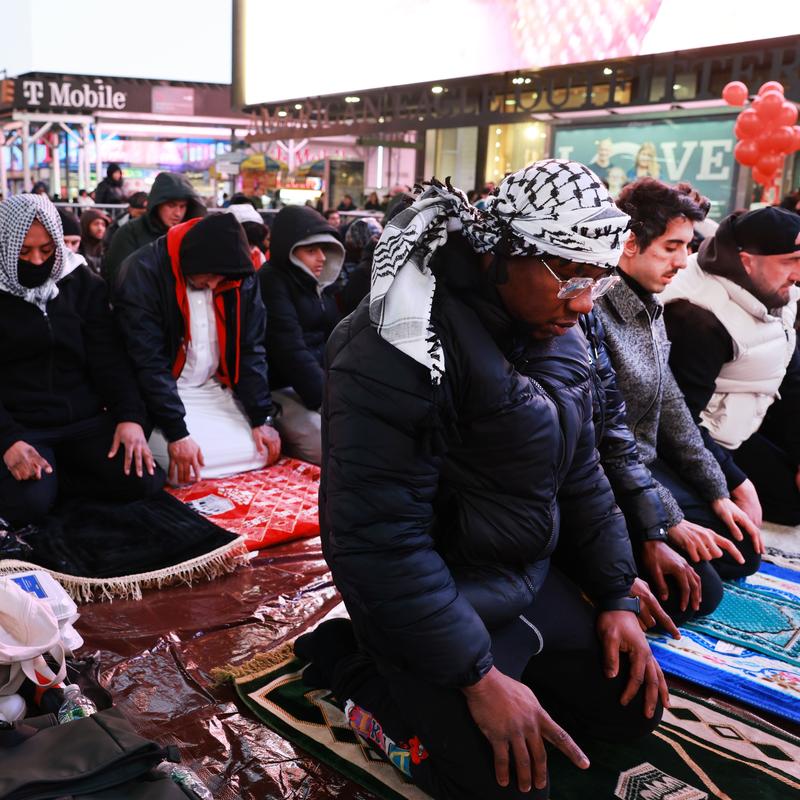
Brian Lehrer: It's The Brian Lehrer Show on WNYC. Good morning again, everyone. As we head toward the end of Ramadan, we want to open up the phones for our Muslim listeners now to say what you've been thinking about during the holy month this year. How much has this year's observance been more of a personal reflection for you about things in your life, or how much have you been thinking of anything in politics or society outside yourself? Both is an acceptable answer. 212-433-WNYC, 212-433-9692.
Again, as we head toward the end of Ramadan, we want to open the phones for our Muslim listeners now to say what you've been thinking about during the holy month this year. Personal, political, about the war, about Mayor Mamdani, or whatever. 212-433-9692, call or text. One thing locally, of course, is that New York City has a Muslim mayor for the first time. I'm sure it's symbolically important to a lot of people. A major first like this for any group, certainly any minority, and often marginalized group, always is symbolically important. The mayor has been making Ramadan visits to various communities in the city all month. Have you been at any of those? What was that like? 212-433-WNYC, 212-433-9692.
Also, is he making any changes that you find meaningful yet at the policy or other governing level, not just symbolic? 212-433-WNYC, 433-9692. Here, for example, is a short clip of the mayor hosting iftar. That's the evening breaking of the fast for city workers on March 12th.
Mayor Zohran Mamdani: It's not every day that we see in one room the sheer breadth of Muslim life in New York City. The many languages spoken, the different cultures lived, the many soccer teams we root for in good times and in bad. I will say it once more, Ramadan Mubarak, my friends.
Brian Lehrer: Mayor Mamdani there a few days ago. Also, with respect to Mamdani being mayor, Muslim listeners, how are you processing or how are you personally experiencing the blowback, the Islamophobia? I have a Muslim friend in particular who says, "Islamophobia. Everybody says it's Islamophobia, but we should just say anti-Muslimism." The bigotry, the hate that's been a factor in the city, and the whole country, too, since Mamdani was elected. Are you experiencing it personally, or how are you processing it, this environment? 212-433-9692.
I'll ask that one again, so you know you're invited on this. How are you processing or how are you personally experiencing the blowback, the Islamophobia, the anti-Muslimism, the bigotry and hate that's been a factor in the city and the whole country, too, since Mamdani was elected? It's always there to some degree, like anti-Semitism is always there, and racism is always there, and other forms of hate, but there was a big surge in the public expression of it 25 years ago after 9/11 in a way that's never gone away, but there's been this new big surge of it around, not an attack like in that case, but in election, the election of Zohran Mamdani as New York City mayor.
You're invited to call in and tell a story if that's affected you as a Muslim who is listening right now, and if it has played any role in how you're experiencing Ramadan, or praying during Ramadan, or just thinking and feeling about things in this past month. At the same time, Mamdani was elected, and it wasn't even that close, and New York is not a majority-Muslim city, so many non-Muslims went out and voted for the first Muslim mayor, even though he is Muslim, and they are not. Maybe that's giving you hope as much as or just in addition to however the backlash is dismaying. You tell us. 212-433-WNYC, 212-433-9692.
There's also, of course, the ongoing war in Gaza, but now also the war in Iran and Lebanon. Has that been a source of Ramadan reflection for you in any direction? It's an Islamic regime, of course, in Iran, but it's also so widely seen as a horrible, murderous, repressive regime by so many Iranians who are Muslim. How are you processing all of that, in addition to the US and Israeli role, or anything else about what it's been like this month, or how you might remember Ramadan 2026 for yourself in the context of your personal life or the world?
You can talk about some of the traditions of the month and get personal that way. Some of the foods that you eat before dawn or after sundown. By the way, aren't you glad Ramadan wasn't in July this year, when you would have to have your suhoor meal at 4:00 in the morning and then wait for the iftar until 9:00 at night? Are there certain passages from the Quran that you've read or found special meaning in this year, or any specific acts of charity, which is a Ramadan thing, or anything else? It's open phones for Muslim listeners to say what you've been thinking about during the holy month this year. 212-433-WNYC, call or text. 212-433-9692.
Joining us to help take your calls is Dr. Sheikh Faiyaz Jaffer, executive director of the Islamic Center and chaplain at NYU. Dr. Jaffer is the first full-time Shia Muslim chapter ever appointed at an American university, I understand. Dr. Jaffer, welcome to WNYC, and Ramadan Kareem.
Dr. Sheikh Faiyaz Jaffer: Thank you so much, Brian. Thanks for having me. Happy to be here.
Brian Lehrer: Can I ask you a stupid non-Muslim question first?
Dr. Sheikh Faiyaz Jaffer: Go for it.
Brian Lehrer: I hear Ramadan Mubarak, and I hear Ramadan Kareem. I'm sure a lot of other non-Muslim listeners do, too. Are they the same? Is it call and response? Is one better than the other, Ramadan Mubarak and Ramadan Kareem?
Dr. Sheikh Faiyaz Jaffer: Both of them are generally used interchangeably. Ramadan Mubarak literally is translated as "have a blessed Ramadan," and Ramadan Kareem, something very, very similar. "May you have a noble month." Many times, someone will say Ramadan Mubarak, and the response will be Ramadan Kareem. Also, culturally, familially, we diversify.
Brian Lehrer: What's the iftar experience been like at NYU this month? The after sunset evening meal?
Dr. Sheikh Faiyaz Jaffer: Yes, it's been really, really meaningful to spend time with so many diverse body of our students who are navigating life and education, relationships, and of course, everything that is happening in the world. We're privileged to be here in New York City and see the diversity of the Muslim community in such a unique way, but without doubt, I think that over the last couple of weeks, especially with everything happening sociopolitically across the world, there's certainly been a little bit more of a heaviness that has really impacted so many members of our community with everything taking place.
Brian Lehrer: Locally, this Ramadan, as I expressed in the intro, is historic for New York City, having its first Muslim mayor who has been publicly breaking fast with city workers and praying at Rikers, but there is also all the blowback. What has that visibility and all of that context meant for the NYU community members who you've been dealing with? How do you find it expressed either emotionally or experientially, or, for that matter, spiritually, by the people you're dealing with? You can speak for yourself as well.
Dr. Sheikh Faiyaz Jaffer: Yes. I think there's two ways to look at it. Like you mentioned in the intro as well, there is this sort of symbolism with so much that the Muslim community in New York City has had to experience over the last 25 years, and there is this really unique full circle moment where the mayor of the biggest city in the world is Muslim and is breaking fast and consistently on the news for these public displays of celebrating the month of Ramadan. I think, for so many people, for so many young people who are navigating issues pertaining to identity, they don't have to necessarily be so shy or timid with an expression of their Muslim identity in public. They can say that, "Hey, I'm fasting."
Maybe before the election of the mayor, or before his very public projection of his religious tradition, maybe because of anti-Muslim rhetoric, people would not have been comfortable to talk about that publicly. I think, in one way, there's this, obviously, incredible, unique, positive, I guess, silver lining that has taken place in the midst of all of the anti-Muslim rhetoric and Islamophobia.
I think on the opposite side, without doubt, unfortunately, so many within the Muslim community are just used to feeling feelings of isolation and marginalization, where that's also picked up locally in the media, with respect to political rhetoric, that is targeting the mayor, or even that which is transpiring across the world, and how maybe that's also contributed toward various developments of Islamophobia locally within our communities.
Unfortunately, it's something that our communities are just so used to. There is this positive aspect, but then there's this sobering moment where it's like, "Oh, wow. This is something that we consistently have to experience even during this most sacred time of the year for us when we're mentored, gathering together in community, and spending time with others." It has its unique challenges as well.
Brian Lehrer: Let's take a phone call from Mohammed in Astoria, who I think has a special blessing that's been bestowed upon him this Ramadan. Mohammed, you're on WNYC.
Mohammed: Hello, and good morning. Thank you for taking my call. Yes, it's an interesting Ramadan. My first Ramadan as a father. We were blessed with our son, Malik, in the beginning of Ramadan, but, unfortunately, didn't get to leave the hospital due to many complications with my wife's health, which we really spent most of the month in the hospital. Thankfully, thank God, thankfully, she's feeling better. It was mixed with happiness, and fear, and anxiety, but we also-- my heart goes out to those in Gaza who lost their healthcare system, and the genocide, and can't find a hospital to go to.
We were surrounded 24/7 by doctors, nurses, a lot of infrastructure that carried us through this journey. I can't imagine how life would be like without any of that.
Brian Lehrer: Mohammed, thank you.
Mohammed: That's my reflection.
Brian Lehrer: Thank you for your call, and congratulations on becoming a father.
Mohammed: Thank you.
Brian Lehrer: It sounds like your wife is doing better now, and I hope that all goes well for you and your baby, Malik, and your wife and yourself. Thank you for calling us. Ramadan Mubarak.
Mohammed: Appreciate it. Thank you.
Brian Lehrer: I acknowledge that not everybody accepts the word genocide for what's going on in Gaza, but I think that's a reflection, Dr. Jaffer, of how so many people in the Muslim communities of the United States, of the world, must be juggling the emotions of the personal and the global. Here he is, about as personal a thing as you can have happen to you, at that level of profundity, becoming a father for the first time. Yet, there's the whole rest of the world, too.
Dr. Sheikh Faiyaz Jaffer: Yes, absolutely. I think that's such a real take. With all of the time that we get a chance to spend with our family and with our community during these days, just spending time with so many people, as I do during the course of this month of Ramadan, there was not a day that passed where people were not reflective of that, which is taking place across the world. We spend a lot of our evenings in prayers and in various acts of religious ritual, in supplication, and so on and so forth. So much of our community members' reflections are no doubt around what is happening in Palestine, in Iran, in Lebanon, in the Sudan, Congo, across Afghanistan, and Pakistan, and different parts of the world.
Even the challenges that individuals and Muslim communities and people are dealing with here locally in this country, with ICE raids, with other feelings of isolation, marginalization, racism, homelessness, all of the various real obstacles that so many within our communities have to face. The month of Ramadan is an opportunity for us to center those things, and hopefully work to give back where we can through charitable efforts or through advocacy mechanisms. It's a really important time for us to think beyond ourselves.
Brian Lehrer: Pat in Hillsborough, New Jersey, you're WNYC. Hi, Pat.
Pat: Hi. I just wanted to comment on two things, two small things. One, I'm really happy that there's a mayor in New York City that is representing positive Muslim values and setting a standard for that. Number two is how surprising it is that I'm an Indian Muslim, and in the Indian community here and overseas as well, there's a lot of racism against Mayor Mamdani. It's like some people I know take it as a joke that he's the mayor that-- he doesn't really represent Muslim values or whatever. He's too liberal, or he's too this, he's too that. Then other people just blatantly are racist towards the fact that he's Muslim at all. It just hurts that that comes from within the community. That's all I wanted to say.
Brian Lehrer: Thank you, Pat. I appreciate your call. We have another text from a listener who says, "As a Muslim American--" Oh, that's a different one. This one, the relevant one, says, "My mother's family are from India. Very hard to be a Muslim there." Then the listener adds something that's on their iftar plates. It says they eat kheer, a dessert with condensed milk, raisins, nuts, and vermicelli. Also, pelau, a very special dish, much like biryani.
That text, there's another one, right? The text backing up what the caller said about how it's difficult to be an Indian Muslim. We know, of course, in the context of India itself, there's so much tension between the Hindu and the Muslim communities there, the Hindu majority, and the Muslim minority. Here, almost like the father who called about the blessing of the birth of his son and what's going on in Gaza, here, a listener says, "It's very hard to be a Muslim in India," and then goes right on to what they have for dessert. I don't know, again, maybe representative of the breadth of emotion at this time.
Dr. Sheikh Faiyaz Jaffer: Absolutely, yes. It's such a unique time. Even as we approach the Eid celebration and the Eid holiday tomorrow, that is certainly the topic of conversation around every family's breakfast, lunch, dinner table, about how to balance. I've had so many experiences talking to families where they have been struggling to navigate how they're going to celebrate this year, and really, how they've been celebrating the last couple of years, and whether or not they should make it super festive for the sake of their children, because it's a really, really important time, or should they hold back some of that, in light of everything happening in the world? It's a tough thing to navigate, no doubt.
Brian Lehrer: Amin on Staten Island, you're on WNYC. Hi, Amin. Thank you for calling in. Ramadan Kareem.
Amin: Thank you for taking my call. Yes, my take on Ramadan this year is how the West, for decades, have always portrayed Muslims in a negative way. Then, all of a sudden, we fall into the brink of World War Three now with the aggression coming in from what's all called the Jewish state, coming from Trump, which is surrounded by hardcore evangelical Christians who attack Iran as a sovereign nation.
I'm trying to take this all in. How are we going to proceed and continue during this holy month of Ramadan? Now we're ending it, and how are we supposed to celebrate? It's supposed to be a time of celebration, and then you take all this in. All we have is our faith in God, and hopefully, that He's the one that maybe can solve all this, because humanity is at a loss right now. That's how I take it.
Brian Lehrer: Amin, thank you--
Amin: We are at a loss right now because we're not even done with Gaza and its genocide going on, and now we enter another genocide.
Brian Lehrer: Amin, thank you for your call. Dr. Jaffer, again, I'll acknowledge, different people have their different language for what's going on and their different politics, but you hear how Amin is sort of at his wits' end about how humanity, as opposed to God intervening, can solve all of this.
Dr. Sheikh Faiyaz Jaffer: Yes. I think one of the efforts that I try to employ in my faith leadership role is really trying to center hope in the midst of so much trials and tribulation and distress that so many are going through. We want to acknowledge that there is pain that people are feeling, and there's no doubt, and that's real, and that's understandable, but as a community, we have certain opportunities and privileges. I don't have to think about what I'm going to eat tonight for iftar, because I have food to break my fast with. At the same time, I'm in a state of recognition that that's a privilege because so many people don't have food on the table.
To be appreciative and to be in a state of gratitude for these blessings that we do have in front of us, and even the ability for us to speak out, the ability to be expressive, the ability to share one's politics and one's reflections, all of these things are meaningful, and they have to be acknowledged and recognized. In terms of cultivating a community that's hopeful about the future, we have opportunities. We have opportunities through our voting mechanisms, we have opportunities through our voices, we have opportunities through our wealth and other sorts of privileges that we're afforded. I don't think we should be in a state of total despair when so much around the world is certainly contributing to that feeling.
I understand it, for sure, but I think, also, we have a sense of responsibility, more so today than we did prior to all this unfortunate violence that is taking place across the world.
Brian Lehrer: One more. Omar in Westchester, you're on WNYC. Hi, Omar. Thank you for calling in.
Omar: Thank you for having me. I really appreciate this conversation. Eid Mubarak to everybody. Yes, I just wanted to say, I had taken the opportunity this Ramadan to go to as many different mosques around the New York area as possible. I know that's a privilege. It was just really beautiful to witness the diversity of the Muslim experience throughout the five boroughs, firsthand. Going to a majority Yemeni mosque in the Bronx, going to a majority Guyanese mosque in Astoria. Even one day, I found myself in Connecticut, and I popped into a building that used to be a church and was converted into a mosque. It still had the stained glass and the wooden rafters.
I feel like on the topic of this conversation about recognizing how we have to remain hopeful, I think New York as a city as a whole gives me hope, especially in this moment with Mayor Mamdani, and just thinking about ways out of this really dark chapter in American history. There's a lot of light that we can start seeing, peeking through the cracks. I hope this Ramadan showed people that.
Brian Lehrer: Omar, thank you very much. That's interesting, that tour that he took himself on to mosques in diverse Muslim communities. As we run out of time, I'll note, as I did in the intro, that you're the first full-time Shia Muslim chaplain appointed at any American university, from what I've read. Do you want to say anything about how Ramadan observance differs or not within the Shia tradition? People who are following the war may know that one of the political dynamics in the Middle East is the divide between Iran, which is largely Shia, and countries like Saudi Arabia, largely Sunni. How does it play for you?
Dr. Sheikh Faiyaz Jaffer: Yes. Essentially, ritualistically, the differences are fairly minor, particularly with the month of Ramadan. There are very, very small differences. Across the board, ritualistically, prayers differ slightly. The conclusion and the timing when the fast during the month of Ramadan differs very slightly. Maybe in the Shia community, we break our fast about 15 or 20 minutes later. In the big picture, an observer who's looking from the outside probably couldn't tell the differences.
Nonetheless, I would say that where this year in specific it's become a little bit more heavy for the Shia community is that, like you mentioned, and I would say, just to bracket or just to offer a quick parenthesis, that a lot of the rhetoric around Shia and Sunni dynamics in the Middle East and Saudi Arabia and Iran and all of this is really a manifestation of geopolitical realities more so than sectarian or religious ones. That being said, the majority of Iran are Shia Muslims, as well as those within the southern part of Lebanon.
Right now, the number of people in my community and congregation who are being impacted with their families being displaced or so on, or the inability for them to be in touch with their families during the course of these nights and days, has been really, really hard. There's not been a day in the last three weeks where I've not spoken to someone who is in tears, saying that they haven't spoken to their family member or someone had been killed. There's this heightened level of grief and sadness, I think, that's been impacting so many within our community.
Again, we have to be hopeful, and we have to continue to do the best that we can with respect to coping, and at the same time, utilizing our privileges to the best that we can. Hopefully, we see an end to all this bloodshed, unfortunately.
Brian Lehrer: Does it ever complicate your role as a chaplain, for all the people and all the Muslims in particular, that there are enough bad guys to identify in this war, depending on your experience, including the government of Iran, which killed, by most accounts, tens of thousands of protesters in the streets, most of whom would have been Muslim in Iran, such an Iranian diaspora community in this country, and maybe some at NYU in a state of horror, what that government has done, in addition to whatever they may feel about the US or Israel. How do you process that? Then we're out of time.
Dr. Sheikh Faiyaz Jaffer: It's certainly a challenging thing. At the end of the day, I want to help people get past their grief and have them centered religiously and spiritually, most importantly. That's what I get paid to do. I try to-- and again, I've seen this so often with so many members of the community. They can be anti a particular political elite, but at the same time, they're also anti-war, or they really don't want it to go down this way. It's been, no doubt, challenging with so many political opinions and so much political rhetoric in the midst of people navigating grief.
Again, my job is to hopefully just recenter people back within the framework of faith without getting into that discourse, because I don't find it to be particularly beneficial, at least within my role.
Brian Lehrer: All right. 20 seconds. What's on your Eid plate tonight?
Dr. Sheikh Faiyaz Jaffer: I have no idea yet, to be honest with you. I've been so busy. I've been so busy taking care of issues pertaining in the community. I'll just summarize. Whatever my wife gives me, I'm okay with it.
Brian Lehrer: Dr. Sheikh Faiyaz Jaffer, executive director of the Islamic Center and chaplain at NYU. Thank you so much for some time today, and Ramadan Kareem to you.
Dr. Sheikh Faiyaz Jaffer: Thank you, Brian. Appreciate you.
Copyright © 2026 New York Public Radio. All rights reserved. Visit our website terms of use at www.wnyc.org for further information.
New York Public Radio transcripts are created on a rush deadline, often by contractors. This text may not be in its final form and may be updated or revised in the future. Accuracy and availability may vary. The authoritative record of New York Public Radio’s programming is the audio record.
