Title: Phone-Free Schools [music]
Brian Lehrer: Brian Lehrer on WNYC, and we're going to stay on the education track for the last 15 minutes of the show. With school closed today, we're going to have a call in for teachers, also, school administrators, even students, on how the New New York statewide ban on smartphones is going for you in your school and in your life. 212-433-WNYC, 212-433-9692. It's November 11th. You've been at it for a few months now. How's it going? 212-433-9692.
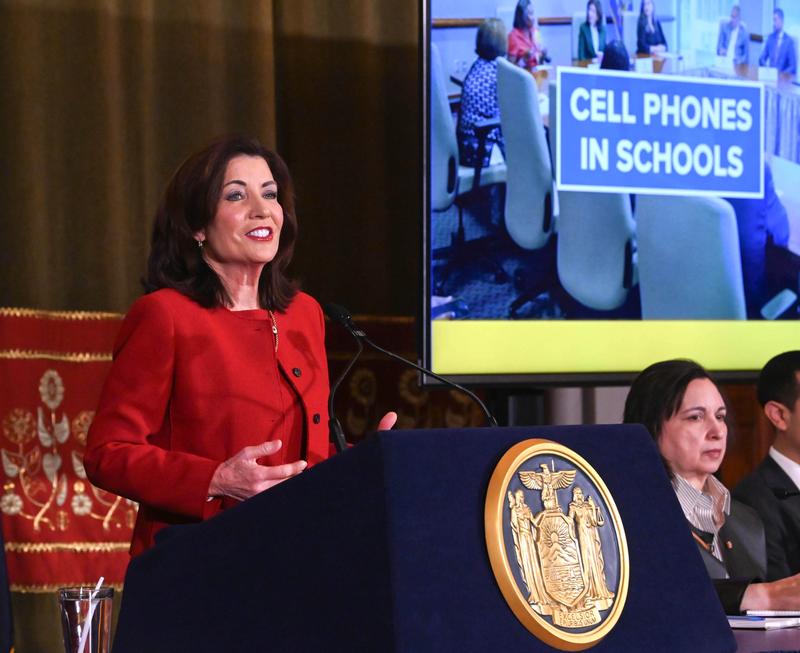
We waited for a day off from school to do our first check-in on this. We know what officials are saying, but what's your experience on the ground with the cell phone ban? 212-433-WNYC. Teachers, school administrators, students who might be listening, also, of course, welcome to call in. 212-433-9692. A little background for those of you who don't remember. Back in May, Governor Kathy Hochul announced that New York would be the largest state in the nation to require bell-to-bell restrictions on smartphones in K through 12 schools. An exact quote from the governor, the goal being to promote distraction-free learning, but also to protect the mental health of students following last year's law restricting addictive social media feeds for minors.
Another quote from the governor, "I know our young people succeed when they're learning and growing, not clicking and scrolling, and that's why New York continues to lead the nation on protecting our kids in the digital age." Listeners, how's the cell phone ban going in your school? Teachers, have you noticed that your students are less distracted? Has it led to less conflict with your students now that you don't have to ask them to put their phones away throughout your lesson?
212-433-WNYC. Parents, are you getting used to not being able to contact your child directly throughout the day? Have you had any issues with the cell phone ban thus far at the family level? Have you noticed a change in your child's behavior, for that matter, maybe for the better, concentration, attention, mental health, or even grades? Students, you're off from school today, too. If any of you happen to be listening, how are you adjusting to a lack of screen time during school hours? Do you feel less distracted in class, or do you just feel like you're being unnecessarily put in a box?
Have you noticed any improvement in your mental health, perhaps, or in your grades, or are you just finding this whole ban to be a nuisance? 212-433-WNYC, 433-9692. I know that the governor did give each individual school the authority to develop their own plans for storing smartphones every day. School administrators, what are the rules at your school? How did you make this bell-to-bell cell phone ban work for your students and staff here in these early weeks?
Do you collect the kids' phones at the start of the day? Do you have them store their phones in the lockers? What's the protocol? How's it working? Any of you parents, teachers, school administrators, students, your early reports on the cell phone ban, if it took place for the first time in your school in September. 212-433-9692. You don't have to be in New York for this, but we know this just officially went into effect in New York. Maybe your school district somewhere else is doing the same thing in Jersey or Connecticut or wherever you are. We'll take your calls right after this.
[MUSIC - Marden Hill: Hijack]
Brian Lehrer: Brian Lehrer on WNYC. By the way, some nice thank you texts still coming in for science teachers. One writes, "Shout-out to my co-teacher, Kelly, who planned a project in our 6th-grade science class, taking students outside to count and analyze the trees and other landscapes." Another one writes, "I took a course in biology in college. The teacher used the matrix to explain cell activity." Onto the cell phone ban, we're getting a lot of happy teachers. Just a few complaints. We'll start with a happy teacher, and a science teacher at that to segue from the previous segment. Megan in Westchester, you're on WNYC. Hi, Megan.
Megan: Hi. Thank you for taking my call. I love this program. I'm going to re-listen. This is great. The cell phone ban has been bell-to-bell in the school that I'm in now. They were practicing this last year, actually. They had a pouch system last year. I'm in a middle school, and the students keep their phones in their lockers from the minute they get in the building. They are not given them at lunch, in breaks, and it's been wonderful because classroom engagement is higher for sure.
I think the biggest benefit is the kids' behavior with each other. They're not walking down the hall with their heads hanging down, looking in their screens, and they're not all gathered around a screen. I see them sometimes walking to school when I'm driving in. If I drive in a little later, I see them sometimes gathered around on the sidewalks looking at their phones, but in General, it's amazing. They're interacting with each other in a way that I haven't seen in four years.
Brian Lehrer: A parent I know told me the lunchroom is loud again. Does that sound right?
Megan: Yes.
Brian Lehrer: Megan, thank you very much. Let's go next to Kate on Staten Island, a middle school teacher in Brooklyn. Hi, Kate, you're on WNYC.
Kate: Hi, Brian, how are you?
Brian Lehrer: Good. How's it going?
Kate: It's going very well, especially since the cell phone rule has come into practice. We also have a pouch system that the kids have to lock their phones in a pouch at the very beginning of the day, and they don't get them back until a staff member unlocks them at the very end of the day. It's probably the best thing that's happened in school since I've started teaching.
Brian Lehrer: Interestingly, the two dissenters who we have getting in touch so far are both parents. One of them writes a text, "I am the mom of a middle schooler, and I think this whole cell phone thing was a manufactured crisis. Nothing feels different at all. Schools were already on top of it." We're going to talk to another parent on that track who's calling in in a second, but have you heard any complaints from parents?
Kate: I have not. I'm actually surprised to hear that there are any. I assure you in the school building, it is nothing but positive.
Brian Lehrer: Kate, thank you very much. Here's one of those parents. Alicia in Kingsburg, New Jersey, you're on WNYC. Hello, Alicia
Alicia: Hi, how are you?
Brian Lehrer: Good, how are you? What's your take?
Alicia: I am good. I am completely against anyone taking my kid's cell phone away for any reason because when I watched the news with this thing in Columbine and so many other school shootings, so many attacks in schools against the children and the teachers, the ones that sounded the alarms were the kids on their phones. They were the ones who were able to call 911.
Brian Lehrer: As an emergency measure, even if all those other things that the teachers are saying are improvements are true, this trumps that for you. Am I understanding you right?
Alicia: Yes, it does, because I actually knew someone who was shot in Columbine. I won't allow it. My kid has his phone. He has his phone. He will not use his phone. He has his phone. It is in his backpack-
Brian Lehrer: In case of emergency.
Alicia: -period.
Brian Lehrer: Alicia, thank you very much. Oh, here's a high school student from Baldwin who I think doesn't like it either. Charles, you're on WNYC. Hey there. Can you hear?
Charles: Yes, I can hear you. In my opinion, I can understand the motives behind the phone ban. However, I can just say that the enforcement at my school, it just isn't working at all. Every day, I see at least 10 or 20 people on their phones. I have no idea how these teachers can't see it, but it's everywhere. It seems like every week, the school staff, they keep on trying to add new measures. Now they started searching people's bags for phones, which seems illegal to me. What about our Fourth Amendment rights?
Every day, they keep on trying to add new policies, but people just keep on using their phones anyway. Even without the phones, students are still determined to get distracted. Now, people are just playing Pokémon on their Chromebooks. They're watching movies in Health class. I saw someone watching Deadpool. I would just say that the phone ban has punished the innocent, and the people who actually are using their phones, they're just keeping on using their phones.
Brian Lehrer: There is the Chromebook exception, which I didn't get into in the intro, but Charles, thank you very much. There's one 15-year-old who knows what the Fourth Amendment is, at least. Nate in Mawa, you're on WNYC. Hi, Nate.
Nate: Hey, Brian. I'm a teacher in New Jersey, and I just want to say this phone ban has been great. The classroom is not perfect, but it has made the classroom much more tolerable without the risk of students being on their phones and possibly even recording you without your consent, because I was in high school not too long ago, and believe me, the kids were fooling around all the time on their phones, doing that. I understand what the last caller was saying about being upset about the phone ban, but now that you actually become a teacher, you start to understand why. I'll put it that way.
Brian Lehrer: House enforcement, because Charles-- By the way, Charles, great call. Call us again on the next school day off when you have something to say. It doesn't have to be about education. Obviously, you're studying civics, and you invoke people's rights and things like that. Do be a caller to the show again, Charles in Baldwin. Nate, for you, he talked about enforcement being almost impossible. What do you see?
Nate: I teach in a middle school, for reference. In my school district, we really don't have any problems with enforcement. Sure, occasionally, now and again, you'll see a kid who maybe brings two phones to school and hands in a fake phone to the homeroom teacher, but honestly, we really don't have many problems with that. The kids hand in their phones at the start of the day to their homerooms, and they get them back at the end. I think the school is for the better with that.
Brian Lehrer: Thank you for your call. Teachers, parents, student, thank you for chiming in on this check-in on how the school cell phone ban is going so far. That's the Brian Lehrer Show for today, produced by Mary Croke, Lisa Allison, Amina Srna, Carl Boisrond, and Esperanza Rosenbaum. Zach Gottehrer-Cohen produces our daily politics podcast. Our interns this term are Amanda De Jesus and Miranda Santos. Megan Ryan is the head of Live Radio, and we had Shayna Sengstock at the audio controls. I'm Brian Lehrer. Stay tuned for Alison.
[music]
Copyright © 2025 New York Public Radio. All rights reserved. Visit our website terms of use at www.wnyc.org for further information.
New York Public Radio transcripts are created on a rush deadline, often by contractors. This text may not be in its final form and may be updated or revised in the future. Accuracy and availability may vary. The authoritative record of New York Public Radio’s programming is the audio record.