Brian Lehrer: Brian Lehrer on WNYC. To end the show every day during the membership drive, we're talking about all the animals that New Yorkers and New Jerseyans and others around here love and care for in your homes, your pets. Yesterday, we talked about the usually warm and cuddly dogs with the creator of Doggest. Today we'll go in another direction and talk about reptiles. What? Yes, they are literally cold-blooded, but some of them could be described as cuddly. I don't mean boa constrictors, which are illegal in New York City. We'll talk about all of this, though, with my guest Sam Laroche, the manager of Petqua, a pet emporium on what's sometimes called the Upper Upper West Side at 98th and Broadway that caters to all kinds of pets and their caregivers and houses quite the menagerie if you've ever seen it. Sam, welcome to WNYC.
Sam Laroche: Hello, Brian. Thank you, thank you for having us.
Brian Lehrer: Did I say the name of the store right with the Q-U-A? Is it Petqua? Is that how you say it?
Sam Laroche: It's correct. It's Petqua. Yes.
Brian Lehrer: One of the more famous residents of Petqua is a really large tortoise named George.
Sam Laroche: George. Exactly.
Brian Lehrer: Why is he so popular with visitors?
Sam Laroche: Oh, I really think they like the fact that he's, I would say, polite. He's easy to encounter, although some people might be a little bit scared of his size. He's funny, means nothing to be afraid of. He's slow-moving, but they love him because they come, they sit near him, they feed him, they pet him, he's no threat, and so he's very approachable.
Brian Lehrer: They pet the tortoise's shell?
Sam Laroche: Absolutely. They actually have sensors. They feel the touch even though the shell is hard as a rock, but they-
Brian Lehrer: I did not know that.
Sam Laroche: -actually feel it. Oh, absolutely, yes. When they pet him, sometimes on one side, he will actually wrap himself more against them like a dog does that pushes itself against you if you pet him, he does the same thing. Not only they pet the shell, but they also pet his head, his neck. He's really a nice guy.
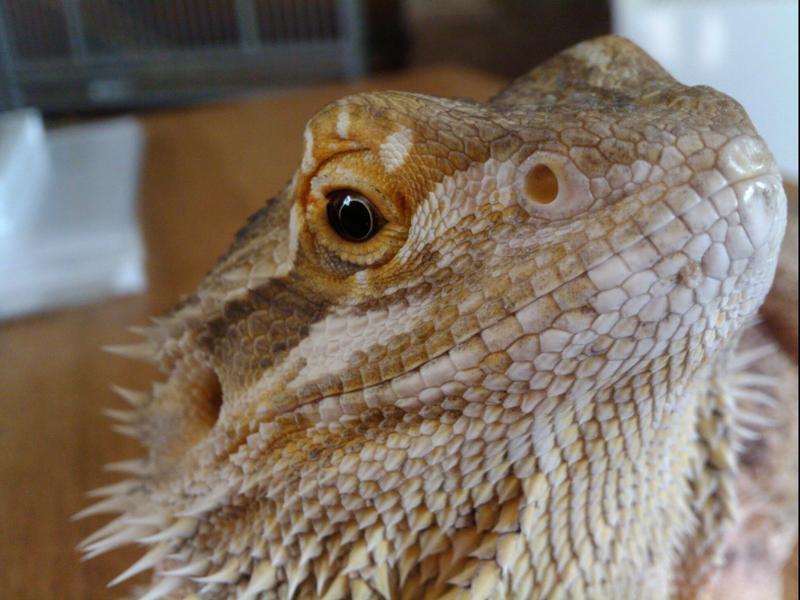
Brian Lehrer: Going to bring up [crosstalk] another kind of reptile that people may or may not be familiar with, or may be surprised to hear that some people keep as pets. One of the producers here got to take care of a bearded dragon over a holiday when it was her child's classroom pet, and can attest that a bearded dragon seems to like to be held. Tell us about bearded dragons.
Sam Laroche: Well, they're native to Australia. They are desert lizards. They are omnivores. In the beginning stage, in other words, when they're juveniles, they'll consume more insects. That's about 80%. As they gradually get to adulthood, they will eat more vegetation. They are also very nice. They can be held, they enjoy that. They don't grow to an enormous size, so they're pretty much ideal for apartments. They can be carried out in the street. They can sit on your shoulder on a sunny day. We have children from like six and over having bearded dragons.
It's a really nice pet. The family enjoys taking them with them when they go on vacation sometimes. If they can take them, of course, we provide boarding here. Bearded dragons have taken over the market more or less because of that. Because they are easy. They have a personality they interact well. They're expressive when you are near them, so they can be fed by hand. Again, that's that close interaction with a pet, which you always want, if that's what you want, of course. Yes, so that's bearded dragons.
Brian Lehrer: What are some other reptiles that people actually keep as pets or that are among the most common that you sell at Petqua? If you watch TV and see insurance commercials, a lot of people seem to be very taken with the gargoyle gecko. In real life, what kinds of reptiles are people owning as pets?
Sam Laroche: Well, funny you mentioned the gargoyle lizard, because originally, the actual lizard they used for that, it was purchased through us as well from Petqua. They modeled that from our lizard. In any case, geckos are also among the popular ones. With the geckos, we break them down into some that are tropical and, of course, some that are desert or more dry, and the ones that eat insects and the ones that don't eat insects. The habitat is different for each one of the groups. Of course, when clients walk in, we have to ask them. If they say, I want a lizard. We have to distinguish between what and what. Some of them are the ones that you can pet, and other ones is the ones that you just enjoy having them and creating a more lush environment because that's where they're coming from. That's what they need to stay healthy. Leopard geckos, gargoyle geckos, crested geckos, day geckos. What else we have in the store right now? We do have crested as well and fat-tailed geckos.
Brian Lehrer: Yes.
Sam Laroche: Well, geckos is the next [unintelligible 00:06:16]
Brian Lehrer: Tell me one other thing that people may be concerned about, and then we'll run out of time. Are there health risks for reptile pet owners, or for that matter, for the reptiles if they can get diseases from people?
Sam Laroche: Yes, and I'll make it quick. All reptiles will be carrying salmonella and a few other bacteria, of course. We always advise the customers that if they have children to address that they cannot handle the pet and touch their eyes, face or food. They need supervision until they get at least that in a register, so they do not expose themselves, but all reptiles do. More so, the smaller turtles, which is illegal to sell if they are less than 4 inches, because they have more volume of the bacteria.
Brian Lehrer: There we leave it with Sam Laroche, manager of Petqua on the Upper West Side, talking about, yes, reptiles as pets. Thanks so much for joining us. I enjoyed this.
Sam Laroche: Thank you, Brian. Thank you. Bye-bye. Take care.
Brian Lehrer: Coming up tomorrow at this time, in our membership drive series on Pets in the City, we will talk about cats.
Copyright © 2025 New York Public Radio. All rights reserved. Visit our website terms of use at www.wnyc.org for further information.
New York Public Radio transcripts are created on a rush deadline, often by contractors. This text may not be in its final form and may be updated or revised in the future. Accuracy and availability may vary. The authoritative record of New York Public Radio’s programming is the audio record.