
Oscar Talk: Streaming vs Theaters
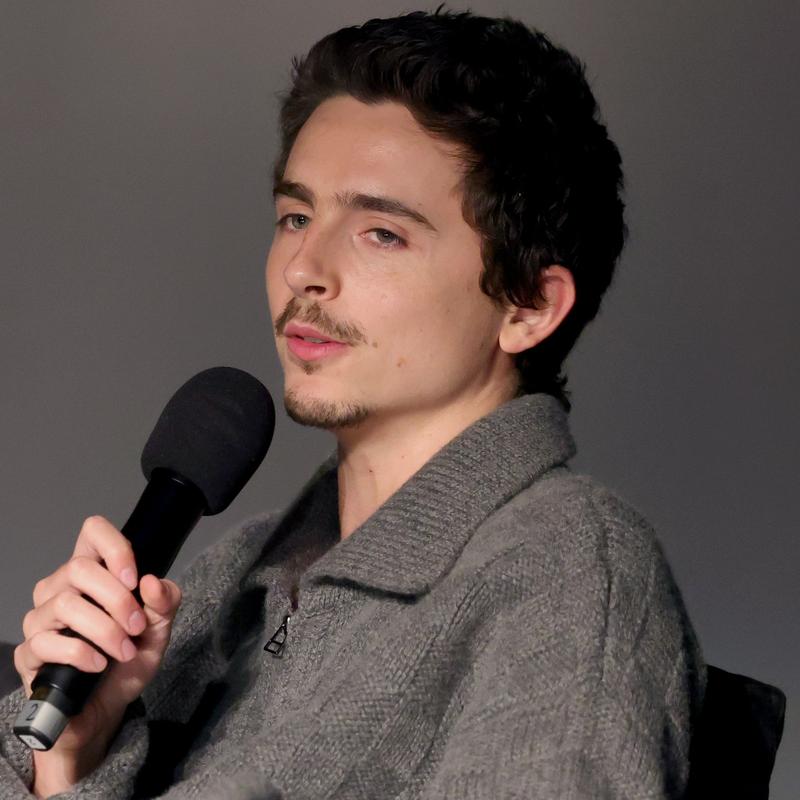
Brian Lehrer: Brian Lehrer on WNYC. For our last segment today, we'll look forward to the Oscars on Sunday night by talking a little bit about some of the Best Picture nominees, but also about the thing that Timothée Chalamet said on CNN the other day about not wanting movie theaters and his genre to go the way of opera and ballet. Now, some people in the opera and ballet worlds were upset and offended by that because they took it as a knock against art forms that they still consider vibrant and meaningful in today's world, right? That's not the part I want to bring up here. Rather, to take his concerns about movies and movie theaters head-on.
We're going to play a longer version of the clip that broke out because I think it's a little deeper than what made the news. He's responding to Matthew McConaughey, who said studios are producing more action scenes because that's what sells in this era of short attention spans. Chalamet replies in part like this.
Timothée Chalamet: I've observed a duo phenomenon where the majority of stuff is getting pushed in that direction. I think I saw an article about a Netflix production guideline, not for all movies, I don't want to speak disparagingly, but where they want their biggest action set pieces up front. The logic used to be you save your big action set piece for the end of a movie, and you save the fireworks for the end, but now they want something up front. I also think there's sort of a reverse thing going on, too, now. I don't want to speak for people here that are younger than me, where people desire, are desiring things that are more patient and that pull you in.
I just saw another article that says Gen Z is a bigger movie-going audience than a millennial audience. I feel like a grandpa saying that. No, but point being, I think, even like Frankenstein, which was a hugely popular movie this year. I didn't think that pacing was extraordinarily fast or anything, but it pulled people in, but it does take you having to wave a flag of, "Hey, this is a serious movie," or something, and some people want to be entertained and quickly. I'm really right in the middle, Matthew, because I admire people, and I've done it myself, to go on a talk show and go, "Hey, we've got to keep movie theaters alive. We've got to keep this genre alive."
Another part of me feels like if people want to see it, like Barbie, like Oppenheimer, they're going to go see it and go out of their way and be loud and proud about it. I don't want to be working in ballet or opera or things, where it's like, "Hey, keep this thing alive, even though no one cares about this anymore." All respect to the ballet and opera people out there.
Brian Lehrer: Timothée Chalamet on CNN. The ballet and opera and nobody cares part aside, there, Chalamet is raising several issues. Are short attention spans leading to more action-based, less thoughtful movies? Is Gen Z, despite phones and everything, going to more movies in the theater than older people? He expressed that concern that movie theaters and his genre might go the way of opera and ballet, however you take that, and he wants to keep movie theaters alive, keep this genre alive as mass entertainment.
We'll talk about that now, and also some of the actual movies. One of my questions on them will be how much social or political meaning did you find in some of the Best Picture nominees in this politically intense year, or should we even be measuring any movies on that scale? My guest is Dana Stevens, film critic at Slate, co-host of the Slate Culture Gabfest podcast, and author of Camera Man: Buster Keaton, the Dawn of Cinema, and the Invention of the Twentieth Century. Dana, always great to talk to you. Welcome back to WNYC.
Dana Stevens: Yes. Happy to be here, Brian.
Brian Lehrer: Listeners, this is for you, too. Among the actual Best Picture nominees, which movie deserves the Oscar, in your opinion? 212-433-WNYC. Did any of these nominees politically hit the sweet spot for you, or just hit the spot, given the times we're living in, one battle after another? Sinners, any of the others? 212-433-9692. To Matthew McConaughey's and Timothée Chalamet's points, since movies became so available at home on streaming services since the start of the pandemic six years ago, and even before, since there's a lot of quality TV as well, are movies, as we know them, an endangered species?
Are they destined to become less of a mass medium and more of an elite, smaller audience high art form? Which is what I think Chalamet meant with his ballet and opera reference. 212-433-WNYC, 212-433-9692, call or text. If you are Gen Z, do you think you're going to the movies more in person than millennials, or even your parents? If you are the parents, what do the movie habits of your Gen Z kids look like compared to yours? Answer any of the above. 212-433-9692. Dana, Chalamet said, part of him feels like, "Hey, we've got to keep movie theaters alive. We've got to keep this genre alive." He doesn't want movie theaters to become a relic, and he said his genre, in addition to saying theaters.
I realized he was spontaneously answering a question. This wasn't some kind of prepared manifesto, but did you take that to refer more to the in-person experience of moviegoing or to the whole genre of film as we know it?
Dana Stevens: I believe, since he was talking about he, himself has gone on talk shows to encourage people to go to the theater, the two things are so tied together. The future of filmmaking really is tied with the future of theaters, I think, because what are we going to call film if we stop having big public places to go watch movies in together? I guess I hear him as defending movies as a medium. I'm really glad, Brian, that you played the full context of that clip.
I was actually going to get ready to establish it in my answer to your first question because I think it's important that though he may have put his foot in his mouth, especially as a child of dancers, putting down ballet and opera in that way, I do think that it was maybe unnecessarily brash, but really a tossed off comment in the much larger context of him really being worried about the future of his own art form amidst all other art forms. I mean, we're in a moment when pretty much the entire cultural industry is endangered. I get him standing up for his medium in it.
Brian Lehrer: You've been a film critic for a while now. Do you see movies or movie theaters as you've known them, becoming more of a boutique, specialized product in any way?
Brian Lehrer: It's hard to deny that viewership has dropped. It never bounced back from the huge drop during COVID-19, right? The huge drop in theater attendance, but it has slowly bounced back. This statistic that you cite about young people, Gen Z going to the movies more, is backed up by some pretty hard numbers. We recently talked about this on my podcast, and it really does look like there's a lot of excitement about seeing movies in theaters and even seeing old movies. There's retrospective movie theaters, art film theaters that are cropping up and surviving all over the place.
I think there is something the same way that younger people are wanting to move away from phone addiction. There's kind of a Neo-Luddite movement. I think that theatrical attendance has been helped by that, which is encouraging in a pretty bleak landscape.
Brian Lehrer: This is probably a side issue, but a listener writes, "My last few trips to the movie theater have been awful. People are constantly talking and looking at their phones. It's like they think they're in their own living room." Maybe you go to screenings for critics, and you're not among the masses, I don't know, but have you experienced anything like that?
Dana Stevens: Yes, I do a little of both. I see a lot of press screenings, but I also see plenty of movies in the theater. This may be COVID-related, too, but yes, I would say that social contract observance in movie theaters has also dropped as a result of the pandemic. There is more talking and more phone use. Again, I think there's some pushback against that. I think about, when you go, for example, to an Alamo Drafthouse theater, how you inevitably get shown one of those bumpers before the movie and after the trailers, where they tell you that they'll strictly enforce phone usage rules and throw you out if you start lighting up the theater with your phone. Yes, there is some antisocial behavior in movie theaters, but I think there is also a lot of discontent with that.
Brian Lehrer: You asked a minute ago, are there movies if there are no movie theaters or no movie theater attendance? I was thinking about the shorter attention spans question that Matthew McConaughey raised in the first place, and maybe that's leading to a quicker progression to action scenes, which was his point, but it doesn't seem to be leading to shorter movies. One Battle After Another-- I'm just looking at these nominees, One Battle After Another, Frankenstein, even Marty Supreme. Oh, it's just a ping pong movie. They're all two and a half hours.
Dana Stevens: At least. Right.
Brian Lehrer: Right? Sinners is 2 hours and 17 minutes. These frontrunners are not your 90-minute in-and-out flicks. Should I be surprised by the length of those films?
Dana Stevens: It's definitely a trend that's been growing, and not just among the more prestigious films that get nominated for Oscars, but I feel like 2 hours and 40 minutes, which is the length of both One Battle After Another and Secret Agent, the Brazilian movie that's also a Best Picture nominee, is getting to be almost a typical length for even pop movies. The Dune movies are incredibly long. The last few Marvel superhero movies that we've had have been super long. I wonder if this is almost related. It's a strange logic, but the idea that you get what you pay for, going to the movies is expensive, and you've got to stir yourself off your couch and go get to a theater.
Maybe people feel like they want to buy the time, but of course, a movie should not be any longer than the length it needs to be. I think a good illustration of how the perspective of what is a long length is really subjective is that, to me, The Secret Agent, which is one of my favorite nominated movies, goes by in a flash, even though it's quite long and complicated and has 20 main characters. Marty Supreme, on the other hand, a movie I did not love, did not need to be two and a half hours long, and felt slow and draggy.
Brian Lehrer: When I watch a movie at home by streaming, when I watched Sinners, when I watched One Battle After Another, I feel like I know I'm watching a movie, I'm not watching a TV show, even though I wasn't in a movie theater, and so there's still a difference. Or am I deceiving myself?
Dana Stevens: No, I feel like the cinematic form still endures in terms of pacing. What is a movie is largely, at this point, defined by not quite the length in itself, but whether it's a single unit, right? Whether it's not an episodic presentation of a story, but a single self-contained presentation of the story. It seems like that genre in itself is not in danger of disappearing, but the communal experience is most certainly in danger of disappearing. Whenever I can, I do pound the table about that. If you care about movies and you want movies to continue showing in theaters, you've got to go see them there once in a while.
Brian Lehrer: William in Westfield, you're on WNYC. Hey, William.
William: Hello. Yes, I'm a Gen Z person. I graduated college back in May. I just wanted to call and say that I do watch a lot of movies, and I think a lot of Gen Z people are using movies communally. Back when I was in college, I ran a weekly movie night with my dorm where just everyone who didn't want to go out and party can come and watch a movie. Nowadays, me and my friends, every week we've been watching one of the Best Picture nominees to get through them, but also just to have an excuse for us all to hang out. I think, I mean, I don't know how this compares to millennials, but a lot of us Gen Z people, especially after Covid, feel this disconnect from others, and we're using movies to fill that in. Give us a reason to get together, and something to talk about.
Brian Lehrer: Great call, William. Thank you very much. You could write that one up on Slate, right, Dana?
Dana Stevens: Oh, yes. That's a great form of socialization. Keep it going. I was also thinking when that caller was speaking about Letterboxd and how the social mediatization of individual film viewing has really helped, I think, cinephilia to catch on. Letterboxd is huge among people, I think, millennials and younger. What it basically is is a sort of amateur review site. You see your movie, and then you can go on there and catalog the movies you've seen and write down what you thought about them, and share it with others.
Brian Lehrer: Someone writes, "My whole theater crying together during Hamnet felt kind of special. Rebecca in Brooklyn, you're on WNYC. Hi, Rebecca.
Rebecca: Hi, Brian. Thank you so much for having me. What I wanted to talk about is I'm Gen X, and my parents, who are, I guess, the greatest generation, I'm not sure what it's called, but they had not gone back to the movie theaters since COVID, but just this past week, they went for the first time. They didn't go for just the regular movie experience. They went to go see Breakfast at Tiffany's at 10:00 AM. They were talking about how they got a special coffee and a madeleine along with it. It was a completely different and special experience.
My thoughts are this is the type of technology discussion we've been having forever. The advent of TV, they were afraid that people were going to stop going to the movies. It's really about pivoting and thinking of new ways to bring people in, in my opinion, because that's a group of people that were afraid to go back to large crowd spaces because of potential exposure. Here, it got them to go. I thought that was really great.
Brian Lehrer: Breakfast at Breakfast at Tiffany's. Dana, quick thought?
Dana Stevens: Just really romantic. That's a great date. I mean, and it proves that it's not only the younger people that get something special from going to movies. I've long said this, even before COVID, when people would wring their hands about theaters disappearing, is that theaters will never completely disappear because people need to go on dates. We need to have a cheap date. Also, teenagers need a place to make out away from their parents, and the movie theaters are perfect for that.
Brian Lehrer: I was also thinking about your book in relation to all this. That'll make any writer happy, right? I was thinking about your book.
Dana Stevens: Oh, joyous. Joyous, yes.
Brian Lehrer: Buster Keaton, the Dawn of Cinema, and the Invention of the Twentieth Century. Your book tells us Buster Keaton was born in 1895, the same year the movie industry was born. I guess he was native to the new art form in a foundational way. Well, Timothée Chalamet was born in 1995, the same year that the internet really became a mass medium. I'm just curious if you thought about how movie makers today, actors, directors, anyone, think about their art form as sort of the invention of the 21st century.
Dana Stevens: Yes. That is a hilarious question, first of all. The Keaton-Chalamet connection. I wish I could make the case that Timothée Chalamet helped invent the internet the way my book argues that Keaton did for cinema, but we could definitely say that Chalamet is a child of the internet age. Even in his self-promotional abilities and going viral for that ballet comment. Between his use of social media to maintain his image, the fact he must be one of the most memed actors of his generation, and knows how to play that angle very well by, for example, doing things like showing up in person to a Timothée Chalamet lookalike contest he did a couple years ago.
Brian Lehrer: Oh, really?
Dana Stevens: Yes. We could somewhat facetiously make the case that he is an internet age actor.
Brian Lehrer: I want to spend our last five minutes on some of the Best Picture nominees and politics in these times. I'm going to let Bruce in Manhattan kick it off with a phone call. Bruce, you're on WNYC. Calling about Sinners, right?
Bruce: Yes, we saw Sinners twice, but fortunately, we bought it the first time and then relaxed at home the second time. The second time, we really appreciated that this film was really all about music. The importance of music to Black culture, starting with the blues and then progressing from the past to the present to the future, in that fantastic scene in the juke joint that goes on and on and on, and figures come in and out, and you just get swept away with the power of moviemaking and the power of music.
Brian Lehrer: Yes. Importance of music to any culture, by extension. That may be one of the greatest scenes in movie history, Dana. I don't know, but politically speaking, maybe The Secret Agent, which I haven't seen, hits the nail most squarely on the head with the main character in the context of an authoritarian regime, but the ones that are getting the most discussion are Sinners and One Battle After Another. I enjoyed both films immensely, but ultimately, I think Sinners was the more ambitious film visually and politically, but I'm an amateur in this lane, I readily admit. Where would you start on any of it?
Dana Stevens: I'm never one to pit Oscar opponents against one another, especially when it's two movies as good as Sinners and One Battle After Another. I love both those movies, and I think they're incredible compliments for this year. The fact that they came out this particular year, obviously not knowing that they would be coming out-- as they were being made, no one knew they'd be coming out in the first year of the new Trump administration, but there's such different and complimentary views of what-- I don't know what you want to call it. Resistance, rebellion, revolution, could be.
I agree with you that Sinners is absolutely brilliant. I would be really happy to see it win Best Director for Ryan Coogler. That's what I'm rooting for, the category I'm rooting for for Sinners most of all, because I didn't realize this until reading up on this year's Oscars, but there has never been a Black American or a Black director who's won Best Director, and there's very few who've even been nominated. That would be a great breakthrough for Ryan Coogler. Sinners, as you say, is one of those movies where the direction is really what stands out, the vision and the originality of Coogler's entire conception of this vast movie that's kind of a thriller and a Western and a vampire movie and a musical and a thriller, everything all at once.
One Battle, on the other hand, has this very different-- It's a darker, maybe more pessimistic view of revolution, but ultimately, as the title says, it's about the cyclical nature of resistance, right? That you fail, and you try again. You fail, and you try again. The next generation picks up the baton and makes its case in a very different and maybe more comic way. Anyway, I'd be very happy to see either movie take Best Picture, but I want to see Sinners get something, because it's just a special, special film.
Brian Lehrer: On One Battle After Another, it's worth it just for Sean Penn's hilarious, cartoonish, bad guy, racist, soldier character. I kept waiting for the--
Dana Stevens: Extraordinary villain. Really incredible performance from Sean Penn.
Brian Lehrer: Right. Really villainous and really hilarious. I kept waiting for the underlying story of immigrant detention and revolution for equality to deliver something more. I noticed that op-ed in The Times the other day by Hope Reeves, the daughter of real-life Weather Underground members from the '70s, who wrote, "The film is less a call to fight the power than a madcap adventure about a couple of deranged agitators." She goes on from there, and it kind of rang true to me. I want to ask you one last thing before we run out of time, that goes back to Sinners.
Listener writes, and I was wondering the same thing. Listener writes, "I like Sinners, and Michael B. Jordan deserves Best Actor, but I thought turning from an interesting period drama to a vampire movie at the end felt disjointed." Can you explain? Can you give us 30 to 40 seconds on the social meaning of vampires in that movie or in the genre generally?
Dana Stevens: First of all, I really disagree with that listener. I think one of the great coups of that movie is the way it incorporates the horror genre, not just at the end. I mean, there's vampires all along. They just don't start killing en masse until the end. I love the way that he takes this familiar trope that we associate mainly with, I don't know, I would say vampires have mainly had a kind of sexual meaning in past cinema.
There's a lot of vampire as the deadly lover, love and death, all these Twilight uses of vampire imagery, and to take vampires and turn them into a racial allegory is something that's really difficult to do without being extremely heavy-handed, and to also tie in music history the way Ryan Coogler does in Sinners, right? With the vampires representing a certain strain of American music, American roots music, coming from Europe and from Scotland and Ireland, and blending with the blues. All of that is happening at a sub-story level. Coogler never has to point it out. Just the story accomplishes it.
Brian Lehrer: The vampire as outsider. Obviously, the Black people in the South, in that context, but also the Irish people, who reference the oppression of the British in that context. Dana Stevens, film critic at Slate. This was great. Thank you so much. Enjoy the Oscars.
Dana Stevens: Oh, always love coming on your show.
Copyright © 2026 New York Public Radio. All rights reserved. Visit our website terms of use at www.wnyc.org for further information.
New York Public Radio transcripts are created on a rush deadline, often by contractors. This text may not be in its final form and may be updated or revised in the future. Accuracy and availability may vary. The authoritative record of New York Public Radio’s programming is the audio record.