
Oscar Docs: The Alabama Solution
Title: Oscar Docs: The Alabama Solution
[MUSIC - Marden Hill: Hijack]
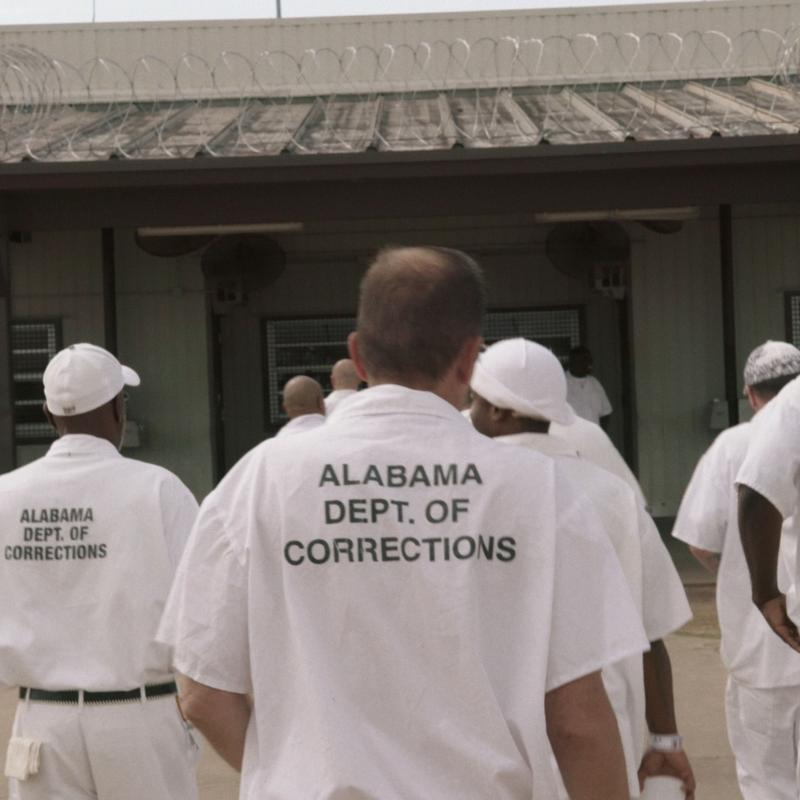
Brian: Brian Lehrer on WNYC. We'll end today by continuing our annual series with the makers of the five feature-length documentaries up for an Oscar. Nothing wrong with celebrating the great actors and other artists who contribute to the arts and entertainment films, but on this show, we do the documentaries. One of this year's nominees is The Alabama Solution, which takes viewers inside Alabama's prison system, a place most Americans never see and that in many ways is designed not to be seen.
The film begins with a revival meeting, basically a religious service, at Easterling Correctional Facility. There's music, there's food, but almost immediately incarcerated men start telling the filmmakers, "This isn't the real prison, this is what they let you see." What follows is a look inside a state prison system, built largely from cell phone footage recorded by incarcerated men themselves over the course of several years.
That footage documents violence, neglect, and the efforts of people inside to organize for change. The film is co-directed and produced by Andrew Jarecki, known for Capturing the Friedmans, you know that, and HBO's The Jinx, and investigative journalist Charlotte Kaufman, who has worked closely with him for the past six years, including on The Jinx: Part 2. Andrew Jarecki and Charlotte Kaufman join me now. Congratulations on the film, congratulations on the Oscar nomination, and welcome to WNYC.
Andrew: Thank you very much for having us.
Charlotte: Thank you. It's so wonderful to be on this beloved show.
Brian: Oh. We'll play some clips from the film in a minute, but I'll tell the listeners that it begins with that peaceful religious revival meeting on what looks like a gorgeous Alabama day, but the facade cracks almost immediately. Some of the men tell you you're not seeing the real Easterling Correctional Facility. What were they trying to tell you in that moment? When did you realize what the film actually needed to be? Andrew, you want to start?
Andrew: Sure. I think I'd always been interested in the prison system ever since making Capturing the Friedmans, because I'd gone into Dannemora, upstate New York's very medieval correctional facility, to see Jesse Friedman. I was so struck by the secrecy of it, and just the fact that they were probably as hostile to visitors as I could have imagined. I stayed interested and kept visiting prisons for years.
I was always interested in Alabama system, which was notorious, but also very secretive, because prisons in the US are kind of black sites that you're not allowed to see into. Then by chance, we were able to get access, very unusual access, to one of the prisons, Easterling, as you said. When we went in, and they allowed us to film just this very small sliver of what was happening, it was clear to us from men taking us aside that there were whole areas of the prison and things going on there that we were not allowed to see.
They started to tell us what those things were. Then when we get nosy, we get thrown out, which you see in the film. Thereafter, we thought it would be very difficult to tell the story, but we learned that there were men inside who had access to contraband cell phones. We ended up meeting two of the very strong leaders of a nonviolent protest movement who were inside, and they said that they would tell us the story. We clearly wanted to center them in the story rather than making something with talking heads or experts. We just recognized that those men were the experts and were incredibly reliable sources of information and video that they had been shooting of the problems inside Alabama's prisons.
Brian: Charlotte, anything you want to add before we play a couple of samples of that?
Charlotte: Yes. I think when we really realized that we had a film, it didn't come before that first visit. We approached that first visit at the revival with just curiosity because you don't often get access to prisons. As soon as we spoke to those men and they were really able to enlighten us about the situation in Alabama, it was clear that there was this very unique opportunity for people to be in dialogue with a population that's incarcerated, whom are usually kept separate from us and secret from us, and communication is very difficult.
That was really, I think, the breakthrough and the miraculous opportunity we had.
Brian: Here's a clip that pertains to Steven Davis. His death is the tragic case that opens the door to so much of what the film uncovers. Then you have this phone call to his mother from an anonymous guard. Here's that moment from the film.
Sandy Ray: Hello? I'm sorry. I'm on oxygen, so I had to take a minute there.
Guard: Okay. I understand.
Sandy Ray: Who's this?
Guard: I know you're grieving and mourning, but I wanted to tell you that your son was beaten to death by an officer. That was a murder. They switch stuff underneath the rug all the time about this.
Sandy Ray: I called the warden this afternoon. An hour later, there was a statement on the news that he rushed out of his cell with two homemade weapons and attacked them.
Guard: With a plastic knife. They always come up with something to justify excess brutality and use of force.
Brian: Wow. Charlotte, what do we know about what actually happened to Steven Davis?
Charlotte: Steven Davis was a man who was incarcerated at Donaldson Correctional Facility. Several months into our investigation, we received a text message from Melvin Ray, who's one of the incredible whistleblowers and activists who were incarcerated in Alabama, saying that a man had been beaten and had been sent to the hospital. This really launches what is the other backbone of the film, which is an investigation into what we find out was a killing of an incarcerated person at the hands of an officer.
I think this scene is when Sandy Ray, his mother, is for the first time receiving real information about what happened to her son. Prior to that, prior to receiving this call in the middle of the night from a man who needs to remain anonymous, but works at the prison system and feels morally obligated to reach out to this grieving mother, prior to that, she was given no information about what happened to her son. She was treated basically as if she was guilty of a crime just by being related to someone who was incarcerated and with very little respect.
Her experience, Sandy Ray, the fact that we were able to follow it in the film, is very powerful because her experience represents mothers and fathers and other family members of thousands of men who have died inside Alabama's prisons. Since we began investigating, over 1,500 men have died inside Alabama's prisons, and that's just one state prison system. Her experience as a family member of someone who is incarcerated, trying to understand what is happening with her son and what has happened, is very representative of others.
Brian: You tell the story of how Steven Davis's cellmate, James Sayles, a key witness, seems terrified. He tells the family attorney that guards have basically warned him not to talk because they could interfere with his release, and then he ends up dead. It certainly took some courage, I guess, on the part of that guard to make that call to Steven Davis's mother. One of the most striking-- Oh, go ahead. You want to say something before we play the next clip?
Charlotte: No, I was just going to say, I think there are just so many people who are trapped in this system, both who are incarcerated and also working within it, that want to speak out, that want to expose how dysfunctional and brutal this incarceration is in America, but there are many elements of intimidation to silence that dissent. I think in this scene, that captures that reality.
Brian: Here's 43 seconds of a scene where one of you, I think, asks an incarcerated person named Melvin about the way they're using their cell phones to record things. You ask, "Wouldn't a regular phone call be better?" Here we go. I think we have this clip.
Charlotte: Would a regular phone call be better?
Melvin Ray: No, because it does not allow us to just be ourselves. When we present our stories, we want to present our whole self, not just our voice.
[music]
Melvin Ray: We're in these walled-off secret societies. These are state institutions, but it's one of the only state institutions that the public or the media has no access to. How can a journalist go into a war zone, but can't go into a prison in the United States of America?
Brian: That's Melvin Ray, one of the prison activists the film centers quite a bit on. Talk about him, Andrew, and this whole idea of the way the incarcerated people use cell phones.
Andrew: It was pretty surprising to us that there were cell phones and that they were so available. I didn't really understand where the cell phones were coming from. It's not common that people in prisons have access or ready access to cell phones. The prisons make a lot of money by charging them for phone calls on the wall phone, which they're allowed to monitor. When we found out that there were these cell phones, we realized that it was a way to cut through the secrecy of the prison system and really be able to see and hear what was going on inside.
When I asked somebody to tell me about the volume of drugs that were coming in, the volume of cell phones, and the availability of these cell phones, I said, "Where is that all coming from?" He looked at me incredulously and said, "We don't leave, right?" I thought that was perhaps obvious to him, that the cell phones and contraband and drugs were coming in through the guards, and there's no question that that's the case. We heard that not only from the incarcerated men, but also heard that from guards.
Brian: One more clip. There's a moment where that same man, Melvin Ray and Robert Earl Council, AKA Kinetik Justice, talk about labor in the prison system and say, "Our labor is what this is all about." They talk about stopping what they see as the machine in this 52nd clip.
[music]
Melvin Ray: When you look at the options, violent, nonviolent, work strike, boycott, what's the absolute best way to hit the system where it's going to hurt the most? You hit them in the pocket, that hurt way more than hitting them in the mouth.
Kinetik Justice: The only thing that's going to work for us is to stop the machine from running, to stop producing goods, stop giving services. We got an official copy of everybody who actually works in the prison, you know what I'm saying? All three shifts to get them on board.
Melvin Ray: We always understood that our labor is what this is all about.
Brian: Andrew, what do you know about how Kinetik and Melvin and another man, Raoul, are doing right now? Because I know they face consequences for being part of this project and their activism.
Andrew: I think the consequences weren't about this project. They've been retaliated against for their activism for many years, including long before we ever met them. We're lucky enough to be able to talk to them and interview them. It's because their job, in their minds, I think, really includes trying to protect the other 20,000 people who are locked in these hellish institutions.
Brian: Charlotte, in our last 30 seconds, what would it mean if you win the Best Feature-Length Documentary Oscar for this to the world outside of your own filmmaking credentials? Should people view this as just about Alabama?
Charlotte: No, this is certainly not about Alabama. We spend $80 billion a year incarcerating 2 million people in our jails and prisons. The system that we call corrections is actually creating a lot of harm and perpetuating many of the reasons that we lock people up in the first place. I think what it would mean, having the nomination, having this recognition, what it already means is that these issues that Robert Earl Council, Kinetik Justice, Raoul Poole have been working so hard to get into the public domain, that people care about it, and their voice does have power.
Brian: The Alabama Solution, now up for a Best Documentary Oscar. Good luck on Sunday.
Andrew: Thank you.
Copyright © 2026 New York Public Radio. All rights reserved. Visit our website terms of use at www.wnyc.org for further information.
New York Public Radio transcripts are created on a rush deadline, often by contractors. This text may not be in its final form and may be updated or revised in the future. Accuracy and availability may vary. The authoritative record of New York Public Radio’s programming is the audio record.
