
Oscar Docs: Cutting through Rocks
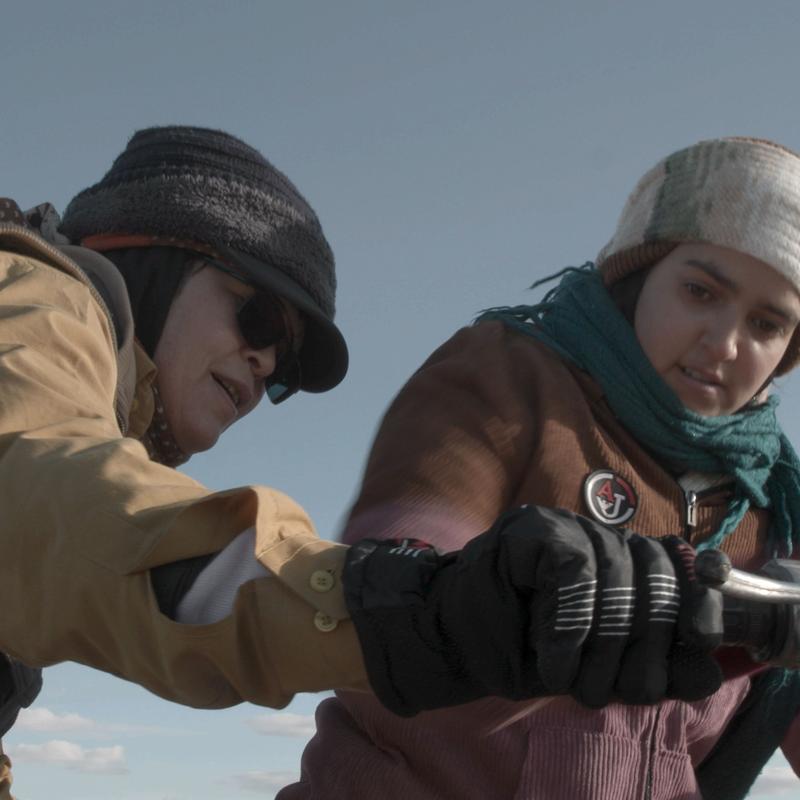
Title: Oscar Docs: Cutting Through Rocks [music]
Brian Lehrer: Brian Lehrer on WNYC. Oh, and now somebody just wrote in light Olive, so it continues. Now we'll conclude our series talking with the five creators of this year's Oscar nominated documentary. We do this series each year in Oscar season as regular listeners know. Nothing wrong with other places centering the great actors and directors, and others behind the arts and entertainment films, but as one piece of being alternative radio, public radio, we focus on the documentaries on this show.
Today we'll talk to the filmmakers behind Cutting Through Rocks, and we'll hear some clips. Cutting Through Rocks is the first Iranian made documentary to earn an Oscar nomination. This film took eight years to make, I'm told, but its story turns out to be especially relevant right now, right with the pro-democracy protests taking place there. The film focuses on Sara Shahverdi, the first woman elected to serve as a village council member in rural northwestern Iran. Here is Sara in her own words.
[MOVIE - Cutting Through Rocks: Sara Khaki and Mohammadreza Eyni]
Sara Shahverdi: [Azeri-Turkish language]
Brian Lehrer: You hear her voice there in her presentation. The translation is, "After he had a few daughters, my father was hoping for a son, but I was born a girl. My father took me to places where only boys were allowed." I guess that sets up how she got into politics. With me now are the filmmakers Sara Khaki, and Mohammadreza Eyni. Welcome to WNYC and congratulations on your Oscar nomination.
Sara Khaki: Hello, and thank you so much for having us here at WNYC.
Brian Lehrer: Sara, how did you first meet your namesake, and why did you want to make a film about her?
Sara Khaki: Well, I was born and raised in Tehran, Iran, and I grew up witnessing so many tenacious individuals like Sara Shahverdi, who were fighting for their independence and demanding space for women and girls around them. I left Iran when I was young, and now having lived equally between the two worlds, between the United States and Iran, I can say that some of the topics that are now explored in Cutting Through Rocks are common concerns, especially in the way in which women bodies become battlegrounds.
With that in mind, I was interested in seeing the ones who never leave their communities. How are they really pushing boundaries in their surroundings? Through extensive research, I came across Sara Shahverdi, who lives in the northwest of Iran. The only female motorcycle rider in the northwest of Iran in the region, and someone who had been a midwife and delivered 400 kids. Through phone calls, she shared with me that she's thinking about running for a council seat. We knew we wanted to make a cinematic story, and I knew that I wouldn't be the only creator here. I needed a collaborator, and no one was better than Mohammadreza Eyni, who I knew from past projects. I called him, and we went to the village together.
Brian Lehrer: Mohammadreza, you're originally from that region, right?
Mohammadreza Eyni: Yes. Hello, WNYC and your listeners. Yes, I'm coming from the community. When Sara called me, it was amazing opportunity for me to go and make a film about my community, especially women. I was always waiting for a chance to make a film about women, and the stories that I was familiar with, but for me, as a male director, it was not possible to go and make an intimate film without having a female director with me.
Sara called me and told me about the story, and we entered to the village together. I can say that we didn't expect that we are going to spend eight years of our lives making this film. It was a very long process. It was eight session of filming. Each time we stayed there for 90 days or 70 days or 50 days because we wanted to experience the changes that our main character is offering to the community, and how they are responding to these changes.
Brian Lehrer: Why did it take eight years to make?
Mohammadreza Eyni: Actually, it's a very good questions.
Sara Khaki: Yes, go ahead, Mohammadreza.
Mohammadreza Eyni: No, no, no, please Sara, you go ahead.
Sara Khaki: We didn't film right in the beginning. We wanted to get to know Sara Shahverdi, the village, her family, and as we moved forward, we wanted to follow her campaigning for running for election, and against all the odds,because the kids she delivered were 18 year old first time voters. She really was able to win the election. We could have stopped right there, but we really were interested in seeing how this woman is using the local power that she gains, and how she's able to create change in her community.
From the moment she wins, she went from teaching the young girls how to ride a motorcycle, bringing equal land ownership for women, and now there are 150 women who co-own lands with their husbands. She brought gas lines, and so many different things. Most importantly, she was able to shift perspectives, and that really took us a while to be able to witness, and we wanted to be there to see the evolution of the character. and eventually the village.
Brian Lehrer: Now you're nominated for an Oscar. Mohammadreza, go ahead.
Mohammadreza Eyni: I think it's very good question that you asked, because it's a nature of observational filmmaking, verity filmmaking, and I really love decision makers, if some of them are listening now to this conversation that support the idea of observation of filmmaking, and not being afraid of being patient with the stories because we need more stories about real people, and spending time with them to share the similar experiences.
Our film is about leadership. The topic that is more urgent than ever, and we need to talk about it because every day we wake up with tragic new, and we need to talk about it. We need to find the idea of who is the best leader for the future of this planet. We need that in our communities. We need to support leaders like Sara in our film, because she's honest, and she is trying to empower others without having the fear of losing her own power, and also creating safe space for others without putting a lot of limitations supporting them. These are the topics we need to explore.
We wanted to spend time, eight years making this film to experience that, and share it with people, because these kind of things, these kind of stories, you need to be patient. I have an example. When we finished the first phase of the filming, it was about Sara's election. When we finished that part, we had a sample and we shared with our colleagues and friends. One of them told us, "Guys, you have a story here about a woman who fights against patriarchy, and despite a lot of setbacks and opponents, she wins." He said, "Guys, you can submit it to festivals, and stream the film." For us, it was important for Sara Khaki and me to spend six more years to see how our main character uses the power, to see how others reacting to her power. This is why we decided to spend eight years to tell this very complex and multi-layered story.
Brian Lehrer: In that context of Sara, who you're documenting in the film, using her power, Sara the filmmaker, how do you think people should view this film in the context of today's news given the current pro-democracy protests taking place in Iran? Do you see them as related?
Sara Khaki: Yes. We cannot take what is happening today in the streets of Iran, or in the houses of all the Iranians indoors. We cannot separate what's happening in the film with what's happening today in Iran. I wanted to say that I always think about the idea that being an Iranian, and being resilient, they go hand in hand. It's just in the DNA of Iranians, and what we see in our character, in Sara Shahverdi, it happens to be two Saras. It's one me and one the character. What we see in her character, and that's really interesting for us to see how she really is going from one setback to another with a lot of tenacity, and a lot of perseverance, and hope. That's really what we see in every Iranians out there.
It really makes us hopeful because we know that change is contagious, and is inevitable. It's not something that happens overnight, and that's something that Sara Shahverdi learns over the course of these many years, but she doesn't stop. She wants to create this. Even if it's a small change, she wants to create that in her community. We need more Sara Shahverdis in every community because we see that happening here in the United States, too, where, what's happening in our thoughts, and our ideas, and how we can move forward in our day to day because these are quite challenging and dark days, and with that idea of cutting through the stones and clearing a path in front of us, we can provide hope for our next generations. I feel like that's becoming the only way.
Brian Lehrer: We're talking, if you're just joining us with the two directors of the Oscar nominated documentary Cutting Through the Rocks, the first Iranian made documentary to earn an Oscar nomination. It's actually the last in our series with the five creators of this year's Oscar nominated feature length documentaries. We learn in the film that Sara was a midwife, that she delivered at least 400 babies, including someone who's 16-years old in the film named Fereshteh, who actually lived with Sara for a bit. Sara was also the only woman in her area who rode a motorcycle, you told us, until she taught Fereshteh, and then later one of the other young girls in the village. Here's a clip of Sara and Fereshteh in the documentary after their first motorcycle lesson.
[MOVIE - Cutting Through Rocks: Sara Khaki and Mohammadreza Eyni]
Fereshteh: [Azeri-Turkish language]
Sara Shahverdi: [Azeri-Turkish language]
Fereshteh: [Azeri-Turkish language]
Brian Lehrer: Of course, there are subtitles in the film. The translation that I have is, Fereshteh says, "Did you ride a motorcycle when you came to deliver me?" [chuckles] Sara says, "Yes, I came with my motorcycle. I rode the motorcycle, I parked it in your backyard, and you were born in the morning." Then Fereshteh says, "When I ride, I feel like I can do anything." Mohammadreza, since this is your native language, what do you call it? Is it Azeri-Turkish? Do I have that right?
Mohammadreza Eyni: Yes, it's Azeri-Turkish, the language. Despite more than 30% of Iranian people speak this language, it's very hard to find films coming from this community, so for me, it was a great chance as I shared, to make a film about the community that I'm coming from. It's funny that you decided to talk about this scene about riding a motorcycle, and how Sara Shahverdi, our main character, giving power to others, teenage girls, by teaching them how to ride a motorcycle.
Yesterday a friend shared with me something. It was really interesting, even here in the US. It was saying that in an 1896 interview, Susan B. Anthony famously stated, "Let me tell you what I think of bicycling. I think it has done more to emancipate women than anything else in the world. I stand and rejoice every time I see a woman ride by on a wheel. The picture of free, untrammeled womanhood."
Brian Lehrer: I did not know that story about Susan B. Anthony and bicycles. That is awesome. This is not a love story exactly, this film, but I'm going to reveal to the listeners that I read that somewhere in the middle of all this eight years of filming, raids, interrogations, living in a village in northwestern Iran where at least you, Sara, didn't come from, the two of you as co-documentarians fell in love and got married. Do I have that right?
Mohammadreza Eyni: [chuckles] Yes.
Sara Khaki: Yes. [chuckles.
Mohammadreza Eyni: I can say this was the most beautiful part of it. What do you think, Sara, about it?
Sara Khaki: Yes. We always talk about how cinema and love brought us together, and through all the ups and downs, we were able to learn more from each other and from our challenges. The title of the film was really, really fitting for what was happening behind the camera, too, because it was really a challenging production for us. Cutting Through Rocks. we really cut through the rocks to make this film. [chuckles]
Brian Lehrer: 30 seconds. What would it mean-- Oh, go ahead, Mohammadreza, you can talk about your love. [chuckles]
Mohammadreza Eyni: [laughs] It was two stories, one behind the camera, our relationship. I can say we needed each other because while making this film, as Sara said, we faced with so many obstacles, and we witnessed so many tragic stories. I can say we became each other's therapists while making the film. Those obstacles created a space for both of us to talk about the topics, and helping each other, and supporting each other. Then we decided to get married in the process of making the film, and for itself, it's a film. We can consider one day making a film about what happened behind the camera.
Also, as you mentioned, we were stopped from filming for one year, and we were banned from leaving the country, and our stuff being confiscated, our hard drives and interrogations. It was really hard process. Many times, both of us were like, "We can finish the film. How it's possible, how we can do it." Now we are here and talking about the film, especially the relationship of the film now with what is happening inside the country. Many of our friends, and us as Iranians are so sad about what is happening inside the country. Many of them shared with us. This is the only small good news that the film is as a first Iranian documentary story being nominated for Oscar. I'm happy to talk about, with Sara, about the ideas, about the layers of the film here, because I think we need that more than ever as Iranians to talk about it. Thanks to you for asking about Iran, and what is happening inside the country.
Brian Lehrer: Mohammadreza Eyni and Sara Khaki, the co-filmmakers, and now wife and husband of the Oscar nominated documentary Cutting Through Rocks. It's been an honor to meet you both. Good luck at the Oscars.
Sara Khaki: Thank you so much.
Mohammadreza Eyni: Thank you so much.
Copyright © 2026 New York Public Radio. All rights reserved. Visit our website terms of use at www.wnyc.org for further information.
New York Public Radio transcripts are created on a rush deadline, often by contractors. This text may not be in its final form and may be updated or revised in the future. Accuracy and availability may vary. The authoritative record of New York Public Radio’s programming is the audio record.