
One Family's Reverse Migration Story
Amina Srna: It's The Brian Lehrer Show on WNYC. I'm producer, Amina Srna, filling in for Brian today. Good morning again, everyone. We now turn to President Donald Trump's mass deportation campaign. Yesterday on Truth Social, President Trump announced that he has fired Department of Homeland Security Secretary Kristi Noem. In the Post, Trump said he will elevate Oklahoma Senator Markwayne Mullin to the cabinet post.
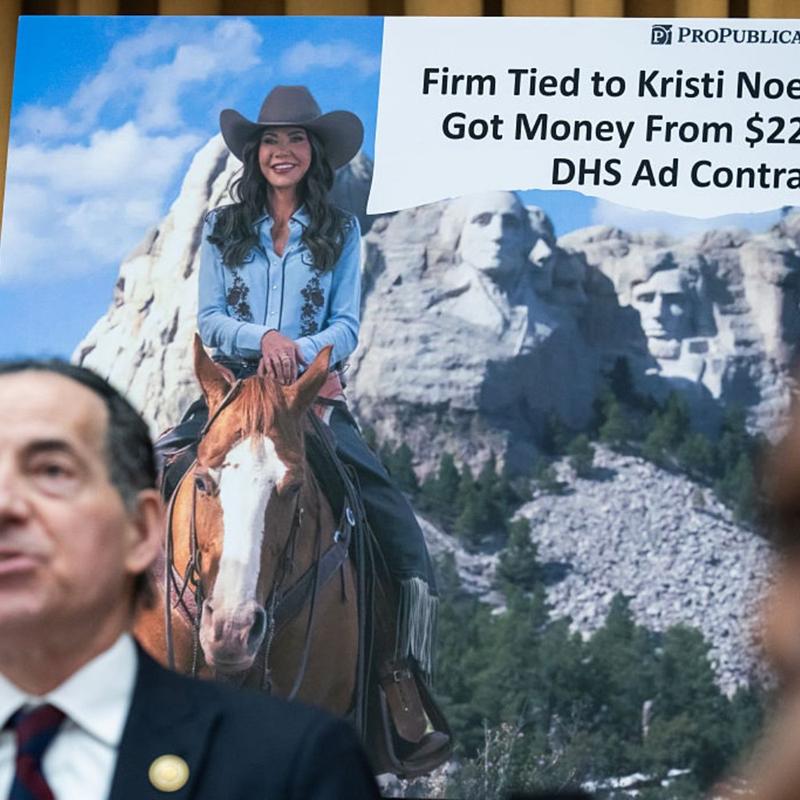
This is the first time in this term that Trump has replaced anyone in his cabinet. Noem will be appointed as a special envoy for "The Shield of the Americas." As the news broke yesterday afternoon, media outlets reported that Trump was critical of one exchange in particular that took place with Republican Senator Kennedy earlier this week. Noem was asked during a congressional testimony about her role in approving contracts for a $220 million ad campaign encouraging immigrants to self-deport.
Caitlin Dickerson is a Pulitzer Prize-winning staff writer at The Atlantic, who has been covering immigration since the first Trump administration. Her recent piece in The Atlantic is a profile of a former New York City mixed immigration-status family, who has just recently moved back to Mexico, where the family's undocumented father is originally from. She joins us now to talk about the latest news and her reporting. Caitlin, welcome back to WNYC.
Caitlin Dickerson: Hi, thanks so much for having me.
Amina Srna: We're going to be joined by the couple in your latest Atlantic article in just a few to talk about how the Trump administration's hostility towards undocumented immigrants is forcing mixed immigration-status families to make some really hard choices. First, I want to ask you for your take on the latest news. On Tuesday, Homeland Security Secretary Kristi Noem was met with skepticism from Republican Senator John Kennedy of Louisiana, who argued during a hearing that more than $200 million in ad campaigns to encourage immigrants to self-deport. He was deeply skeptical of why this cost so much. Let's hear a little bit. It's a little under a minute of that exchange.
Senator John Kennedy: How do you square that concern for waste, which I share, with the fact that you have spent $220 million running television advertisements that feature you prominently?
Kristi Noem: Sir, the president tasked me with getting the message out to the country and to other countries where we were seeing the invasion come from with putting commercials out that told them that if they were in this country illegally that they needed to leave, or we would detain them and remove them, and they not get the chance to come back to America the right way. That has been extremely effective.
Senator John Kennedy: The president asked you to run these advertisements, is that right?
Kristi Noem: We had that conversation, yes.
Amina Srna: Caitlin, for listeners who aren't familiar, last February, DHS announced the ad campaign, which features Noem telling migrants to go home or face deportation. Can you tell us more about that ad campaign and why the political fallout now?
Caitlin Dickerson: Sure, so the ad campaign is part of a broader approach that involves social media posts, illustrations that DHS has commissioned, and television commercials as well, trying to spread the message about this aggressive crackdown campaign and really openly asking people without legal status to leave the United States. It's in so much of the agency's messaging.
Just a comment that I received from them on a story earlier this week said that we encourage anyone without legal status in the United States to take advantage of the cash offer the administration has made to anyone who's willing to self-deport. This idea of an intimidation campaign to encourage people to leave the United States if they don't have status is not controversial in the eyes of the administration. It's really central to the goals that they have.
I think that what happened with Secretary Noem losing her job has to do with a couple of things. We all know, and we've seen in the past, that, at times, President Trump can turn on top members of his administration who are seen as taking up too much attention, distracting certainly from him. That may be the case to some extent with Secretary Noem, but I think the real political reality that culminates in a moment like this is that immigration enforcement went from President Trump's top issue, what he considered to be his most popular issue when he won the presidency, to one of his least popular.
Now, Americans have become very disillusioned with ICE's behavior and certainly with the killings of civilians, US civilian protesters, Renée Good and Alex Pretti, in addition to people who ICE was actually trying to arrest and deport. I think that the administration is concerned about that heading into the midterm elections and wants to show that they're making a change.
First, that was by putting Tom Homan, who was Trump's border czar, in charge of ICE enforcement over Gregory Bovino, that bombastic and controversial Border Patrol leader, and now by replacing Secretary Noem. I will say, the administration has been very clear that the aggressive crackdown isn't going to end. I think we're seeing a change in leadership, but I wouldn't expect that the deportation campaign is going to wind down by any means.
Amina Srna: Let's talk about that change in leadership. Trump said he will elevate Oklahoma Senator Markwayne Mullin to the cabinet post. What do we know about Senator Mullin, and how he might conduct Trump's deportation agenda?
Caitlin Dickerson: Well, he's a junior senator from Oklahoma, and he's been in lockstep with the president throughout his career in Congress. He's shown himself to be a reliable Trump supporter and advocate. I think that he'll really continue to do what Kristi Noem did at DHS. The DHS secretary position is an interesting one. You're running an agency of 250,000 people, but immigration is one of our most politicized issues.
Whereas 15, 20 years ago, a DHS secretary might have had a little bit more autonomy. Really, since that first Trump presidency, there's been a lot of top-down influence directly from the White House. That's especially true under this Trump administration. Trump's top immigration advisor, Stephen Miller, in the White House, meets regularly, I believe, on a daily basis with leadership at DHS. Really, this DHS secretary, Markwayne Mullin, is going to be expected to carry out the wishes of the White House, not to be an individual actor who's going to come up with his own ideas, but to do what Trump wants him to do and what Stephen Miller wants him to do, as long as Miller continues to have the high level of influence that he has.
Amina Srna: Noem will be appointed as special envoy for the "Shield of the Americas." That's a new role that the president will announce, I guess, this Saturday. Do we know what that might entail?
Caitlin Dickerson: I think that Kristi Noem's future really remains an open question. It's not clear if she's been given a position that is intended to be so insignificant that she'll leave government or stay out of the way. I don't expect her to have any significant influence on homeland security issues. I think this public replacement of her is a pretty clear message from the White House that they don't want to see Noem, at least right now, in any kind of a public-facing leadership position of high influence. My suspicion at this point is that it's more of a figurehead role. We'll have to see. Is it possible that Noem can have a comeback in Trump's eyes at some point? It is, but I think it would be pretty hard to do after something this publicly embarrassing, frankly.
Amina Srna: All right, moving on to your latest for The Atlantic. You report 4.2 million American citizens and permanent residents in the United States have an undocumented spouse, and 6.3 million children have an undocumented parent. Before we bring in our guests, can you tell us more about the former New York City family that you profiled?
Caitlin Dickerson: Yes, so Rachel and Irvi Cruz, who are on the line with us, we first met in 2016. I actually wrote a story about them in The New York Times. I was interested right after Trump's first election in how mixed-status families were processing the news, and how they were going to try to navigate this new world where, even during his first presidency, Trump had made these promises to go after anybody without legal status.
As you just said, there are millions of American citizens and permanent legal residents who have undocumented spouses who are caught in this limbo. There's no way for most of them to legalize, no matter what they do, no matter how long they've been here. Lots of people stuck in this in-between state. We stayed in touch over the years. I'm sure they'll share with you more about this. Their two daughters, Sara and Ana, were very young when we first started talking. I think they were two and four years old. The idea of uprooting the family to Mexico at that point, I think, was pretty daunting.
It wasn't clear after Trump's first election which direction the United States was headed in. In 2016, there was still some optimism about comprehensive immigration reform that floated around in Congress, starting around the years 2003, 2004. There was still some momentum there. I think when Trump was elected for the second time, it just became clear that this was a mass deportation campaign that the public voted for. The stress and the fear of what might happen to Irvi became too much.
Amina Srna: Listeners, we know we have several of you out there who are part of mixed immigration-status families or have mixed immigration-status families in your communities. That can mean undocumented immigrants, as we will talk about shortly, but also green card holders, visa holders. There seems to be a lot of us here in New York City who have this mismatch.
Help us report this story. What sort of conversations are you having about the future with your family members? Do you know of anyone who has decided to go back to their country of origin, or maybe you want to share how hard it was to obtain legal residency in the United States in the first place? Tell us your immigration stories at 212-433-WNYC. That's 212-433-9692. You can also text that number. Joining us now are Rachel and Irvi Cruz. Welcome to WNYC. Thank you so much for joining us.
Rachel Cruz: Thank you so much for having us from sunny Mexico.
Amina Srna: Irvi, you want to tell us a little bit about your journey to the United States?
Irvi Cruz: Yes. Hi. Good morning, everyone. I'm originally from Mexico. I moved to the United States when I was 19 years old. I had a dream to have a better life, better future, new places, risk everything, and try something new. I decided to do it when I was 19. 27 years later, decided to go back home. Not for good reasons, not the way I want to go back, but I did. I did it.
Rachel Cruz: This is really hard for him to talk about, obviously. This is Rachel. I'll chime in whenever it gets a little bit too hard. We can unpack all of the reasons why it's so hard for him to talk about this because he lived the majority of his life in New York. For a long time, we thought that's the way it would always be.
Amina Srna: Rachel, before we get into some of the decisions your family had to make, you do have two daughters who were born and raised in New York City. Do you want to tell us a little bit about them?
Rachel Cruz: Of course. Sara is now 13, and Ana is 11. Like all parents, we think that they are incredible. We know that based on their school performance that they're doing really well. They're intelligent. They're empathetic. We thought we had figured out the whole New York City game about getting them into gifted and talented programs and middle schools and, eventually, applying to high school and doing all of the right after-school activities and summer programs.
That's really the space we were in, always with this underlying knowledge that their father was undocumented in the United States, and those things could change. Living in New York City surrounded by, like you said, other undocumented folks, other mixed-status families, there was always, like Caitlin said, this level of optimism that I think change for us with the current presidency, but back--
Amina Srna: Go ahead, please.
Rachel Cruz: No, I was just going to say "back to my kids" because that was the original question, is just they're incredible. We're so proud of them for adjusting to a situation we couldn't have envisioned a year ago.
Amina Srna: Right. Caitlin, in her reporting, writes about how things seem to shift quite drastically during the summer of 2024, actually, when President Biden announced the Keeping Families Together program that would finally allow people like Irvi to become citizens through their American spouse. After you applied to that program, things changed very quickly. Can you walk us through what happened next?
Rachel Cruz: Sure. I'm going to keep using that word "optimism" that Caitlin uses, too. There's always, like even during the toughest times throughout the last few decades, these slivers of hope that something would change. The Keeping Families Together act as one of those things. I spent a very long Sunday gathering all of the documents that the program asked for. I sent it in.
I believe the next day is when it was struck down. That really was a turning point for us because not only were our hopes dashed, but now, the government had all of our information. We had a lot of questions about, "Well, what do we do now?" Obviously, in the back of our minds, an option for us was always to go back to Oaxaca, which is where my husband's from.
Amina Srna: I don't know who wants to answer this question, but when did you realize that you needed to move the family back?
Irvi Cruz: Actually, it was our decision that we had a little talk before December of 2024. Rachel mentioned that things are going to get not good in the country. It looks like the way he was thinking, the way he was acting, the way he wants to do things, it will affect me a lot. We start talking a little more, decision that we should make, what was the best for our family, because that's our priority for us. Our kids, our family, our happiness.
Even though we tried to look for a lot of options and tried to be positive, there is no way I'm going to get what I deserve, which is the opportunity to become a citizen. I realized that I get really disappointed. I tried to not drag my family on that feeling. I tried to be positive. I was honest to everyone. Everybody was honest. I think as a family, we decided that the best decision to do is just leave, leave before things get bad for me, get arrested like deported or be in jail for something that I haven't done just because of my skin color, because of where I'm from, because I don't have a paper that says that I'm not from there. It will scare everyone in the family.
At first, it wasn't easy. It was only Rachel and I, then we bring the girls, and we talk. Then after that, we bring our entire family, our grandparents, my parents, and everybody support us to decisions-- I think we make the right decision because even though we're suffering like missing while we left, like our family, our lives, we're all together. We support each other. Things here are not as easy as it used to be. It's hard to start over again.
It's hard to learn many things and go back. I just say it's hard, but we hear. We hear. I think that the decision we make is one of the best decisions we ever made. I'm still positive thinking that my kids never regret me or throw something on my face for taking them away from their house, from their country, from their friends, but we're good. My kids are so positive. They're really nice kids. I'm glad that we did it all together. It's a great decision. I think we're okay with the decision we made.
Rachel Cruz: To clarify, Kristi Noem's ad campaign had nothing to do with our decision to go to Mexico.
Amina Srna: Right. Caitlin, to bring you back into this conversation, we did talk about Noem's self-deportation campaign at the beginning of this segment, and the ad money used to promote it. Is it actually a thing? I know it's not a part of Rachel and Irvi's story, but do we have any sense of how many people are impacted?
Caitlin Dickerson: Oh, unfortunately, we don't have numbers, and the administration has thrown out-- At one point, they said two million people have self-deported, but without any evidence behind it. We really don't know how many people have left the United States. I would say, anecdotally, as an immigration reporter, I do hear stories about people making this kind of decision a lot.
For this piece, I interviewed the head of an advocacy group called American Families United that represents those four-plus million US citizens and lawful permanent residents who have an undocumented spouse. The head of that group, Ashley DeAzevedo, told me that she hears every day from another family who's made this choice. I think to Rachel and Irvi's credit, they paid close attention to Trump when he was running for president. They took him seriously and knew that what he was promising would come to fruition.
Early on, lots of people were skeptical on whether the administration would follow through. Part of that is through some misinformation, Trump would go back and forth when he was campaigning. He'd say, "We're going to focus on the worst of the worst," but then also that anyone without status was at risk. To their credit, the Cruz's understood what was going to happen, I think, before a lot of people in the country did.
I think that the impact of the ad campaigns has really been more on those folks who were holding out hope in the first few months that perhaps the administration wouldn't be quite as aggressive as they promised during the campaign. I can't tell you how many people I've spoken to, including Irvi. We look back at their lives in the United States, deeply ensconced in their communities, contributing members of their communities, people who are working and supporting families.
I think a lot of people think about common sense, "Why would DHS come after me when I don't have legal status? I've contributed so much and really taken so little from this country." People really held on to hope that that would, in some way, protect them. I think the ad campaigns are really trying to make clear to people that that isn't the case, something that Rachel and Irvi intuited so early on.
I just wanted to give a little bit more information to share just how deeply ensconced they were in New York City. I have to say that Rachel was a beloved New York City public school teacher, spent more than 17 years in the system and ultimately rose to become the head of a program that teaches English as a new language at her school. Irvi worked at a bistro on the Upper West Side for more than a decade and was eventually promoted to become a manager. He took on a second job and was eventually making more money than Rachel.
As Rachel mentioned, the girls were in gifted and talented schools. They were able to borrow against Rachel's retirement at one point and purchase a house in the Bronx, Little Italy. They really had achieved a semblance of the American dream, the New York City dream, before making this decision, which was part of what made it so significant and impactful. I just wanted to give people in the city who are listening a better picture of the family that they're hearing from.
Amina Srna: Thanks for that, Caitlin. We have a text that goes to something that you were just talking about. Listener writes, "I am also in a mixed-status marriage. Please let listeners know, there are two bills in Congress that would help our families. They're spearheaded by a group called American Families United," as you mentioned, Caitlin. "One is the Dignity Act, and one is the AFU Act. We really need people to call, especially Republican Congress members and senators, asking for these to be sponsored." Caitlin, are you familiar with those two acts? You want to give us a brief overview?
Caitlin Dickerson: I am. The basic idea is to allow people who are married to a US citizen to immediately apply for legal status. A lot of people, even if you marry a US citizen, you face legal bars on your entry to the United States, which is a little confusing because you're already here. Having been here without authorization can subject you to a bar of either 2, 5, or 10 years [*CORRECTION* 3 or 10 years]. There's also a permanent bar that Irvi faced because he spent significant time in the United States, left, and then returned.
Just the act of going back and forth across the border, that can subject you to a permanent legal bar from gaining legal status, regardless of whether you're married to an American citizen. That's why you have more than four million people who are in this predicament. That's what those bills are hoping to address. It was interesting to me when I interviewed Ashley DeAzevedo, as I mentioned, the head of American Families United.
She talked about how, for years, that group has organized an annual trip to Washington, DC, around Valentine's Day for members to meet with lawmakers and explain their predicament. She said that lawmakers have admitted in some of those meetings, not realizing themselves that this was an issue. It's a reflection of our very convoluted existing immigration laws that haven't been updated since 1996 that are badly in need of changes, especially ones for families like this one, who, I think, when you look at polling, by and large, Americans tend to support and support the idea of a legal pathway, but it just doesn't exist.
Amina Srna: Actually, Caitlin, I want to get your take on a caller who identifies as Mexican American and stands by the deportation campaign. I wonder if you have a response on the other side. Here's Gabriel in Bergen County, New Jersey. Hi, Gabriel. You're on WNYC.
Gabriel: Hi. Thanks for taking my call.
Amina Srna: Thanks for calling in. What would you like to say?
Gabriel: Oh, just that my dad is documented. He has a green card, but he's not a citizen. My mom's an American citizen, so I'm half-Mexican, half-American. I'm part of the Latino coalition that ended up voting for Trump, and I still stand by Trump. I don't stand by necessarily all the tactics that we are using, showing up to Home Depots. A lot of my family is illegal in Long Island. They all work construction, the same thing. My only thing is that blue states have a lot of immigrants in jails who have committed crimes. They're not working with the Trump administration. They're not handing them over like they did with Obama.
80% of Obama's deportations, he was the deporter-in-chief, were from jails for people who committed crimes. Since it's Trump, it's Republican, "Oh, we don't want to be seen working with him, so, no, not allowed in the jails." New Jersey, same thing in New York. It's like we can't get it done. Now, they're going to all these places where they really shouldn't be picking up people from construction sites and stuff. I don't agree with that, but I also don't agree with the Democrats holding them out of jails, of places where people should be being deported. That's what I wanted to get across.
Amina Srna: Gabriel, thank you so much for your call. Caitlin, I wonder if you have a response to this. I think some of the numbers Gabriel cited, maybe you have your fingers on the pulse on that, but how do you respond?
Caitlin Dickerson: Yes, thanks for calling in. I think it's a really interesting perspective with regard to the police cooperating with immigration enforcement. I think that the current Trump administration has been pushing some pretty effective spin on that issue, especially recently. The reality is that the situation has changed over time. When it comes to ICE detainers and ICE wanting to work directly with local law enforcement, ICE has the ability to pick people up who are facing serious criminal charges or who have convictions within 48 hours.
Sometimes the issue is that ICE wants jails to hold on to people beyond what is constitutionally allowable. In the United States, you can't be held indefinitely if you're not facing a charge. Sometimes, if somebody was temporarily booked into police custody, ICE will want police to hold on to them for a longer period of time, extending those constitutional limits to give ICE additional time to pick people up.
Often, sheriff's departments won't agree to do that because there have been lots of lawsuits over these detainers. They usually end up being really expensive for local law enforcement agencies because of violating people's constitutional rights on ICE's behalf. There have been shifts back and forth with the willingness of local law enforcement to work with ICE. I don't think it's as partisan as the caller described.
The ultimate data on the Obama administration's deportations, I actually don't have the number in front of me to corroborate that 80% percent had criminal records, like the caller said. Early in the Obama administration, really, ICE was pursuing arrests indiscriminately. It wasn't until that second term that President Obama faced so much backlash for arresting people without criminal records that he then imposed these now notorious enforcement priorities, directing ICE to focus on people who were considered to be a threat to the public.
President Trump, when he took office the first time, he eliminated those priorities that directed ICE to focus on people with serious criminal records. That's really the reason why so many people are being pursued right now who don't because President Biden put them back into place. Then, when Trump took office a second time, he took those priorities away again.
I think that's the primary reason why you're seeing so many people without criminal records being pursued. I think the argument that ICE has no choice but to go after those people because they don't have access to those who are threats to the public doesn't really totally make sense. The president could have easily kept those limitations in place and found ways to go after people who he actually considers to be priorities if that's the case,
Amina Srna: We have a text that goes back to something Irvi said a little bit earlier in our conversation. This listener writes, "Moving back implies that the family lived there before, they didn't. Only one member was from Mexico. The family 'moved to Mexico,' not 'moved back to Mexico.'" As we unfortunately run out of time in this segment, Rachel and Irvi, do you want to talk a little bit about that listener's text, or maybe just reflect a little bit on how you and your family are adjusting?
Rachel Cruz: Yes, definitely. We've been struggling a lot with the terminology like "back," and "to," and "home." I think listening and, for me personally, seeing Irvi getting so upset just now talking about our life in New York, really reminds me that even if we're not going to be living there that New York will always be a home. Immigrants like Irvi are what make New York such a special place.
He's moved back here. I have moved here. This is where we live. There's no place like New York. I think we would have been great there. New York would have been lucky to have us. We're really lucky to be sitting in a beautiful place right now, about to eat a wonderful home-cooked meal, but there's just something about that bustling city with millions of people from all over the world that just can't be beat.
Amina Srna: Rachel and Irvi Cruz are New Yorkers living in Mexico after fear of deportation by the Trump administration. Caitlin Dickerson is a staff writer at The Atlantic. Thank you all for your time today and sharing your story.
Rachel Cruz: Thank you.
Caitlin Dickerson: Thank you for having us.
Announcer: Since WNYC's first broadcast in 1924, we've been dedicated to creating the kind of content we know the world needs. Since then, New York Public Radio's rigorous journalism has gone on to win a Peabody Award and a duPont-Columbia Award, among others. In addition to this award-winning reporting, your sponsorship also supports inspiring storytelling and extraordinary music that is free and accessible to all. To get in touch and find out more, visit sponsorship.wnyc.org.
Copyright © 2026 New York Public Radio. All rights reserved. Visit our website terms of use at www.wnyc.org for further information.
New York Public Radio transcripts are created on a rush deadline, often by contractors. This text may not be in its final form and may be updated or revised in the future. Accuracy and availability may vary. The authoritative record of New York Public Radio’s programming is the audio record.
