
Offshore Wind, China and the GOP
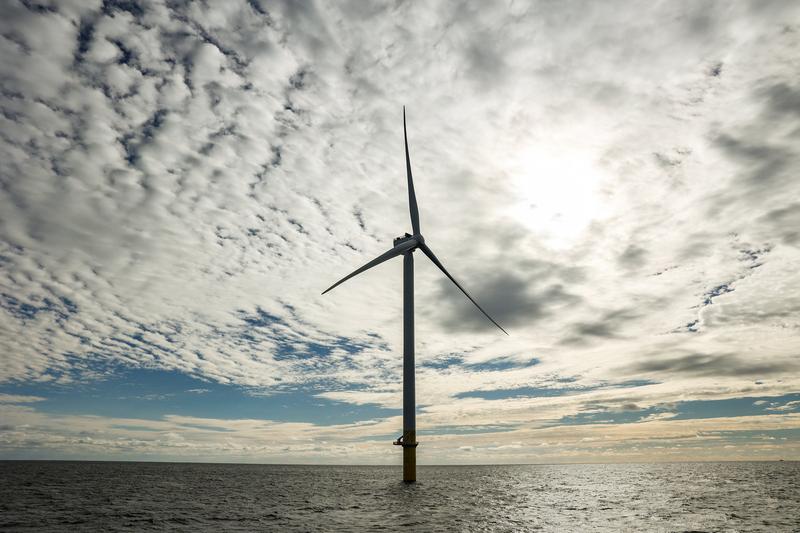
( Steve Pfost/Newsday RM via / Getty Images )
Brian Lehrer: Brian Lehrer on WNYC. You might say the Republican Party used to have an abundance theory of energy policy, develop all kinds to keep energy bills low. An article on the climate-focused news site Heatmap says not anymore. At least there's tension in the party about that. We'll talk now about the new energy restrictionists, including President Trump, who made headlines on this yesterday. We'll get Heatmap's take on the Paris Climate Treaty, which just turned 10 years old this month. Did you know that? Looks great on paper. We'll see how much it changed the climate.
With us now are two guests: Robinson Meyer, founding executive editor of Heatmap, he wrote the Paris Accord story, and Jael Holzman, senior reporter at Heatmap, on her article The Party of All of the Above Is Now the Party of Anything But. Robinson and Jael, thanks for coming on today. Hey there.
Robinson Meyer: Thank you so much for having us. We're excited to be here.
Jael Holzman: Thanks for having us.
Brian Lehrer: Jael, let me start with you since there's a major new development in your story. Maybe start by telling us what President Trump did yesterday on this topic.
Jael Holzman: Yesterday, the president used national security claims to order a halt work to the five offshore wind projects currently under development off the coast of the United States in the Atlantic. What this ostensibly means is that gigawatts of energy that could power whole cities' worth of human activity have suddenly halted. What we are experiencing under this federal government is a restrictionist approach to "renewable energy," wind, solar energy at utility scale to power human activity. The offshore wind industry has been the most vulnerable target of this government because it relies entirely on acreage or waters that are under federal control.
Yesterday, what happened was a potential death knell for the capacity for offshore wind to develop in the United States. Listeners in New York City, that includes the Empire Wind project, which you may remember was halted before. Then, in a deal with Governor Kathy Hochul that included green-lighting new pipeline infrastructure for gas, the Trump administration claimed that it was going to let it keep moving. That is no longer the case. Empire Wind, along with an offshore wind project off the coast of Virginia and offshore wind developments off the coast of New England, are now entirely stopped. It's unclear if they'll be allowed to resume construction.
Brian Lehrer: Off the coast of Virginia and off the coast of New England. Is it relevant that those are all blue states?
Jael Holzman: Unfortunately, it's absolutely relevant, although it's important to remember Virginia is not a blue state. Its Republican Governor Glenn Youngkin, supports the offshore wind project that was under development until yesterday and approaching completion next year. The reason for the support is because Virginia is a hub for data center development. It's where the most data centers are active and under construction. As listeners may know, those things require a lot of energy. Derailing construction of new energy sources is anathema to what President Trump has called his "energy dominance agenda."
His personal distaste for and cultural resonance with people who are against offshore wind and renewable energy in general that has appeared to win the day over the need for electrons to power data centers in Virginia.
Brian Lehrer: I guess we could characterize Virginia, maybe, as a purple state. Republican Glenn Youngkin has been the governor, but they just elected a Democratic governor and other seats there are trending democratic, at least for the moment. Bringing up Glenn Youngkin is really relevant because you frame this as not simply environmentalist versus fossil fuel companies, whose energy they want to replace with renewables, but as a tension between two competing GOP energy philosophies. Can you describe that tension in some more detail?
Jael Holzman: Absolutely. What we know is that Republicans, for years, have tried to paint themselves as "all of the above." This phrase, "all of the above," has been their rebuttal to claims that they are against renewable energy. As it's become cheaper to operate and construct, Democrats, in the name of climate action, have supported renewable energy deployment as quickly as possible as a goal to reach net zero to reduce greenhouse gas emissions, which scientists say we need to do to successfully abate the trend of global climate change. Republicans using the "all of the above" tag only worked insofar as Donald Trump's influence couldn't touch it.
We saw a rise in its usage amongst Republican politicians in the Biden era, for example. As Trump has returned to power and he has keyed it specifically into the cultural morass around renewable energy in more rural and in coastal areas of the United States, what we've seen is that his distaste for offshore wind, for solar power, has won the day over what used to be a more laissez-faire capitalist approach to just letting the market decide. Now this trend in culture is weaving its way into Congress.
What I've been writing about is that energy developers, to meet this rising demand for artificial intelligence, for data centers, have been screaming at the top of their lungs, "We need to build a lot more energy generation in this country of all fuel types." That's what they've been saying. Obviously, "all fuel types" has a climate consequence there. Nevertheless, one would assume that if the goal is global AI competition and reducing consumers' electricity prices, then politicians of all stripes ahead of a midterm would want to pass something to address those concerns.
The article that you're addressing is the fact that I've been writing about how Republicans are essentially the only thing standing in the way of that "all of the above" legislation that could move projects of all fuel types through the federal bureaucratic process. They're standing in the way of it because of this specific cultural distaste for renewable energy. It honestly may be the case that we deal with logjams in the development of these energy sources for years because of that issue. Whether it be at the local level, listeners in New York may be familiar with issues around battery storage, for example, in Queens and in Long Island.
This is an issue that is honestly nascent. We need to find a way to reckon with the fact that through community input and through a cultural disdain, these faster-to-build and cheaper electricity sources are getting delayed, whether it be in Congress with the executive or at the local level.
Brian Lehrer: Really interesting that you frame this in culture war terms rather than just in economic terms. Which we have heard over the years from a lot of Republicans who say fossil fuels are necessary to prosperity, to have supply continuing to meet demand, so that energy prices don't go up. They may have been against government mandates or incentives to produce renewable energy, which puts their thumb on the marketplace, but putting their thumb on the marketplace in the other direction and trying to stop market-based production of renewables like wind is a whole other thing.
Interesting explanation as we continue with Jael Holzman, senior reporter, and Robinson Meyer, who will bring in, in a minute, founding executive editor of Heatmap on 10 years since the Paris Accords were signed on climate. We'll bring in Robinson on that in a minute, and Jael on her article The Party of All of the Above Is Now the Party of Anything But. When it comes to energy, who has a question or a comment or wants to lob a one culture war arrow? 212-433-WNYC, 212-433-9692, you can call, or you can text. Just one more thing for you, Jael, before we get to Robinson.
You write that Trump's action yesterday, claiming national security grounds for canceling all these Northeast wind farms, takes a kernel of truth and blows it up well beyond its apparent implication. What's the kernel of truth?
Jael Holzman: In any kind of "whataboutism" argument, you take a small consequence of an action. Then you say, "Well, what about this thing? What about that thing?" Then you use that to either reject the proposition or to delay it taking place, the action, the proposition. In this case, offshore wind, technically speaking, can impact radar and radar technologies of all stripes. People have been trying to figure out how to improve this issue, in particularly with offshore wind, because if you're trying to defend the homeland, you will want to have good radar detection on the coastline.
However, the Pentagon for decades has been working on this issue. I wrote a story for Heatmap earlier in the fall about one offshore wind project off the coast of Rhode Island, Revolution Wind, which the Trump administration paused yesterday after pausing previously a couple of months ago, only to get knocked down in court because the developer, Danish company Orsted, came to the court and said, "Hey, we have all these emails and memos very clearly showing the military signing off on this project." In spite of whatever radar implications there may be, there actually has been a clearinghouse for interagency review at the military level for a long time.
The Government Accountability Office told me that there is no communication issues leading to the military being overridden by permitting officials in any way. In short, this radar issue is coming up out of nowhere. If there's some secret hidden document, top-classified report showing that actually liberals in the Biden and Obama administration have for years been hiding the existence of-
Brian Lehrer: That doesn't exist as far as we know.
Jael Holzman: -severe radar implications.
Jael Holzman: It doesn't exist.
Brian Lehrer: He's just coming back, it sounds like, to his opposition to wind farms, which may be for wholly other reasons, culture war reasons, as you say, but trying out whatever rationale he thinks might get past the courts.
Jael Holzman: Right. The only problem is that when they tried this with Revolution Wind off the coast of Rhode Island only a few months ago, they lost in court. Handily and quickly, a preliminary injunction was brought in, and construction could resume.
Brian Lehrer: They've got another wrinkle on it. Robinson, let me turn to you. You write the Heatmap Daily newsletter. Back on December 12th, you took stock of the real-world effects of the Paris Climate Accords. I read your newsletter on that day, and I've been wanting to have you on ever since. December 12th was the actual 10th anniversary of the agreement. You say, yes, it did change the world, just not in the way people thought it would. Let's do a little bit of history. Remind us of what led up to Paris because you frame it as coming after decades of failure.
Robinson Meyer: Thank you so much for having us, Brian, and thank you for having me and thanks for reading the newsletter. The world starts trying to put together some global climate treaty roughly in 1991. That's the starting gun for the world deciding, "Hey, climate change is probably a real thing. We're going to set up a body of scientists who will study it and confirm its reality. At the same time, we're going to start working on a treaty process that will find some way of dealing with this huge problem that seems closely connected to fossil fuels and therefore closely connected to economic growth."
The council of scientists, which we now know as the Intergovernmental Panel on Climate Change or the IPCC, puts together a series of reports confirming climate change, and the world reads them. In the 1990s, it puts together one treaty, that's the Kyoto Protocol, which passes in some countries, but is not adopted by the United States. Crucially, that treaty basically has some text that's binding on rich countries and some text that's binding on lower or middle-income countries. Also, important at the time, China was considered a lower-to-middle-income country. It was not bound by the fossil fuel restrictions that were going to be bound on rich countries.
Kyoto really doesn't work. The world spends another 10 years, the 2000s, spinning its wheels. The Bush administration at the time, not really a fan of any climate treaty. Obama wins, the world again actually fails to come to some kind of climate treaty in 2010 in Copenhagen. It is only then, at the very end of the Obama administration, working with the Chinese government and working with European governments, is able to put together the Paris Agreement. The interesting thing about the Paris Agreement, when it's passed, is that it's the first climate treaty that first of all imposes the same terms on all countries, whether they're rich or poor.
It does that by basically not binding their emissions at all. It says that what's going to happen is that each country, every five years, will propose its own emissions reduction plan, and it'll bring that emissions reduction plan to the rest of the world. They will all look at each other's emission reduction plans, urge each other to cut emissions faster. Then do some collaboration work, maybe. Then, they'll do it all again, and they'll meet every year, but every five years, they'll bring their big emissions reduction plans together and meet with them. That's actually the calendar that has held since the Paris Agreement was finalized in 2015.
The US has come, and it has gone, but roughly every five years, it was a little delayed by the pandemic, all the countries of the world have brought together new emissions reduction plans and have put, I think, global emissions on a different trajectory. We can talk about why that might be.
Brian Lehrer: One of my New Year's resolutions for 2026 is to bring the science more, not just the politics, when we talk about climate and public health in general. It was interesting to me in your article that you did some numbers about how much global warming as measured by temperature rise, it was targeted to prevent Paris Treaty and why that number was chosen and where we are. Can you go over a little bit of that in about a minute or so?
Robinson Meyer: Yes, I can. I think the interesting thing about the Paris Treaty, and in some ways, the lasting consequence of it, is that, already going into 2015, the world's countries had decided that the ostensible goal of global climate policy would be to hold global temperature rise to 2 degrees Celsius by 2100, which is about 3.7. I'm not going to remember the exact translation off the top of my head. First of all, in 2015, they were not on track at all. We were going to hit well over 3 °C. I think right now we're going to go between 2.5 °C and 3 °C. Of course, we could get better. There's still a lot of time between now and 2100.
What's interesting is that in Paris, the small island states, the countries that are most exposed to climate change got together and they made a huge push. They said, "Yes, we have this 2 °C goal, this goal to limit temperature rise to 2 °C, but for us, because we're most affected by sea level rise, we think the goal should actually be 1.5 °C." They did two things that were quite successful. First of all, they inserted into the text of the Paris Agreement a pledge that the world would pursue efforts to keep temperature rise as close as possible to 1.5 degrees Celsius.
Second of all, they got the IPCC, the international body of scientists from around the world, to write a report on the hazards of exceeding 1.5 degrees Celsius. That report, when it was put into the Paris Agreement or when they got this commitment, didn't seem like that big a deal. When that report came out in 2018, it was the first report that really tied climate science to a specific policy goal. It showed the world how damaging exceeding 1.5 °C would be. It gave concrete numbers. It showed the impact in different parts of the world.
It galvanized, I think, the wave of climate activism that we saw in the late 2010s into the 2020s. It galvanized the European Green Deal, which is their big climate package. Certainly, it inspired the Sunrise Movement here and helped give rise to the Inflation Reduction Act and to the Biden administration. It was not a big deal. It didn't seem like a big deal when it happened in 2015, but it wound up being maybe the most important outcome of the Paris Agreement.
Brian Lehrer: We're getting some texts like this: "That sounds like a BS climate, carbon reduction plan." One of the interesting things in your article is that you write, "I am not among those who believe that the treaty has been a failure, although it would be difficult in this politically arid moment to call it a complete success." I guess you were just laying that out because it's been a little bit of a success in terms of the numbers slowing climate change, global warming, but a bigger success, I think I hear you saying, in terms of planting the seeds of the global activism that will keep on the gas pedal. Maybe that's a bad analogy on this issue.
Robinson Meyer: [laughs] I think that's right. The other thing that we haven't talked about at all is that it really changed how climate change was perceived in China, insofar as we can tell. Chinese companies were already meeting demand for solar panels from California and Germany. It was after the Paris Agreement that the Chinese government seemed to realize-- and the historical work still here hasn't been done as well as I might like. It does seem like the Chinese government realized that the rest of the world respected and appreciated their efforts at emissions reduction.
They accelerated China's efforts and the efforts of Chinese companies to develop electric vehicles, to develop solar panels and to develop batteries. Those three industries are now the bulk of China's export industries. They're actually places where China is far advanced of the US. In a way that is going to create and is already creating economic competitiveness and even military competitiveness problems for the US, because electric vehicles and batteries are such important general-purpose technologies. I don't think you get that huge Chinese clean energy boom without the Paris Agreement. It's good for the world that we have this Chinese clean energy boom.
At the same time, it has consequences that we also have to deal with as Americans and as the United States. I also think you can look around and say, "Well, it's not like the world has rallied behind climate change as this big unifying cause since 2015." The issue has only become more polarized. I think a lot more people know about climate change now and think about it now than they did in 2015. I don't know that it's any more unifying a political mission than it was in 2015.
Brian Lehrer: As a last thought, a listener writes that Democrats-- text has already disappeared from my screen, but the gist was that Democrats should use the idea that China's going to beat us economically in the race for renewable energy on a large scale if Trump continues to go in his "anything but renewable energy" direction. Which brings us back to you, Jael, for a last thought before we go. Some of the other callers are saying he's against offshore wind, not because he hates renewables, but because he is a real estate developer. It's bad for visual appeal on a lot of properties. Another one cites his golf course in particular in Scotland. You get the idea.
Jael Holzman: What's going to be even worse for properties on the coastline is climate change. We are able to deal with the viewshed issue through so many means. Plenty of countries have done a lot more in terms of offshore wind development than us, and they're doing just fine. I think really what it boils down to is: Do we want to, together, come up with a solution for a community to survive in spite of serious challenges we get by energy and capitalism, or do we want to allow a very small group of people to stop the provision of energy to a lot more than just those people? That's really what it all boils down to.
Brian Lehrer: Our coverage of climate, among other things, will continue into 2026. For today, we thank Robinson Meyer, founding executive editor of Heatmap and Jael Holzman, senior reporter at Heatmap, for talking about these two topics, which intersect with each other. Thank you very much for coming on with us.
Robinson Meyer: Thanks for having us.
Jael Holzman: Thank you.
Copyright © 2025 New York Public Radio. All rights reserved. Visit our website terms of use at www.wnyc.org for further information.
New York Public Radio transcripts are created on a rush deadline, often by contractors. This text may not be in its final form and may be updated or revised in the future. Accuracy and availability may vary. The authoritative record of New York Public Radio’s programming is the audio record.
