
NYC School Bus Woes
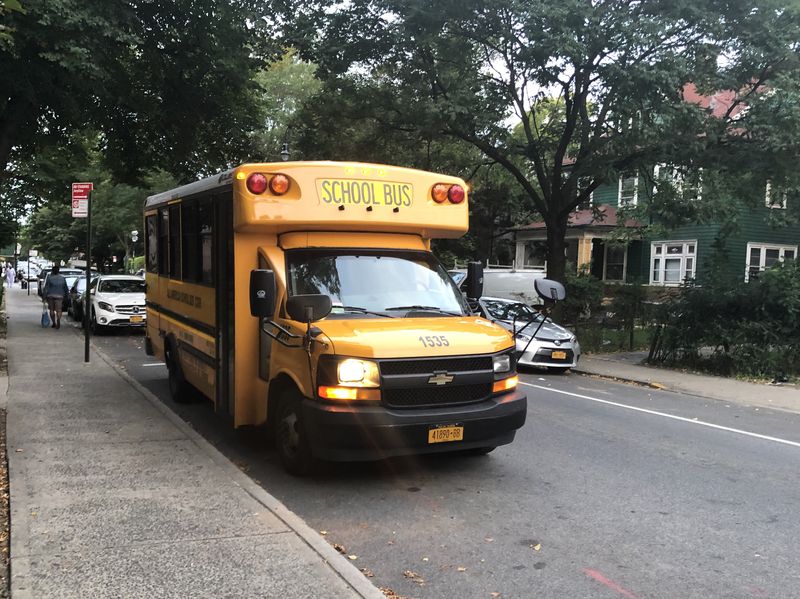
( Jessica Gould/WNYC )
Amina Srna: It's The Brian Lehrer Show. I'm producer Amina Srna filling in for Brian today. Good morning again, everyone. Now, we turn to the immediate fate of school bus contracts in New York City. Last night, the New York City Panel for Education Policy held a hearing on whether or not to extend the current decades-old contract with bus operating companies charged with getting city students to school every morning. This comes after a standoff last month between the city and the five largest operating companies, which have threatened to halt all operations without a new contract.
Eventually, the two parties agreed to hold a vote on whether or not to extend the current contract, and that vote happened last night. The result, another three-year extension. But parents are unhappy with the service these school bus operators are providing. Imagine waiting for hours for a bus that never comes, or a seven-mile trip taking over two hours to complete each morning and afternoon. Imagine filing a complaint with the Department of Education about these chronic delays only to learn that the city has no records of delays on your bus route.
Imagine getting a text message from your child asking you to pick them up from the hospital after a school bus accident. But no one from the bus operating company even alerted you that there was an accident. That's what happened to Chris Van Dyke. Here's what he shared with WNYC and Gothamist education reporter Jessica Gould.
Chris Van Dyke: She was texting me, and he said he was going to Elmers. I was like, "Elmers?" I finally figured, I was like, "Do you mean Elmhurst?" Eventually, what happened is all the kids were taken by ambulance to Elmhurst Hospital. The crazy part is we were never informed at any point.
Amina Srna: Jessica Gould joins us now with her reporting on the endemic issues with New York City's school buses and the result of last night's hearing. Jessica, welcome back to WNYC.
Jessica Gould: Hey.
Amina Srna: And listeners, we'll open the phones for you right away. Do you rely on a school bus to get your child to and from school every day? Let us know if you're having issues with the service. Do you experience regular delays or buses not showing up at all? Help us report the story. Are there any school bus drivers listening in? Give us your side of the story when it comes to contract negotiations and the daily issues you experience on your bus route. We can also take your questions for our guest, WNYC and Gothamist education reporter, Jessica Gould.
Call or text us now at 212-433-WNYC. That's 212-433-9692. Jessica, catch us up on the events from right before yesterday's hearing. Last month, the school bus operators, the operating companies, were threatening to halt service. How did they avoid the shutdown? What was at stake?
Jessica Gould: Just going a little bit back in a story that goes back decades, but just to the summer, the contracts with the largest bus companies expired and the city had been extending them on a month-to-month basis, trying to figure out what to do in order to enact some longer term and major improvements to the bus system, a system that parents have complained is deeply dysfunctional for years. The bus companies said that these month-to-month extensions were making it very hard for them to do business, that they couldn't keep their payroll going, they couldn't maintain their equipment, and they threatened to stop working as soon as the first of this month.
Ultimately, they reached a deal with the city to have a three-year contract extension, which was being voted on last night. The city had to approve it. They had one more month to month, and then this three-year. The three-year extension passed, but it was controversial. A lot of parents want changes and improvements to their school buses sooner than three years. There's a complicated set of reasons for why they can't get that immediately, which we can talk about.
Amina Srna: You've reported that the city contract is 46 years old. Why hasn't there been a new one in almost half a century?
Jessica Gould: Yes, they're extended with some changes around the margins. This most recent extension is going to have a little bit more opportunity for parents to weigh in with biannual parent meetings and training days for employees. In terms of making wholesale changes and offering businesses the opportunity to compete, that really hasn't happened, at least for these major contracts for 46 years. The reason has to do with a dispute over labor provision within the contracts. Bus drivers want a protection for their wages and ideally priority in hiring if their bus companies close, which is something that the city has granted.
Some years ago, the court said that it can't actually give them that, that it's anti-competitive. In order to avoid having a strike from bus drivers who want that labor protection, they've just been extending these old contracts, which means they can't make major changes. It's very in the weeds, it's very complicated. What the officials say needs to happen is a legislative change.
The courts say it's illegal to have this labor provision, so they want a new law in Albany and bills have been proposed to do this, to allow for these labor provisions and then write that into new contracts, put them out to bid, offer competition, see who the best bidders are and really renegotiate for the first time in a long time, major changes to how buses operate.
Amina Srna: Let's go to a caller. Joseph in Laurel Park, Brooklyn. Hi, you're on WNYC.
Joseph: Borough Park, Borough Park. I have a younger brother who's disabled and needs to take a special school bus to school every single day. The hassle is out of this world. Companies cancel. They show up late. We cancel one company to switch to a different company. The first company shows up and then calls us and asks us where is the kid, where we want to pick them up. The city gives you a list of companies to use. There's no way to give feedback to tell them that the companies are just not showing up on time. It is an absolute stress.
I'm on the phone with my mother at least once a week, where she tells me, the bus didn't show up. The bus came early, the bus came late. There's no consistency. There's nobody on top of them. There's no one to talk to. It's horrible. It causes a tremendous amount of stress. My mother is all day long working with the bus companies, with the therapists. It's just another hassle on top of another hassle. It seems like the city doesn't want to do anything about it. Nobody cares. There's no one to talk to.
Amina Srna: Joseph, thank you so much for your call. Jessica, before we get into the parents' experiences with the school bus system, Joseph was talking about his young brother, who is disabled. Can you tell us more about the students who rely on it? Your report, it is mostly students with disabilities and those living in city shelters, right?
Jessica Gould: It's largely students with disabilities and those living in shelters and also foster care. Other students do take the buses. They have challenges, too, if they're going a far distance. Because students with disabilities have to travel to specialized programs all across the city and also often have additional needs, whether it's wheelchair accessibility or a nurse that travels with them or a paraprofessional, they rely on buses to get where they need to go. These rides can take a long time.
Many families say they take a lot longer than they need to and they don't know why the routes aren't more efficient. What the caller said is what I hear a lot, that buses don't show up. There's no warning. There's not clarity about who to call, who to complain to. I get more new stories about this every week.
Amina Srna: Here's a text, "In connection to the conversation about school buses, I was a preventative case manager, working with families at migrant shelters who had child welfare involvement. Most of these families had issues due to their children's truancy. However, the mothers would be waiting outside for hours with very little warm clothing in winter months to have their child be picked up. Sometimes, buses would never show. This continued concern about truancy, and to the ACS, they believed that this was continued evidence to have policing in these families' lives.
On the issue of student homelessness and students living in shelters, migrant or otherwise, we learned last month that nearly one in seven New York City public school students experienced homelessness last year. That's 154,000 students." Jessica, can you talk about the difficulties these students face with attendance as the listener texts about truancy and how reliable school buses may make these issues even worse?
Jessica Gould: Yes, it's very hard if your bus is inconsistent and you live far away from the schools, which a lot of these students do. Families are moved from one shelter to another. They moved far away from the school that they were at. They want to stay at the school, they're legally entitled to, but they rely on a bus to get there. It is an enormous undertaking for the bus system, for the city, for the companies to get kids to schools all across the city. The city is big and trafficky, and families are moving all the time. Students have high needs.
In an era when we can easily get an Uber to take us anywhere, there are a lot of questions about why this can't be done more efficiently.
Amina Srna: We heard that clip at the top of the segment of a parent you spoke to whose son had contacted him from Elmhurst Hospital after his school bus was in an accident. Can you tell us what happened there?
Jessica Gould: Sure. It sounds like the bus was moving, and it wasn't necessarily the bus' fault. A car opened the door, and the bus ran into it, and the driver slammed on the brakes. The bus full of kids as a precaution, I don't believe there were any injuries. I was told there were no injuries. They were taken to Elmhurst Hospital. This is a bus serving special school for students with disabilities in Queens. The problem that the parents, and I talked to a couple parents from this route, talked about was that nobody from the bus company or the city told them that their kids were there.
They were in contact with the kids themselves. This child has dyslexia and typed out Elmers, not really knowing where they were. The parent had to figure this out. This lack of communication comes up a lot with families about where their kids are, their families who have in snowstorms, kids have been stuck on buses, and they've had to track them down. It's just a really tough system to navigate. Nobody can really answer why it is as tough as it is.
Amina Srna: You did speak with a representative from Logan Bus Company. What did they say about their handling of the incident? Why didn't they contact parents?
Jessica Gould: They said that they did. They said that they did, but I talked to two parents who said they weren't contacted. I know that the city gave them a violation for lack of communication. The bus companies have been fighting back pretty hard against this onslaught of criticism, saying that they are trying, that it's a hard job, that their drivers work really hard and are dedicated. They had a lot of drivers come to meetings, the public meetings in recent weeks to talk about their dedication. They get up at 3:00, 4:00 in the morning and work till later in the evening.
With a high needs population, oftentimes it's not easy. At the same time, these companies are getting multimillion-dollar contracts to take kids to and from, and there doesn't seem to be the responsiveness to the family's needs that is necessary.
Amina Srna: Last night, the panel voted to extend the contract, but it wasn't a unanimous decision. What was the split?
Jessica Gould: There were parent representatives on this panel that oversees contracts who said that they just couldn't in good conscience keep extending contracts with companies that, in their minds, have really failed students. One member of the panel said, "This is not the message that we want to send, particularly to our students with disabilities, that this is an okay way to do business and to serve them."
The majority was of the mind that there needs to be time to get this legislation in Albany passed so that there isn't a strike that completely disrupts the system so that bus drivers get the work the protections that they want and say that they, in the past, would go on strike for if they don't get and to then write actually strong new contracts for the bus companies. There just needs to be some time to get it done. That was where the majority landed.
Amina Srna: We have a parent calling in who would like to see a revision on the contract. Here is Anita in Manhattan. Hi, Anita. Thanks for calling in.
Anita: Hello, good morning. Thanks for reviewing this segment today. It's extremely important. What I was hoping when I attended the PEP meeting is that there would be an opportunity to revise the contract. There is quite a need. Let's keep in mind that the busing schools, the busing system is for students who are having special needs, whether they have an IEP or a 504. That's what the busing is there for, for the students. One thing that just is blaring and a revision called for revision is the fact that special needs students need their support.
That involves working, meeting their teachers, their UFT teachers, who are contracted to provide office hours during the ninth period or immediately after school for about 40 to 50 minutes. These special needs kids who need the supports, need the extra tutoring, the one-on-ones with their teachers, are not able to access this opportunity because they have to take the bus or stay in the school and find another way to return home, homebound. This is an equity issue right here. This is not allowing them to partake in meeting their teacher's one-on-one.
Mind you, we're dealing with classroom size, law transitions, and large classrooms. They cannot access this type of support. This individualized or small group support that the teachers are in agreeance to provide as per their UST contract. It's an equity issue.
Amina Srna: Anita, thank you. Thank you so much for your call. Jess, what was coming up for you when you were listening to Anita's call?
Jessica Gould: Well, I've heard this a lot. I mean, this is a real issue with the contracts as they stand. They don't require buses to provide after-school service. Kids with disabilities can't get the tutoring after school and still get a ride home. They can't participate in extracurriculars and internships in the same way. Also, for the summer program, Summer Rising, and other summer programs that serve them, it limits their capacity to be fully equitable as she said.
Amina Srna: Parents are complaining about a lack of accountability for these structural issues, some of which Anita has mentioned, with school buses. Does the city keep track of school bus delays and incidents?
Jessica Gould: This was something that our colleague Joe Hong and I looked at over the summer and into the new school year. There is data online about delays. What we found, and there are a lot, there are a lot of delays, although the companies in the city would say that it's a small fraction of the total amount of trips. What we found, talking to dozens of parents, was that there were many delays that weren't reflected in the city's data that they had experienced. The question is-- well, first of all, the school bus companies themselves self-report the delays, and that's a concern.
Are they reporting them accurately? They say that they are, but clearly, something is missing. Are they being penalized according to the reality of the service that students are experiencing?
Amina Srna: Let's go to another caller who is a bus driver, Francesca in the Bronx. Hi, Francesca, you're on WNYC.
Francesca: Hi. I was a bus driver kind of a long time ago, so I can't speak to exactly what's happening here and now today. I can tell you my experience at the time, and I don't think a lot has changed in this way. The people that I worked with, the other drivers, they were really nice, kind, concerned people. We were doing special needs kids' bus routes, elderly. Everybody was really nice, but it's a really hard job. The schedule is extremely difficult. You're getting up really early. There's limited transportation to where you need to go at 4:00 in the morning.
You're doing several hours. Then you got to cool your heels in the middle of the day. Then you got to go back to work. You're working several hours, you get home. By the time you get home, you better go to bed, or you're going to be eat dinner and go to bed, or you're going to be falling asleep on your route the next day. It's really demanding in a way that people don't really appreciate or understand and then you're not getting paid well. The turnover is going to be, at least at the time, it was really high.
I don't know what kind of finances the upper management was dealing with, but I do remember that they made their very best effort to prevent us from unionizing at the company that I was working at years ago because they didn't want that. If people are going to bail out of their job, like one day to the next, because they've got a better opportunity, that's what's going to happen. That's going to create some of the reliability problems. Not all of it, but certainly it contributes to it, and you can't really blame them. I mean, I bailed out eventually. I couldn't take the low pay with the rough schedule.
Amina Srna: Francesca, thank you so much for your call. Please call us back anytime. Jess, we've heard a lot from parents and from siblings. We're getting a lot of text messages. Did you speak with bus drivers about this contract and what they had to say?
Jessica Gould: I've talked to them and their union and they've also testified in the recent hearings. First of all, a lot of parents say that, it's not the driver's fault or the matrons who work with them, that they're very dedicated, they really appreciate them, and it's more that they're holding the city and the companies in particular to account. This point about turnover and the difficulty of the job, it's integral because people say that there is a huge bus driver shortage, and that's why routes are long, and if somebody calls out sick, there's not a replacement.
That's part of why there's so much emphasis on this labor provision to at least provide some stability within a job that has a lot of difficulties.
Amina Srna: Even if the contract has been extended for another three years, this resolution doesn't solve the issues parents and education advocates have raised about the service, right?
Jessica Gould: Yes. I mean, as I said, there's a few things that the companies have promised to do to work more closely with the parents and share its phone system metrics with the DOE, more training for employees. These major issues, about after-school and tight requirements and penalties, these have not yet been addressed.
Amina Srna: Before you go, a less discussed part of Mayor-Elect Mamdani's campaign platform is his promise to tackle wasteful spending on contracts and other inefficiencies in the city government. How might he handle future contract negotiations when they come to his desk?
Jessica Gould: It's interesting because, as this was unfolding, it was right in the last weeks of the election. He and his team said that they were supportive of the panel not bowing to companies and giving a five-year contract that would extend past the end of his first term. I asked his team for a response last night to the vote, and they said that they're going to ensure that all of the contract provisions are followed. We'll have to see what they advocate for as new contracts are considered.
Amina Srna: My guest was WNYC and Gothamist education reporter Jessica Gould. Jess, thanks so much for coming on today.
Jessica Gould: Thank you.
Copyright © 2025 New York Public Radio. All rights reserved. Visit our website terms of use at www.wnyc.org for further information.
New York Public Radio transcripts are created on a rush deadline, often by contractors. This text may not be in its final form and may be updated or revised in the future. Accuracy and availability may vary. The authoritative record of New York Public Radio’s programming is the audio record.