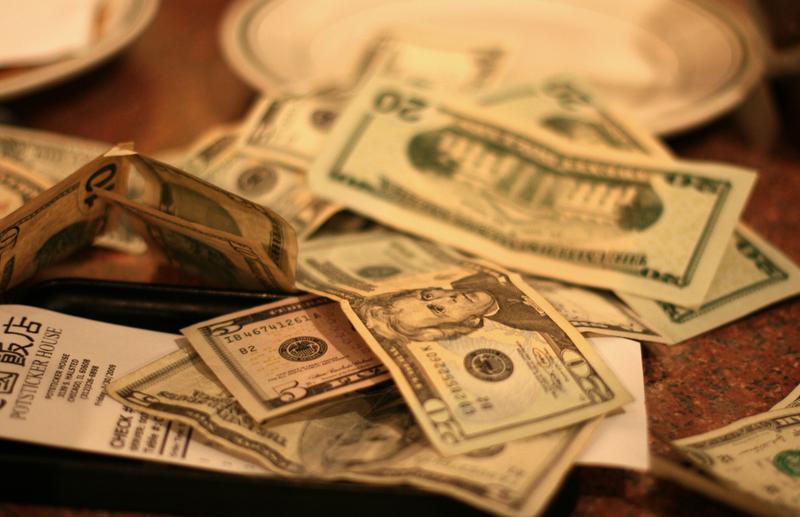
Brian Lehrer: Brian Lehrer on WNYC. For our last few minutes today, we're going to talk about the pros and cons of how much we're becoming a cashless society. How cashless? Well, for example, according to Capital One shopping, over 65 million Americans are Apple Pay users, but there's an article out in The New York Times titled A Tap-to-Pay Society Is Leaving These New Yorkers Behind. These New Yorkers include street performers, food vendors, candy sellers, the homeless and others who are struggling. Quoting from the article, "So what happens to those who rely on the donations and sales of more fortunate passersby when carrying cash becomes a novelty rather than a necessary part of life?" Our guest, Anna Kodé, reporter covering design and culture for the Real Estate section of The Times, will join us momentarily, but we do want to open the phones for you as well. Have you been left behind in any way by our Tap-to-Pay society? Do you rely on other people carrying cash to make your living? 212-433-WNYC, or if there's anything good you want to say about our increasingly cashless society, 212-433-9692, call or text right now. Anna, welcome to WNYC. Thank you for joining us.
Anna Kodé: Thank you for having me.
Brian Lehrer: Tell us more about those left behind by tap to pay.
Anna Kodé: Well, a lot of these people, including the ones you just said, the homeless, food vendors, anyone selling things on the street, or street musicians, they don't have access to banking in the same way that a lot of other people do. There's a lot of language barriers for some of these folks. Then there's just barriers to getting credit cards and apps and smartphones and all of those things as well, so they really rely on cash. When everyone else is not carrying around as much cash, those opportunities for getting a spare dollar, just some spare change, are kind of diminished.
Brian Lehrer: Can you talk about how this is affecting some of those folks lives? You did interview some, right?
Anna Kodé: I did. Some people told me that they're getting less cash and that they have to spend longer hours out in the cold asking for change. Other people told me that they've noticed different kinds of interactions forming. Someone passing by might say, "I don't have cash, but let me grab you something at the bodega. What do you want?" Little interactions like that are happening.
Then, of course, a lot of people are trying to put out-- if they do have access, they're trying to get their Venmo username or their Zelle username out there. They'll have a cardboard sign that says that. Even then it's hard because there are so many different payment apps, that one person might have Venmo, but another has Zelle, and that doesn't totally erase the problem either.
Brian Lehrer: Yes. One listener writes, "Don't forget the unbanked." Another listener writes, "Please also talk about the potential for extreme forms of surveillance that could result from a cashless society." Surveillance and control. We've already seen how surveillance can be used in nefarious ways. What do you say to those listeners?
Anna Kodé: I think the other aspect of cash that did come up in my story is that it's pretty instant. Someone hands you a dollar, you immediately have that dollar that you can use. It's not the same with other forms of payment. Sometimes it'll take a while for that payment to settle. Of course, like that listener was saying, it can be tracked and other people might be able to see it. Once you make a payment to someone else like that, you're connected to them in a way that with cash you just hand it off and go.
Brian Lehrer: Listener writes, "The only time I carry cash is to buy an ICEE for my kids, but even my local street cart vendor takes Venmo and Zelle now." Here's Vijay in Lincroft, New Jersey. Vijay, you're on WNYC. Hello.
Vijay: Hi.
Brian Lehrer: Go ahead.
Vijay: Can you hear me?
Brian Lehrer: Yep.
Vijay: I was just going to say that in India, it's very advanced in terms of technological innovation. There's something called UPI, Universal Payment Interface. It's a little-- Well, what's that called? Little square sign that you have largely that you can focus your phone on and pay. This is used by everybody, including fruit sellers, vendors on the street, and there's much more low and middle class and so on there than here, and solution is there.
Brian Lehrer: Interesting. He's saying there's an example where maybe it's not so bad. I guess it relates back to that last text I read where the listener said, "Even my local streetcar vendor takes Venmo and Zelle now." What do you think?
Anna Kodé: Yes, I'm not too familiar with that system. That does sound interesting and more accessible. Yes, I did talk to a vendor for this story, a former vendor, and he talked about how he had been using cash for a long, long time, and finally when his business expanded and he had a couple partners that he could work with, that's when he was finally able to make time to set up a system to accept digital payments. He spoke a lot about vendors, in New York at least, they're working 14- to 16-hour days. They don't have much time to be like, "Let me pause and figure out how to accept Square tonight." It's not that simple.
Brian Lehrer: Listener writes, "Please tell your guest I really enjoy reading her work. I read the story on how cashlessness affects certain folks. Also read her story about the hostile architecture of public benches in New York City." You have at least one fan who's following your work in our audience.
Anna Kodé: That's really kind.
Brian Lehrer: Another listener writes, "Janno Lieber, head of the MTA, mentioned, on your last call with him," meaning the last time he was on the show, "That Omni was meant to help with accessibility," but listener writes, "It completely leaves out people who do not have access to online banking, et cetera. Do you have that critique of the incoming Omni system?"
Anna Kodé: I actually didn't look too much into Omni for this story. I was just more focused on mainly the interactions between different groups of New Yorkers.
Brian Lehrer: Then let's take another call. Dan in the East Village, you're on WNYC. Hi, Dan.
Dan: Hi, Brian. I'm 60 now, but for the last 40 years I've been something an obsessive budgeter, and that budgeting really relies on using cash. 40 years ago when I made $3.50 an hour, I got $50 a week, and that's all I had to get through the week. For the years, obviously, the amount is more now, but when you have that money in your pocket, you know how much money you have, and a move over to cards and electronic payments, I think people really lose track of what they're spending. It's not an easy thing to do to keep track of what you're spending. In my experience, no one spends less than they think they're spending.
Brian Lehrer: Dan, thank you very much. You have anything on that?
Anna Kodé: Yes, that is fascinating. I think some people I interviewed, it didn't really make it into the story, did talk about how it's harder to keep track, and then sometimes when they Venmo someone money, doesn't feel as real as with cash. The other thing I would just point out too is that, with how we're carrying less cash, that also means we have less different amounts of cash. You might not have as many $1 bills as you used to in the past. You might only be carrying $20s, and that also makes a difference. You're less likely to hand a street performer you like a $20 bill as opposed to just $1 bill that you have in your pocket.
Brian Lehrer: A listener responds, by the way, to that other commenter and says, "Omni has a cash prepay option at machines." Another one says, "A lot of places charge extra for using a card instead of cash. Is it a money-making scheme, to some degree, or maybe they're just compensating for what they have to pay the card companies?" Anna, are you there, did we lose you?
Anna Kodé: Oh, sorry about that. Again, sorry, my reporting didn't really go into that too much, so I don't think I can comment on that.
Brian Lehrer: In our last 20 seconds, how can we stay connected with the fellow New Yorkers who you really spotlight, or help those need when you're not carrying cash?
Anna Kodé: I spoke to a number of different people who all had different forms of doing this. Some people told me that they forced themselves to bring cash when they're leaving their apartment, they just take an extra minute to say, "I might pass by someone who I want to give cash to." Other people told me that they'll just say to a person, if they don't have cash on them, they'll say, "What do you need? Can I get you a water? Do you want something from the McDonald's?" Right there. Just being more present in that way.
Brian Lehrer: Anna Kodé, reporter, covering design and culture and now the cashless economy for the Real Estate section of The New York Times. Thank you for sharing it with us.
Anna Kodé: Thanks for having me.
Copyright © 2025 New York Public Radio. All rights reserved. Visit our website terms of use at www.wnyc.org for further information.
New York Public Radio transcripts are created on a rush deadline, often by contractors. This text may not be in its final form and may be updated or revised in the future. Accuracy and availability may vary. The authoritative record of New York Public Radio’s programming is the audio record.