
NJ's Outgoing AG Reflects on Achievements and Challenges
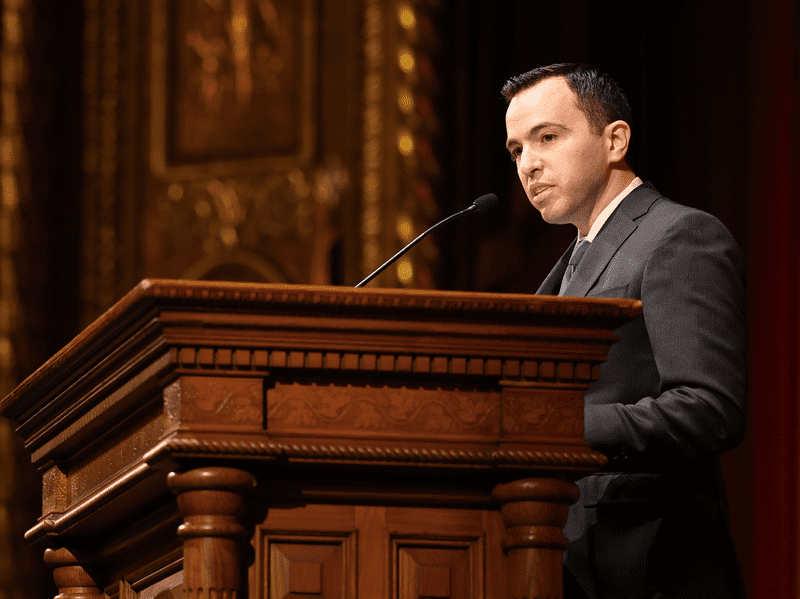
( Edwin J. Torres/NJ Governor's Office )
Title: NJ's Outgoing AG Reflects on Achievements and Challenges
[music]
Brian Lehrer: It's The Brian Lehrer Show on WNYC. Good morning again, everyone. Now, an exit interview with the outgoing New Jersey Attorney General Matt Platkin. He has had a pretty notable tenure as attorney general. You could call it controversial or perhaps consequential, depending on how you see things. Platkin came into the national spotlight through his leadership in a series of lawsuits against the Trump administration, including challenges involving birthright citizenship and federal funding tied to programs like SNAP.
In Jersey, he pushed aggressive gun violence reduction efforts, brought corruption cases against powerful political figures, and led major lawsuits against corporations ranging from social media companies to chemical manufacturers accused of environmental contamination. As might be expected in a state with a long and complicated history of political corruption, many New Jerseyans listening right now, I don't have to tell you, right? His time in office has also been marked by intense pushback, even from members of his own party. Republicans attempted to impeach him and charge him with using the office for his own political gain, but some Democrats accused him of using the office to target political allies.
State police unions sued him. By any measure, it's been an eventful four years. Now, for some background, Platkin was appointed by Governor Murphy in 2022. New Jersey is one of the few states where the attorney general is appointed by the governor and confirmed by the legislature rather than elected independently like Tish James in New York, for example. Platkin so therefore will step down as Governor-elect Mikie Sherrill takes office on January 20th and names his successor.
Attorney General Platkin is with us now to reflect on these past four years, the intense legal and constitutional moment we're in right now, and maybe what he hopes the next attorney general will pursue from his work or independently. Attorney General Platkin, thanks for doing this. Welcome back to WNYC.
Attorney General Matt Platkin: Thanks so much for having me.
Brian Lehrer: Let's start with some of your lawsuits against Trump, beginning with birthright citizenship. How did your office become the national leader in that case?
Attorney General Matt Platkin: Well, look, the executive order that tried for the first time in 157 years to eliminate birthright citizenship from the United States Constitution was signed around 8:00 PM on the president's first day in office. We filed the first suit the next morning at about 11:00 AM. Obviously, it takes a tremendous amount of preparation to be able to move that quickly.
The work really started in the beginning of 2024 when myself, people like Tish James, and a handful of other attorneys general across the country came together and said, "Look, what President Trump on the campaign trail is saying, what they wrote in Project 2025 is really scary for our states," and we don't want to be caught flat-footed if and when this comes to pass, so we spent months preparing for those initial sets of executive orders.
It just so happened that the first one out of the gate was, again, an attempt to say, for the first time since the Civil War, that babies born on US soil would not be treated and given the same rights and privileges of every US citizen. I'm proud that we led that suit right up to the United States Supreme Court, and I'm proud that birthright citizenship remains a constitutional protection in this nation, thanks to our work.
Brian Lehrer: What do you think of what's happening now in Minnesota from a state and federal jurisdiction standpoint? Homeland Security Secretary Noem has now announced deployment of more ICE agents there after the shooting of Renee Good last week. ICE agents, from reports I've seen, were going door to door, especially in largely Somali neighborhoods, rather than focusing on violent felons, as was the original stated premise of what Trump deportation policy was going to prioritize.
There's even the possibility, and this is where my question for you comes in, of state police or state-deployed National Guard intervening against ICE in some states if the state perceives ICE as acting illegally. Have you grappled with that set of issues, even though you haven't had to directly confront it in New Jersey?
Attorney General Matt Platkin: Yes, we've thought through a whole range of scenarios, and I would just say, look, I think everybody wants a secure border. We want to make sure that our nation is protected, but that is a very different question than saying whether American citizens should be terrorized or potentially murdered by a rogue law enforcement agency. What I saw last week, obviously the shooting itself was horrific, and put aside whatever you think, Renee Good was a 37-year-old mother, not much younger than myself.
If you can't take a step back and show some humanity in that moment, as the vice president of this nation clearly was unable to do, you should reassess whether you should be in public life because the situation right now across this country really scares me and should scare every American because I think we're at the precipice of something really alarming where, again, you have this rogue law enforcement agency where they're paying $50,000 a recruit, they're giving them none of the training that law enforcement usually has, and they're sending them out to essentially terrorize residents of this country, whether American citizens or not.
That puts our residents at risk, puts our citizens at risk, and it puts law enforcement at risk, and so I am very concerned about the escalation that seems to be the goal here, no matter who it affects. In this case, it resulted in a 37-year-old American citizen, mother killed on the streets in Minnesota.
Brian Lehrer: Do you think state authorities could or should ever try to arrest ICE agents for acting what they may consider illegally?
Attorney General Matt Platkin: Yes, I think the law in certain circumstances would allow it. Look, the federal officers are appropriately afforded broad immunity for their actions, but throughout the nation's history, we've seen examples where they've exceeded that authority in ways that break the law. I would think potentially a law enforcement officer, federal or otherwise, if they-- Again, I'm not prejudging this case, but generally speaking, if you're committing an act of homicide, that's a pretty good set of facts, I think, for a state to test that immunity limitation.
It cannot be the case that federal officers can kill American citizens who are breaking no laws with impunity. That cannot be something we can allow in the United States of America. I can't even believe I have to say that.
Brian Lehrer: In your tenure as New Jersey Attorney General, you also led several lawsuits against big corporations. One of them in 2023, you filed suits against social media companies like TikTok, Meta, and Discord for engaging in deceptive practices, allegedly that you said were harmful to children and teenagers. Where does that case stand?
Attorney General Matt Platkin: Yes, I'm proud that we've led some of the most consequential lawsuits against these tech platforms that have been essentially treating kids, a generation of kids, as guinea pigs and causing a mental health crisis that has affected, like I said, a generation of children. We are a lead state in the TikTok and Meta cases, which I'm proud have broad bipartisan coalitions that have brought those suits. I'm proud that New Jersey is in a position, which we probably wouldn't have been before my tenure, to lead those suits. Those suits are proceeding, and I believe they're going to deliver real results for the people in this country and relief for our kids. Discord is another great example.
We were the first state to sue Discord. 200 million kids are on that platform. That company just announced, by the way, that they want an IPO. We were the first state to sue them after we found a series of really harmful things that kids were experiencing on their platforms, despite the fact that Discord was telling parents and kids alike that it was safe when they knew it wasn't. That's a pattern we're seeing with these social media companies and increasingly now with AI companies where they're telling you their products are safe when they know they aren't. That's just textbook consumer fraud. It's the same types of case we brought against tobacco industry or opioid industry or you name the industry.
Social media companies aren't immune from that type of lawsuit just because they're fancy tech companies. I'm very proud both as the attorney general and as a parent of two young children, I'm proud that New Jersey has led some of the most consequential lawsuits ever filed against these social media platforms, which I believe are going to fundamentally reshape how that industry operates.
Brian Lehrer: On what you said earlier about state police possibly arresting federal ICE agents, listener writes, "You're talking about a civil war." What would you say to that listener?
Attorney General Matt Platkin: No, I don't think that's what you're talking about. I think what you're saying is federal officers under certain circumstances are still subject to the laws of the state in which they operate in, and they are not allowed to just go out and murder people. If that's what this president wants, then there are consequences for that.
Brian Lehrer: Right, but you're making the distinction between individual acts that might be illegal and an illegal deployment like get out of our state.
Attorney General Matt Platkin: Yes, and look, those deployments have been litigated. We have supported states like California and Oregon and Illinois, and they're in their litigation, and the Supreme Court has spoken on that, and President Trump has withdrawn National Guard troops from states. The question of whether he can deploy National Guard or United States Military perhaps is one question.
The question of whether an officer in a particular moment has violated state law by assaulting or injuring or tragically killing a resident or a United States citizen of a state, that's a very different question. These are questions that we don't tend to deal with too much because we don't usually have federal officers running around terrorizing law-abiding residents of our states, which is what we are seeing right now. ProPublica did a very significant amount of reporting on the number of United States citizens who have been arrested, had their home searched without warrants, injured, hogtied, assaulted by federal officers. That is not something we have typically seen, at least not in a very long time.
Brian Lehrer: Frederick in Princeton has, I think, kind of the opposite take than the texter whose note I read on the relationship between state police and federal police. Frederick, you're on WNYC with New Jersey Attorney General Matt Platkin. Hi.
Frederick: Yes. Good morning, Brian. Thank you so much for taking my call. I think we need to realize what the facts are. We're in a police state. There is no question about it. We could spin this any way you want, but being a student of politics, I could see where Miller and Bannon are working right out of a German Nazi situation, and they're the ones to fill Trump with all this idea, but we are in a police state, and unless the people understand that-- Now, if you're going to call the state police--, and you got to remember something, these are all Trumpers. What are we to do, to use Lenin's words, "What are we to do with this situation?" That's my comment, Brian.
Brian Lehrer: Frederick, thank you for your call. Well, he's got his opinions about where we are at the national level, but relevant to you, he brings in the role of the state police. I guess he doesn't trust the state police as a group because he believes so many of them are probably Trump supporters.
Attorney General Matt Platkin: I don't think that's a founded concern. I've dealt with law enforcement-- We say state police, we're talking about in New Jersey 42,000 state and local law enforcement officers who I believe are the most professional, best-trained law enforcement professionals in the country. Look, I think we could get bogged down in a conversation about whether a specific act violates a state law and whether law enforcement would assess that. I think that remains to be determined how that will play out. I do believe there are circumstances where federal officers could violate state law and be subject to state prosecution, and those circumstances may have already presented themselves.
There's a separate question about, to answer his last question, what Frederick can do, and I think you're seeing that. You saw huge numbers of people show up just yesterday in places across this country, including in New York and in New Jersey, protesting what they saw last week. We've seen that time and again over the past several months. I do believe in a broader sense, we are at a point of a-- I've said this basically since February, I think we've been in a moment of constitutional crisis where the president and his administration has essentially thumbed their nose at the rule of law.
When that happens, the way to respond is for the public to make clear that they don't support it. That has been true in the United States over the course of our history. It's been true in every democratic society in world history. I want to strike a note of optimism here because I do believe the public is and has and will make quite clear that this is not the America that we know and love. It's not. When you see clearly political prosecutions or federal law enforcement terrorizing American citizens, that's not who we are. I believe the public's response to that is what is going to get us through this moment.
Brian Lehrer: I want to ask you about a particular conflict between you and unions that represent the New Jersey State Police. They've sued you, as you know, in a bid to block your investigation into whether troopers deliberately slowed down traffic enforcement in response to claims of racial profiling in some of their stops. They also want the judge, as I understand it, to bar the outside attorneys that you've appointed from investigating racial profiling by the state police further. Where does that stand?
Attorney General Matt Platkin: I'm somewhat limited in what I can say for a couple of reasons. One, that suit was unsuccessful, so just put that aside. The person that they were saying was practicing, properly, by the way, was Preet Bharara, who I think many of your listeners know. I have tremendous respect for the state police, I want to be clear. I've worked with them for many years now. I've seen the work we talked about or could talk about with gun violence or drug trafficking or responding to the COVID pandemic and emergency management.
They do extraordinary work. This particular case was something that I was very concerned about given the ongoing professional relationship we have and day-to-day working relationship we have. I felt the allegations were sufficiently serious that I needed to bring in somebody from the outside so that we could have an independent person look at it. That is ongoing. I will defer to Mr. Bharara and his team on the status of that, but the civil lawsuit that you referenced, that was unsuccessful.
Brian Lehrer: Okay. Talk about some of the work that you did with the state police. Listeners, if you're just joining us, we're reviewing some of the four years in office of New Jersey Attorney General Matt Platkin in this exit interview. You did a data analysis, very interesting, with the state police that showed that just a thousand people in New Jersey are largely responsible for all the gun violence, and by focusing on them, you could reduce shootings. What's your hope for how those findings are going to inform policy under the next administration?
Attorney General Matt Platkin: Well, look, I think it already has. I mean, I got interested and involved in public service in high school because I grew up in the Columbine generation, and I didn't want to see the gun violence epidemic continue to be the leading cause of death for children. Now, I'm very sad to say that, as a parent of two young kids, guns continue to be the leading cause of death for children in this country. That should be something that bothers all of us, but in New Jersey, we have treated gun violence like the public health crisis that it is, and we've used every possible avenue to combat it. As you noted, it is not nine and a half million people causing gun violence in the state of New Jersey.
It is around a thousand people. When you take a law enforcement approach that holds truly violent people and bad actors accountable as opposed to, say, dragging a law enforcement net through an entire community, you can be very effective at driving down violence. We have done that, but if that's all we did, we would not have been as effective as we have been, so in addition to that, we've invested historic amounts, and I thank Governor Murphy and the legislature for this as well in community-based responses to gun violence.
Six years ago, the state had never put a dollar in community-based organizations that can reach people and help them understand that violence is not a proper solution to a conflict. Well, now we've put $150 million into that work. I created the first office of its kind nationally that coordinates that work on a statewide level. That work is ongoing and is working. I also created the first office of its kind in the country dedicated to bringing lawsuits against bad actors in the firearms industry.
In the last two and a half years, we've brought more lawsuits than any other state in the country against bad actors, including some of the largest manufacturers in the world like Glock and Sig Sauer as well as retailers who have violated our laws. All of that has culminated in the lowest levels of gun violence we've ever seen. Three years ago, I announced that we were going to have under a thousand people shot in New Jersey. Now that's a thousand people too many, but we had never had below a thousand people. The first year we had 924 people shot.
The next year, 778. Last year we just announced, 559. The 10 years before I took office, the average was over 1,300 people shot. Now we're down to 559, and I hope those numbers keep going down. My message is simple. It can be very easy-- When you look at what the Supreme Court has done, when you look at the state of gun violence, and you see the horrors that we continue to live through. I've seen a lot of them. It can be easy to become cynical and maybe even a little depressed, but my optimistic note is what we have done in New Jersey shows we can save lives and reduce gun violence to historically low levels at a time when, again, it remains the leading cause of death for kids.
Brian Lehrer: On corruption in New Jersey, I want to ask about the charges that you led as attorney general against George Norcross, the Democratic Party boss in South Jersey. Just to remind our listeners or those who don't know this story, the Attorney General's Office filed a suit last year alleging that Norcross and his allies conspired to take control of waterfront properties to further his business interests. That suit was dismissed by a Superior Court judge. You've appealed the case, but I want to ask you, why do you think the Norcross defense team had so much success influencing public opinion and the legal community? What do you think they missed?
Attorney General Matt Platkin: Well, look, I would just say at the outset, anybody who thinks corruption isn't a problem in New Jersey, or frankly, in this country, is living under a rock. Corruption is one of the most fundamental challenges we face as a nation, and it's not victimless. When people skim off the top, we all pay the tab for that. It means we have less money for things that we need, like education and health care and law enforcement, you name it. I'm not going to apologize for the fact that we have taken an aggressive approach to combating corruption. I think that is why my office literally was created. I think it's our obligation.
We have had hundreds of successful corruption cases in my tenure, and I'm very proud of that, including some of the most consequential cases New Jersey has ever brought. The case you referenced is on appeal. It was dismissed under a decision that-- [unintelligible 00:21:04] no court in the country as far as we can find has ever dismissed a lawsuit or a criminal case. We'll see how the appeal plays out.
Look, the thing about corruption cases, when you bring them, you're bringing them against, by definition, powerful people, people who have the privilege of a bully pulpit, usually well resourced. They have a fair amount of influence. That's why they're able to engage in corrupt acts. They often, no surprise, don't like when they're held accountable, and so they are not people who tend to go quietly into the night. They like to kick up dust. They accuse you of everything under the sun. It is almost always BS, but they do it as a way of maybe retaliating or maybe trying to influence how the case proceeds.
I never let any of that deter me. Our job is to pursue cases by career prosecutors and investigators, as was done in that case. I don't think anybody should be held to a different standard. I don't think you're treated better or worse because of your stature in life. That is how I've approached every day in this job, in that case and in every case we filed.
Brian Lehrer: Looking structurally beyond the one case, you created a new TRUST Commission, as you called it, a couple of years ago to combat corruption. That Commission just issued a report with nearly a dozen recommendations aimed at strengthening transparency and accountability in state government, but you're leaving office, your term is ending. Do you have confidence that the incoming AG Jennifer Davenport will follow up on those recommendations?
Attorney General Matt Platkin: I have unequivocal confidence in soon-to-be Attorney General Jen Davenport. I've worked with her for many years. She's an exemplary public servant and just a great person. I have no doubt, she will do a great job and will continue to be a strong independent attorney general who, I believe, takes corruption seriously. Obviously, she'll make her own assessment on any individual issue or case, but I couldn't have more confidence in somebody coming in to this office.
Brian, this office, it can be lonely. You are independent for a reason, and you have to make tough decisions, and you're the one who has to put your name on it. I've been quite comfortable making tough decisions. I sleep very well at night knowing I made decisions every single day that I had the privilege of holding this office based on what I thought was right legally and in the best interest of the nine and a half million people who call New Jersey home, and that's it.
Brian Lehrer: In so doing, you've sometimes alienated fellow Democrats. Let me ask you about this other kind of good government controversy that you've been involved with, that includes Senator Andy Kim. Without getting too bogged down in the details for our listeners, I'll explain briefly as I can. Senator Kim led an effort to reform the way the party organizations endorse candidates in New Jersey, which gives them a leg up on the ballot.
You opposed that effort. You called it unconstitutional, even though many see it as a reform for good government. Kim ultimately won the injunction. Spoiler alert. It's already started to have an impact on elections in the state. More reformers, anti-machine and progressive candidates won last year. Maybe it's related. Why did you decide to weigh in on the issue when your stance was sure to alienate so many progressives and reformers?
Attorney General Matt Platkin: Well, Brian, just to be clear, I actually didn't defend the statute, which I think was the side the reformers wanted.
Brian Lehrer: Okay.
Attorney General Matt Platkin: Look, that was an extraordinarily difficult decision personally, but it was one that I think was definitely right legally. Essentially, for those who don't know, it was a long-standing practice that was not grounded in the law, that was originally passed about how primary ballots in New Jersey were structured. It essentially resulted in a substantial advantage for incumbents that we felt violated the First Amendment, among other challenges. My office generally defends statutes. Just to be clear. When a law is challenged in New Jersey, the attorney general defends it.
I don't believe it is my job to inject my personal views when a statute is legally defensible, but we laid out in that case, when we filed our letter, a series of reasons why that practice was not defensible and undermined the democratic process. By the way, every court agreed with us on it. I think you're seeing now a substantial opening up of the democratic process in New Jersey, which I think is a good thing.
Brian Lehrer: Last thing, you've made a mark in this role for sure. You care about these kinds of issues and policies for sure. People even who never heard of you before can hear it in this conversation. I'm guessing it's unlikely you would step back from public service. What's next for Matt Platkin?
Attorney General Matt Platkin: [chuckles] Still working on it. I'm not leaving New Jersey. This is where I'm from and it's where we're raising our kids, my wife and I. I'm going to stay involved here. The issues that we talked about, Brian, gun violence and combating corruption and standing up for our democracy, those aren't things that I started caring about in 2022 and they're not things that I'm going to stop caring about next Tuesday at noon. I suspect I'll very much stay involved in all of the above.
I'm just really proud that I had the opportunity and honored that I had the opportunity to serve this state, state that I love. I'm grateful to the governor, and most importantly, I'm grateful to the nine and a half million people. I've gotten to meet so many amazing people over the last four years that inspire me. I think we delivered some real results for them.
Brian Lehrer: Is there one result that you would say, "Okay, way down the road, when somebody looks back at the history of state attorneys general in New Jersey, they say, 'Oh, Matt Platkin, he was the guy who--'"
Attorney General Matt Platkin: Yes, we didn't talk about it, but the decision to take over the Paterson Police Department two and a half years ago is something that I'm extraordinarily proud of. It was a moment of crisis in that city, the third largest city in our state. It was something I didn't have to do, but I couldn't sleep at night knowing that there was something we could do about it and not do it. In the last two and a half years or so, we've seen crime plummet in that city. We've seen trust be restored. I was just there last Thursday. I'm extraordinarily proud of the progress we've made there, and I hope it continues.
Brian Lehrer: I'll give you a little more space on that. What particular reform of the Paterson Police Department do you think helped reduce crime?
Attorney General Matt Platkin: Oh, there were dozens. I mean, look, when I showed up in March of 2023, there were literal barricades in front of the police department keeping the public out. The first thing I did is I said, "I will not even do the press conference until those barricades are gone." I think that was a symbolic gesture, but it was one that we carried through in terms of changing how the department interacts with the residents of that city. I brought in professional leadership. Isa Abbassi came over from New York City. We brought a new team. We brought some resources. Thanks to the governor and the legislature. We retrained everybody. We brought the public into the department.
Now it's not just the stats. I mean, stats, we don't-- Last year, 42 people were shot in Paterson. That's a 67% reduction since we took office, but the stats only tell part of the story. I've been to community events and block parties with hundreds of kids interacting with members of the police department. You would not have seen that in 2023 or before when I was really worried about the crisis of confidence that law enforcement was facing in that city, which, by the way, was not good for the residents of that city who want to be safe and want to be treated with respect.
It's also not good for the law enforcement officers who make up that department, who want to do their jobs, and so I'm really proud of the reforms we've put in place. I think Paterson is a national model for a turnaround story in law enforcement. Yes, if you ask me what I'm most proud of, that's right up there at the top of the list.
Brian Lehrer: The outgoing New Jersey Attorney General Matt Platkin. Thanks for sitting for this exit interview. We really appreciate it. Good luck in the future.
Attorney General Matt Platkin: Thanks, Brian.
Copyright © 2026 New York Public Radio. All rights reserved. Visit our website terms of use at www.wnyc.org for further information.
New York Public Radio transcripts are created on a rush deadline, often by contractors. This text may not be in its final form and may be updated or revised in the future. Accuracy and availability may vary. The authoritative record of New York Public Radio’s programming is the audio record.
