
New York's Venezuelan Community Reacts to Trump's Maduro Ouster
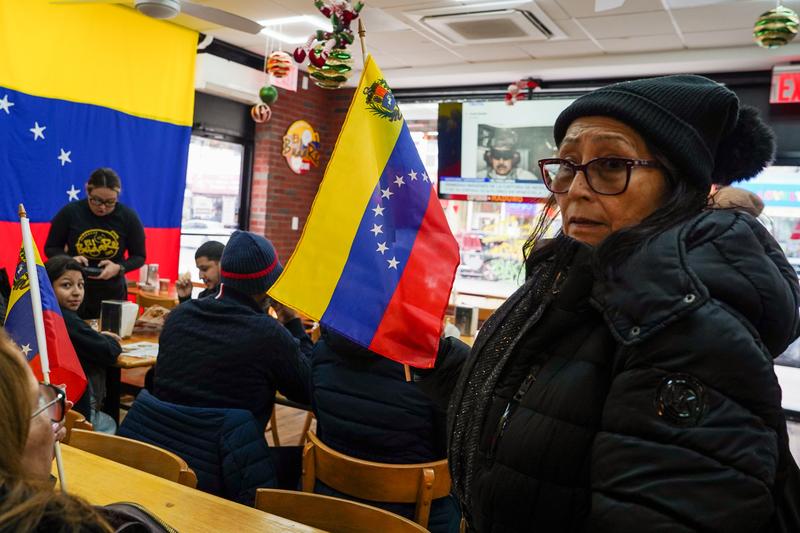
( Ryan Murphy / Getty Images )
Title: New York's Venezuelan Community Reacts to Trump's Maduro Ouster
[MUSIC - Marden Hill: Hijacked]
Brian Lehrer: It's the Brian Lehrer Show on WNYC. Good morning again, everyone. We'll talk now about the Venezuela situation in the context of the large number of Venezuelans in the New York area. For many years now, Venezuela has been at the center of one of the largest displacement crises in the world. Millions of people have left the country amid economic collapse, shortages of basic necessities, in part due to US Sanctions and political repression.
Here in New York, we are home to a large and politically engaged Venezuelan community. The US Military operation in Venezuela that removed Nicolás Maduro from power raises the question, what does all this mean for Venezuelans here, and who still have family back home? Ironically, last year, when Maduro was still in charge, the Trump administration, wanting recent asylum seekers to leave, said it had already become safe enough to return to Venezuela, and he revoked their temporary protected immigration status.
Now the administration is saying it again for the new context. No Maduro, no problem. Here is Department of Homeland Security Assistant Secretary for Public Affairs Tricia McLaughlin on Fox News.
Tricia McLaughlin: The great news for those who are here from Venezuela on temporary protected status is that they can now go home with hope for their country, a country that they love, that there is going to be peace, prosperity, and stability.
Brian Lehrer: How much is that true? Let's talk. Joining us is Gisela Salim-Peyer, associate editor at The Atlantic and a native of Venezuela who's been reporting closely and deeply on the situation in that country, including the opposition movement and the country's relationship with the United States. Gisela, thank you so much for some time today. Welcome to WNYC.
Gisela Salim-Peyer: Thank you so much for having me.
Brian Lehrer: Listeners, we want to invite you in, especially if you're part of New York's Venezuelan community or if you have family still in Venezuela. How are you reacting to this moment? Does the US Role feel like help, interference, some of each, something I didn't mention, and what are you worried or relieved about right now? 212-433-WNYC, 212-433-9692. Would you start, Gisela, by just describing in general terms the size and makeup of the New York Venezuelan community? Who's here and why?
Gisela Salim-Peyer: I don't think there is a very big Venezuelan community, or at least not as big as in other parts of the US, like Miami and the South Florida areas, or the Austin, but New York being such a big city, there's a lot of Venezuelans, and they're here for different reasons. They arrived at different times. Some of them, they've been here for years and are professionals. Others have more recently arrived with the waves that came during the second Trump administration and the Biden administration, people that maybe crossed the border by foot, trekked through the Darién. There's all sorts of Venezuelans in New York.
Brian Lehrer: Did earlier generations of Venezuelans who might be more professional in their work backgrounds or in class terms, are there differences and reasons why they came in that generation to the large number of asylum seekers? People will remember during the Biden administration, especially when there was such a flood of asylum seekers across the border from various places in Latin America, Venezuela, for a while, was producing the most, and so many were coming to New York. When you look generationally, was there a difference in motivation for arriving here?
Gisela Salim-Peyer: I think this holds true for Venezuela, as for many other countries. I think the people who left sooner, the sooner you left, the higher your, let's say, economic means, and the more comfortable the conditions in which you left. The people who started living, let's say, late aughts or early 2010s, they were living in a better condition. They were leaving, maybe to study here. They came by plane. Then, as the situation got worse and worse, you had more people overstaying their visas. Then you had people going to the US by foot and trekking the Darién because the humanitarian crisis was so dire that they couldn't make ends meet.
Brian Lehrer: You were in the courtroom, I see, when Maduro was arraigned. Describe the scene in terms of Venezuelan New Yorkers who came out to witness it.
Gisela Salim-Peyer: Venezuelan New Yorkers were the biggest group of people who had come hoping to get a seat at the court. None of them came out of solidarity for Maduro. They came to see a tyrant punished, or at least those were the terms in which this was described to me. A lot of them-- Not a lot of them. Let's say a couple of them had been political prisoners. There was this woman, Laura, who lives in Madrid, and she came to New York to help her daughter with her newborn.
She told her daughter that the five-month-old was going to be left with a nanny because she just couldn't miss this moment. Then there was another political activist from the opposition called David Cardenas. He was very active in the opposition. Maduro one time had singled him out on TV and said that Operation Knock Knock was going to come for him. Operation Knock Knock is when the police knocks your door and takes you to jail. David responded to that, to Trump on Instagram, by saying that Operation Trump Trump was going to come for Maduro. Waiting outside the courthouse, he told me with a smug smile, "I guess, Trump Trump came before Knock knock."
Brian Lehrer: I understand. Those Venezuelans who showed up at the courtroom, who were anxious to see Maduro punished, how much do you think they represent the larger group of Venezuelans in New York as opposed to a smaller activist core?
Gisela Salim-Peyer: I wouldn't be able to tell you that. I think to be able to take some time off work and show up, you definitely have to have means, let's say. I know a lot of Venezuelans here in New York are undocumented or have more fragile legal status. The people I spoke to in the courtroom, to the extent that they were willing to share their status, they had green cards. They were neither undocumented nor on asylum, or actually one was on asylum, but he had already been given asylum.
Brian Lehrer: Explain even further the extent to which you think it's true that some people see Maduro's ouster as long overdue accountability, and others see it as a dangerous precedent. In your story, you wrote about scenes from the courtroom that included a conversation with a woman you call Maria. You wrote, "Maria told me that no one she knew in America could understand why she was excited to see Maduro arrested." She said, "My friends are like, 'This is imperialism, and so sorry Trump did this to your country,'" but that's, I guess, surprising to Maria. Explain that tension.
Gisela Salim-Peyer: I don't know that it was surprising to Maria. Maria told me that she really empathizes with progressive politics and progressive causes. She was frustrated that Venezuela is such a left-right issue that people-- She expressed some frustration when she spoke to me that people on the left were just less willing to see Venezuela as a very dire humanitarian crisis. She said that her housemate was a prison abolition activist, and she empathizes with some of the things that her housemate advocates for, but when her housemate, an abolition activist, wanted to protest the mistreatment of Maduro, she said basically, "My empathy has limits."
Brian Lehrer: I understand. Did you witness when you were covering the arraignment, dueling protests? Because just as in the tension that was the premise of the last question, there were people, they're obviously Venezuelans, who were happy to see Maduro removed from power and maybe brought to justice, as they see it. We have a text from somebody who writes, "Venezuelan New Yorkers who came to support the arraignment clashed with leftist protesters." One side called the other side names, according to this text, but did you see anything like that?
Gisela Salim-Peyer: I saw a little bit of that before getting into the courthouse. There were the Hands off Venezuela people on one side, and there were the other people, which were mostly Venezuelan, who were there in a celebratory mood. Also, I sat there in the courthouse, waiting to see the trial. Most of the people were Venezuelans eager to see Maduro punished, but not all. Some of them were, let's say, law students who spoke with a bit more-- who were less sanguine about this. They were saying, "You have to separate the issue of the capture with the issue of this trial, but the capture puts the system of international justice in danger."
I think one way to summarize this clash in perspectives is that I think for American and international observers, this is all about something bigger than Venezuela. This is about the fact that a US President can bomb a country and overthrow a foreign leader without so much as a war declaration or congressional approval. [crosstalk] Oh, sorry.
Brian Lehrer: Go ahead. No, go ahead, finish your thought.
Gisela Salim-Peyer: For Venezuelans, I think this is mostly about Venezuela.
Brian Lehrer: If most of those at the courthouse supporting the removal were Venezuelan, can you say anything about the demographics of the people who were there opposing it?
Gisela Salim-Peyer: Opposing the--
Brian Lehrer: Opposing the US Action?
Gisela Salim-Peyer: You mean outside the court?
Brian Lehrer: Yes. Who were the protesters against doing what Trump did?
Gisela Salim-Peyer: I didn't do much reporting on that. I think they seemed American. They had the Hands off Venezuela signs, but I did most of my reporting waiting for the arraignment, and in the courthouse. Everything I did was in the courthouse. It was just a fleeting sight that I saw these dueling crowds.
Brian Lehrer: Got it. I played the clip introducing the segment of a Trump administration official saying, "It's now safe to go home." I mentioned that even last year, well before they removed Maduro last week, the Trump administration was saying, "Things have improved in Venezuela. All you Venezuelan migrants who came in the last few years, it's safe to go home now." Obviously, the Trump administration is trying to get so many Latin American migrants and even other migrants to leave the country.
Now they're saying it again with the removal of Maduro. Can you reflect on any of the reality of that either last year, whether things were actually becoming safe enough again in Venezuela for any reason, that it was appropriate to remove en masse the temporary protected status that had been offered to Venezuelans because of Maduro's rule, or if the removal of Maduro changes the safety or livability for Venezuelans here who might want to go back there?
Gisela Salim-Peyer: I think this is not true. It was neither true last year, and it's not true now. It was not true last year because after the July 28th, 2024, election, where Maduro basically lost the election but proclaimed himself victor and stayed in power, there was a very acute wave of repression where a lot of activists, opposition staffers, and also just regular people who had maybe shared an anti-Maduro meme on social media were thrown into prison. It was definitely not true last year because that wave of repression was still going strong. It's definitely not true now because it doesn't look--
Maduro is for sure out of the picture in Venezuela, but regime change does not appear to be guaranteed. In fact, ever since Saturday, it seems like the regime has held together. Delcy Rodríguez got sworn in, and right after the event where she got sworn in, the inauguration ceremony, 10 journalists were arrested and sent to political prisoners. Diosdado Cabello and Vladimir Padrino López, two of the ministers, said that they would do a big investigation as to the Venezuelans who have supported the US Military interventions, suggesting that they would be sent to Venezuela's notorious jails and torture chambers.
Brian Lehrer: Let's take a phone call. Ken in Florida says he's a Venezuelan American. Ken, you're on WNYC. Thank you so much for calling in.
Ken: Hi there. First time calling in. I wanted to say that, as somebody who grew up in both countries, I understand why a lot of Venezuelans are happy about what happened. Certainly, nobody defends Maduro, but I don't support the way that this was done. I don't agree that the end justifies the means, and I really am upset about what that means for the United States as the aggressor, but at the same time, nobody could have removed this or fixed the government in Venezuela from within.
There needed to be some external action that has been overdue for the last 25 years, to be honest, and I think that's where a lot of the jubilation and a lot of the looking the other way from the Venezuelan community comes from.
Brian Lehrer: It sounds like you would have rather seen maybe some kind of regional action led by a coalition of Latin American countries, maybe with the United States involved, but not this US removing Maduro for the interests of the United States. Am I paraphrasing well?
Ken: I think that's correct. Although the international coalitions and that sort of thing, that's been ongoing since Chavez was there. I think there's been a lot of frustration because it has felt from Venezuelans that nobody has really paid attention or helped in any meaningful way other than simply looking over elections and just allowing fraud and fraudulent elections to continue.
Brian Lehrer: Have you had conversations with other Venezuelan Americans who you may know in Florida about what you laid out here, your mixed feelings about being happy that Maduro is out, but not liking the way it was done?
Ken: Yes, I have, and I think for the most part, Venezuelans are just happy that the head of this very terrible government is out. From the people that I've spoken with and the comments that I've read online, I don't think anybody's really looking beyond that. That's what concerns me, is that I don't see anything changing.
Brian Lehrer: Let me read you a text from another listener and just get your take, and then I'll ask our guest. A listener write, "Maduro needed to be removed. No questions about it, but the biggest threat to Venezuelans will be the American intervention and the illegal taking of their natural resources. History, facts, racist person. The US Foreign policy has never been in favor of the countries they target. My country, Guatemala," writes this person, "Suffered the US Monroe Doctrine as much as many other countries. Good luck, Venezuela, say goodbye to your sovereignty." What are you thinking or feeling as you hear that text?
Ken: That's how I feel as well. I think it's horrible, among other things, that the United States and President Trump intends to simply exploit the natural resources of another country and intends to administer them as they see fit. Stealing the sovereignty of our country.
Brian Lehrer: Ken, I really appreciate you calling-- Thank you very much. Feel free to call us again. Any thoughts from you, Gisela, as you listen to that call and that text?
Gisela Salim-Peyer: I think there's a lot of people who are very apprehensive. It's interesting because I spoke with an international human rights lawyer who said that she has been documenting instances of Maduro's abuses, tortures, and extrajudicial killings for years. I thought that she was going to have some reservations about the way that these strikes were carried. She said not at all, because she said that if international law was going to do something, it would have already done it by now.
I think there is a lot of apprehension, especially inside the country. It's a tricky situation because the people inside the country cannot really speak right now because there's a lot of repression. They cannot speak candidly, but the people outside the country who are activists and the most vocal people outside the country are very enthusiastic about this, but I think there is a feeling that we don't know what's going to happen. We don't know if the country that will emerge from all of this will be better.
Brian Lehrer: I'm looking at the headline of the article you published in The Atlantic yesterday, called the Venezuelan Opposition's Desperate Gamble. Who do you mean by the opposition, and what is this desperate gamble?
Gisela Salim-Peyer: Venezuela has the particularity that although it has been in a dictatorship for a lot of time, it has a very organized opposition movement. The opposition movement has had many leaders, but these leaders have always backed each other. It's a unified movement. Right now, the leader of the opposition movement is María Corina Machado. I think it's fair to say that she's the leader of the movement, not just of a faction within the movement, because everybody has just been behind her. I think the Venezuelan opposition movement is remarkably unified.
Brian Lehrer: Unified behind Machado. President Trump said she doesn't have the respect or support to run the country. Do you think there's any grain of truth to that?
Gisela Salim-Peyer: Polls do not back up what Trump said. She's the most popular politician in Venezuela by far, according to polls. In 2023, before the election primary, she won more than 90% of the votes in the opposition primary, and she would have run for president had she not been banned precisely because Maduro and company thought that she was too dangerous.
No, I think some sources from the Venezuelan opposition that have tried to make sense of Trump's comments have suggested to me that what Trump means with not having respect within the country is that she doesn't have respect within the military, which is needed to keep order in the country. That's what they think, but I'm not sure if that's what Trump actually meant.
Brian Lehrer: Why do you think that Trump really sidelined her, then? We played the clip on Monday's show of María Corina Machado at the Nobel Peace Prize or near the Nobel Peace Prize ceremony. She won the Nobel Peace Prize for 2025, and she was there in Oslo, and she dedicated the prize to President Trump because of his pressure on Maduro. Even with all this popularity as the leading opposition leader, as you were just describing, when Trump removed Maduro, he kicked her to the curb at the same time. Why do you think Trump did that?
Gisela Salim-Peyer: Can you repeat the question? Why do you think she did exactly what?
Brian Lehrer: Why do you think Trump sidelined Machado?
Gisela Salim-Peyer: That is a very, very good question. I don't know that I have the answer to. Depending on who you ask, you will get a different response. People who are more cynical would say that Trump is so bitter about not winning the Nobel Prize, that that could be a very big reason. Then there's some New York Times reporting that suggests that the presidential envoy, Brian Lerner, just got frustrated with her because she didn't really have a plan to lead the country, and she was overestimating how fragile the Maduro regime was, and they just didn't trust her.
I think some of the most hopeful Venezuelans, they think that this is part of a grand strategy for a regime change, but they say, not yet. Machado is not ready for this. That's what the Venezuelans who have a more generous interpretation of what Trump is saying, think.
Brian Lehrer: In fact, we have this text with a question to this point that asks, "If the entire regime is left in place, judicial, governmental, police, military," because that seems to be the case. Maduro's own vice president is the one who Trump has endorsed as being in charge now, "Will the security and welfare of Venezuelan citizens improve?" asks this listener. With Trump in charge, but Maduro's vice president also in charge, what do you think does change domestically for Venezuelans?
Gisela Salim-Peyer: That really remains to be seen. I think so far it has been remarkable how the regime has held together, how much military leaders and high-up ministers have made a point of doing a lot of press conferences, being seen. As I mentioned before, they arrested these 10 journalists after Delcy Rodríguez's inauguration. That seems to be making a point like, "We are still here." Very little has changed. Delcy Rodríguez herself said that there was only one president of Venezuela and that this person's name was Nicolás Maduro.
They seem to be holding onto the status quo or making a big effort to give the appearance that that's what's happening. A very important fact is that the political prisoners are still in prison. I think there is an agreement among the activists that I have spoken to that if there is going to be a wider regime change that goes beyond ousting Maduro, the first step will be freeing the political prisoners. There is no sign that that's going to happen, even though Trump suggested that El Helicoide had been closed, but that has not happened yet.
Brian Lehrer: I'm looking at the list of articles that you've written for The Atlantic in recent months, and I see that as early as October, you wrote one with a headline, The US Is Preparing for War in Venezuela. You saw this coming. You wrote another one in November called Why Maduro Probably Can't Count on Putin. Then another one in November that's relevant to something Trump and Marco Rubio and others have been saying just in the last few days, since they seized Maduro, that other countries should watch out, like Colombia. You had an article in November called Why is Colombia's President Provoking Trump? Gustavo Petro Seems to Think that He's Better Off Being the American President's Victim than His Friend.
I'll bite. Why is Colombia's President Petro provoking Trump? When you say victim, is he preparing himself to be ousted, too?
Gisela Salim-Peyer: I think that could be a bit far-fetched. A lot of Latin American leaders went ahead and criticized Trump's actions in the Caribbean, which is, I think, an understandable position if you're a Latin American leader and you see Trump attacking a Latin American country. You see Claudia Sheinbaum has condemned this. I think Lula has condemned--
Brian Lehrer: President of Mexico, Sheinbaum.
Gisela Salim-Peyer: Yes, exactly. Lula of Brazil condemned it, but I think Petro went really a bit farther than most. He was more bombastic in his delivery. He went outside of the United Nations and told the American military to ignore Trump. Then, in an interview, he suggested that Trump should be ousted, which left the interviewer visibly shocked that a Colombian president was proposing regime change in the United States. He definitely made a point of going farther than just condemnation.
As I wrote in that article, and after interviewing many Colombian observers, I think it has to do more with his internal politics. There's going to be elections in Colombia next year, and I think he hopes that his protege will win and his party will favor. I think he hopes that the population would rally around him. I think in Colombia, the issue of drugs creates a lot of painful memories.
Trump basically said that Gustavo Petro was a drug lord, which is something that even the people in the opposition in Colombia would-- Even the people who are critical of Petro would resent, because basically you're saying that the president of Colombia is a drug leader, when Colombia has been fighting so hard to get rid of this horrible image it has as the birthplace of Pablo Escobar and a giant cocaine farm. It was a really painful thing for Colombians to hear, and I think Petro ceased on that.
Brian Lehrer: Oh, because a lot of the people in this country who I've heard be critical of the removal of Maduro say the drug charges against him are trumped up. If you really want to look at where drugs are coming into the US from, from Latin America, it's not fentanyl from Venezuela. That's a fiction. It's cocaine from Colombia. Are you saying that's false?
Gisela Salim-Peyer: No. That's not wrong. That's not wrong, but to say that the president of Colombia is a drug lord, there's no evidence for that. It's true that Colombia has a lot of drug production and drug trafficking, but it's not true that the government is complete-- There's no evidence that Gustavo Petro himself is complicit.
Brian Lehrer: Gisela Salim-Peyer, associate editor at The Atlantic and a native of Venezuela who has been reporting closely on Venezuela, the opposition movement, the country's relationship with the United States, and now the Venezuelan community in New York's response to Maduro being brought here for trial. Thank you so much for all your reporting, all your context, and all your time with us today. We really appreciate it.
Gisela Salim-Peyer: Thank you so much.
Copyright © 2026 New York Public Radio. All rights reserved. Visit our website terms of use at www.wnyc.org for further information.
New York Public Radio transcripts are created on a rush deadline, often by contractors. This text may not be in its final form and may be updated or revised in the future. Accuracy and availability may vary. The authoritative record of New York Public Radio’s programming is the audio record.
