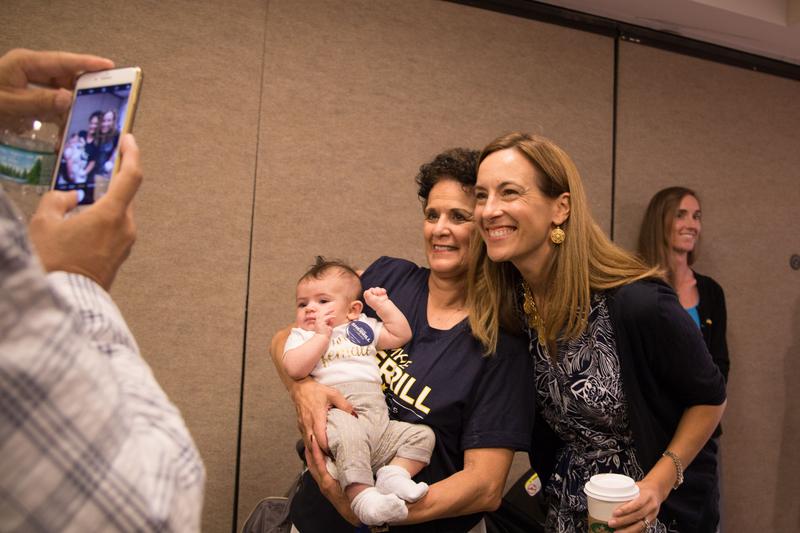
Brian Lehrer: It's the Brian Lehrer Show on WNYC. Good morning again, everyone. As we continue to unpack all the election results, we'll have Christina Greer, the Fordham University political science professor and frequent guest, coming up later in the hour on the New York results, we're going to talk right now to Michael Hayes, who covers New Jersey for us, and in the middle, we're going to have Susan Page, the Washington Bureau chief of USA Today, to put it into national context. What do the New York, and New Jersey, and Virginia, and California, if you didn't follow that and some other things, actually mean for the rest of the Trump administration for potential control of Congress next year and for other things. Susan Page coming up. Christina Greer coming up. We just heard before the news from New Jersey Governor-elect Mikie Sherrill. With me now to dig a little more into those results and talk about what lies ahead for Sherrill as she assumes the governor's mansion is Michael Hayes, WNYC and Gothamist reporter covering the New Jersey governor's race. Also, the author of The Secret Files: Bill De Blasio, The NYPD, and The Broken Promises of Police Reform. Hey, Mike, I know it was a long night. Thanks for getting up. Welcome back to the show.
Michael Hayes: Hey, Brian, thanks for having me.
Brian Lehrer: Are you as stunned, as some people seem to be, by the margin of her victory, 13 points? All these polls were so close. A lot of people were predicting, history suggests Ciattarelli would win, but 13 points.
Michael Hayes: Yes. Brian, to answer your question very plainly, I am stunned. She had a lot going against her going into election night, not the least of which that this is the first time that either party in 60 years has won three consecutive governor's terms. I was trying to think of a sports analogy here, Brian. You and I are both big baseball fans, and there's one sitting right there. I know we don't have too many Dodger fans listening right now probably, but a couple weeks ago, Shohei Ohtani hit three home runs and struck out 10 in one game. I think that performance is probably the best analogy for what Sherrill did last night in New Jersey.
Brian Lehrer: I was trying to think of another baseball analogy, but I couldn't. Part of that big win is that this was the first time a party, either political party, won three consecutive governor's terms in New Jersey since 1961. What do we know so far about Sherrill's coalition? Whose support did she garner and take away from Trump or just get more people to turn out than last year when Democratic turnout really lagged? Did any particular demographic send her over the edge?
Michael Hayes: Brian, again, in a word, everyone. Before we start getting calls from people being like, "Your reporter's out of his mind equating Shohei Ohtani with an off-year New Jersey election," let me give you some stats here. Let's talk about the urban turnout a little bit. Democrats were very worried about urban turnout. Rightfully so. Turnout in New Jersey urban centers in the state has been down the last couple of election cycles. Turnout in our urban centers yesterday in this election was up over 100%. Give you an example, in Newark, for example, turnout was 137% of the last governor's race, and Sherrill won 89% of the vote there.
A lot of people thought Ciattarelli would be strong in the suburbs. We talked about Morris County, a place where he beat Governor Murphy in '21 by 11 points. Well, Sherrill is beating him there as well. You asked about demographics, Brian. I'm just pulling up a text I got from a political professor. She won 18 to 29 men, 46 to 56 men, women across the board. CNN had an exit poll last night among 18 to 29-year-olds. She beat Ciattarelli 68% at 31. There's been a lot of talk about younger people, gen Z voters moving to the right last night in New Jersey, certainly buck that trend if it is one. To put a bookend on this right now, she's overperforming Kamala Harris by about eight points.
Brian Lehrer: To go back to your Shohei Ohtani analogy, I guess getting such a big turnout in Newark is the three home runs diminishing the Republican vote to the point where she even won 18 to 29-year-old men. That's the six shutout innings part, shutting down the Republicans compared to Trump. You mentioned Morris County. I want to raise one that I've been watching closely. I asked Governor-elect Sherrill about it know before the news and she didn't have too much to say in a national context. Certainly, she had things to say in a New Jersey context.
Passaic County, and that's a county as you know that is historically Democratic. It's got a lot of immigrants, a lot of Latino immigrants. It's got Paterson with a Muslim community and other immigrants, and historically Democratic, but it actually went for Trump last year by three points and surprised a lot of people. Mikey Sherrill won Passaic county by 15 points. As much conversation as there's been nationally about how some working class, affordability-minded Blacks and Latinos, in particular, trended toward Trump last year, I wonder if you see Passaic County as a national bellwether.
Michael Hayes: That's a really, really good question. Gosh, it's almost hard to pigeonhole Passaic when you look at last night's results, Brian, because I give you another example. Hudson County, heavily Latino, example there, Union City is 84% Latino. Joe Biden in 2021, he was plus 46 there, and then Donald Trump did some real damage in 2024 to the Democrats. Harris was only plus 28. Well, last night, Sherrill is currently up by 49 points there, so she's doing even better than Joe Biden. Her message with Latino voters, the type of heavy immigrant demographics that you see in a place like Passaic, she's doing well across New Jersey with those folks. We heard her-- [audio cut]
Brian Lehrer: Did we lose Mike line?
Michael Hayes: I'll talk a little bit with you about how she-- Hey, do you got me?
Brian Lehrer: Yes.
Michael Hayes: Sorry about that. Yes, going back to what Governor-elect Sherrill was saying, she seems to think that she really connected with those people and heard their needs. This has been a message of her campaign throughout, is that, "I hear you, I hear your concerns." Look, Ciattarelli, he tried his best to take the same approach with a place like Passaic County. He was in cities in Passaic a lot over the last few months talking directly with voters, and yet it just seems like it hasn't connected.
To go back to your initial question, is this a bellwether? I think, based on her ultra strong performance, I don't see how you could see it any other way as what Mikie Sherrill did to bring out particularly Latino voters last night as really, really a strong indicator that Democrats have a real shot to turn the tide there.
Brian Lehrer: I'm going to put that same question in a couple of minutes to Susan Page, the Washington Bureau chief for USA Today, who's standing by. Let me play one clip from Sherrill's victory speech last night and get your take on this.
Mikie Sherrill: I know these are tough times. I know not everyone voted for me, but I'm working for everyone, every single one of you. When we all do better, we all do better.
Brian Lehrer: It's not going to be easy, right? Same thing in New York, the unaffordability of life right now is really entrenched. It's not because of one thing that they can reverse, it's on food and utilities and housing and other things. A governor can't come in and wave his or her magic wand and say, " Fie on you billionaires. We're going to lower the price of things now." What do you think stands ahead for Mikie Sherrill at the policy level and how, as far as you could tell?
Michael Hayes: Going back to that clip you just played, Brian, I was in the room last night and I was stage right when she delivered it, particularly that line, "When everyone does better, we all do better." I feel like shortly after that, she had to pause because she was getting, from groups of union supporters, 32BJ in particular, were particularly out there last night at the party they started. They loved that line. They were going crazy.
Yes, there's a lot of messaging in there, "I'm going to be a governor for everyone," but I think there's a subtextual thing going on here, is that she's letting her supporters know, "I'm going to be heavily focused on the working class. We'll see how that translates to policy. We still don't know a ton about what Mikie Sherrill's priorities and the main things she's going to initially focus on are going to be. You asked her about this emergency declaration on energy costs. Governor Murphy himself said during the campaign last month he's not quite sure how that would work, governor freezing energy costs. I think there's a lot still to flesh out there, but yes, she seems to, that said, be generating a lot of excitement amongst her supporters.
Brian Lehrer: Mike Hayes on the Jersey bit for WNYC, and our local news website, Gothamist. Mike, thanks a lot.
Michael Hayes: Sure thing. Thanks.
Copyright © 2025 New York Public Radio. All rights reserved. Visit our website terms of use at www.wnyc.org for further information.
New York Public Radio transcripts are created on a rush deadline, often by contractors. This text may not be in its final form and may be updated or revised in the future. Accuracy and availability may vary. The authoritative record of New York Public Radio’s programming is the audio record.